Private vs. Public IP Addresses: Understand the Basics

ChanChan
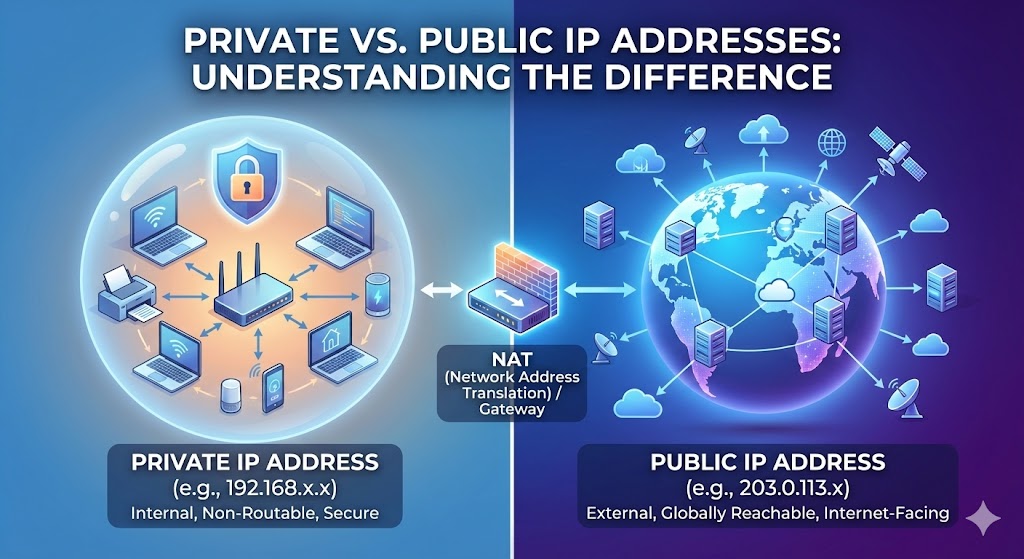
A conceptual digital illustration showing the distinction between public and private IP addresses. On one side, a "Public IP" is represented by an open globe and a lighthouse, symbolizing visibility to the wide internet. On the other side, a "Private IP" is shown inside a secure home and office building, representing local network internal routing. A router sits in the middle, acting as a gateway connecting the two environments through a secure bridge.

In today’s interconnected digital world, the concept of IP addresses is fundamental to how devices communicate over the internet. Whether you’re browsing the web, sending emails, or streaming your favorite shows, your device relies on an IP address to connect to other devices and servers. But did you know that there are different types of IP addresses, namely private and public? Let’s delve into the basics of private vs. public IP addresses in a language that’s easy to understand.

IP Addresses in a simple explanation

Before that, let’s clarify what an IP address is. IP stands for Internet Protocol, and an IP address is a unique numerical identifier assigned to each device connected to a network. Think of it as your device’s digital fingerprint, which allows it to be identified and communicate with other devices on the internet.

Private IP Addresses
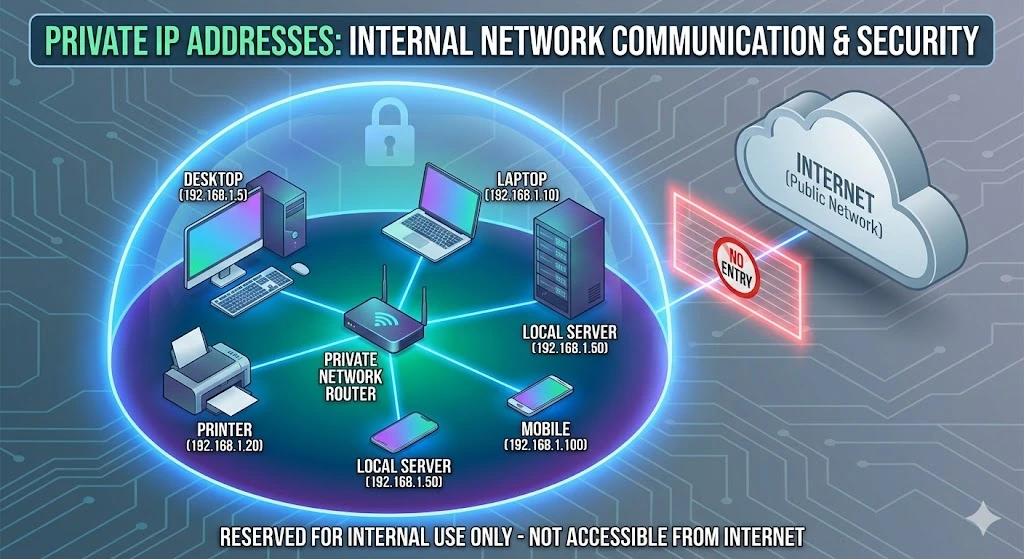
Private IP addresses are used within a private network, such as a home or business network, to identify devices and facilitate communication between them. These addresses are not accessible from the Internet and are reserved for internal use only. The most commonly used private IP address ranges are IPv4 and IPv6.


Private IP addresses enable devices within a network to communicate with each other, access shared resources like printers or servers, and maintain network security by restricting direct access from the internet.

Public IP Addresses
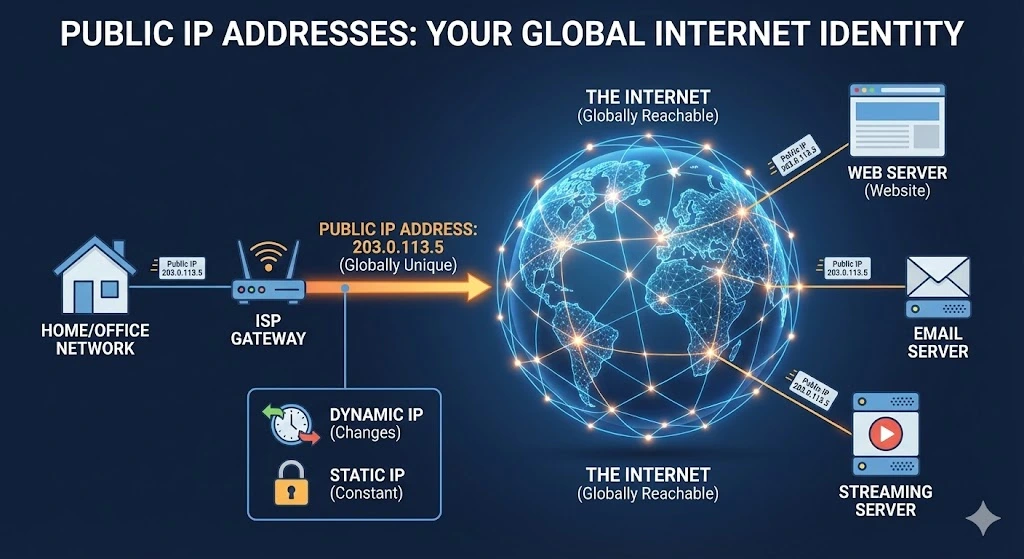
A dynamic digital illustration of a world map interconnected by glowing data lines. In the foreground, several devices like a web server, a smartphone, and a corporate headquarters are highlighted with unique "Public IP" labels. Glowing data packets travel between these devices and a large cloud representing the global internet. The image conveys the concept of global reachability and the role of ISPs in providing the interface for worldwide communication.

On the other hand, public IP addresses are globally unique addresses assigned to devices connected directly to the internet. These addresses are available across the internet and serve as the interface between a device and the rest of the online world. When you access a website, send an email or stream content, your device uses its public IP address to communicate with servers and other devices on the internet.


Public IP addresses are allocated by Internet Service Providers (ISPs) and are typically dynamic, meaning they can change periodically, or static, meaning they remain constant over time. Businesses, web servers, and other internet-facing devices often use static public IP addresses to ensure consistent accessibility.

Key differences between Public and Private IP addresses
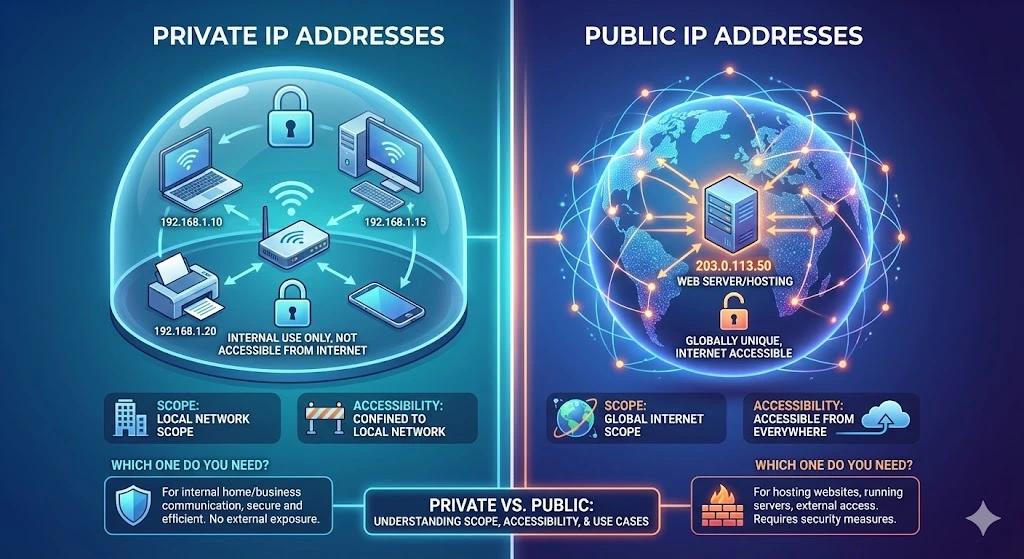
The primary difference between private and public IP addresses lies in their scope and accessibility:

  • Scope: Private IP addresses are confined to a local network and are not accessible from the internet. Public IP addresses, on the other hand, are globally unique and enable devices to communicate across the internet.
  • Accessibility: Private IP addresses are reserved for internal use within a network and are not directly accessible from the Internet. Public IP addresses are accessible from the internet, allowing devices to send and receive data to and from external networks and servers.

Which one do you need?

The choice between private and public IP addresses depends on your network configuration and requirements.

  • Private IP Addresses: If you’re setting up a home or business network for internal use only, private IP addresses are sufficient. They provide a secure and efficient way for devices within the network to communicate without exposing them to external threats.
  • Public IP Addresses: If you need your devices to be accessible from the internet, such as for hosting a website or running a server, you’ll need a public IP address. However, keep in mind that public IP addresses may attract security risks, so proper measures such as firewalls and security protocols are essential.

Private and public IP addresses

Private and public IP addresses serve distinct purposes in the realm of networking. Private IP addresses are used within local networks for internal communication, while public IP addresses facilitate communication with external networks and devices over the internet. Understanding the differences between the two types of addresses is crucial for designing and managing effective network infrastructures that meet your connectivity needs while ensuring security and accessibility.

Trusted IPv4 Leasing for Business Growth

Get enterprise-grade IPv4 space quickly, with seamless deployment and end-to-end management.

Get Started with i.lease

FAQs

How do I find my Public IP address?

The easiest way to find your Public IP address is to type “What is my IP” into a search engine like Google. Because your Public IP is assigned by your ISP to your router, every device in your home or office connected to that router will usually show the same Public IP.

Can someone hack me if they have my Public IP address?

Knowing a Public IP address is like knowing a home’s street address—it doesn’t give someone a key to the door, but it tells them where the house is. Hackers can use a Public IP to scan for open ports or unpatched vulnerabilities in your router. This is why using a Firewall and keeping your router’s software updated is essential.

What is NAT (Network Address Translation) and how does it relate to IPs?

NAT is a technology used by your router to act as a “translator.” It allows multiple devices with Private IP addresses in your home to share a single Public IP address to access the internet. This effectively conserves the limited supply of Public IPv4 addresses.
Related Posts

IPv4 Renewal Risk: Who Protects Your Network?

Your IPv4 Lease Is Not Safe If Nobody Owns the Renewal Risk

Who is actually responsible for keeping this IPv4 access alive? Not who sold it.Not who introduced it.Not who issued the invoice.Not who sent the first LOA. Who owns the renewal risk when the relationship becomes stressed, the upstream source changes position, the documentation is questioned, or the provider chain no longer responds? For businesses that depend on IPv4 for hosting, SaaS, VPN, telecom, cloud, security, email delivery, or customerRead more Related Posts Principaux points à prendre en compte lors du commerce d’adresses IPv4 sur le marché secondaire Naviguer sur le marché secondaire de l’IPv4 exige une attention particulière à la légalité, à la réputation, à la tarification, Read more Que se passe-t-il lorsque les ressources IP sont mal gérées ? Une mauvaise gestion des ressources IP peut entraîner des pannes, des failles de sécurité, des mises sur liste noire, une Read more Location d’adresses IPv4 à court terme ou à long terme Face aux pénuries d’IPv4, les entreprises doivent évaluer le coût, la rapidité et la croissance du réseau lorsqu’elles choisissent un Read more .related-post {} .related-post .post-list { text-align: left; } .related-post .post-list .item { margin: 5px; padding: 10px; } .related-post .headline { font-size: 18px !important; color: #999999 !important; } .related-post .post-list .item .post_thumb { max-height: 220px; margin: 10px 0px; padding: 0px; display: block; } .related-post .post-list .item .post_title { font-size: 16px; color: #3f3f3f; margin: 10px 0px; padding: 0px; display: block; text-decoration: none; } .related-post .post-list .item .post_excerpt { font-size: 13px; color: #3f3f3f; margin: 10px 0px; padding: 0px; display: block; text-decoration: none; } @media only screen and (min-width: 1024px) { .related-post .post-list .item { width: 30%; } } @media only screen and (min-width: 768px) and (max-width: 1023px) { .related-post .post-list .item { width: 90%; } } @media only screen and (min-width: 0px) and (max-width: 767px) { .related-post .post-list .item { width: 90%; } }

ipv-assets

Why self-holding can expose IPv4 assets to registry risk

Self-holding IPv4 assets increases exposure to registry risk as compliance responsibility, transfer validation, and governance pressure are concentrated internally. Key points   Self-holding IPv4 assets concentrate registry compliance responsibility, increasing exposure to audits, transfer validation issues, and documentation gaps. As IPv4 scarcity grows, registry governance becomes stricter, making ownership structure a key factor in operational risk. IPv4 ownership is now defined by governance, not possession   IPv4 addresses are no longerRead more Related Posts Arrendamiento de direcciones IPv4 a corto plazo frente a arrendamiento a largo plazo Ante la escasez de IPv4, las empresas deben sopesar el costo, la velocidad y el crecimiento de la red al Read more ¿Cuánto costará un bloque IPv4 /24 en 2026? Cómo comprar direcciones IPv4 a través de un agente de IP certificado .related-post {} .related-post .post-list { text-align: left; } .related-post .post-list .item { margin: 5px; padding: 10px; } .related-post .headline { font-size: 18px !important; color: #999999 !important; } .related-post .post-list .item .post_thumb { max-height: 220px; margin: 10px 0px; padding: 0px; display: block; } .related-post .post-list .item .post_title { font-size: 16px; color: #3f3f3f; margin: 10px 0px; padding: 0px; display: block; text-decoration: none; } .related-post .post-list .item .post_excerpt { font-size: 13px; color: #3f3f3f; margin: 10px 0px; padding: 0px; display: block; text-decoration: none; } @media only screen and (min-width: 1024px) { .related-post .post-list .item { width: 30%; } } @media only screen and (min-width: 768px) and (max-width: 1023px) { .related-post .post-list .item { width: 90%; } } @media only screen and (min-width: 0px) and (max-width: 767px) { .related-post .post-list .item { width: 90%; } }

IPv4 block cannot be renewed

Is Your Company Absorbing IPv4 Risk?

Is Your Company Becoming the Shock Absorber for IPv4 Risk?  Many businesses think the biggest IPv4 risk is not having enough addresses. That is only part of the problem. The more dangerous question is this: when something goes wrong, who absorbs the damage? If your IPv4 strategy is poorly structured, the answer may be your company. Your business may carry the customers, servers, routing, contracts, compliance duties, support workload,Read more Related Posts Arrendamiento de direcciones IPv4 a corto plazo frente a arrendamiento a largo plazo Ante la escasez de IPv4, las empresas deben sopesar el costo, la velocidad y el crecimiento de la red al Read more ¿Cuánto costará un bloque IPv4 /24 en 2026? Guía completa del mercado de direcciones IP ¿Qué es un mercado de direcciones IP? Un mercado de direcciones IP es una plataforma estructurada donde las organizaciones pueden Read more .related-post {} .related-post .post-list { text-align: left; } .related-post .post-list .item { margin: 5px; padding: 10px; } .related-post .headline { font-size: 18px !important; color: #999999 !important; } .related-post .post-list .item .post_thumb { max-height: 220px; margin: 10px 0px; padding: 0px; display: block; } .related-post .post-list .item .post_title { font-size: 16px; color: #3f3f3f; margin: 10px 0px; padding: 0px; display: block; text-decoration: none; } .related-post .post-list .item .post_excerpt { font-size: 13px; color: #3f3f3f; margin: 10px 0px; padding: 0px; display: block; text-decoration: none; } @media only screen and (min-width: 1024px) { .related-post .post-list .item { width: 30%; } } @media only screen and (min-width: 768px) and (max-width: 1023px) { .related-post .post-list .item { width: 90%; } } @media only screen and (min-width: 0px) and (max-width: 767px) { .related-post .post-list .item { width: 90%; } }