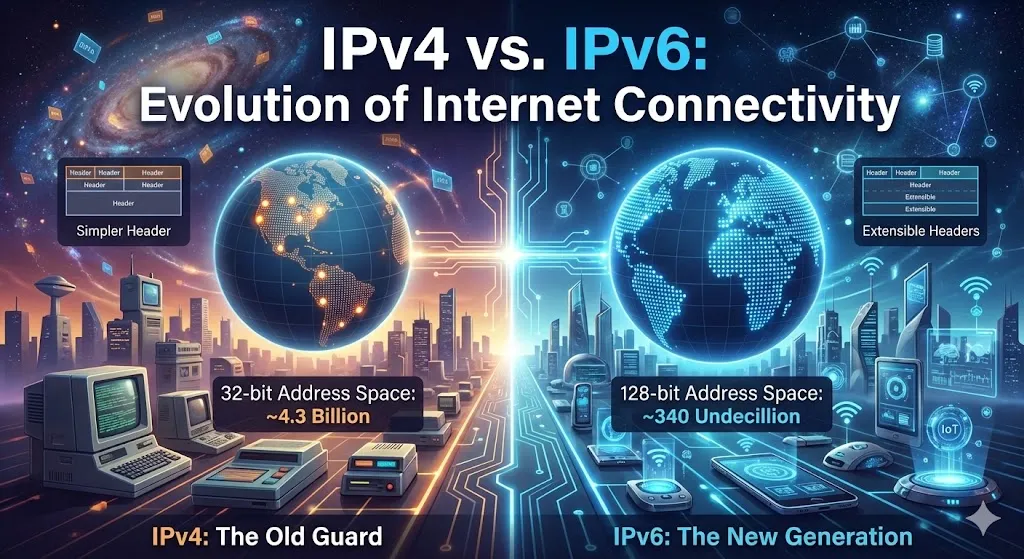
IPv4 and IPv6 are two versions of the Internet Protocol. They are used to identify devices, route traffic, and allow networks to communicate across the internet.
Table of Contents
IPv4 is the older and still widely used version. IPv6 is the newer version, created to provide a much larger address space and support long-term internet growth. Although IPv6 adoption is increasing, IPv4 remains important for hosting, cloud infrastructure, VPNs, email systems, data centres, enterprise networks, and customer-facing services.
For businesses, the question is not simply whether IPv6 is better than IPv4. The practical question is how to support IPv6 growth while maintaining IPv4 continuity where customers, systems, and applications still depend on it.
At i.lease, businesses can Buy IPv4, Sell IPv4, or use Lease IPv4 to support infrastructure growth, compatibility, and operational continuity.
What is IPv4?
IPv4 stands for Internet Protocol version 4. It is the most widely used version of the Internet Protocol and has supported internet growth for decades.
IPv4 uses a 32-bit address format. A typical IPv4 address looks like this:
192.0.2.1
IPv4 provides about 4.3 billion possible addresses. That number was once enough, but global internet growth, cloud services, mobile networks, hosting, SaaS platforms, and connected devices increased demand beyond the original supply.
Because freely available IPv4 supply is now limited, businesses often access IPv4 through transfers, marketplaces, purchases, or leasing.
What is IPv6?
IPv6 stands for Internet Protocol version 6. It is the newer version of the Internet Protocol and was created to provide a much larger address space than IPv4.
IPv6 uses a 128-bit address format. A typical IPv6 address looks like this:
2001:db8::1
The larger address space makes IPv6 suitable for long-term internet growth, especially as more devices, networks, and services come online.
However, IPv6 does not automatically replace IPv4 everywhere. Many networks, applications, and users still rely on IPv4, so businesses often need to support both protocols.
IPv4 vs IPv6 Comparison
IPv4 vs IPv6 Comparison
Factor
IPv4
IPv6
Address size
32-bit
128-bit
Example address
192.0.2.1
2001:db8::1
Address supply
Limited
Much larger
Current usage
Still widely used
Growing adoption
Business role
Compatibility, hosting, cloud, VPN, email, legacy systems
Future scalability, modern network planning, large device growth
Transition model
Still required by many systems
Often deployed alongside IPv4
Common business approach
Buy, sell, transfer, or lease IPv4
Deploy gradually through IPv6 readiness and dual-stack planning
Key differences between IPv4 and IPv6
1. Address space
The biggest difference between IPv4 and IPv6 is address space. IPv4 uses 32-bit addresses, while IPv6 uses 128-bit addresses. This gives IPv6 a much larger pool of available addresses.
2. Address format
IPv4 addresses are written in decimal numbers separated by dots. IPv6 addresses are written in hexadecimal format separated by colons.
3. Network design
IPv6 can support more direct addressing and long-term network scalability. IPv4 networks often rely on techniques such as NAT because public IPv4 addresses are limited.
4. Compatibility
IPv4 and IPv6 are not directly interchangeable. A system using only IPv6 may not automatically communicate with an IPv4-only system without translation, tunnelling, or dual-stack support.
5. Business adoption
IPv6 adoption is increasing, but IPv4 remains deeply embedded in business infrastructure. Many organizations still need IPv4 for customer access, legacy systems, hosting, email, VPNs, APIs, and enterprise applications.
Why IPv6 was created
IPv6 was created because IPv4 address space is limited. As the internet expanded globally, the original IPv4 supply became insufficient for long-term demand.
IPv6 helps solve the address capacity problem by providing a much larger address pool. This supports future growth in mobile networks, cloud infrastructure, IoT, enterprise systems, and connected devices.
For businesses, IPv6 readiness is important because it helps prepare infrastructure for the future. But IPv6 adoption should be planned carefully, especially when customers and systems still require IPv4 access.
Why IPv4 still matters
IPv4 still matters because much of the internet continues to rely on it. Websites, hosting platforms, VPNs, email systems, enterprise networks, cloud services, and customer environments often still require IPv4 connectivity.
IPv4 is also important for compatibility. Some customers, regions, applications, and legacy systems may not be fully IPv6-ready. If a business removes IPv4 too early, it may affect reachability and service continuity.
This is why IPv4 should not be treated as an obsolete technical label. For many businesses, IPv4 remains an operational resource that supports routing, customer access, revenue, and continuity.
IPv4 and IPv6 together: dual-stack networks
Many businesses use a dual-stack setup. This means the network supports both IPv4 and IPv6 at the same time.
Dual-stack allows a business to serve IPv6-ready users while still supporting IPv4 users, applications, and systems. This is often the safest transition approach because it avoids forcing customers or services into one protocol too early.
For example, a hosting provider may enable IPv6 for future readiness while continuing to lease IPv4 addresses for customers that still need IPv4. A SaaS platform may prepare IPv6 support while keeping IPv4 available for enterprise integrations and legacy systems.
What businesses should consider before choosing IPv4, IPv6, or both
Businesses should not make IPv4 and IPv6 decisions based only on technical theory. The right approach depends on customers, applications, infrastructure, location, security tools, and operational requirements. Before changing your IP strategy, ask these questions:
- Do your customers still need IPv4 access?
- Are your applications fully tested on IPv6?
- Does your hosting provider, ISP, or cloud provider support IPv6 properly?
- Can your firewall, monitoring, and security tools manage IPv6 traffic?
- Do you need public IPv4 addresses for hosting, VPN, email, or customer services?
- Would buying or leasing IPv4 be more practical for your current business needs?
Practical note from i.lease
IPv6 is important for long-term internet growth, but IPv4 remains important for many businesses today. The safest approach is often not to choose one too early, but to plan a transition that protects customer access, routing, compatibility, and service continuity.
Buy, Sell, or Lease IPv4 during the Transition
As IPv6 adoption grows, IPv4 still plays an important role in business infrastructure. Companies may need to buy, sell, or lease IPv4 addresses depending on their situation.
Buy IP Addresses
Businesses that need long-term control over address space can Buy IP Address through i.lease. This may be suitable for data centres, hosting providers, cloud platforms, SaaS companies, telecom networks, and enterprises with stable long-term IPv4 needs.
Sell IP Addresses
Organizations with unused or underused IPv4 address space can Sell IP Address through i.lease. This allows resource holders to monetize IPv4 blocks that are no longer needed for active operations.
IPv4 Leasing
Businesses that need flexibility can use IPv4 Leasing to access IPv4 addresses without buying them outright. Leasing may be useful for hosting, VPN services, temporary projects, regional expansion, or IPv4 continuity during IPv6 transition.
The best choice depends on whether your business needs long-term control, short-term flexibility, or a way to monetize unused IPv4 resources.
Final thoughts
IPv4 and IPv6 both matter. IPv6 provides the address space needed for long-term internet growth, while IPv4 remains essential for compatibility, customer access, hosting, cloud infrastructure, VPNs, email systems, and many business services.
The practical strategy is not to ignore IPv6 or abandon IPv4 too early. Businesses should prepare for IPv6 while maintaining IPv4 where it still supports real operations.
There are also new technical proposals being discussed, including IPv8. In an IETF Internet-Draft, Thain (2026) describes IPv8 as a managed network protocol suite with backward compatibility claims, including IPv4 representation inside IPv8 and a goal of addressing IPv4 exhaustion. However, the same document is still an Internet-Draft, meaning it should be treated as “work in progress” rather than an adopted replacement for IPv4 or IPv6.
Frequent Asked Questions
What is the main difference between IPv4 and IPv6?
The main difference is address size. IPv4 uses 32-bit addresses, while IPv6 uses 128-bit addresses. This gives IPv6 a much larger address space.
Is IPv6 better than IPv4?
IPv6 provides more address space and supports long-term scalability. However, IPv4 remains important because many networks, users, applications, and business systems still depend on it.
Will IPv6 replace IPv4?
IPv6 is growing, but IPv4 has not disappeared. Many businesses still use IPv4 and IPv6 together through dual-stack networks.
Why is IPv4 still used?
IPv4 is still used because many websites, hosting services, email systems, VPNs, enterprise networks, and customer environments continue to rely on IPv4 connectivity.
What is dual-stack?
Dual-stack means a network supports both IPv4 and IPv6 at the same time. This allows businesses to serve IPv6-ready users while maintaining compatibility with IPv4 users and systems.
Should my business use IPv4 or IPv6?
Many businesses should plan for both. IPv6 supports long-term growth, while IPv4 may still be needed for compatibility, customer access, hosting, and operational continuity.
Can I buy IPv4 addresses through i.lease?
Yes. Businesses can Buy IP through i.lease when they need long-term IPv4 address control.
Can I lease IPv4 addresses instead of buying?
Yes. Businesses can use IPv4 Leasing to access IPv4 resources without buying them outright.