Why i.lease Exists: IPv4 Continuity Is Not Commodity Access

StephanieStephanie
IPv4 Continuity Not Commodity


Most businesses enter the IPv4 market with a simple goal.

They need addresses.

Maybe they need them for hosting.
Maybe they need them for VPN infrastructure.
Maybe they need them for cloud services, SaaS platforms, telecom expansion, email systems, cybersecurity tools, or customer-facing applications.

So they search for an IPv4 provider.

They compare prices. They check block sizes. They ask how fast delivery can happen. They look for a seller, broker, or leasing platform that can provide the number of addresses they need.

That approach is understandable.

But it is incomplete.

Because IPv4 access is not only a supply problem.

It is a continuity problem.

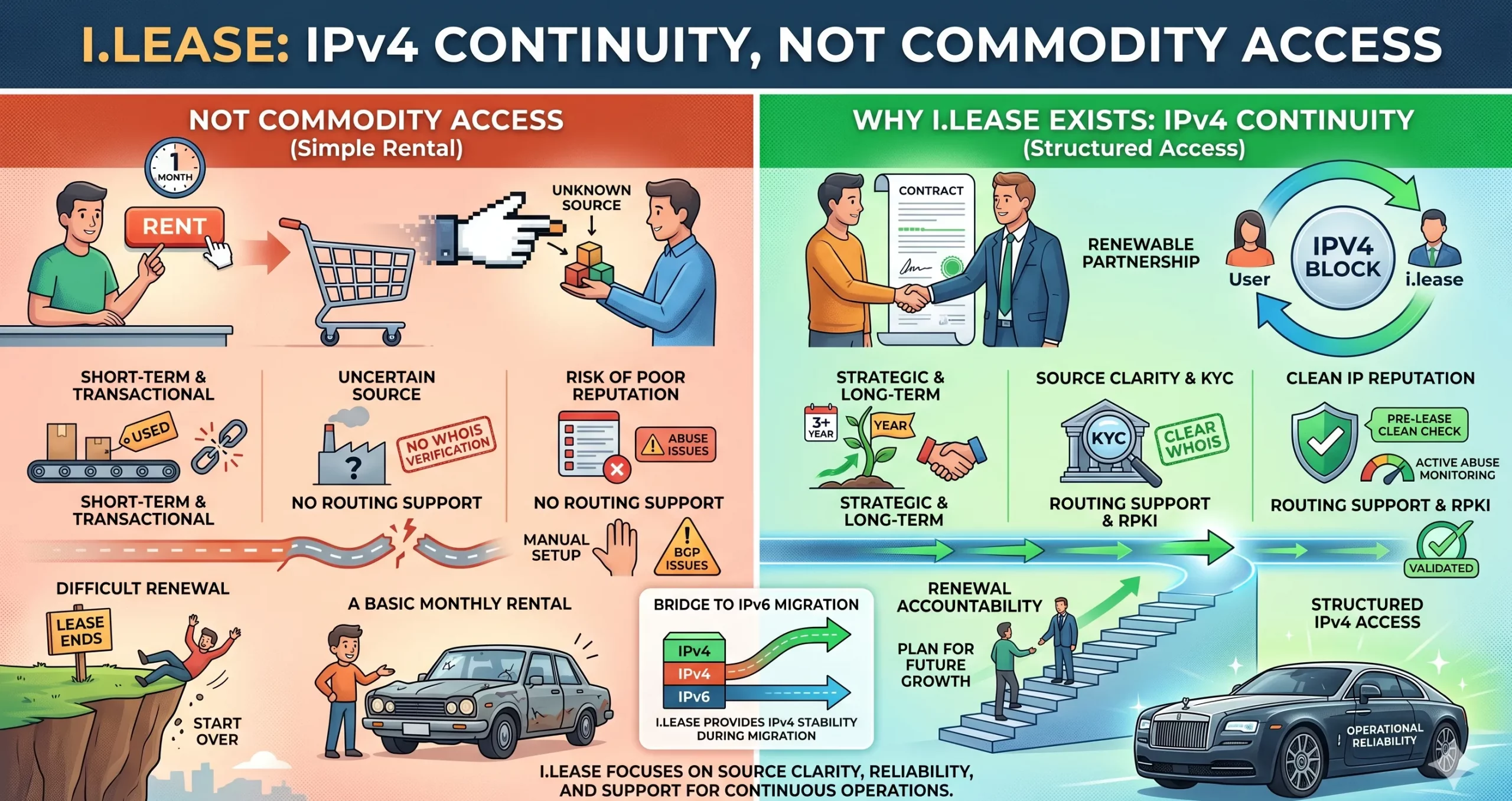
A business does not only need an IPv4 block to exist. It needs that block to remain usable, routable, documented, renewable, reputation-safe, and operationally stable after services are already built on top of it.

That is why i.lease exists.

i.lease is not only about finding IPv4 addresses. It is about helping businesses avoid weak IPv4 structures where the customer pays for access but still absorbs the risk when routing, renewal, documentation, reputation, or provider-chain problems appear.

This is the practical business meaning of Double Extraction: the customer pays for IPv4 access, but still carries the operational downside if the structure behind that access fails.

For IPv4 users, that distinction matters.

The short game treats IPv4 as inventory.

The long game treats IPv4 as continuity infrastructure.

An ordinary IPv4 provider may answer only one question:

Can we supply the addresses?

But a serious business must ask more:

Can the addresses be routed?
Can the source be explained?
Can the lease be renewed?
Can the provider support documentation?
Can abuse reports be handled?
Can reputation problems be checked?
Can the customer continue operating if something goes wrong?

IPv4 access becomes dangerous when the business receives a block but does not understand the structure behind it.

A provider may have a sales relationship with the customer, but the actual source may sit upstream. A broker may arrange access, but another party may control renewal. A seller may promise delivery, but routing support may depend on a third party. A lease may look stable today, but the documentation path may be unclear when renewal comes.

That is why ordinary access is not enough.

For business infrastructure, IPv4 must be treated as a continuity layer.

What Makes IPv4 Different from Ordinary Digital Inventory

IPv4 addresses are not ordinary digital products.

They are not like software licenses that can simply be replaced overnight. They are not like cloud instances that can always be recreated with a few clicks. They are not like temporary account credentials that can be changed without operational impact.

IPv4 addresses can become part of a company’s infrastructure identity.

A single IPv4 range may support:

  • production servers
  • VPN gateways
  • customer allowlists
  • DNS records
  • email reputation
  • SaaS platforms
  • fraud-control systems
  • telecom services
  • hosting customers
  • API endpoints
  • remote access infrastructure
  • security monitoring systems

Once customers, firewalls, applications, mail systems, and routing policies are built around those addresses, replacing them can become difficult.

That is why IPv4 should not be treated as a disposable commodity.

It is operational infrastructure.

The Hidden Risk Inside Weak IPv4 Provider Chains

The biggest IPv4 risk is not always visible at the beginning.

At the start, everything may look simple.

The provider sends a quote.
The customer signs an agreement.
The IPv4 block is assigned.
The service begins.
The network goes live.

The risk appears later.

It appears when renewal must be confirmed. It appears when routing authorization is needed. It appears when an upstream party delays. It appears when abuse handling becomes urgent. It appears when a customer asks for documentation. It appears when the IP reputation is not clean. It appears when the provider cannot explain who controls the source.

This is provider-chain risk.

The customer may believe it has one IPv4 provider. In reality, the chain may involve multiple parties: broker, upstream holder, registry account, routing support, abuse contact, documentation issuer, and renewal authority.

If the customer does not know who controls what, the customer may not discover the weakness until the network is already dependent on the addresses.

That is why i.lease focuses on structure, not only supply.

Double Extraction: Paying for IPv4 While Absorbing the Risk

This is where Double Extraction becomes a practical business issue.

Double Extraction happens when the customer pays for IPv4 access but still carries the real downside when the structure above the address space fails.

In a weak IPv4 sourcing model, the customer may pay the monthly lease fee or purchase price, but still absorb:

  • downtime
  • emergency migration
  • delayed deployment
  • routing disruption
  • engineering workload
  • reputation cleanup
  • customer complaints
  • compliance review
  • contract pressure
  • uncertainty over renewal
  • uncertainty over documentation

The provider collects the fee.

The customer carries the disruption.

That is the business version of Double Extraction.

It is not only about money paid upfront. It is about who carries the consequence when the address block becomes difficult to use.

A cheap IPv4 lease can become expensive if the customer must later pay in emergency work, customer damage, downtime, or replacement cost.

A fast IPv4 deal can become slow if routing or documentation support is missing.

A brokered arrangement can become fragile if nobody clearly owns renewal accountability.

The real question is not:

How much does this IPv4 block cost?

The better question is:

Who carries the risk when the IPv4 structure is tested?

Why Continuity Matters After Deployment

IPv4 continuity matters most after deployment.

Before deployment, the business still has options.

It can compare providers. It can delay selection. It can negotiate. It can request documents. It can choose another source.

After deployment, the situation changes.

Customers may already be connected. Applications may already be configured. DNS may already point to the addresses. Firewalls may already allowlist them. Email reputation may already be warming up. Monitoring systems may already depend on them. Contractual obligations may already assume stable access.

At that point, the cost of switching becomes higher.

That is why continuity must be checked before deployment, not after the first disruption.

A reliable IPv4 structure should answer:

  • How will the address block remain usable?
  • Who supports routing?
  • Who confirms renewal?
  • Who handles documentation?
  • Who responds to abuse issues?
  • Who supports reputation problems?
  • Who escalates if the provider chain fails?

Without those answers, the customer may be building critical services on weak ground.

Why i.lease Focuses on Source Clarity

Source clarity is one of the first signs of a serious IPv4 provider.

A business should understand where the IPv4 block comes from and who has authority to lease, route, or transfer it.

This does not mean every internal detail must be exposed publicly. But a business customer should not be left with vague answers.

Source clarity helps reduce:

  • renewal uncertainty
  • routing delay
  • documentation gaps
  • upstream dependency
  • transfer confusion
  • abuse-handling ambiguity
  • provider-chain risk

If the provider cannot explain the structure clearly enough for business review, the customer should treat that as a warning sign.

Source clarity is not paperwork for its own sake.

It is the foundation of continuity.

Why Routing Support Is a Business Requirement

IPv4 addresses have value only if they can be used.

For most business use cases, that means the addresses must be routable in a stable and predictable way.

Routing support may include:

  • BGP announcement planning
  • route object creation
  • LOA support where applicable
  • ROA or RPKI-related coordination where applicable
  • upstream provider acceptance
  • reverse DNS planning
  • geolocation planning
  • routing monitoring
  • technical escalation

A provider that only supplies addresses but cannot support routing leaves the customer exposed.

The customer may have the block, but not a clear path to use it.

That is not continuity.

That is inventory without operational proof.

Why Renewal Accountability Cannot Be an Afterthought

IPv4 leasing does not end when the addresses are delivered.

The real test is whether access remains stable over time.

Renewal accountability matters because businesses often build long-running services around leased IPv4 addresses.

A serious IPv4 provider should make renewal responsibilities clear:

  • When does renewal need confirmation?
  • Who controls the renewal process?
  • What happens if an upstream source delays?
  • How much notice will the customer receive?
  • Does routing authorization continue during renewal?
  • What happens if the customer needs to extend?
  • Who handles documentation updates?

Without renewal accountability, the customer may not know whether today’s stable IPv4 access will remain stable tomorrow.

For customer-facing infrastructure, that uncertainty is a business risk.

Why IP Reputation Affects Real Usability

A block can be technically available and still commercially weak.

IP reputation affects whether the address range can be used smoothly for:

  • email delivery
  • hosting
  • SaaS platforms
  • VPN services
  • security tools
  • customer onboarding
  • fraud-control systems
  • enterprise access

If an address range has abuse history, spam records, blacklist issues, proxy abuse, malware association, or repeated complaints, the customer may face problems after deployment.

A cheap IPv4 block with poor reputation can require expensive cleanup.

A provider should help the customer understand the reputation condition before the customer builds services around the block.

This is another reason why IPv4 should not be judged by price alone.

The lowest price may hide the highest operational cost.

Lease, Buy, or Sell: Why Structure Matters More Than Labels

Many businesses ask whether they should lease or buy IPv4.

That is a useful question.

But it is not the first question.

The first question is whether the structure supports continuity.

Leasing may be suitable when the business needs flexibility, faster access, lower upfront cost, or temporary capacity.

Buying may be suitable when the business needs long-term control and has the capital, legal, technical, and operational capacity to manage the address space.

Selling may be suitable for holders with unused IPv4 resources who want to convert idle capacity into business value.

But in every case, structure matters.

A lease with strong source clarity may be safer than a purchase with weak documentation.

A purchase with clean records may be better than a cheap lease with unclear renewal.

A sale through a structured process may reduce risk compared with an informal broker chain.

The label matters less than the accountability behind it.

How i.lease Helps Businesses Reduce IPv4 Exposure

i.lease helps businesses approach IPv4 access with a continuity-first mindset.

Instead of treating IPv4 as a simple marketplace item, i.lease focuses on the operational questions that determine whether the address space can support real business use.

i.lease helps businesses evaluate:

  • source clarity
  • routing support
  • IP reputation
  • renewal accountability
  • documentation readiness
  • provider-chain transparency
  • escalation responsibility
  • lease-versus-buy suitability
  • long-term operational reliability

This matters because businesses do not only need numbers.

They need address space that can support running services.

Businesses that need flexible IPv4 capacity can explore IPv4 leasing. Companies that need long-term control can review options to Buy IPv4 addresses. Address holders with unused resources can learn how to Sell IPv4 addresses through a clearer commercial path.

Practical IPv4 Continuity Checklist

Before choosing an IPv4 provider, businesses should ask:

  1. Who controls the source of the IPv4 block?
  2. Is the provider direct, or is there a broker chain?
  3. Who supports routing authorization?
  4. Are LOA, route object, ROA, or RPKI-related workflows required?
  5. Has the IP reputation been checked?
  6. Are there abuse records or blacklist concerns?
  7. Who owns renewal accountability?
  8. What happens if the upstream source delays?
  9. Who handles abuse reports?
  10. Who provides documentation if customers or compliance teams request it?
  11. Who escalates if routing fails?
  12. What happens if the block must be replaced?
  13. How much notice is given before any material change?
  14. Is the provider able to support the intended use case?
  15. If the structure fails, who carries the business cost?

That final question is the most important.

If the answer is “the customer,” then the business may already be exposed to Double Extraction.

Final Thought

i.lease exists because IPv4 access should not be reduced to a simple inventory transaction.

A business does not only need an address block.

It needs continuity.

It needs the block to route.
It needs the source to be clear.
It needs reputation to be usable.
It needs renewal to be accountable.
It needs documentation to survive review.
It needs escalation when something goes wrong.

The IPv4 market is full of offers that look simple at the beginning.

But real risk appears after deployment.

That is why the safest IPv4 strategy is not always the cheapest offer or the fastest quote.

The safest IPv4 strategy is the one that protects the business after the network depends on the addresses.

Before leasing, buying, or selling IPv4, ask one question:

Are we only getting access, or are we securing continuity?

If the answer is unclear, the risk is already inside the structure.

Also Read

Frequent Asked Questions

Why does i.lease exist?

i.lease exists to help businesses access IPv4 addresses through a continuity-first structure. Instead of treating IPv4 as simple inventory, i.lease focuses on source clarity, routing support, IP reputation, renewal accountability, documentation readiness, and operational reliability.

What is Double Extraction in IPv4 access?

Double Extraction happens when a business pays for IPv4 access but still carries the real operational downside if renewal, routing, provider-chain, reputation, or documentation problems appear.

Why is IPv4 continuity important?

IPv4 continuity is important because many businesses build live infrastructure around IP addresses. If the addresses become unroutable, unavailable, poorly documented, or reputation-damaged, the business may face downtime, customer complaints, emergency migration, and compliance pressure.

Is the cheapest IPv4 provider always the best choice?

No. A cheap IPv4 provider may still create risk if source clarity, routing support, IP reputation, renewal accountability, or escalation responsibility is weak. Businesses should compare total risk, not only price.

What should businesses check before leasing IPv4?

Businesses should check source clarity, routing support, LOA or ROA/RPKI-related requirements, IP reputation, renewal accountability, abuse handling, documentation readiness, and provider-chain transparency.

Can i.lease help businesses buy or sell IPv4 addresses?

Yes. i.lease supports IPv4 leasing, buying, and selling through a structured approach focused on continuity, source clarity, routing readiness, reputation, and operational reliability.

相关文章

Running Code Primacy

运行代码优先性:为什么 IPv4 租约应该以运行证明来评判

IPv4 租赁通常始于一个简单的问题: 这个供应商能不能给我们这些地址? 但对于依赖 IPv4 来支持托管、VPN、SaaS、云、电信、安全、电子邮件投递或面向客户平台的企业来说,这个问题还不够。 更好的问题是: 这个 IPv4 结构能否证明它在运营上可行? 这正是 Running-Code Primacy 重要的地方。 Running-Code Primacy 意味着,真实运行中的运营现实,应该优先于机构语言、销售说法、流程上的安心感或抽象承诺。在 IPv4 地址市场中,企业不应只通过价格、地址块大小或精美的销售页面来判断 IPv4 供应商。企业应该通过证据来判断:该地址空间是否可以路由、续期、记录、支持,并在生产环境中保持稳定。 对 i.lease 来说,商业启示很直接: IPv4 访问应该通过运营证明来评估,而不只是纸面上的可用性。 什么是 Running-Code Primacy? Running-Code Primacy 是一种理念,认为互联网治理和资源协调应始终以正在运行的网络为基础。 互联网工程传统长期重视实际实现,而不是理论设计。Running-Code Primacy 背后的原则主张,号码资源协调应通过运行中网络的技术需求来解释,而不是通过广泛的机构权威来解释。 对于 IPv4 地址市场,这一原则可以转化为商业语言: 不要只依赖说法。要寻找证明。 供应商可能会说 IPv4 地址块可用。但它能否支持路由?能否提供文件?能否说明来源控制?能否处理续期?当信誉或滥用问题出现时,它能否回应?部署之后,它能否保持客户网络稳定? Running-Code Primacy 并不意味着忽略合同、记录或治理。这些仍然重要。它意味着最终测试应该是运营现实。 如果一个 IPv4 安排无法支持正在运行的网络,那就还不够。 为什么 IPv4 买家和租户应该重视 IPv4 不只是基础设施预算中的一个项目。 对许多企业来说,IPv4 支撑着真实系统: 托管平台 云服务 VPN 网关 SaaS 应用 企业访问控制 电子邮件基础设施 电信系统 安全工具 面向客户的网站 API 端点 监控系统Read more Related Posts Why most enterprises are accidentally exposed to IPv4 allocation failure risk IPv4 scarcity is widely understood. What many enterprises still underestimate is the continuity risk surrounding how address resources are governed Read more Why i.lease Exists: IPv4 Continuity Is Not Commodity Access Most businesses enter the IPv4 market with a simple goal. They need addresses. Maybe they need them for hosting.Maybe they Read more Running-Code Primacy: Why IPv4 Leasing Should Be Judged by Operational Proof IPv4 leasing often begins with a simple question:Can this provider give us the addresses?But for businesses that depend on IPv4 Read more .related-post {} .related-post .post-list { text-align: left; } .related-post .post-list .item { margin: 5px; padding: 10px; } .related-post .headline { font-size: 18px !important; color: #999999 !important; } .related-post .post-list .item .post_thumb { max-height: 220px; margin: 10px 0px; padding: 0px; display: block; } .related-post .post-list .item .post_title { font-size: 16px; color: #3f3f3f; margin: 10px 0px; padding: 0px; display: block; text-decoration: none; } .related-post .post-list .item .post_excerpt { font-size: 13px; color: #3f3f3f; margin: 10px 0px; padding: 0px; display: block; text-decoration: none; } @media only screen and (min-width: 1024px) { .related-post .post-list .item { width: 30%; } } @media only screen and (min-width: 768px) and (max-width: 1023px) { .related-post .post-list .item { width: 90%; } } @media only screen and (min-width: 0px) and (max-width: 767px) { .related-post .post-list .item { width: 90%; } }

IPv4 Poverty Penalty

IPv4 贫困惩罚:为什么小型网络需要支付更多费用

IPv4 访问在纸面上可能看起来是一样的。 相同的注册机构表格。相同的转让规则。相同的供应商合同。相同的合规语言。相同的续期流程。 但相同的文件,并不总是带来相同的结果。 对于大型运营商来说,IPv4 摩擦可能是可以管理的。他们可能拥有法律团队、政策人员、网络工程师、合规支持、资本储备,以及足够多的客户来把延迟成本分摊到更大的业务规模中。 但对于较小的运营商来说,同样的摩擦可能变得危险。 IPv4 转让延迟可能拖慢扩张。文件问题可能阻碍部署。续期问题可能带来面向客户的风险。薄弱的供应商链条可能迫使紧急迁移。注册机构或政策争议可能消耗企业无法承受的资金。 这就是 IPv4 访问中 贫困惩罚 的实际含义:更贫困、更小型或利润率更薄的运营商,往往会为同样的不确定性付出更高代价,因为它们吸收延迟、流程和自由裁量风险的能力更弱。 危险不只是 IPv4 的价格。 危险在于它周围隐藏的成本。 什么是 IPv4 贫困惩罚? IPv4 贫困惩罚,是指较小型运营商在 IPv4 访问受到流程、延迟、不确定性、文件负担、供应商链条薄弱或注册层风险影响时所面对的隐藏成本。 这并不意味着小企业总是支付更高的每 IP 标价。有时会,有时不会。 更深层的问题是,较小型运营商往往支付更多间接成本。 它们没有足够资本来承受延迟。 它们没有足够人员来处理文件。 它们与供应商谈判的能力较弱。 如果出现争议,它们的法律承受能力较低。 如果地址块无法使用,它们的备用选择更少。 如果部署延迟,它们可能更快失去客户。 大型运营商可以把 IPv4 摩擦视为行政上的不便。较小型运营商却可能把同样的摩擦体验为对增长、服务交付或生存的直接威胁。 这就是为什么贫困惩罚不只是一个社会性说法。在 IPv4 访问中,它会变成运营现实。 为什么相同规则会产生不平等风险 许多系统声称自己是平等的,因为相同规则适用于所有人。 但在商业基础设施中,相同规则仍然可能产生不平等风险。 大型网络可能拥有了解转让要求的政策团队。较小型 ISP 可能只有一名工程师同时处理路由、客户支持、账单和合规。 云平台可能可以承受数周延迟,因为它有资本储备和备用容量。较小型托管服务商如果本月无法开始部署,可能就会失去客户。 跨国买家可能可以谈判更强的条款。较小型买家可能因为选择较少,而接受薄弱的供应商条件。 规则可能相同。 负担并不相同。 这就是为什么可见的 IPv4 价格只是实际成本的一部分。对小型企业来说,不确定性的隐藏成本可能比月租费或购买价差更大。 小型网络承担的隐藏成本 贫困惩罚会通过一些容易被忽视、直到直接冲击业务时才显现的成本出现。 1. 合规成本 较小型运营商可能需要准备文件、解释使用场景、验证记录、更新联系人、回应供应商问题,或满足转让要求,但它们通常没有专门的合规团队。 2. 延迟成本 延迟可能阻止新客户上线、推迟服务器部署、拖慢区域扩张,或阻碍服务按时上线。 3. 法律成本 如果出现争议,大型运营商可能可以吸收法律审查成本。较小型运营商可能因为成本太高而避免维护自身立场。 4. 工程成本 薄弱的供应商文件、不清晰的路由授权,或突然更换 IP,都可能消耗小团队难以轻易承担的工程时间。Read more Related Posts 运行代码优先性:为什么 IPv4 租约应该以运行证明来评判 IPv4 租赁通常始于一个简单的问题:这个供应商能不能给我们这些地址?但对于依赖 IPv4 来支持托管、VPN、SaaS、云、电信、安全、电子邮件投递或面向客户平台的企业来说,这个问题还不够。更好的问题是:这个 IPv4 结构能否证明它在运营上可行?这正是 Running-Code Primacy 重要的地方。Running-Code Primacy 意味着,真实运行中的运营现实,应该优先于机构语言、销售说法、流程上的安心感或抽象承诺。在 IPv4 地址市场中,企业不应只通过价格、地址块大小或精美的销售页面来判断 IPv4 供应商。企业应该通过证据来判断:该地址空间是否可以路由、续期、记录、支持,并在生产环境中保持稳定。对 i.lease 来说,商业启示很直接:IPv4 访问应该通过运营证明来评估,而不只是纸面上的可用性。什么是 Running-Code Primacy?Running-Code Read more Penalización por pobreza de IPv4: ¿Por qué las redes pequeñas pagan más? El acceso IPv4 puede parecer igual sobre el papel. Los mismos formularios de registro. Las mismas reglas de transferencia. Los Read more Pénalité liée à la pauvreté sur IPv4 : pourquoi les petits réseaux paient plus cher L’accès IPv4 peut sembler égal sur le papier.Les mêmes formulaires de registre.Les mêmes règles de transfert.Les mêmes contrats fournisseurs.Le même Read more .related-post {} .related-post .post-list { text-align: left; } .related-post .post-list .item { margin: 5px; padding: 10px; } .related-post .headline { font-size: 18px !important; color: #999999 !important; } .related-post .post-list .item .post_thumb { max-height: 220px; margin: 10px 0px; padding: 0px; display: block; } .related-post .post-list .item .post_title { font-size: 16px; color: #3f3f3f; margin: 10px 0px; padding: 0px; display: block; text-decoration: none; } .related-post .post-list .item .post_excerpt { font-size: 13px; color: #3f3f3f; margin: 10px 0px; padding: 0px; display: block; text-decoration: none; } @media only screen and (min-width: 1024px) { .related-post .post-list .item { width: 30%; } } @media only screen and (min-width: 768px) and (max-width: 1023px) { .related-post .post-list .item { width: 90%; } } @media only screen and (min-width: 0px) and (max-width: 767px) { .related-post .post-list .item { width: 90%; } }

IPv4 Renewal Risk: Who Protects Your Network?

如果无人承担续约风险,您的 IPv4 租约就不安全。

谁才是真正负责维持这个 IPv4 访问持续可用的人? 不是卖给你的人。不是介绍给你的人。不是开出发票的人。也不是发送第一份 LOA 的人。 当合作关系变得紧张、上游来源改变立场、文件受到质疑,或者供应商链条不再回应时,谁承担续期风险? 对于依赖 IPv4 来支持托管、SaaS、VPN、电信、云、安全、电子邮件投递或客户访问的企业来说,这不是一个小小的行政问题。 这是一个连续性问题。 当续期责任不清晰时,你的 IPv4 租赁可能会变成一个隐藏的倒计时。 为什么 IPv4 续期风险容易被忽视 大多数公司只会检查一个 IPv4 地址块今天是否可用。 他们检查 IP 是否可以路由。 他们检查地址块是否干净。 他们检查价格是否可以接受。 他们检查供应商是否能够快速交付。 这些检查都很重要。 但还不够。 IPv4 风险通常会在之后才出现,也就是企业已经围绕这些地址建立服务之后。到那时,这些 IP 可能已经绑定到客户账户、防火墙规则、邮件信誉、白名单、DNS 记录、应用基础设施、合规记录和内部运营流程。 到了那个阶段,更换 IP 就不再简单。 它可能意味着宕机、客户投诉、信誉损失、工程工作量增加,以及合同中断。 这就是为什么续期很重要。 IPv4 租赁的第一个月,只能证明访问已经被安排好。续期阶段,才能证明这个结构是否可靠。 一个薄弱的供应商在初期接入时可能看起来很强。真正的考验,是当租赁必须续期、被维护、被证明、被延长或被升级处理时。 访问与连续性之间的危险差异 IPv4 访问意味着你现在可以使用这些地址。 IPv4 连续性意味着你可以有信心继续使用这些地址。 许多公司混淆了这两者。 访问是短期的。连续性是结构性的。 访问回答的是: 我今天可以路由这些 IP 吗? 我现在可以部署服务器吗? 我可以收到 LOA 吗? 我可以开始使用这个地址块吗? 连续性提出的是更深层的问题: 谁控制来源关系? 谁负责续期责任? 谁支持路由变更? 如果文件受到质疑,谁来回应? 谁在压力到达客户之前吸收上游压力? 谁具备法律、运营和注册机构相关能力来保护连续性? 这种差异很重要,因为 IPv4 已经不再是随意的技术输入。它支撑着真实的业务活动、客户访问、收入、基础设施和运营连续性。注册层和认可层可能位于有价值的网络资源之上,而一旦连续性中断,运营商和客户承担的是真正的业务后果。 这就是为什么最便宜的 IPv4Read more Related Posts Why i.lease Exists: IPv4 Continuity Is Not Commodity Access Most businesses enter the IPv4 market with a simple goal. They need addresses. Maybe they need them for hosting.Maybe they Read more Running-Code Primacy: Why IPv4 Leasing Should Be Judged by Operational Proof IPv4 leasing often begins with a simple question:Can this provider give us the addresses?But for businesses that depend on IPv4 Read more IPv4 Poverty Penalty: Why Small Networks Pay More IPv4 access can look equal on paper.The same registry forms.The same transfer rules.The same provider contracts.The same compliance language.The same Read more .related-post {} .related-post .post-list { text-align: left; } .related-post .post-list .item { margin: 5px; padding: 10px; } .related-post .headline { font-size: 18px !important; color: #999999 !important; } .related-post .post-list .item .post_thumb { max-height: 220px; margin: 10px 0px; padding: 0px; display: block; } .related-post .post-list .item .post_title { font-size: 16px; color: #3f3f3f; margin: 10px 0px; padding: 0px; display: block; text-decoration: none; } .related-post .post-list .item .post_excerpt { font-size: 13px; color: #3f3f3f; margin: 10px 0px; padding: 0px; display: block; text-decoration: none; } @media only screen and (min-width: 1024px) { .related-post .post-list .item { width: 30%; } } @media only screen and (min-width: 768px) and (max-width: 1023px) { .related-post .post-list .item { width: 90%; } } @media only screen and (min-width: 0px) and (max-width: 767px) { .related-post .post-list .item { width: 90%; } }