Pourquoi les entreprises adoptent le BYOIP
 Stephanie
Alors que les organisations du monde entier accélèrent leur transformation numérique, l’adoption du cloud n’est plus une simple tendance technologique, mais une initiative stratégique majeure. Les entreprises migrent leurs charges de travail critiques vers le cloud à un rythme sans précédent afin d’améliorer leur flexibilité, leur évolutivité et leur rentabilité. Cependant, cette transformation n’est pas sans défis. L’un des enjeux les plus pressants de la migration vers le cloud est la nécessité de conserver une maîtrise totale des configurations réseau, de garantir des politiques de sécurité robustes et d’assurer la continuité de service, notamment pour les services étroitement liés à l’infrastructure existante.
Table of Contents
L’introduction de la solution pratique « Bring Your Own Internal Network » (BYOIP) se généralise rapidement auprès des entreprises confrontées à ces situations complexes. BYOIP permet aux organisations de migrer vers des fournisseurs de services cloud tout en conservant leurs adresses IP pré-attribuées. Elles peuvent ainsi continuer à opérer avec les mêmes identités numériques établies au fil des ans, préservant leur réputation, simplifiant la configuration et évitant des coûts d’interruption de service élevés.
Cet article explore les raisons pour lesquelles les entreprises adoptent la pratique du « Bring Your Own Internet Access Point » (BYOIP), analyse les facteurs commerciaux à l’origine de cette tendance, ses avantages concrets, les considérations techniques et réglementaires, et explique comment les principales plateformes cloud telles qu’Amazon Web Services (AWS), Microsoft Azure et Google Cloud peuvent faciliter son application. Du taux de délivrabilité des e-mails à la conformité aux réglementations sur la souveraineté des données, le BYOIP devient progressivement une stratégie clé pour les responsables informatiques modernes souhaitant garantir la résilience opérationnelle et le contrôle du réseau dans un monde où le cloud est omniprésent.
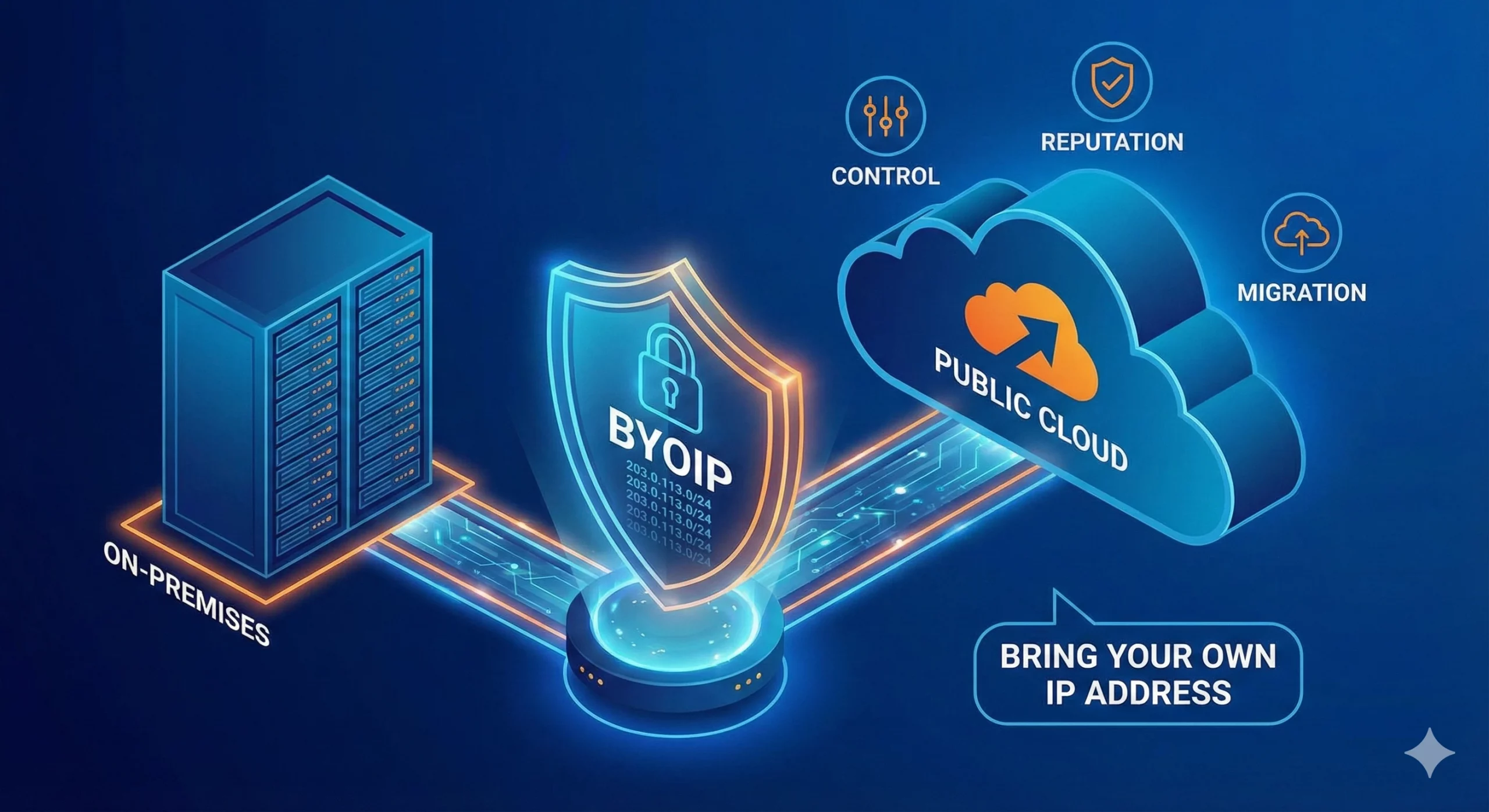
Le BYOIP permet aux entreprises d’utiliser leurs propres plages d’adresses IP publiques auprès des fournisseurs de services cloud (CSP). Cette approche leur permet de conserver leurs adresses IP existantes, préservant ainsi leur réputation et simplifiant la configuration de la sécurité lors de la migration vers le cloud. Les principaux fournisseurs de services cloud tels qu’Amazon Web Services (AWS), Microsoft Azure, Google Cloud Platform (GCP), IBM Cloud et Oracle Cloud Infrastructure (OCI) prennent tous en charge le BYOIP, permettant une intégration simple et transparente à leurs plateformes.
Dans un monde numérique de plus en plus interconnecté, les adresses IP sont considérées comme une ressource essentielle. Ce ne sont pas seulement des identifiants techniques, mais aussi des éléments essentiels à l’identité et à la crédibilité en ligne d’une organisation. La délivrabilité des e-mails, les pare-feu, les listes blanches d’API et le contrôle d’accès basé sur la géolocalisation reposent tous sur des adresses IP stables et cohérentes. La perte ou la modification de ces adresses lors d’une migration vers le cloud peut perturber les opérations commerciales, nuire à la confiance des clients et même entraîner des conséquences réglementaires dans des secteurs tels que la finance ou la santé.
Comprendre le BYOIP
C’est pourquoi l’utilisation de sa propre adresse IP (BYOIP) est devenue un choix essentiel. Lors de la migration de leur infrastructure vers le cloud, les entreprises peuvent conserver leurs propres plages d’adresses IP, qu’elles les obtiennent directement auprès d’organismes d’enregistrement Internet régionaux comme l’ARIN, le RIPE NCC ou l’APNIC, ou qu’elles les achètent auprès de revendeurs d’adresses IP légitimes. Les entreprises ne dépendent plus uniquement des adresses IP attribuées par les fournisseurs de services cloud, mais peuvent directement intégrer leurs plages d’adresses au réseau cloud, ce qui leur assure une meilleure continuité et un contrôle accru.
Par exemple, AWS prend en charge la fonctionnalité BYOIP via son service Elastic IP Address, permettant aux entreprises de publier leurs plages d’adresses IP sur le réseau Amazon et de les utiliser au sein de clouds privés virtuels (VPC). De même, Azure permet aux clients d’utiliser leurs propres préfixes IP dans des services tels que les passerelles d’application et les pare-feu Azure. Google Cloud offre une prise en charge similaire grâce à sa fonctionnalité BYOIP, qui permet d’importer des plages d’adresses IP dans des nuages privés virtuels et de les gérer comme des ressources régionales. La prise en charge du « bring your own internet access point » (BYOIP) par les principaux fournisseurs de services cloud n’est pas simplement une question de commodité technique ; cela reflète en fait le consensus croissant au sein de l’ensemble du secteur concernant l’importance de conserver les identités numériques dans le cloud. Qu’il s’agisse de minimiser les temps d’arrêt, d’assurer un basculement transparent entre différentes régions ou de préserver la réputation des noms de domaine liés au trafic de courrier électronique depuis des années, BYOIP construit un pont crucial entre les systèmes traditionnels et l’avenir du cloud natif.
Avantages de l'adoption du BYOIP
Préserver la réputation de la propriété intellectuelle
Conserver ses adresses IP existantes permet aux entreprises de préserver leur réputation, un point particulièrement important pour des services comme la messagerie électronique où la réputation de l’adresse IP influe sur la délivrabilité. Changer d’adresse IP peut entraîner le classement des e-mails comme spam ou leur blocage, ce qui nuit à la communication avec les clients et les partenaires.Using familiar IP addresses allows for easier transfer of existing security policies, reducing the complexity of reconfiguring firewalls and access controls in new environments. This continuity ensures that security measures remain consistent during and after migration.
Simplifier les politiques de sécurité
L’utilisation d’adresses IP connues facilite le transfert des politiques de sécurité existantes, réduisant ainsi la complexité de la reconfiguration des pare-feu et des contrôles d’accès dans les nouveaux environnements. Cette continuité garantit la cohérence des mesures de sécurité pendant et après la migration.
Garantir la conformité réglementaire
Le BYOIP facilite la conformité aux réglementations sectorielles et aux lois sur la souveraineté des données en permettant aux entreprises de conserver le contrôle de leurs ressources de propriété intellectuelle. Ceci est particulièrement crucial pour les organisations opérant dans des régions où les exigences de résidence des données sont strictes..
Rationaliser les migrations vers le cloud
La conservation des adresses IP lors des migrations vers le cloud minimise les interruptions, garantissant ainsi une migration plus fluide et la continuité des services. Cette approche réduit le besoin de reconfiguration et de tests approfondis, accélérant ainsi le calendrier global de la migration.
Mise en œuvre de BYOIPA sur les plateformes cloud

Amazon Web Services (AWS)
AWS permet aux clients d’utiliser leurs propres adresses IP pour des services comme EC2 et Global Accelerator. Cette fonctionnalité contribue à maintenir une cohérence des adresses IP sur l’ensemble des déploiements AWS, préservant ainsi l’identité de marque et simplifiant la configuration réseau.
Microsoft Azure
Azure prend en charge le BYOIP grâce à sa fonctionnalité de préfixe IP personnalisé, permettant aux entreprises d’intégrer leurs plages d’adresses IP à l’infrastructure réseau Azure. Cette intégration facilite la migration et l’application de politiques réseau cohérentes entre les environnements sur site et cloud.
GCP propose la fonctionnalité BYOIP via les préfixes publics, permettant aux organisations d’utiliser leurs adresses IP au sein des services cloud de Google. Cette fonctionnalité facilite la migration tout en minimisant les interruptions de service et en préservant les configurations existantes.
Google Cloud Platform (GCP)
IBM Cloud
IBM Cloud prend en charge le BYOIP, facilitant ainsi l’intégration des adresses IP existantes dans l’environnement cloud d’IBM. Ceci est avantageux pour les stratégies de cloud hybride, garantissant la cohérence entre différents modèles de déploiement.
Oracle Cloud Infrastructure (OCI)
OCI permet aux clients d’utiliser leur propre espace d’adressage IP, en l’alignant sur leurs configurations et politiques réseau existantes. Cette prise en charge garantit aux entreprises la conservation de leurs ressources IP et des configurations associées lors de la migration.
Challenges and considerations
Complexité technique
La mise en œuvre du BYOIP (Bring Your Own IP) exige une planification rigoureuse et une coordination étroite avec les fournisseurs de services cloud afin de garantir un routage et une intégration optimaux. Ce processus peut impliquer la configuration des autorisations d’origine de routage (ROA) et la mise à jour des enregistrements RDAP (Registry Data Access Protocol).
Exigences réglementaires
Les organisations doivent s’assurer que leur utilisation du BYOIP est conforme aux réglementations et politiques en vigueur. Cela inclut la vérification de la propriété des adresses IP et la garantie de leur enregistrement auprès des registres Internet régionaux.
Incidences financières
Le transfert d’adresses IP vers les plateformes cloud peut engendrer des coûts, notamment des frais potentiels facturés par les fournisseurs de services cloud. Toutefois, le BYOIP peut également permettre de réaliser des économies en évitant les frais liés à l’utilisation d’adresses IP attribuées par un fournisseur.
Conclusion
Les entreprises adoptent de plus en plus l’approche « Apportez votre propre protocole Internet » (BYOIP) pour optimiser la gestion de leurs ressources réseau, garantir la conformité aux exigences réglementaires et faciliter une transition fluide et sans interruption vers le cloud. Face à l’accélération du passage aux stratégies hybrides et multicloud, la conservation des plages d’adresses IP publiques existantes n’est plus un simple choix technique, mais une nécessité stratégique.
Pour de nombreuses organisations, les adresses IP sont bien plus que de simples identifiants de routage : elles constituent un élément essentiel de l’infrastructure numérique qui sous-tend la confiance des clients et la continuité des opérations. Par exemple, une plage d’adresses IP utilisée depuis longtemps peut figurer sur la liste blanche de clients, de partenaires commerciaux ou d’applications critiques. Le taux de délivrabilité des e-mails, étroitement lié à la réputation de l’adresse IP, peut chuter considérablement en cas de changement d’adresse non vérifié. Grâce à la solution « Apportez votre propre IP » (BYOIP), les entreprises peuvent éviter ces risques et continuer à utiliser les mêmes adresses IP que celles utilisées par leurs noms de domaine, leurs serveurs de messagerie et leurs API. Cela réduit le risque d’être considéré comme du spam ou intercepté par les filtres de sécurité, ce qui peut entraîner des pertes importantes de revenus et nuire à la valeur de la marque.
De plus, le BYOIP facilite la mise en œuvre de politiques de sécurité cohérentes entre les systèmes cloud et les systèmes locaux. Les pare-feu, les systèmes de détection d’intrusion et les listes de contrôle d’accès (ACL) s’appuient généralement sur des règles basées sur l’adresse IP. Sans BYOIP, les équipes de sécurité doivent reconfigurer et vérifier ces règles à chaque migration ou extension d’infrastructure vers une nouvelle région ; un processus fastidieux et source d’erreurs. En utilisant leurs propres adresses IP, les entreprises peuvent maintenir une limite de réseau cohérente, ce qui simplifie considérablement la mise en œuvre des protocoles de sécurité et la surveillance du trafic dans différents environnements.
Du point de vue de la conformité, le BYOIP (Bring Your Own IP Address) peut aider les organisations à respecter les réglementations locales ou sectorielles en matière de traitement des données. Dans des secteurs comme la finance, la santé ou les marchés publics, où les exigences en matière de résidence et de traçabilité des données sont extrêmement élevées, la possibilité d’utiliser et de gérer des adresses IP au sein d’une juridiction spécifique offre des garanties supplémentaires. Elle peut également faciliter le processus d’audit, en garantissant que les flux de données et les limites du réseau sont bien documentés et sous le contrôle de l’entreprise, et non du fournisseur de cloud.
En définitive, le BYOIP (Bring Your Own IP) intègre flexibilité opérationnelle, continuité de la sécurité et autonomie stratégique. Face à un écosystème cloud de plus en plus complexe et interconnecté, les entreprises qui adoptent le BYOIP peuvent s’adapter plus rapidement à cet environnement, opérer de manière plus fiable et éviter de nombreux risques liés à une dépendance exclusive à l’allocation d’adresses IP natives du cloud.
Trusted IPv4 Leasing for Business Growth
Get enterprise-grade IPv4 space quickly, with seamless deployment and end-to-end management.
Get Started with i.leaseFoire aux questions (FAQ)
Qu'est-ce que le BYOIP ?
BYOIP signifie « Apportez votre propre adresse IP », une pratique qui permet aux entreprises d’utiliser leurs plages d’adresses IP existantes dans des environnements cloud, assurant ainsi la continuité et le contrôle de leurs ressources réseau.
Quels fournisseurs de cloud prennent en charge le BYOIP ?
Les principaux fournisseurs de services cloud, notamment AWS, Microsoft Azure, Google Cloud Platform, IBM Cloud et Oracle Cloud Infrastructure, proposent une prise en charge BYOIP, permettant aux entreprises d’intégrer leurs adresses IP aux services cloud.
Quels sont les avantages du BYOIP ?
BYOIP offre plusieurs avantages, tels que la préservation de la réputation IP, la simplification des transferts de politiques de sécurité, la garantie de la conformité réglementaire et la facilitation de migrations vers le cloud plus fluides.
Existe-t-il des défis associés au BYOIP ?
Oui, la mise en œuvre du BYOIP peut impliquer des complexités techniques, des considérations réglementaires et des coûts potentiels, nécessitant une planification et une coordination minutieuses avec les fournisseurs de services cloud.
Quel est l'impact du BYOIP sur la migration vers le cloud ?
BYOIP simplifie la migration vers le cloud en permettant aux entreprises de conserver leurs adresses IP existantes, réduisant ainsi le besoin de reconfiguration et minimisant les interruptions de service pendant la transition.
Blogs associés
相关文章

什么是电信公司?电信运营商如何为英国、美国和加拿大提供网络连接支持?
电信公司(Telco Companies),也称为电信运营商(Telecommunications Companies),提供通信与网络连接服务。这些服务包括移动通信网络、宽带互联网、光纤连接、固定电话服务、企业网络连接、云连接、托管网络服务以及数据中心连接等。 对于普通消费者而言,电信公司通常被视为移动通信或宽带互联网服务提供商。对于企业来说,电信公司远不只是一个服务品牌,更是关键的基础设施合作伙伴,帮助企业连接办公室、数据中心、云平台、远程员工、客户应用程序以及各类数字化服务。 随着企业越来越依赖云平台、SaaS 应用、AI 工具、VPN、网络安全系统以及在线服务,电信公司已成为数字基础设施规划中不可或缺的重要组成部分。 电信公司是什么? 电信公司(Telco Companies)是提供电信服务的企业。这些服务让个人、设备、企业和各种系统能够跨越距离进行通信与连接。 一家电信公司可能提供以下服务: 移动通信服务 宽带互联网 光纤连接 固定电话服务 企业互联网接入 企业广域网(WAN)服务 云连接服务 数据中心连接 VPN 服务 托管网络解决方案 互联网传输(Internet Transit) 电信批发服务 部分电信公司拥有并运营大规模的实体网络基础设施;另一些则通过批发接入、租用基础设施或与网络运营商合作来提供电信服务。 电信公司提供哪些服务? 电信公司同时为个人消费者和企业客户提供服务。 面向消费者的服务通常包括移动通信套餐、家庭宽带、光纤互联网、固定电话以及通信组合套餐。 面向企业的服务则可能包括专线互联网接入、企业光纤、专用网络、云连接、托管安全服务、数据中心连接、物联网(IoT)连接以及企业移动通信方案。 对于大型企业客户,电信公司还可提供: 多地点办公室网络连接 远程员工接入 私有云连接 SD-WAN(软件定义广域网) 灾难恢复连接 低延迟网络路由 互联网传输(Internet Transit) 网络监控 托管防火墙服务 正因如此,电信公司不仅对日常通信至关重要,也是现代企业建设先进数字基础设施的重要支柱。 电信公司 vs 互联网服务提供商 vs 网络运营商 电信公司(Telco)、互联网服务提供商(ISP)和网络运营商(Network Operator)之间可能存在重叠,但它们并不完全相同。 电信公司提供电信服务。 互联网服务提供商(ISP)提供互联网接入服务。 网络运营商负责建设、运营和管理网络基础设施。 一些大型电信公司同时承担这三种角色。它们拥有基础设施、运营网络,并向市场提供互联网、移动通信以及企业网络服务。 规模较小的服务提供商则可能专注于其中某一层。例如,互联网服务提供商(ISP)可以销售宽带服务,而无需拥有所有实体网络基础设施;网络运营商可能负责建设和运营光纤网络,并向电信公司或 ISP 提供批发网络接入;电信公司则可能结合自有网络与合作伙伴网络,为客户提供移动通信和企业服务。 对于企业而言,理解这些区别非常重要,因为服务质量不仅取决于销售该方案的品牌,还受到其底层网络、路由设计、网络覆盖范围以及技术支持体系等因素的影响。 为什么电信公司对企业至关重要 电信公司之所以重要,是因为几乎所有现代企业都依赖稳定的网络连接。 企业可能需要电信服务来支持: 办公室互联网接入 移动网络连接 远程办公 客户支持系统 云应用程序 SaaS 平台 支付系统 VPNRead more Related Posts 什么是电信公司?电信运营商如何为英国、美国和加拿大提供网络连接支持? 电信公司(Telco Companies),也称为电信运营商(Telecommunications Companies),提供通信与网络连接服务。这些服务包括移动通信网络、宽带互联网、光纤连接、固定电话服务、企业网络连接、云连接、托管网络服务以及数据中心连接等。 对于普通消费者而言,电信公司通常被视为移动通信或宽带互联网服务提供商。对于企业来说,电信公司远不只是一个服务品牌,更是关键的基础设施合作伙伴,帮助企业连接办公室、数据中心、云平台、远程员工、客户应用程序以及各类数字化服务。 随着企业越来越依赖云平台、SaaS 应用、AI 工具、VPN、网络安全系统以及在线服务,电信公司已成为数字基础设施规划中不可或缺的重要组成部分。 电信公司是什么? 电信公司(Telco Companies)是提供电信服务的企业。这些服务让个人、设备、企业和各种系统能够跨越距离进行通信与连接。 一家电信公司可能提供以下服务: 移动通信服务 宽带互联网 光纤连接 固定电话服务 企业互联网接入 企业广域网(WAN)服务 云连接服务 数据中心连接 VPN TCP 与 UDP:IPv4 租赁和企业网络指南 TCP 和 UDP 是互联网中最重要的两种传输层协议。它们决定数据如何在设备、服务器、云平台、VPN 网关、DNS 解析器、电子邮件系统、流媒体平台以及企业应用程序之间传输。 对于企业而言,TCP 和 UDP 不仅仅是技术术语,它们会直接影响实际的基础设施性能。公网 IPv4 地址提供可从互联网访问的网络端点,而 TCP 和 UDP 则决定流量如何通过该端点进行传输。 这对于租用或购买 IPv4 地址的企业尤为重要。企业租用 IPv4 什么是区域互联网注册管理机构(RIR) 区域互联网注册管理机构(Regional Internet Registry, RIR)是负责在特定地理区域内分配和管理互联网编号资源的组织。这些资源主要包括 IP 地址(IPv4 和 IPv6)以及自治系统号(ASN),它们是支撑设备和网络在互联网上相互通信的关键要素。 如果没有一套组织完善的系统来分配唯一的 IP 地址和路由标识符,互联网便无法正常运转。RIR 确保这一过程在各自管辖的区域内保持公平、高效与一致,从而避免冲突,并提升互联网治理的透明度。 全球五大 RIR 目前全球共有五家获官方认可的 RIR,各自负责世界上特定的区域:AFRINIC – 非洲网络信息中心(非洲)APNIC – 亚太网络信息中心(亚太地区)ARIN .related-post {} .related-post .post-list { text-align: left; } .related-post .post-list .item { margin: 5px; padding: 10px; } .related-post .headline { font-size: 18px !important; color: #999999 !important; } .related-post .post-list .item .post_thumb { max-height: 220px; margin: 10px 0px; padding: 0px; display: block; } .related-post .post-list .item .post_title { font-size: 16px; color: #3f3f3f; margin: 10px 0px; padding: 0px; display: block; text-decoration: none; } .related-post .post-list .item .post_excerpt { font-size: 13px; color: #3f3f3f; margin: 10px 0px; padding: 0px; display: block; text-decoration: none; } @media only screen and (min-width: 1024px) { .related-post .post-list .item { width: 30%; } } @media only screen and (min-width: 768px) and (max-width: 1023px) { .related-post .post-list .item { width: 90%; } } @media only screen and (min-width: 0px) and (max-width: 767px) { .related-post .post-list .item { width: 90%; } }
TCP 与 UDP:IPv4 租赁和企业网络指南
TCP 和 UDP 是互联网中最重要的两种传输层协议。它们决定数据如何在设备、服务器、云平台、VPN 网关、DNS 解析器、电子邮件系统、流媒体平台以及企业应用程序之间传输。 对于企业而言,TCP 和 UDP 不仅仅是技术术语,它们会直接影响实际的基础设施性能。公网 IPv4 地址提供可从互联网访问的网络端点,而 TCP 和 UDP 则决定流量如何通过该端点进行传输。 这对于租用或购买 IPv4 地址的企业尤为重要。企业租用 IPv4 地址并不是单纯为了持有这些地址,而是为了运行网站、API、VPN 隧道、DNS 服务、电子邮件平台、SaaS 应用程序、游戏服务器、流媒体系统、安全工具以及云端工作负载。不同类型的服务决定了需要使用 TCP、UDP,还是同时使用两者。 通过 i.lease,企业可以使用 IPv4 租赁服务获取用于实际网络部署的公网 IPv4 资源。需要长期控制 IP 地址资源的企业也可以购买 IP 地址,而拥有闲置 IPv4 资源的组织则可以出售 IP 地址。 TCP和UDP是什么? TCP 和 UDP 都是传输层协议。它们位于 IP 协议之上,帮助应用程序通过网络发送和接收数据。 IP 地址用于确定流量应该发送到哪里,而 TCP 和 UDP 则决定这些流量如何进行传输。 简单来说: TCP 适用于重视可靠性和按顺序传输数据的场景。 UDP 适用于重视速度、低延迟和轻量化数据传输的场景。 企业可能会使用同一个公网 IPv4 地址来运行不同的服务,但每项服务可能依赖不同的传输协议。例如,网站可能使用 TCP,VPN 网关可能使用 UDP,DNS 解析器可能同时使用 UDP 和 TCP,而游戏服务器则可能更倾向于使用 UDP,因为对于实时游戏而言,延迟造成的影响通常比少量数据包丢失更加明显。 因此,TCPRead more Related Posts 什么是电信公司?电信运营商如何为英国、美国和加拿大提供网络连接支持? 电信公司(Telco Companies),也称为电信运营商(Telecommunications Companies),提供通信与网络连接服务。这些服务包括移动通信网络、宽带互联网、光纤连接、固定电话服务、企业网络连接、云连接、托管网络服务以及数据中心连接等。 对于普通消费者而言,电信公司通常被视为移动通信或宽带互联网服务提供商。对于企业来说,电信公司远不只是一个服务品牌,更是关键的基础设施合作伙伴,帮助企业连接办公室、数据中心、云平台、远程员工、客户应用程序以及各类数字化服务。 随着企业越来越依赖云平台、SaaS 应用、AI 工具、VPN、网络安全系统以及在线服务,电信公司已成为数字基础设施规划中不可或缺的重要组成部分。 电信公司是什么? 电信公司(Telco Companies)是提供电信服务的企业。这些服务让个人、设备、企业和各种系统能够跨越距离进行通信与连接。 一家电信公司可能提供以下服务: 移动通信服务 宽带互联网 光纤连接 固定电话服务 企业互联网接入 企业广域网(WAN)服务 云连接服务 数据中心连接 VPN TCP 与 UDP:IPv4 租赁和企业网络指南 TCP 和 UDP 是互联网中最重要的两种传输层协议。它们决定数据如何在设备、服务器、云平台、VPN 网关、DNS 解析器、电子邮件系统、流媒体平台以及企业应用程序之间传输。 对于企业而言,TCP 和 UDP 不仅仅是技术术语,它们会直接影响实际的基础设施性能。公网 IPv4 地址提供可从互联网访问的网络端点,而 TCP 和 UDP 则决定流量如何通过该端点进行传输。 这对于租用或购买 IPv4 地址的企业尤为重要。企业租用 IPv4 什么是区域互联网注册管理机构(RIR) 区域互联网注册管理机构(Regional Internet Registry, RIR)是负责在特定地理区域内分配和管理互联网编号资源的组织。这些资源主要包括 IP 地址(IPv4 和 IPv6)以及自治系统号(ASN),它们是支撑设备和网络在互联网上相互通信的关键要素。 如果没有一套组织完善的系统来分配唯一的 IP 地址和路由标识符,互联网便无法正常运转。RIR 确保这一过程在各自管辖的区域内保持公平、高效与一致,从而避免冲突,并提升互联网治理的透明度。 全球五大 RIR 目前全球共有五家获官方认可的 RIR,各自负责世界上特定的区域:AFRINIC – 非洲网络信息中心(非洲)APNIC – 亚太网络信息中心(亚太地区)ARIN .related-post {} .related-post .post-list { text-align: left; } .related-post .post-list .item { margin: 5px; padding: 10px; } .related-post .headline { font-size: 18px !important; color: #999999 !important; } .related-post .post-list .item .post_thumb { max-height: 220px; margin: 10px 0px; padding: 0px; display: block; } .related-post .post-list .item .post_title { font-size: 16px; color: #3f3f3f; margin: 10px 0px; padding: 0px; display: block; text-decoration: none; } .related-post .post-list .item .post_excerpt { font-size: 13px; color: #3f3f3f; margin: 10px 0px; padding: 0px; display: block; text-decoration: none; } @media only screen and (min-width: 1024px) { .related-post .post-list .item { width: 30%; } } @media only screen and (min-width: 768px) and (max-width: 1023px) { .related-post .post-list .item { width: 90%; } } @media only screen and (min-width: 0px) and (max-width: 767px) { .related-post .post-list .item { width: 90%; } }
什么是BYOIP(自备IP地址)?
自带 IP(Bring Your Own IP,简称 BYOIP)是一种网络部署方式,允许企业将自己现有的公网 IP 地址段应用于云服务提供商、数据中心、内容分发网络(CDN)或其他基础设施平台。 企业无需使用服务提供商分配的新公网 IP 地址,而是可以使用自己已拥有或已获授权使用的 IPv4 或 IPv6 地址前缀。服务提供商会验证该组织对该地址段的使用权限,并在支持的情况下,通过其自身网络对该地址段进行路由公告(Advertise)。 BYOIP 有助于企业在迁移至云平台时保留现有的防火墙规则、白名单(Allowlists)、客户系统集成、IP 信誉(IP Reputation)、DNS 配置以及既有的网络身份。这不仅能够减少因更换 IP 地址而带来的业务中断,还能降低对服务提供商分配 IP 的依赖,使未来的基础设施迁移与扩展更加灵活且易于管理。 对于需要 BYOIP 地址资源的企业,可选择 购买 IPv4 地址(Buy IP),以获得长期控制权;如果更重视灵活性,也可采用 IPv4 租赁(IPv4 Leasing),按业务需求获取公网 IP 资源。 什么是BYOIP? BYOIP 是 Bring Your Own IP(自带 IP)的缩写。这是一种网络部署模式,允许组织将现有的公网 IP 地址段带入云服务提供商或其他基础设施平台使用。 在 BYOIP 模式下,组织仍然拥有或保留该 IP 地址段的使用权,而平台则获得授权,可在其基础设施中对该地址段进行路由公告(Advertise)和使用。随后,这些 IP 地址可分配给虚拟机(Virtual Machines)、负载均衡器(Load Balancers)、VPN 网关、内容分发服务(CDN)、安全平台以及公网应用程序端点等受支持的服务。 例如,一家企业将应用程序从本地数据中心迁移到云环境时,可能并不希望更换现有的公网 IP 地址。这些 IP 地址可能已经存在于客户白名单(Allowlists)、防火墙策略、DNS 记录、合作伙伴配置以及电子邮件信誉(Email Reputation)数据库中。 BYOIP 使企业能够在迁移工作负载的同时,继续使用原有的公网 IP 地址,从而保持更一致的网络身份,并减少因更换 IP 地址而带来的配置调整和业务影响。 Related Posts 什么是电信公司?电信运营商如何为英国、美国和加拿大提供网络连接支持? 电信公司(Telco Companies),也称为电信运营商(Telecommunications Companies),提供通信与网络连接服务。这些服务包括移动通信网络、宽带互联网、光纤连接、固定电话服务、企业网络连接、云连接、托管网络服务以及数据中心连接等。 对于普通消费者而言,电信公司通常被视为移动通信或宽带互联网服务提供商。对于企业来说,电信公司远不只是一个服务品牌,更是关键的基础设施合作伙伴,帮助企业连接办公室、数据中心、云平台、远程员工、客户应用程序以及各类数字化服务。 随着企业越来越依赖云平台、SaaS 应用、AI 工具、VPN、网络安全系统以及在线服务,电信公司已成为数字基础设施规划中不可或缺的重要组成部分。 电信公司是什么? 电信公司(Telco Companies)是提供电信服务的企业。这些服务让个人、设备、企业和各种系统能够跨越距离进行通信与连接。 一家电信公司可能提供以下服务: 移动通信服务 宽带互联网 光纤连接 固定电话服务 企业互联网接入 企业广域网(WAN)服务 云连接服务 数据中心连接 VPN TCP 与 UDP:IPv4 租赁和企业网络指南 TCP 和 UDP 是互联网中最重要的两种传输层协议。它们决定数据如何在设备、服务器、云平台、VPN 网关、DNS 解析器、电子邮件系统、流媒体平台以及企业应用程序之间传输。 对于企业而言,TCP 和 UDP 不仅仅是技术术语,它们会直接影响实际的基础设施性能。公网 IPv4 地址提供可从互联网访问的网络端点,而 TCP 和 UDP 则决定流量如何通过该端点进行传输。 这对于租用或购买 IPv4 地址的企业尤为重要。企业租用 IPv4 什么是区域互联网注册管理机构(RIR) 区域互联网注册管理机构(Regional Internet Registry, RIR)是负责在特定地理区域内分配和管理互联网编号资源的组织。这些资源主要包括 IP 地址(IPv4 和 IPv6)以及自治系统号(ASN),它们是支撑设备和网络在互联网上相互通信的关键要素。 如果没有一套组织完善的系统来分配唯一的 IP 地址和路由标识符,互联网便无法正常运转。RIR 确保这一过程在各自管辖的区域内保持公平、高效与一致,从而避免冲突,并提升互联网治理的透明度。 全球五大 RIR 目前全球共有五家获官方认可的 RIR,各自负责世界上特定的区域:AFRINIC – 非洲网络信息中心(非洲)APNIC – 亚太网络信息中心(亚太地区)ARIN .related-post {} .related-post .post-list { text-align: left; } .related-post .post-list .item { margin: 5px; padding: 10px; } .related-post .headline { font-size: 18px !important; color: #999999 !important; } .related-post .post-list .item .post_thumb { max-height: 220px; margin: 10px 0px; padding: 0px; display: block; } .related-post .post-list .item .post_title { font-size: 16px; color: #3f3f3f; margin: 10px 0px; padding: 0px; display: block; text-decoration: none; } .related-post .post-list .item .post_excerpt { font-size: 13px; color: #3f3f3f; margin: 10px 0px; padding: 0px; display: block; text-decoration: none; } @media only screen and (min-width: 1024px) { .related-post .post-list .item { width: 30%; } } @media only screen and (min-width: 768px) and (max-width: 1023px) { .related-post .post-list .item { width: 90%; } } @media only screen and (min-width: 0px) and (max-width: 767px) { .related-post .post-list .item { width: 90%; } }
