Which RIRs Support Inter-RIR IPv4 Transfers in 2026?
 Stephanie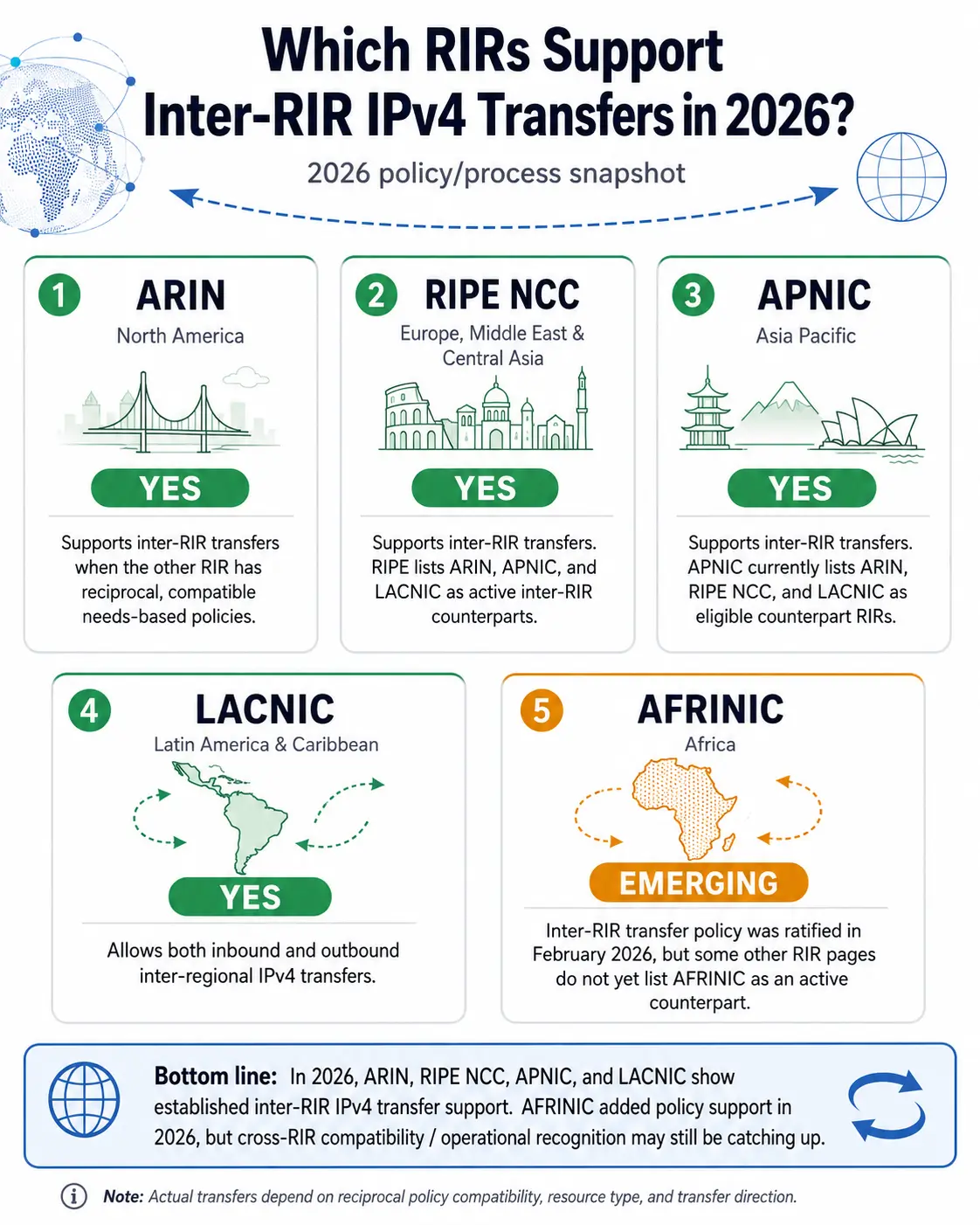
Table of Contents
IPv4 addresses may be globally routable, but transferring their registration from one organization to another is governed by Regional Internet Registry (RIR) policy.
For organizations buying or selling IPv4 address space internationally, this creates an important question:
Which RIRs support inter-RIR IPv4 transfers in 2026?
As of August 2026, ARIN, RIPE NCC, APNIC, and LACNIC have established frameworks for inter-RIR IPv4 transfers, subject to compatibility between the RIRs and the requirements that apply to the source and recipient. AFRINIC has also ratified a broader transfer policy that formally provides for certain inter-RIR transfers, but its implementation status requires additional attention before organizations rely on an AFRINIC cross-regional transaction.
Understanding these differences is essential when planning an international IPv4 transaction.
What Is an Inter-RIR IPv4 Transfer?
An inter-RIR IPv4 transfer occurs when IPv4 address space moves between organizations registered in the service regions of two different Regional Internet Registries.
For example:
- An IPv4 block registered with RIPE NCC is transferred to an organization in the ARIN region.
- An APNIC-registered block moves to a qualified recipient in another compatible RIR.
- A LACNIC-region organization receives IPv4 space from another supported registry.
This differs from an intra-RIR transfer, where the source and recipient remain within the same RIR.
For a broader explanation of how the registries work, read i.lease’s guide to What Is a Regional Internet Registry (RIR)?.
Inter-RIR transactions can be more complex because both registries may need to approve and coordinate the transfer. RIPE NCC, for example, explicitly states that an inter-RIR transfer involving its region must be approved by both RIPE NCC and the other RIR before completion.
Which RIRs Support Inter-RIR IPv4 Transfers in 2026?
Here is the practical picture as of August 2026:
| RIR | Region | Inter-RIR IPv4 Transfer Status | Important Consideration |
|---|---|---|---|
| ARIN | United States, Canada and parts of the Caribbean | Supported | Requires a compatible counterpart RIR and applicable needs-based requirements |
| RIPE NCC | Europe, Middle East and parts of Central Asia | Supported | Supports IPv4 transfers with compatible RIR regions |
| APNIC | Asia Pacific | Supported | Counterpart RIR must permit the transfer |
| LACNIC | Latin America and the Caribbean | Supported | Policy covers both intra- and inter-RIR IPv4 transfers |
| AFRINIC | Africa | Policy ratified; implementation requires verification | New inter-RIR framework was ratified in 2026, while current operational documentation still reflects the transition |
The result is that international IPv4 transactions are possible across much of the global RIR system, but “inter-RIR supported” does not mean every block can automatically move between every registry.
Eligibility still depends on the policies of the specific registries involved.
1. ARIN Inter-RIR IPv4 Transfers
The American Registry for Internet Numbers (ARIN) supports inter-RIR transfers under Section 8.4 of its Number Resource Policy Manual.
ARIN’s policy states that inter-regional IPv4 and ASN transfers may occur only through RIRs that agree to the transfer and maintain reciprocal, compatible needs-based policies.
This means an organization cannot simply purchase an IPv4 block anywhere in the world and request that ARIN register it.
Several conditions need to align.
The source must be recognized as the legitimate registered rights holder, the resource must qualify for transfer, the counterpart RIR must support the transaction, and recipients within the ARIN region must satisfy the applicable ARIN transfer requirements.
For organizations acquiring IPv4 space, careful preparation before the transaction can significantly reduce unnecessary transfer delays.
Businesses looking for available address space can explore IPv4 addresses for sale through the i.lease marketplace.
2. RIPE NCC Inter-RIR IPv4 Transfers
RIPE NCC has one of the most clearly documented inter-RIR transfer processes.
Its current documentation identifies inter-RIR transfer arrangements involving ARIN, APNIC, and LACNIC, including IPv4 transfers.
A transfer involving RIPE NCC generally requires approval by both registries.
When addresses enter the RIPE NCC service region, RIPE NCC may also perform due diligence on the receiving organization and determine the appropriate registration status of the resources.
Another important operational consideration is that registry transfer is only one part of the process.
RIPE NCC notes that services such as reverse DNS and RPKI may be affected during an inter-RIR transfer. Existing ROAs associated with resources leaving the RIPE region may be removed, requiring new routing authorization to be established through the receiving RIR.
This is why a successful IPv4 acquisition should be measured by more than a completed registry record.
The address space also needs to remain operationally usable.
3. APNIC Inter-RIR IPv4 Transfers
The APNIC Internet Number Resource Policies explicitly provide for inter-RIR IPv4 transfers.
APNIC states that it will process and record an inter-RIR IPv4 transfer when the counterpart RIR has a policy permitting transfers between APNIC and that region. The minimum transfer size under APNIC’s policy is generally a /24.
APNIC also requires the IPv4 resources to be properly registered and free from disputes over the status of the resource holder.
For organizations operating across Asia-Pacific markets, this makes registry due diligence particularly important before signing a transaction.
The existence of an IPv4 block alone does not prove that the proposed transfer is eligible.
Organizations should verify:
- Registered holder information
- Transfer restrictions
- Block history
- Applicable holding periods
- Recipient eligibility
- RPKI and routing readiness
- Reputation and abuse history
i.lease discusses these wider considerations in Understanding RIR Transfer Rules Across Regions.
4. LACNIC Inter-RIR IPv4 Transfers
LACNIC permits both inbound and outbound inter-regional IPv4 transfers without requiring a merger or acquisition between the organizations involved.
LACNIC’s IPv4 transfer policy applies to transactions where one of the participating organizations belongs to another RIR region as well as transfers occurring entirely inside the LACNIC region. The policy sets a minimum transferable block size of /24.
The introduction of inter-regional transfers has made it easier for organizations in Latin America and the Caribbean to participate in the broader IPv4 transfer market.
However, the same principle still applies:
The policies of both sides of an inter-RIR transaction matter.
A transfer permitted by one RIR will not necessarily succeed if the counterpart registry’s requirements are not satisfied.
5. What About AFRINIC Inter-RIR Transfers in 2026?
AFRINIC requires special attention because its position is evolving.
On February 4, 2026, AFRINIC published details of a ratified Number Resources Transfer Policy that formally allows inter-RIR transfers under specified conditions where appropriate reciprocal arrangements exist. The policy also introduces important restrictions: AFRINIC-issued IPv4 space generally cannot simply be transferred out of the African region, while certain categories such as eligible legacy resources and resources previously transferred into AFRINIC may be treated differently.
However, this does not mean organizations should assume that every AFRINIC inter-RIR transfer path is already operational.
AFRINIC’s current resource-transfer guidance still describes policy-based transfers primarily in terms of IPv4 transfers within the AFRINIC service region, and its current Consolidated Policy Manual continues to list Section 5.7 as “IPv4 Resource Transfers within the AFRINIC region.”
The ratified policy documentation itself also identifies an implementation timeline and the need for coordination with other RIRs.
Therefore, organizations considering an AFRINIC-related inter-RIR transaction in 2026 should verify current implementation and counterpart compatibility directly with the relevant registries before committing to the transaction.
This distinction between a ratified policy and an operational transfer process is important.
Why Inter-RIR IPv4 Transfers Are More Complex
An intra-RIR transfer typically involves one registry framework.
An inter-RIR transfer introduces two.
That means the transaction can involve different rules for the source organization, recipient organization, resource eligibility, documentation, holding periods, needs justification and registry contracts.
There are also operational elements beyond approval.
A registry transfer may affect:
RPKI and ROAs: Routing authorizations may need to be recreated after a registry change.
Reverse DNS: Existing delegations may need to be removed and established again with the new registry.
WHOIS and RDAP: Registration data must correctly identify the post-transfer resource holder.
Routing objects: Network operators may need to update associated Internet Routing Registry information.
Geolocation: Third-party geolocation databases do not necessarily update immediately after a registry transfer.
IP reputation: A registry-compliant IPv4 block can still have historical reputation problems that affect email delivery, hosting, VPN services or other applications.
This is why buying IPv4 address space is not merely about agreeing on a price.
It is about ensuring the resource can move legally, administratively and operationally from one environment to another.
Inter-RIR Transfer vs IPv4 Leasing
Buying address space through an inter-RIR transfer provides long-term control of the resource registration, but a transfer may involve significant due diligence and registry coordination.
For organizations that primarily need IPv4 capacity rather than a permanent acquisition, leasing can offer another path.
With IPv4 leasing, the registered resource does not necessarily need to undergo a permanent ownership or holdership transfer between the parties. This can make leasing useful for organizations that need additional capacity, geographic flexibility or shorter deployment horizons without committing capital to an outright IPv4 purchase.
The i.lease IPv4 marketplace supports organizations looking to source IPv4 capacity through buying, selling and leasing options.
The appropriate model depends on the organization’s requirements.
A network expecting to use the addresses permanently may prefer acquisition.
A company with changing capacity needs may find leasing more flexible.
How to Prepare for an Inter-RIR IPv4 Transfer
Before purchasing IPv4 space from another registry region, both buyers and sellers should determine the transfer path before completing commercial negotiations.
Confirm:
Which RIR currently registers the IPv4 block.
Which RIR will register the recipient after the transfer.
Whether those RIRs currently support the proposed transfer path.
Whether the specific IPv4 block is eligible for transfer.
Whether the source satisfies applicable holding and registration requirements.
Whether the recipient meets applicable qualification requirements.
Whether registry documentation is complete and consistent.
Whether the block has routing, reputation, blacklist or geolocation concerns.
How RPKI, rDNS and routing objects will be handled after completion.
What happens if either RIR rejects or delays the transfer.
Organizations selling unused resources should perform the same checks before marketing them internationally. IPv4 holders can learn more about the process through Sell IPv4 Addresses on i.lease.
Why Registry Compatibility Should Be Checked Before Buying IPv4
One of the biggest mistakes in an international IPv4 transaction is treating the resource as if it were a conventional asset that can simply be delivered after payment.
IPv4 transfers depend on registry recognition.
A commercial agreement between a buyer and seller does not by itself change authoritative RIR registration.
The transaction must satisfy the relevant registry policies.
That makes due diligence important before funds move.
A structured IPv4 marketplace can help buyers evaluate resource availability, reputation and registry requirements before entering the formal transfer process. i.lease provides RIR-aligned IPv4 purchasing with pre-vetted marketplace listings, escrow protection and transfer coordination.
Which RIR Is Best for an IPv4 Transfer?
There is no single “best” RIR for IPv4 transfers.
The correct registry is determined by factors such as the existing registration of the resource, the recipient’s operational presence, applicable registry policy and the intended transfer structure.
Instead of choosing an RIR based only on perceived simplicity, organizations should ask:
Can the specific source, recipient and IPv4 block complete the intended transfer under both registries’ current rules?
That question is much more useful than asking which registry has the easiest transfer policy.
Frequently Asked Questions
Which RIRs allow inter-RIR IPv4 transfers in 2026?
ARIN, RIPE NCC, APNIC and LACNIC have established operational frameworks for inter-RIR IPv4 transfers, subject to counterpart compatibility and applicable registry requirements. AFRINIC ratified a broader inter-RIR-capable transfer policy in February 2026, but organizations should verify its current implementation status and the specific transfer path before proceeding.
Can IPv4 addresses be transferred from RIPE NCC to ARIN?
Yes. RIPE NCC documents IPv4 transfer arrangements with ARIN, while ARIN permits inter-RIR transfers with registries that meet its compatibility requirements. Both registries must approve the applicable transaction.
Can IPv4 addresses be transferred between APNIC and another RIR?
Yes, provided the counterpart RIR maintains an inter-RIR transfer policy that permits the transaction. APNIC’s current policy explicitly provides for inter-RIR IPv4 address transfers under this condition.
Does LACNIC support international IPv4 transfers?
Yes. LACNIC permits inter-regional IPv4 transfers, subject to its policy requirements and coordination with the counterpart RIR.
Does AFRINIC support inter-RIR IPv4 transfers?
AFRINIC ratified a new Number Resources Transfer Policy in February 2026 that formally provides for certain inter-RIR transfers. However, its currently published operational transfer guidance and implemented policy manual still reflect an implementation transition. Organizations should confirm the specific transfer path with AFRINIC and the counterpart RIR before relying on it.
How long does an inter-RIR IPv4 transfer take?
There is no universal timeline. Processing depends on both registries, the accuracy of the documentation, recipient qualification, resource eligibility and how quickly each party responds. RIPE NCC specifically notes that inter-RIR transfers generally involve more coordination and can take longer than transfers occurring only within its service region.
Is buying IPv4 from another RIR safe?
It can be, provided the transaction includes proper registry verification, due diligence and operational checks. Buyers should verify the registered resource holder, transfer eligibility, IP reputation, routing history and relevant RIR requirements before payment and transfer.
Final Thoughts
Inter-RIR IPv4 transfers have made the IPv4 market significantly more global.
In 2026, ARIN, RIPE NCC, APNIC and LACNIC provide established pathways for cross-regional IPv4 transfers, while AFRINIC’s newly ratified transfer framework represents an important policy development that should be monitored as implementation progresses.
But registry support is only the starting point.
A successful transaction requires the right IPv4 block, an eligible source, a qualified recipient, compatible registry policies, accurate documentation and a plan for maintaining routing and operational continuity after the transfer.
For organizations looking to acquire address space, the i.lease IPv4 marketplace provides access to IPv4 buying, selling and leasing options with a focus on structured, RIR-aligned transactions.
Looking for IPv4 address space?
Explore IPv4 addresses available for purchase, or list unused IPv4 resources for sale through i.lease.
Frequent Asked Questions
1. Which RIRs support inter-RIR IPv4 transfers in 2026?
ARIN, RIPE NCC, APNIC, and LACNIC have established processes for inter-RIR IPv4 transfers with compatible Regional Internet Registries. AFRINIC ratified its Number Resources Transfer Policy on February 4, 2026, introducing a framework for eligible inter-RIR transfers subject to resource category and counterpart RIR requirements.
2. What are the five Regional Internet Registries?
The five RIRs are ARIN for North America and parts of the Caribbean, RIPE NCC for Europe, the Middle East and parts of Central Asia, APNIC for Asia Pacific, LACNIC for Latin America and the Caribbean, and AFRINIC for Africa. Each RIR maintains its own policies for managing and transferring Internet number resources.
3. Can IPv4 addresses be transferred between two different RIRs?
Yes, but only when the RIRs involved permit the proposed transfer and the transaction satisfies their applicable requirements. For example, RIPE NCC requires an inter-RIR transfer to be approved by both RIPE NCC and the counterpart RIR before it can be processed.
4. What is the minimum IPv4 block size for an inter-RIR transfer?
A /24 IPv4 block is a common minimum transfer size under several RIR policies. ARIN specifies a /24 minimum for transfer recipients, while AFRINIC’s ratified transfer framework and APNIC transfer policies also include requirements affecting eligible resources and recipients. Buyers should always confirm the rules of both RIRs before proceeding.
5. How can I buy IPv4 addresses through an inter-RIR transfer?
Start by confirming the source RIR, destination RIR, ownership and transfer eligibility of the IPv4 block. The buyer should also review IP reputation, routing history, RPKI requirements, registry documentation and any recipient qualification rules before completing the purchase. Businesses looking for IPv4 resources can explore IPv4 addresses for sale on i.lease.
相关文章

什么是电信公司?电信运营商如何为英国、美国和加拿大提供网络连接支持?
电信公司(Telco Companies),也称为电信运营商(Telecommunications Companies),提供通信与网络连接服务。这些服务包括移动通信网络、宽带互联网、光纤连接、固定电话服务、企业网络连接、云连接、托管网络服务以及数据中心连接等。 对于普通消费者而言,电信公司通常被视为移动通信或宽带互联网服务提供商。对于企业来说,电信公司远不只是一个服务品牌,更是关键的基础设施合作伙伴,帮助企业连接办公室、数据中心、云平台、远程员工、客户应用程序以及各类数字化服务。 随着企业越来越依赖云平台、SaaS 应用、AI 工具、VPN、网络安全系统以及在线服务,电信公司已成为数字基础设施规划中不可或缺的重要组成部分。 电信公司是什么? 电信公司(Telco Companies)是提供电信服务的企业。这些服务让个人、设备、企业和各种系统能够跨越距离进行通信与连接。 一家电信公司可能提供以下服务: 移动通信服务 宽带互联网 光纤连接 固定电话服务 企业互联网接入 企业广域网(WAN)服务 云连接服务 数据中心连接 VPN 服务 托管网络解决方案 互联网传输(Internet Transit) 电信批发服务 部分电信公司拥有并运营大规模的实体网络基础设施;另一些则通过批发接入、租用基础设施或与网络运营商合作来提供电信服务。 电信公司提供哪些服务? 电信公司同时为个人消费者和企业客户提供服务。 面向消费者的服务通常包括移动通信套餐、家庭宽带、光纤互联网、固定电话以及通信组合套餐。 面向企业的服务则可能包括专线互联网接入、企业光纤、专用网络、云连接、托管安全服务、数据中心连接、物联网(IoT)连接以及企业移动通信方案。 对于大型企业客户,电信公司还可提供: 多地点办公室网络连接 远程员工接入 私有云连接 SD-WAN(软件定义广域网) 灾难恢复连接 低延迟网络路由 互联网传输(Internet Transit) 网络监控 托管防火墙服务 正因如此,电信公司不仅对日常通信至关重要,也是现代企业建设先进数字基础设施的重要支柱。 电信公司 vs 互联网服务提供商 vs 网络运营商 电信公司(Telco)、互联网服务提供商(ISP)和网络运营商(Network Operator)之间可能存在重叠,但它们并不完全相同。 电信公司提供电信服务。 互联网服务提供商(ISP)提供互联网接入服务。 网络运营商负责建设、运营和管理网络基础设施。 一些大型电信公司同时承担这三种角色。它们拥有基础设施、运营网络,并向市场提供互联网、移动通信以及企业网络服务。 规模较小的服务提供商则可能专注于其中某一层。例如,互联网服务提供商(ISP)可以销售宽带服务,而无需拥有所有实体网络基础设施;网络运营商可能负责建设和运营光纤网络,并向电信公司或 ISP 提供批发网络接入;电信公司则可能结合自有网络与合作伙伴网络,为客户提供移动通信和企业服务。 对于企业而言,理解这些区别非常重要,因为服务质量不仅取决于销售该方案的品牌,还受到其底层网络、路由设计、网络覆盖范围以及技术支持体系等因素的影响。 为什么电信公司对企业至关重要 电信公司之所以重要,是因为几乎所有现代企业都依赖稳定的网络连接。 企业可能需要电信服务来支持: 办公室互联网接入 移动网络连接 远程办公 客户支持系统 云应用程序 SaaS 平台 支付系统 VPNRead more Related Posts 什么是电信公司?电信运营商如何为英国、美国和加拿大提供网络连接支持? 电信公司(Telco Companies),也称为电信运营商(Telecommunications Companies),提供通信与网络连接服务。这些服务包括移动通信网络、宽带互联网、光纤连接、固定电话服务、企业网络连接、云连接、托管网络服务以及数据中心连接等。 对于普通消费者而言,电信公司通常被视为移动通信或宽带互联网服务提供商。对于企业来说,电信公司远不只是一个服务品牌,更是关键的基础设施合作伙伴,帮助企业连接办公室、数据中心、云平台、远程员工、客户应用程序以及各类数字化服务。 随着企业越来越依赖云平台、SaaS 应用、AI 工具、VPN、网络安全系统以及在线服务,电信公司已成为数字基础设施规划中不可或缺的重要组成部分。 电信公司是什么? 电信公司(Telco Companies)是提供电信服务的企业。这些服务让个人、设备、企业和各种系统能够跨越距离进行通信与连接。 一家电信公司可能提供以下服务: 移动通信服务 宽带互联网 光纤连接 固定电话服务 企业互联网接入 企业广域网(WAN)服务 云连接服务 数据中心连接 VPN TCP 与 UDP:IPv4 租赁和企业网络指南 TCP 和 UDP 是互联网中最重要的两种传输层协议。它们决定数据如何在设备、服务器、云平台、VPN 网关、DNS 解析器、电子邮件系统、流媒体平台以及企业应用程序之间传输。 对于企业而言,TCP 和 UDP 不仅仅是技术术语,它们会直接影响实际的基础设施性能。公网 IPv4 地址提供可从互联网访问的网络端点,而 TCP 和 UDP 则决定流量如何通过该端点进行传输。 这对于租用或购买 IPv4 地址的企业尤为重要。企业租用 IPv4 什么是区域互联网注册管理机构(RIR) 区域互联网注册管理机构(Regional Internet Registry, RIR)是负责在特定地理区域内分配和管理互联网编号资源的组织。这些资源主要包括 IP 地址(IPv4 和 IPv6)以及自治系统号(ASN),它们是支撑设备和网络在互联网上相互通信的关键要素。 如果没有一套组织完善的系统来分配唯一的 IP 地址和路由标识符,互联网便无法正常运转。RIR 确保这一过程在各自管辖的区域内保持公平、高效与一致,从而避免冲突,并提升互联网治理的透明度。 全球五大 RIR 目前全球共有五家获官方认可的 RIR,各自负责世界上特定的区域:AFRINIC – 非洲网络信息中心(非洲)APNIC – 亚太网络信息中心(亚太地区)ARIN .related-post {} .related-post .post-list { text-align: left; } .related-post .post-list .item { margin: 5px; padding: 10px; } .related-post .headline { font-size: 18px !important; color: #999999 !important; } .related-post .post-list .item .post_thumb { max-height: 220px; margin: 10px 0px; padding: 0px; display: block; } .related-post .post-list .item .post_title { font-size: 16px; color: #3f3f3f; margin: 10px 0px; padding: 0px; display: block; text-decoration: none; } .related-post .post-list .item .post_excerpt { font-size: 13px; color: #3f3f3f; margin: 10px 0px; padding: 0px; display: block; text-decoration: none; } @media only screen and (min-width: 1024px) { .related-post .post-list .item { width: 30%; } } @media only screen and (min-width: 768px) and (max-width: 1023px) { .related-post .post-list .item { width: 90%; } } @media only screen and (min-width: 0px) and (max-width: 767px) { .related-post .post-list .item { width: 90%; } }
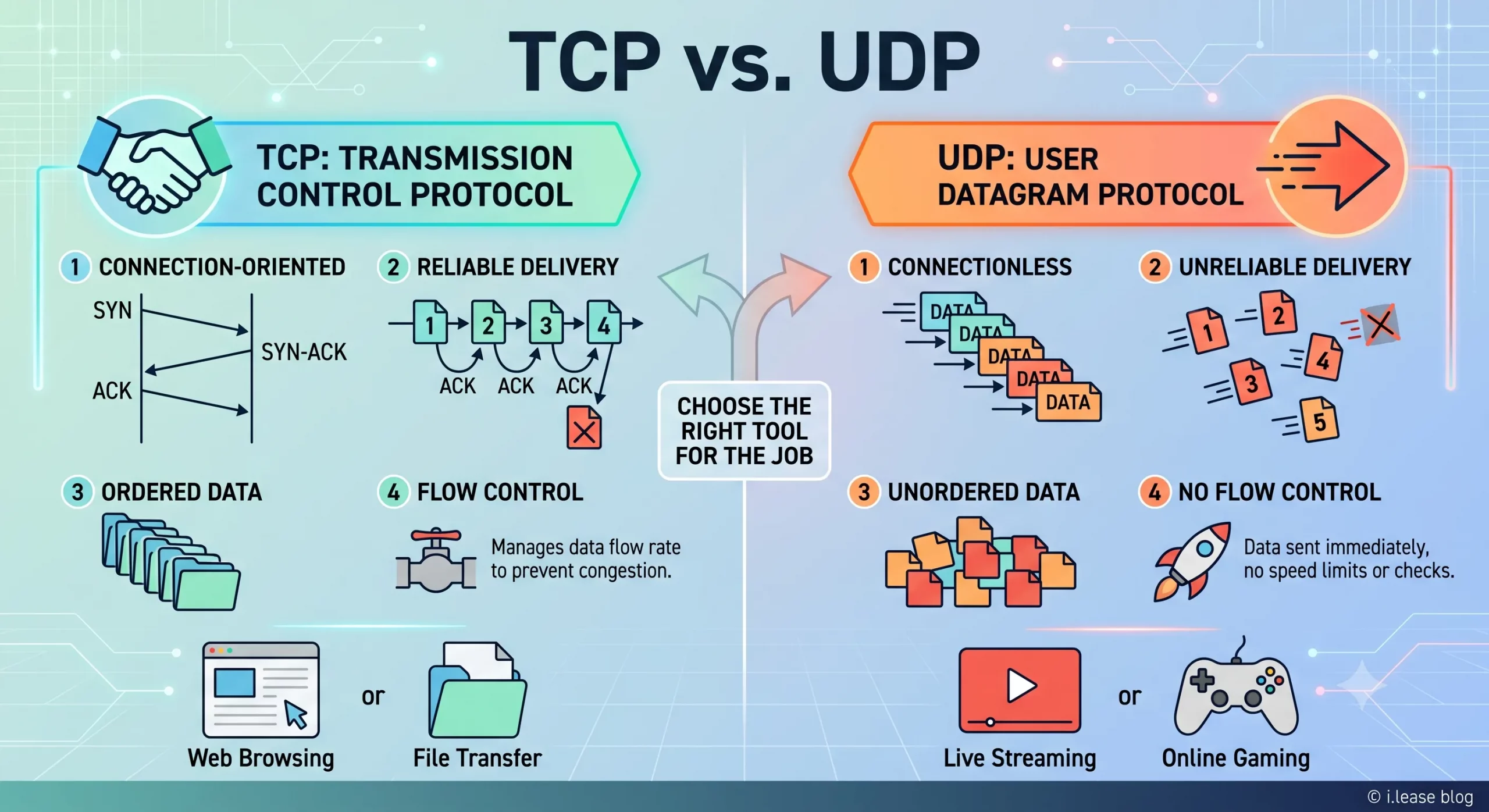
TCP 与 UDP:IPv4 租赁和企业网络指南
TCP 和 UDP 是互联网中最重要的两种传输层协议。它们决定数据如何在设备、服务器、云平台、VPN 网关、DNS 解析器、电子邮件系统、流媒体平台以及企业应用程序之间传输。 对于企业而言,TCP 和 UDP 不仅仅是技术术语,它们会直接影响实际的基础设施性能。公网 IPv4 地址提供可从互联网访问的网络端点,而 TCP 和 UDP 则决定流量如何通过该端点进行传输。 这对于租用或购买 IPv4 地址的企业尤为重要。企业租用 IPv4 地址并不是单纯为了持有这些地址,而是为了运行网站、API、VPN 隧道、DNS 服务、电子邮件平台、SaaS 应用程序、游戏服务器、流媒体系统、安全工具以及云端工作负载。不同类型的服务决定了需要使用 TCP、UDP,还是同时使用两者。 通过 i.lease,企业可以使用 IPv4 租赁服务获取用于实际网络部署的公网 IPv4 资源。需要长期控制 IP 地址资源的企业也可以购买 IP 地址,而拥有闲置 IPv4 资源的组织则可以出售 IP 地址。 TCP和UDP是什么? TCP 和 UDP 都是传输层协议。它们位于 IP 协议之上,帮助应用程序通过网络发送和接收数据。 IP 地址用于确定流量应该发送到哪里,而 TCP 和 UDP 则决定这些流量如何进行传输。 简单来说: TCP 适用于重视可靠性和按顺序传输数据的场景。 UDP 适用于重视速度、低延迟和轻量化数据传输的场景。 企业可能会使用同一个公网 IPv4 地址来运行不同的服务,但每项服务可能依赖不同的传输协议。例如,网站可能使用 TCP,VPN 网关可能使用 UDP,DNS 解析器可能同时使用 UDP 和 TCP,而游戏服务器则可能更倾向于使用 UDP,因为对于实时游戏而言,延迟造成的影响通常比少量数据包丢失更加明显。 因此,TCPRead more Related Posts 什么是电信公司?电信运营商如何为英国、美国和加拿大提供网络连接支持? 电信公司(Telco Companies),也称为电信运营商(Telecommunications Companies),提供通信与网络连接服务。这些服务包括移动通信网络、宽带互联网、光纤连接、固定电话服务、企业网络连接、云连接、托管网络服务以及数据中心连接等。 对于普通消费者而言,电信公司通常被视为移动通信或宽带互联网服务提供商。对于企业来说,电信公司远不只是一个服务品牌,更是关键的基础设施合作伙伴,帮助企业连接办公室、数据中心、云平台、远程员工、客户应用程序以及各类数字化服务。 随着企业越来越依赖云平台、SaaS 应用、AI 工具、VPN、网络安全系统以及在线服务,电信公司已成为数字基础设施规划中不可或缺的重要组成部分。 电信公司是什么? 电信公司(Telco Companies)是提供电信服务的企业。这些服务让个人、设备、企业和各种系统能够跨越距离进行通信与连接。 一家电信公司可能提供以下服务: 移动通信服务 宽带互联网 光纤连接 固定电话服务 企业互联网接入 企业广域网(WAN)服务 云连接服务 数据中心连接 VPN TCP 与 UDP:IPv4 租赁和企业网络指南 TCP 和 UDP 是互联网中最重要的两种传输层协议。它们决定数据如何在设备、服务器、云平台、VPN 网关、DNS 解析器、电子邮件系统、流媒体平台以及企业应用程序之间传输。 对于企业而言,TCP 和 UDP 不仅仅是技术术语,它们会直接影响实际的基础设施性能。公网 IPv4 地址提供可从互联网访问的网络端点,而 TCP 和 UDP 则决定流量如何通过该端点进行传输。 这对于租用或购买 IPv4 地址的企业尤为重要。企业租用 IPv4 什么是区域互联网注册管理机构(RIR) 区域互联网注册管理机构(Regional Internet Registry, RIR)是负责在特定地理区域内分配和管理互联网编号资源的组织。这些资源主要包括 IP 地址(IPv4 和 IPv6)以及自治系统号(ASN),它们是支撑设备和网络在互联网上相互通信的关键要素。 如果没有一套组织完善的系统来分配唯一的 IP 地址和路由标识符,互联网便无法正常运转。RIR 确保这一过程在各自管辖的区域内保持公平、高效与一致,从而避免冲突,并提升互联网治理的透明度。 全球五大 RIR 目前全球共有五家获官方认可的 RIR,各自负责世界上特定的区域:AFRINIC – 非洲网络信息中心(非洲)APNIC – 亚太网络信息中心(亚太地区)ARIN .related-post {} .related-post .post-list { text-align: left; } .related-post .post-list .item { margin: 5px; padding: 10px; } .related-post .headline { font-size: 18px !important; color: #999999 !important; } .related-post .post-list .item .post_thumb { max-height: 220px; margin: 10px 0px; padding: 0px; display: block; } .related-post .post-list .item .post_title { font-size: 16px; color: #3f3f3f; margin: 10px 0px; padding: 0px; display: block; text-decoration: none; } .related-post .post-list .item .post_excerpt { font-size: 13px; color: #3f3f3f; margin: 10px 0px; padding: 0px; display: block; text-decoration: none; } @media only screen and (min-width: 1024px) { .related-post .post-list .item { width: 30%; } } @media only screen and (min-width: 768px) and (max-width: 1023px) { .related-post .post-list .item { width: 90%; } } @media only screen and (min-width: 0px) and (max-width: 767px) { .related-post .post-list .item { width: 90%; } }
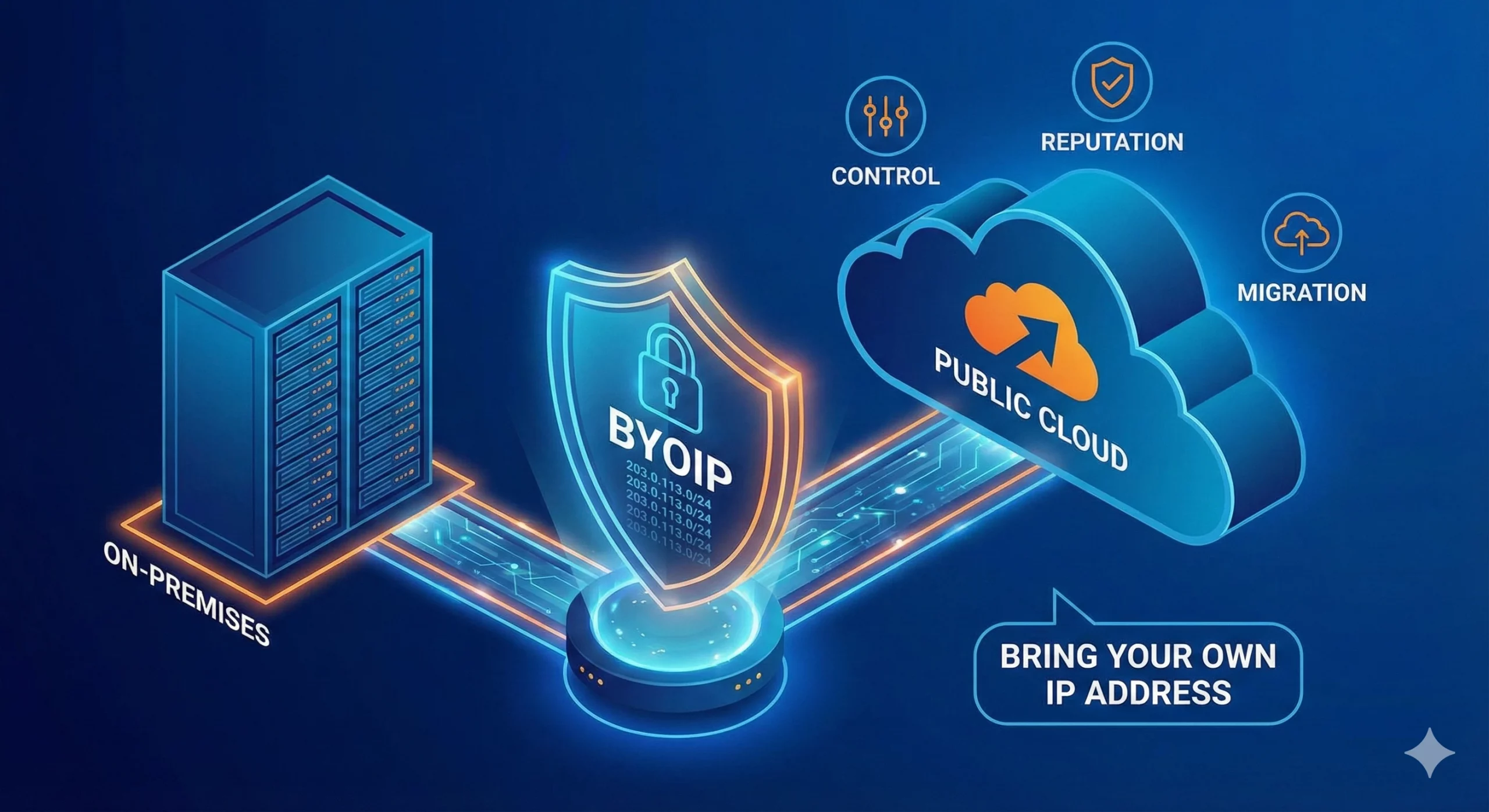
什么是BYOIP(自备IP地址)?
自带 IP(Bring Your Own IP,简称 BYOIP)是一种网络部署方式,允许企业将自己现有的公网 IP 地址段应用于云服务提供商、数据中心、内容分发网络(CDN)或其他基础设施平台。 企业无需使用服务提供商分配的新公网 IP 地址,而是可以使用自己已拥有或已获授权使用的 IPv4 或 IPv6 地址前缀。服务提供商会验证该组织对该地址段的使用权限,并在支持的情况下,通过其自身网络对该地址段进行路由公告(Advertise)。 BYOIP 有助于企业在迁移至云平台时保留现有的防火墙规则、白名单(Allowlists)、客户系统集成、IP 信誉(IP Reputation)、DNS 配置以及既有的网络身份。这不仅能够减少因更换 IP 地址而带来的业务中断,还能降低对服务提供商分配 IP 的依赖,使未来的基础设施迁移与扩展更加灵活且易于管理。 对于需要 BYOIP 地址资源的企业,可选择 购买 IPv4 地址(Buy IP),以获得长期控制权;如果更重视灵活性,也可采用 IPv4 租赁(IPv4 Leasing),按业务需求获取公网 IP 资源。 什么是BYOIP? BYOIP 是 Bring Your Own IP(自带 IP)的缩写。这是一种网络部署模式,允许组织将现有的公网 IP 地址段带入云服务提供商或其他基础设施平台使用。 在 BYOIP 模式下,组织仍然拥有或保留该 IP 地址段的使用权,而平台则获得授权,可在其基础设施中对该地址段进行路由公告(Advertise)和使用。随后,这些 IP 地址可分配给虚拟机(Virtual Machines)、负载均衡器(Load Balancers)、VPN 网关、内容分发服务(CDN)、安全平台以及公网应用程序端点等受支持的服务。 例如,一家企业将应用程序从本地数据中心迁移到云环境时,可能并不希望更换现有的公网 IP 地址。这些 IP 地址可能已经存在于客户白名单(Allowlists)、防火墙策略、DNS 记录、合作伙伴配置以及电子邮件信誉(Email Reputation)数据库中。 BYOIP 使企业能够在迁移工作负载的同时,继续使用原有的公网 IP 地址,从而保持更一致的网络身份,并减少因更换 IP 地址而带来的配置调整和业务影响。 Related Posts 什么是电信公司?电信运营商如何为英国、美国和加拿大提供网络连接支持? 电信公司(Telco Companies),也称为电信运营商(Telecommunications Companies),提供通信与网络连接服务。这些服务包括移动通信网络、宽带互联网、光纤连接、固定电话服务、企业网络连接、云连接、托管网络服务以及数据中心连接等。 对于普通消费者而言,电信公司通常被视为移动通信或宽带互联网服务提供商。对于企业来说,电信公司远不只是一个服务品牌,更是关键的基础设施合作伙伴,帮助企业连接办公室、数据中心、云平台、远程员工、客户应用程序以及各类数字化服务。 随着企业越来越依赖云平台、SaaS 应用、AI 工具、VPN、网络安全系统以及在线服务,电信公司已成为数字基础设施规划中不可或缺的重要组成部分。 电信公司是什么? 电信公司(Telco Companies)是提供电信服务的企业。这些服务让个人、设备、企业和各种系统能够跨越距离进行通信与连接。 一家电信公司可能提供以下服务: 移动通信服务 宽带互联网 光纤连接 固定电话服务 企业互联网接入 企业广域网(WAN)服务 云连接服务 数据中心连接 VPN TCP 与 UDP:IPv4 租赁和企业网络指南 TCP 和 UDP 是互联网中最重要的两种传输层协议。它们决定数据如何在设备、服务器、云平台、VPN 网关、DNS 解析器、电子邮件系统、流媒体平台以及企业应用程序之间传输。 对于企业而言,TCP 和 UDP 不仅仅是技术术语,它们会直接影响实际的基础设施性能。公网 IPv4 地址提供可从互联网访问的网络端点,而 TCP 和 UDP 则决定流量如何通过该端点进行传输。 这对于租用或购买 IPv4 地址的企业尤为重要。企业租用 IPv4 什么是区域互联网注册管理机构(RIR) 区域互联网注册管理机构(Regional Internet Registry, RIR)是负责在特定地理区域内分配和管理互联网编号资源的组织。这些资源主要包括 IP 地址(IPv4 和 IPv6)以及自治系统号(ASN),它们是支撑设备和网络在互联网上相互通信的关键要素。 如果没有一套组织完善的系统来分配唯一的 IP 地址和路由标识符,互联网便无法正常运转。RIR 确保这一过程在各自管辖的区域内保持公平、高效与一致,从而避免冲突,并提升互联网治理的透明度。 全球五大 RIR 目前全球共有五家获官方认可的 RIR,各自负责世界上特定的区域:AFRINIC – 非洲网络信息中心(非洲)APNIC – 亚太网络信息中心(亚太地区)ARIN .related-post {} .related-post .post-list { text-align: left; } .related-post .post-list .item { margin: 5px; padding: 10px; } .related-post .headline { font-size: 18px !important; color: #999999 !important; } .related-post .post-list .item .post_thumb { max-height: 220px; margin: 10px 0px; padding: 0px; display: block; } .related-post .post-list .item .post_title { font-size: 16px; color: #3f3f3f; margin: 10px 0px; padding: 0px; display: block; text-decoration: none; } .related-post .post-list .item .post_excerpt { font-size: 13px; color: #3f3f3f; margin: 10px 0px; padding: 0px; display: block; text-decoration: none; } @media only screen and (min-width: 1024px) { .related-post .post-list .item { width: 30%; } } @media only screen and (min-width: 768px) and (max-width: 1023px) { .related-post .post-list .item { width: 90%; } } @media only screen and (min-width: 0px) and (max-width: 767px) { .related-post .post-list .item { width: 90%; } }
