Rent IPv4 Addresses: The Enterprise Guide to Building Long-Term IPv4 Continuity
 Stephanie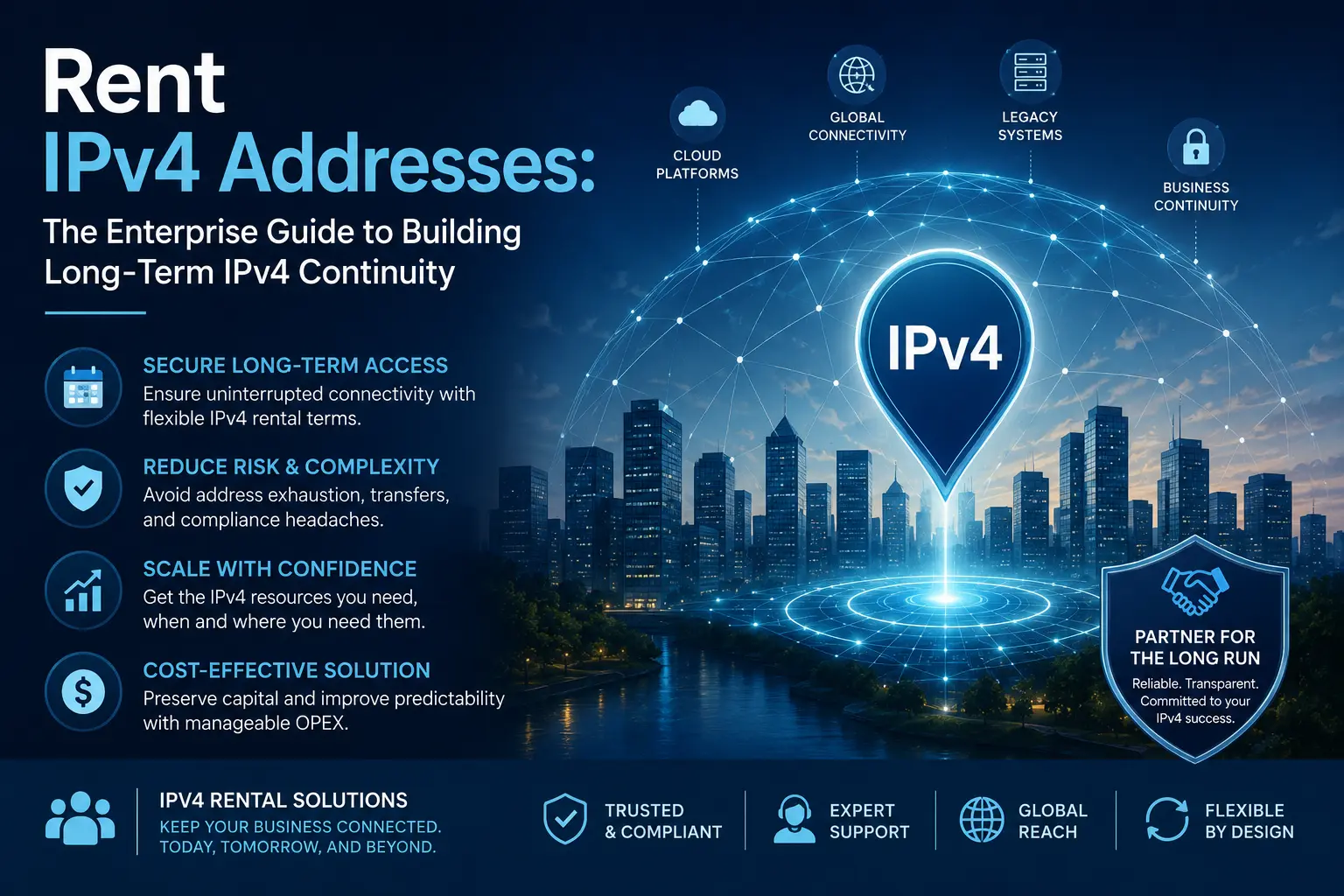
If you’re looking to rent IPv4 addresses, you’re not alone.
Table of Contents
Businesses worldwide continue to need IPv4 resources to support growth, expand infrastructure and meet customer demand.
However, the conversation around IPv4 is changing.
For years, businesses treated IPv4 as a procurement exercise.
The process was simple:
- Find available IPv4
- Acquire IPv4
- Deploy IPv4
Today, that mindset is becoming outdated.
IPv4 has evolved into critical infrastructure.
At i.LEASE, we believe businesses should think beyond transactions and start planning for continuity.
Because obtaining IPv4 is no longer the hardest challenge.
Maintaining reliable access to IPv4 over time is becoming increasingly important.
As Heng Lu has previously written, many questions in today’s IPv4 market are actually risk questions disguised as transaction questions.
The same principle applies when organizations rent IPv4.
The question is no longer:
Where can we rent IPv4 addresses?
The better question is:
How can we rent IPv4 addresses while building long-term resilience?
This guide explains how businesses can do exactly that.
What Does It Mean to Rent IPv4 Addresses?
Renting IPv4 addresses allows organizations to access IPv4 resources without purchasing them outright.
Instead of making large capital investments, businesses obtain access through flexible commercial arrangements.
Organizations commonly rent IPv4 for:
- Hosting infrastructure
- Cloud platforms
- Data centres
- Internet service providers
- SaaS platforms
- Enterprise applications
Renting provides flexibility while preserving capital.
For many organizations, renting is no longer a temporary solution.
It is becoming part of long-term infrastructure planning.
Why Businesses Rent IPv4 Instead of Buying
Organizations usually rent IPv4 for four reasons.
Lower Upfront Investment
Buying IPv4 can require substantial capital investment.
Renting allows businesses to allocate resources elsewhere.
Faster Deployment
Businesses often need additional IPv4 capacity immediately.
Renting accelerates growth.
Greater Flexibility
Requirements evolve over time.
Renting allows organizations to adapt.
Better Cash Flow Management
Many organizations prefer predictable operating expenses over large capital expenditures.
Why IPv4 Still Matters in an IPv6 World
Many people ask:
Isn’t IPv6 replacing IPv4?
Eventually, yes.
Immediately, no.
The internet will likely operate in a dual-stack environment for many years.
IPv4 remains important because:
- Legacy systems still depend on it
- Customers continue to require it
- Hosting providers continue supporting it
- Interoperability remains essential
Most organizations are not choosing IPv4 instead of IPv6.
They are operating both simultaneously.
This means IPv4 remains a strategic infrastructure resource.
Who Should Rent IPv4?
Renting IPv4 is particularly useful for organizations experiencing growth.
Hosting Providers
Expand customer capacity quickly.
Cloud Providers
Scale infrastructure efficiently.
Data Centres
Support customer demand.
Internet Service Providers
Manage subscriber growth.
Enterprises
Support digital transformation projects.
Organizations with changing requirements often benefit the most.
How to Rent IPv4 Addresses in 5 Steps
Step 1: Determine Your Requirements
Evaluate:
- Number of addresses required
- Geographic requirements
- Growth expectations
- Business objectives
Avoid reactive decisions.
Step 2: Define Your Timeline
Ask:
- Is this temporary?
- Is this long term?
- Is this permanent?
Time affects strategy.
Step 3: Evaluate Providers Carefully
Don’t focus solely on price.
Also evaluate:
- Stability
- Transparency
- Operational maturity
- Support quality
Step 4: Understand The Entire Lifecycle
Evaluate:
- Provisioning
- Scaling
- Renewals
- Exit planning
Infrastructure should always be viewed as a lifecycle.
Step 5: Build Continuity Into Your Strategy
This is where many organizations fail.
Obtaining IPv4 is easy.
Maintaining continuity is harder.
How Much Does It Cost to Rent IPv4 Addresses?
Pricing varies according to several factors.
Address Block Size
Larger requirements affect pricing.
Rental Duration
Longer agreements may affect costs.
Market Conditions
Supply and demand influence pricing.
Geographic Requirements
Regional availability may impact costs.
Avoid choosing providers based solely on price.
The cheapest solution is not always the lowest-risk solution.
Rent IPv4 vs Buy IPv4
| Category | Rent IPv4 | Buy IPv4 |
|---|---|---|
| Upfront investment | Lower | Higher |
| Flexibility | High | Lower |
| Capital efficiency | High | Lower |
| Ownership | No | Yes |
| Adaptability | High | Lower |
Many organizations use hybrid approaches.
The objective is resilience.
Not ideology.
Where Can Businesses Rent IPv4 Addresses?
Businesses typically access IPv4 through several models.
IPv4 Brokers
Transaction-focused intermediaries.
IPv4 Marketplaces
Platforms that connect participants.
IPv4 Leasing Platforms
Platforms focused on long-term access models.
At i.LEASE, we encourage businesses to evaluate more than price and availability.
They should also evaluate sustainability.
Because renting IPv4 is ultimately an infrastructure decision.
Not just a transaction.
What Is IPv4 Continuity Risk?
IPv4 continuity risk is the possibility that long-term access, operational flexibility or infrastructure stability becomes disrupted over time.
Many organizations assume:
If we obtained IPv4, the problem is solved.
Unfortunately, that assumption creates risk.
The challenge is rarely obtaining IPv4.
The challenge is sustaining access over years.
Not months.
The Four Types of IPv4 Continuity Risk
Registry Risk
As Heng Lu has argued, some broker questions are actually registry risk questions.
Organizations should understand the larger ecosystem surrounding IPv4.
Provider Dependency Risk
Every provider relationship introduces dependency.
Ask:
What happens if our infrastructure relies entirely on one source?
Operational Risk
Can your systems adapt as requirements evolve?
Flexibility matters.
Strategic Risk
Short-term thinking often creates long-term constraints.
Plan beyond today’s requirements.
10 Questions to Ask Before You Rent IPv4 Addresses
1. Why Are We Renting IPv4?
This may sound obvious, but it’s the question most organizations skip.
Many businesses only realize they need IPv4 when they are already under pressure. New customers are arriving, servers are reaching capacity, or expansion plans are underway.
But before renting IPv4, define the actual business objective.
Are you:
- Expanding hosting capacity?
- Launching new services?
- Entering a new region?
- Supporting customer growth?
- Bridging a temporary shortage?
The answer matters because different objectives require different strategies.
At i.LEASE, we believe IPv4 should not be treated as an emergency procurement exercise. It should be treated as infrastructure planning.
The clearer your objective, the easier it becomes to build a sustainable IPv4 strategy.
2. How Long Will We Need These Addresses?
Time fundamentally changes risk.
Many organizations solve a six-month problem with a five-year commitment, while others build long-term infrastructure on temporary assumptions.
Ask yourself:
- Is this a short-term project?
- Is this a growth phase?
- Is this permanent infrastructure?
Infrastructure tends to outlive initial assumptions.
Services grow. Customers expand. Systems become more dependent on the resources that support them.
The longer IPv4 becomes embedded in your operations, the more continuity matters.
Don’t only plan for today’s requirements.
Plan for the next three to five years.
3. Are We Solving Capacity Problems or Building Infrastructure?
These are not the same thing.
Capacity solves immediate shortages.
Infrastructure supports long-term growth.
Many organizations confuse the two.
Adding more IPv4 addresses may solve today’s bottleneck, but if those addresses become integrated into your production systems, you’ve made an infrastructure decision.
Infrastructure decisions require a different mindset.
Ask:
Will our business depend on these addresses next year?
If the answer is yes, stop thinking about transactions and start thinking about continuity.
4. Where Do These IPv4 Addresses Come From?
This is one of the most important questions nobody asks.
Most businesses only see a transaction.
However, IPv4 exists within a much larger ecosystem.
As Heng Lu has argued, some questions in the IPv4 market are actually risk questions disguised as transaction questions.
Instead of only asking:
Who is renting us IPv4?
Also ask:
What ecosystem sits behind these addresses?
Understanding source transparency, operational legitimacy and long-term sustainability helps businesses reduce uncertainty.
Infrastructure leaders should always know where critical resources originate.
Further reading: Heng Lu, When Registry Power Detaches From Liability, It Detaches From Reality
5. Are We Creating a Single Point of Failure?
Convenience often creates concentration risk.
It’s easy to depend entirely on a single provider because it simplifies operations.
But every dependency introduces risk.
Ask yourself:
- What percentage of our infrastructure depends on one source?
- Do we have contingency plans?
- Could we adapt if circumstances change?
No organization can eliminate dependency entirely.
The objective is to manage it intentionally.
Healthy infrastructure is resilient infrastructure.
6. Can This Support Future Growth?
The IPv4 strategy that works today may not work tomorrow.
Growth changes requirements.
Questions to consider include:
- Can we expand into other regions?
- Can we onboard more customers?
- Can we increase infrastructure capacity?
Businesses rarely remain static.
Your IPv4 strategy shouldn’t either.
Build flexibility into your infrastructure from the beginning.
Planning for growth is often cheaper than reacting to growth later.
7. What Happens If Requirements Change?
Requirements always change.
The real question is whether your infrastructure can adapt when they do.
Businesses should understand:
- Renewal processes
- Expansion options
- Migration strategies
- Exit planning
Many organizations only think about onboarding.
Very few think about offboarding.
Infrastructure planning should cover the entire lifecycle.
Not just initial deployment.
8. Are We Optimizing For Price Or Continuity?
This may be the biggest mistake organizations make.
Low prices are attractive.
But the cheapest option today isn’t always the lowest-cost decision tomorrow.
Businesses should balance:
- Cost
- Flexibility
- Stability
- Operational resilience
At i.LEASE, we believe continuity deserves a seat at the decision-making table.
Because price is temporary.
Continuity is strategic.
Businesses that optimize solely for cost often create larger problems later.
We’ve also seen how organizations can unlock long-term value by treating digital infrastructure as a strategic asset rather than a short-term expense. This case study explores how enterprises generate recurring income from IPv4 while strengthening business continuity and operational resilience.
Read this: Case study: How enterprises generate recurring income from IPv4
9. Who Owns IPv4 Continuity Internally?
This responsibility often falls between departments.
Is it:
- Network engineering?
- Infrastructure operations?
- Procurement?
- Leadership?
Increasingly, IPv4 affects all of them.
Someone should be responsible for long-term continuity planning.
Without ownership, continuity becomes accidental.
And accidental continuity is not a strategy.
Assigning accountability early creates stronger infrastructure later.
10. Are We Building Resilience Or Solving Today’s Problem?
This may be the most important question of all.
The old mindset says:
We need more IP addresses.
The new mindset says:
We need reliable access to IPv4 that can support our business over time.
There’s a subtle but important difference.
Obtaining IPv4 is relatively straightforward.
Maintaining continuity is much harder.
At i.LEASE, we believe organizations are entering a new era of IPv4 planning.
The conversation is no longer ownership versus renting.
The conversation is resilience.
Because ultimately, the biggest risk isn’t failing to obtain IPv4.
It’s assuming continuity happens automatically.
It doesn’t.
Continuity must be designed.
Most businesses don’t fail because they couldn’t obtain IPv4 addresses.
They run into problems because they underestimate what happens after obtaining them.
At i.LEASE, we believe the biggest IPv4 risks are often created unintentionally through small decisions that accumulate over time.
Here are five common mistakes organizations should avoid.
5 Mistakes That Create IPv4 Continuity Risk
Mistake 1: Choosing Providers Solely Based on Price
Price is important.
But price should never be the only evaluation criteria.
The cheapest option today can become the most expensive decision tomorrow if it introduces operational friction, unnecessary complexity or future limitations.
Instead of asking:
Who has the cheapest IPv4?
Ask:
Which option best supports our long-term infrastructure goals?
Businesses should evaluate:
- Stability
- Transparency
- Flexibility
- Continuity
Price is temporary.
Infrastructure decisions often last for years.
Mistake 2: Treating IPv4 as a One-Time Procurement Task
Many organizations think:
We got the addresses. Problem solved.
Unfortunately, that’s rarely true.
Infrastructure evolves continuously.
Customer demand changes.
Services expand.
Geographic requirements shift.
IPv4 should not be treated as a one-time procurement exercise.
It should be managed as an ongoing infrastructure responsibility.
The decision doesn’t end when IPv4 is deployed.
In many ways, that’s when the real work begins.
Mistake 3: Ignoring Future Growth
Businesses rarely remain static.
The IPv4 requirements you have today may look very different 24 months from now.
Before renting IPv4, ask:
- What happens if we double our customer base?
- What happens if we expand into new markets?
- What happens if demand grows faster than expected?
Organizations often spend significant effort solving today’s bottleneck while unintentionally creating tomorrow’s constraints.
Growth should be part of the initial conversation.
Not an afterthought.
Mistake 4: Creating Provider Dependency Without Realizing It
Convenience often creates concentration risk.
Over time, entire infrastructures can become dependent on a single source without anyone noticing.
This doesn’t mean dependency is inherently bad.
Every organization has dependencies.
The risk emerges when dependencies become invisible.
Ask yourself:
- What percentage of our infrastructure relies on one provider?
- Do we have contingency plans?
- Could we adapt if circumstances change?
Healthy infrastructure is resilient infrastructure.
Resilient infrastructure avoids unnecessary single points of failure.
Mistake 5: Ignoring IPv4 Continuity Planning
This is perhaps the biggest mistake of all.
Many organizations assume continuity happens automatically.
It doesn’t.
As Heng Lu has argued, many IPv4 decisions are actually risk decisions disguised as transaction decisions.
The same applies here.
Obtaining IPv4 is relatively easy.
Sustaining reliable access over time is much harder.
Businesses should think about:
- Long-term operational stability
- Future growth
- Provider relationships
- Infrastructure resilience
At i.LEASE, we believe organizations should move from procurement thinking to continuity thinking.
The question is no longer:
How do we get IPv4?
The better question is:
How do we maintain reliable access to IPv4 over time?
That’s the conversation infrastructure leaders should be having.
The Bigger Shift: From Procurement to Stewardship
The IPv4 market is evolving.
Organizations are moving away from purely transactional thinking.
They’re beginning to think about continuity, resilience and long-term sustainability.
The businesses that succeed over the next decade won’t necessarily own the most IPv4 addresses.
They will be the organizations that manage IPv4 continuity most effectively.
Because ultimately, the biggest IPv4 risk isn’t scarcity.
It’s assuming continuity will take care of itself.
It won’t.
Continuity must be intentionally designed.
Why Traditional IPv4 Procurement Is Changing
Historically, businesses viewed IPv4 as procurement.
That model is evolving.
Organizations increasingly need to think beyond obtaining IPv4.
They need to think about sustaining it.
This is why continuity is becoming more important than ownership.
The organizations that succeed over the next decade won’t necessarily own the most IPv4.
They will maintain continuity most effectively.
Why i.LEASE Thinks Differently
i.LEASE was created around a simple observation.
The industry is good at helping businesses obtain IPv4.
The industry is less mature at helping businesses maintain continuity.
This continuity-first philosophy is heavily influenced by Heng Lu’s writing around registry risk and LARUS ‘s operational approach to infrastructure planning.
The future of IPv4 is not ownership versus renting.
The future of IPv4 is sustainable access.
The question is no longer:
How do we get IPv4?
The better question is:
How do we sustain IPv4 over time?
Conclusion
The easiest part of IPv4 is obtaining it.
The harder part is sustaining it.
Organizations that understand this distinction will build stronger infrastructure over the next decade.
Because continuity doesn’t happen automatically.
Continuity must be designed.
Frequent Asked Questions
1. Is renting IPv4 legal?
Commercial IPv4 leasing and transfer arrangements are widely practiced globally, subject to applicable registry policies, contractual agreements and operational requirements.
2. Is renting IPv4 better than buying?
There is no universal answer. The right approach depends on your infrastructure strategy, capital allocation priorities, business growth plans and long-term operational requirements.
3. How long can organizations rent IPv4?
Rental periods vary based on commercial agreements, provider models and business needs. Organizations should evaluate whether the arrangement aligns with their long-term continuity requirements.
4.What is IPv4 continuity risk?
IPv4 continuity risk is the possibility that access to critical IP resources, operational stability or future scalability could be disrupted due to changes in policies, providers or infrastructure dependencies.
5.What is the biggest mistake organizations make?
Treating IPv4 as a one-time procurement exercise instead of an ongoing infrastructure responsibility.
The organizations that manage IPv4 most effectively treat it as a strategic asset that requires continuous planning, governance and risk management.
相关文章

什么是电信公司?电信运营商如何为英国、美国和加拿大提供网络连接支持?
电信公司(Telco Companies),也称为电信运营商(Telecommunications Companies),提供通信与网络连接服务。这些服务包括移动通信网络、宽带互联网、光纤连接、固定电话服务、企业网络连接、云连接、托管网络服务以及数据中心连接等。 对于普通消费者而言,电信公司通常被视为移动通信或宽带互联网服务提供商。对于企业来说,电信公司远不只是一个服务品牌,更是关键的基础设施合作伙伴,帮助企业连接办公室、数据中心、云平台、远程员工、客户应用程序以及各类数字化服务。 随着企业越来越依赖云平台、SaaS 应用、AI 工具、VPN、网络安全系统以及在线服务,电信公司已成为数字基础设施规划中不可或缺的重要组成部分。 电信公司是什么? 电信公司(Telco Companies)是提供电信服务的企业。这些服务让个人、设备、企业和各种系统能够跨越距离进行通信与连接。 一家电信公司可能提供以下服务: 移动通信服务 宽带互联网 光纤连接 固定电话服务 企业互联网接入 企业广域网(WAN)服务 云连接服务 数据中心连接 VPN 服务 托管网络解决方案 互联网传输(Internet Transit) 电信批发服务 部分电信公司拥有并运营大规模的实体网络基础设施;另一些则通过批发接入、租用基础设施或与网络运营商合作来提供电信服务。 电信公司提供哪些服务? 电信公司同时为个人消费者和企业客户提供服务。 面向消费者的服务通常包括移动通信套餐、家庭宽带、光纤互联网、固定电话以及通信组合套餐。 面向企业的服务则可能包括专线互联网接入、企业光纤、专用网络、云连接、托管安全服务、数据中心连接、物联网(IoT)连接以及企业移动通信方案。 对于大型企业客户,电信公司还可提供: 多地点办公室网络连接 远程员工接入 私有云连接 SD-WAN(软件定义广域网) 灾难恢复连接 低延迟网络路由 互联网传输(Internet Transit) 网络监控 托管防火墙服务 正因如此,电信公司不仅对日常通信至关重要,也是现代企业建设先进数字基础设施的重要支柱。 电信公司 vs 互联网服务提供商 vs 网络运营商 电信公司(Telco)、互联网服务提供商(ISP)和网络运营商(Network Operator)之间可能存在重叠,但它们并不完全相同。 电信公司提供电信服务。 互联网服务提供商(ISP)提供互联网接入服务。 网络运营商负责建设、运营和管理网络基础设施。 一些大型电信公司同时承担这三种角色。它们拥有基础设施、运营网络,并向市场提供互联网、移动通信以及企业网络服务。 规模较小的服务提供商则可能专注于其中某一层。例如,互联网服务提供商(ISP)可以销售宽带服务,而无需拥有所有实体网络基础设施;网络运营商可能负责建设和运营光纤网络,并向电信公司或 ISP 提供批发网络接入;电信公司则可能结合自有网络与合作伙伴网络,为客户提供移动通信和企业服务。 对于企业而言,理解这些区别非常重要,因为服务质量不仅取决于销售该方案的品牌,还受到其底层网络、路由设计、网络覆盖范围以及技术支持体系等因素的影响。 为什么电信公司对企业至关重要 电信公司之所以重要,是因为几乎所有现代企业都依赖稳定的网络连接。 企业可能需要电信服务来支持: 办公室互联网接入 移动网络连接 远程办公 客户支持系统 云应用程序 SaaS 平台 支付系统 VPNRead more Related Posts 什么是电信公司?电信运营商如何为英国、美国和加拿大提供网络连接支持? 电信公司(Telco Companies),也称为电信运营商(Telecommunications Companies),提供通信与网络连接服务。这些服务包括移动通信网络、宽带互联网、光纤连接、固定电话服务、企业网络连接、云连接、托管网络服务以及数据中心连接等。 对于普通消费者而言,电信公司通常被视为移动通信或宽带互联网服务提供商。对于企业来说,电信公司远不只是一个服务品牌,更是关键的基础设施合作伙伴,帮助企业连接办公室、数据中心、云平台、远程员工、客户应用程序以及各类数字化服务。 随着企业越来越依赖云平台、SaaS 应用、AI 工具、VPN、网络安全系统以及在线服务,电信公司已成为数字基础设施规划中不可或缺的重要组成部分。 电信公司是什么? 电信公司(Telco Companies)是提供电信服务的企业。这些服务让个人、设备、企业和各种系统能够跨越距离进行通信与连接。 一家电信公司可能提供以下服务: 移动通信服务 宽带互联网 光纤连接 固定电话服务 企业互联网接入 企业广域网(WAN)服务 云连接服务 数据中心连接 VPN TCP 与 UDP:IPv4 租赁和企业网络指南 TCP 和 UDP 是互联网中最重要的两种传输层协议。它们决定数据如何在设备、服务器、云平台、VPN 网关、DNS 解析器、电子邮件系统、流媒体平台以及企业应用程序之间传输。 对于企业而言,TCP 和 UDP 不仅仅是技术术语,它们会直接影响实际的基础设施性能。公网 IPv4 地址提供可从互联网访问的网络端点,而 TCP 和 UDP 则决定流量如何通过该端点进行传输。 这对于租用或购买 IPv4 地址的企业尤为重要。企业租用 IPv4 什么是区域互联网注册管理机构(RIR) 区域互联网注册管理机构(Regional Internet Registry, RIR)是负责在特定地理区域内分配和管理互联网编号资源的组织。这些资源主要包括 IP 地址(IPv4 和 IPv6)以及自治系统号(ASN),它们是支撑设备和网络在互联网上相互通信的关键要素。 如果没有一套组织完善的系统来分配唯一的 IP 地址和路由标识符,互联网便无法正常运转。RIR 确保这一过程在各自管辖的区域内保持公平、高效与一致,从而避免冲突,并提升互联网治理的透明度。 全球五大 RIR 目前全球共有五家获官方认可的 RIR,各自负责世界上特定的区域:AFRINIC – 非洲网络信息中心(非洲)APNIC – 亚太网络信息中心(亚太地区)ARIN .related-post {} .related-post .post-list { text-align: left; } .related-post .post-list .item { margin: 5px; padding: 10px; } .related-post .headline { font-size: 18px !important; color: #999999 !important; } .related-post .post-list .item .post_thumb { max-height: 220px; margin: 10px 0px; padding: 0px; display: block; } .related-post .post-list .item .post_title { font-size: 16px; color: #3f3f3f; margin: 10px 0px; padding: 0px; display: block; text-decoration: none; } .related-post .post-list .item .post_excerpt { font-size: 13px; color: #3f3f3f; margin: 10px 0px; padding: 0px; display: block; text-decoration: none; } @media only screen and (min-width: 1024px) { .related-post .post-list .item { width: 30%; } } @media only screen and (min-width: 768px) and (max-width: 1023px) { .related-post .post-list .item { width: 90%; } } @media only screen and (min-width: 0px) and (max-width: 767px) { .related-post .post-list .item { width: 90%; } }
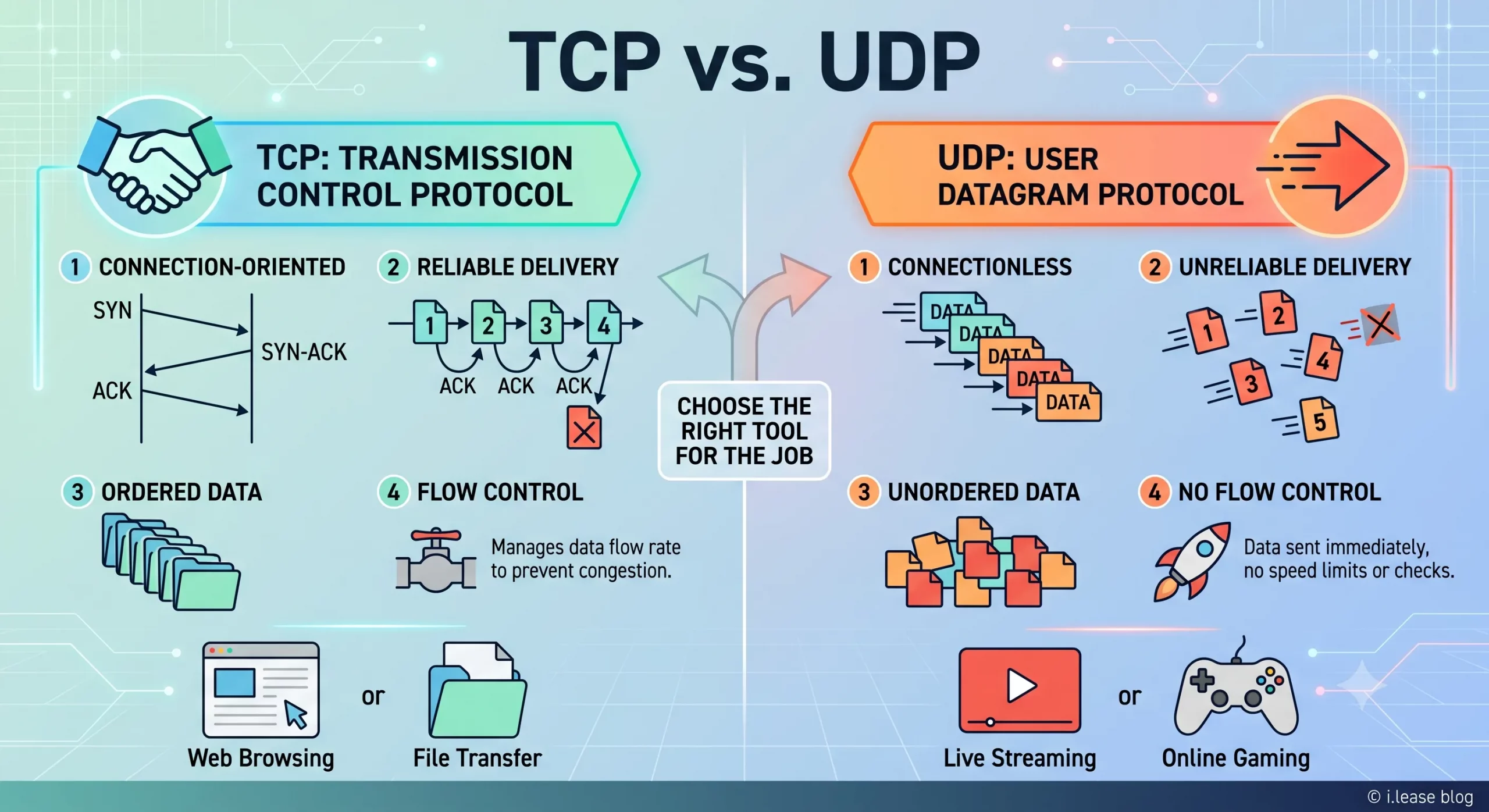
TCP 与 UDP:IPv4 租赁和企业网络指南
TCP 和 UDP 是互联网中最重要的两种传输层协议。它们决定数据如何在设备、服务器、云平台、VPN 网关、DNS 解析器、电子邮件系统、流媒体平台以及企业应用程序之间传输。 对于企业而言,TCP 和 UDP 不仅仅是技术术语,它们会直接影响实际的基础设施性能。公网 IPv4 地址提供可从互联网访问的网络端点,而 TCP 和 UDP 则决定流量如何通过该端点进行传输。 这对于租用或购买 IPv4 地址的企业尤为重要。企业租用 IPv4 地址并不是单纯为了持有这些地址,而是为了运行网站、API、VPN 隧道、DNS 服务、电子邮件平台、SaaS 应用程序、游戏服务器、流媒体系统、安全工具以及云端工作负载。不同类型的服务决定了需要使用 TCP、UDP,还是同时使用两者。 通过 i.lease,企业可以使用 IPv4 租赁服务获取用于实际网络部署的公网 IPv4 资源。需要长期控制 IP 地址资源的企业也可以购买 IP 地址,而拥有闲置 IPv4 资源的组织则可以出售 IP 地址。 TCP和UDP是什么? TCP 和 UDP 都是传输层协议。它们位于 IP 协议之上,帮助应用程序通过网络发送和接收数据。 IP 地址用于确定流量应该发送到哪里,而 TCP 和 UDP 则决定这些流量如何进行传输。 简单来说: TCP 适用于重视可靠性和按顺序传输数据的场景。 UDP 适用于重视速度、低延迟和轻量化数据传输的场景。 企业可能会使用同一个公网 IPv4 地址来运行不同的服务,但每项服务可能依赖不同的传输协议。例如,网站可能使用 TCP,VPN 网关可能使用 UDP,DNS 解析器可能同时使用 UDP 和 TCP,而游戏服务器则可能更倾向于使用 UDP,因为对于实时游戏而言,延迟造成的影响通常比少量数据包丢失更加明显。 因此,TCPRead more Related Posts 什么是电信公司?电信运营商如何为英国、美国和加拿大提供网络连接支持? 电信公司(Telco Companies),也称为电信运营商(Telecommunications Companies),提供通信与网络连接服务。这些服务包括移动通信网络、宽带互联网、光纤连接、固定电话服务、企业网络连接、云连接、托管网络服务以及数据中心连接等。 对于普通消费者而言,电信公司通常被视为移动通信或宽带互联网服务提供商。对于企业来说,电信公司远不只是一个服务品牌,更是关键的基础设施合作伙伴,帮助企业连接办公室、数据中心、云平台、远程员工、客户应用程序以及各类数字化服务。 随着企业越来越依赖云平台、SaaS 应用、AI 工具、VPN、网络安全系统以及在线服务,电信公司已成为数字基础设施规划中不可或缺的重要组成部分。 电信公司是什么? 电信公司(Telco Companies)是提供电信服务的企业。这些服务让个人、设备、企业和各种系统能够跨越距离进行通信与连接。 一家电信公司可能提供以下服务: 移动通信服务 宽带互联网 光纤连接 固定电话服务 企业互联网接入 企业广域网(WAN)服务 云连接服务 数据中心连接 VPN TCP 与 UDP:IPv4 租赁和企业网络指南 TCP 和 UDP 是互联网中最重要的两种传输层协议。它们决定数据如何在设备、服务器、云平台、VPN 网关、DNS 解析器、电子邮件系统、流媒体平台以及企业应用程序之间传输。 对于企业而言,TCP 和 UDP 不仅仅是技术术语,它们会直接影响实际的基础设施性能。公网 IPv4 地址提供可从互联网访问的网络端点,而 TCP 和 UDP 则决定流量如何通过该端点进行传输。 这对于租用或购买 IPv4 地址的企业尤为重要。企业租用 IPv4 什么是区域互联网注册管理机构(RIR) 区域互联网注册管理机构(Regional Internet Registry, RIR)是负责在特定地理区域内分配和管理互联网编号资源的组织。这些资源主要包括 IP 地址(IPv4 和 IPv6)以及自治系统号(ASN),它们是支撑设备和网络在互联网上相互通信的关键要素。 如果没有一套组织完善的系统来分配唯一的 IP 地址和路由标识符,互联网便无法正常运转。RIR 确保这一过程在各自管辖的区域内保持公平、高效与一致,从而避免冲突,并提升互联网治理的透明度。 全球五大 RIR 目前全球共有五家获官方认可的 RIR,各自负责世界上特定的区域:AFRINIC – 非洲网络信息中心(非洲)APNIC – 亚太网络信息中心(亚太地区)ARIN .related-post {} .related-post .post-list { text-align: left; } .related-post .post-list .item { margin: 5px; padding: 10px; } .related-post .headline { font-size: 18px !important; color: #999999 !important; } .related-post .post-list .item .post_thumb { max-height: 220px; margin: 10px 0px; padding: 0px; display: block; } .related-post .post-list .item .post_title { font-size: 16px; color: #3f3f3f; margin: 10px 0px; padding: 0px; display: block; text-decoration: none; } .related-post .post-list .item .post_excerpt { font-size: 13px; color: #3f3f3f; margin: 10px 0px; padding: 0px; display: block; text-decoration: none; } @media only screen and (min-width: 1024px) { .related-post .post-list .item { width: 30%; } } @media only screen and (min-width: 768px) and (max-width: 1023px) { .related-post .post-list .item { width: 90%; } } @media only screen and (min-width: 0px) and (max-width: 767px) { .related-post .post-list .item { width: 90%; } }
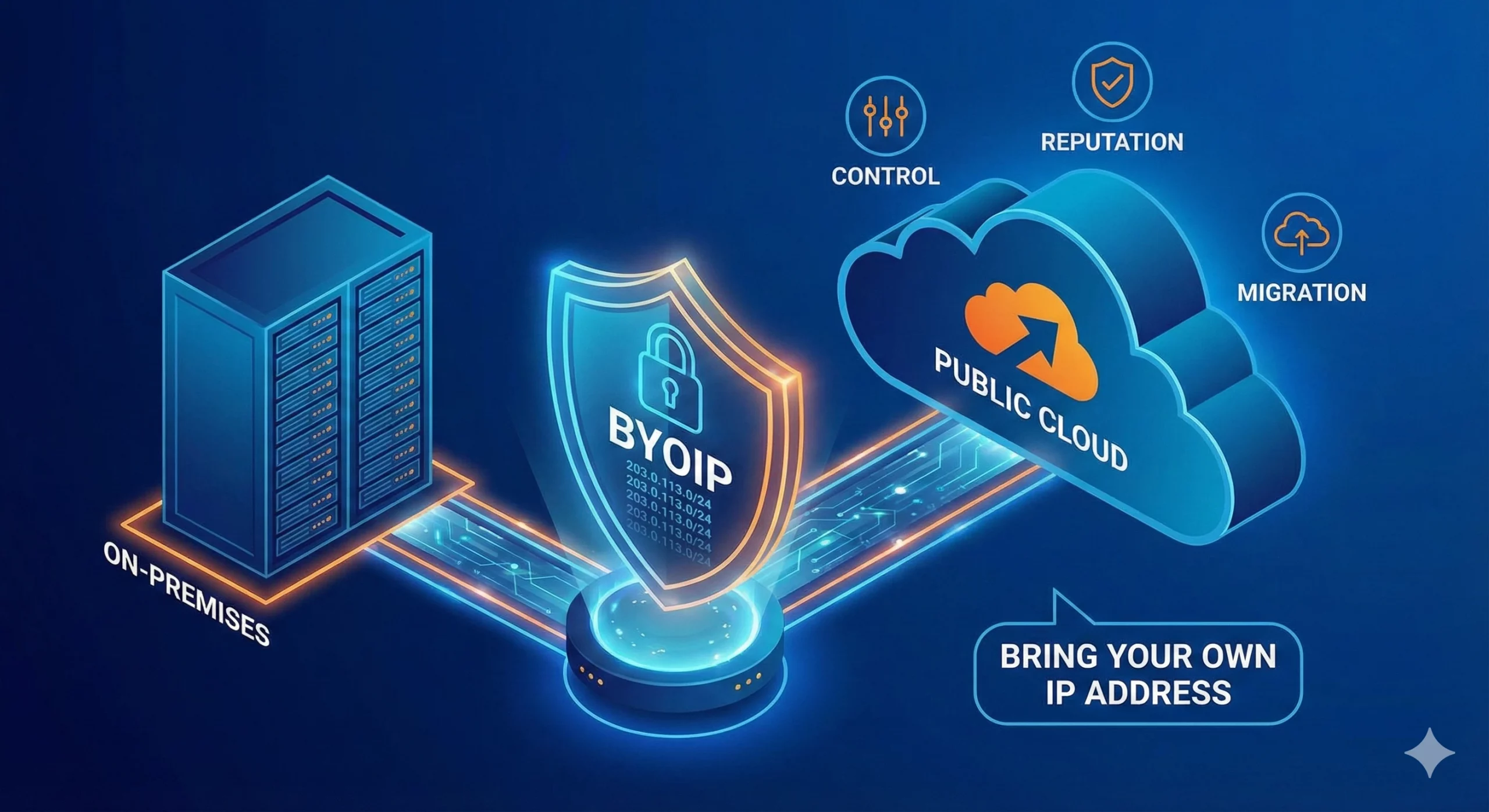
什么是BYOIP(自备IP地址)?
自带 IP(Bring Your Own IP,简称 BYOIP)是一种网络部署方式,允许企业将自己现有的公网 IP 地址段应用于云服务提供商、数据中心、内容分发网络(CDN)或其他基础设施平台。 企业无需使用服务提供商分配的新公网 IP 地址,而是可以使用自己已拥有或已获授权使用的 IPv4 或 IPv6 地址前缀。服务提供商会验证该组织对该地址段的使用权限,并在支持的情况下,通过其自身网络对该地址段进行路由公告(Advertise)。 BYOIP 有助于企业在迁移至云平台时保留现有的防火墙规则、白名单(Allowlists)、客户系统集成、IP 信誉(IP Reputation)、DNS 配置以及既有的网络身份。这不仅能够减少因更换 IP 地址而带来的业务中断,还能降低对服务提供商分配 IP 的依赖,使未来的基础设施迁移与扩展更加灵活且易于管理。 对于需要 BYOIP 地址资源的企业,可选择 购买 IPv4 地址(Buy IP),以获得长期控制权;如果更重视灵活性,也可采用 IPv4 租赁(IPv4 Leasing),按业务需求获取公网 IP 资源。 什么是BYOIP? BYOIP 是 Bring Your Own IP(自带 IP)的缩写。这是一种网络部署模式,允许组织将现有的公网 IP 地址段带入云服务提供商或其他基础设施平台使用。 在 BYOIP 模式下,组织仍然拥有或保留该 IP 地址段的使用权,而平台则获得授权,可在其基础设施中对该地址段进行路由公告(Advertise)和使用。随后,这些 IP 地址可分配给虚拟机(Virtual Machines)、负载均衡器(Load Balancers)、VPN 网关、内容分发服务(CDN)、安全平台以及公网应用程序端点等受支持的服务。 例如,一家企业将应用程序从本地数据中心迁移到云环境时,可能并不希望更换现有的公网 IP 地址。这些 IP 地址可能已经存在于客户白名单(Allowlists)、防火墙策略、DNS 记录、合作伙伴配置以及电子邮件信誉(Email Reputation)数据库中。 BYOIP 使企业能够在迁移工作负载的同时,继续使用原有的公网 IP 地址,从而保持更一致的网络身份,并减少因更换 IP 地址而带来的配置调整和业务影响。 Related Posts 什么是电信公司?电信运营商如何为英国、美国和加拿大提供网络连接支持? 电信公司(Telco Companies),也称为电信运营商(Telecommunications Companies),提供通信与网络连接服务。这些服务包括移动通信网络、宽带互联网、光纤连接、固定电话服务、企业网络连接、云连接、托管网络服务以及数据中心连接等。 对于普通消费者而言,电信公司通常被视为移动通信或宽带互联网服务提供商。对于企业来说,电信公司远不只是一个服务品牌,更是关键的基础设施合作伙伴,帮助企业连接办公室、数据中心、云平台、远程员工、客户应用程序以及各类数字化服务。 随着企业越来越依赖云平台、SaaS 应用、AI 工具、VPN、网络安全系统以及在线服务,电信公司已成为数字基础设施规划中不可或缺的重要组成部分。 电信公司是什么? 电信公司(Telco Companies)是提供电信服务的企业。这些服务让个人、设备、企业和各种系统能够跨越距离进行通信与连接。 一家电信公司可能提供以下服务: 移动通信服务 宽带互联网 光纤连接 固定电话服务 企业互联网接入 企业广域网(WAN)服务 云连接服务 数据中心连接 VPN TCP 与 UDP:IPv4 租赁和企业网络指南 TCP 和 UDP 是互联网中最重要的两种传输层协议。它们决定数据如何在设备、服务器、云平台、VPN 网关、DNS 解析器、电子邮件系统、流媒体平台以及企业应用程序之间传输。 对于企业而言,TCP 和 UDP 不仅仅是技术术语,它们会直接影响实际的基础设施性能。公网 IPv4 地址提供可从互联网访问的网络端点,而 TCP 和 UDP 则决定流量如何通过该端点进行传输。 这对于租用或购买 IPv4 地址的企业尤为重要。企业租用 IPv4 什么是区域互联网注册管理机构(RIR) 区域互联网注册管理机构(Regional Internet Registry, RIR)是负责在特定地理区域内分配和管理互联网编号资源的组织。这些资源主要包括 IP 地址(IPv4 和 IPv6)以及自治系统号(ASN),它们是支撑设备和网络在互联网上相互通信的关键要素。 如果没有一套组织完善的系统来分配唯一的 IP 地址和路由标识符,互联网便无法正常运转。RIR 确保这一过程在各自管辖的区域内保持公平、高效与一致,从而避免冲突,并提升互联网治理的透明度。 全球五大 RIR 目前全球共有五家获官方认可的 RIR,各自负责世界上特定的区域:AFRINIC – 非洲网络信息中心(非洲)APNIC – 亚太网络信息中心(亚太地区)ARIN .related-post {} .related-post .post-list { text-align: left; } .related-post .post-list .item { margin: 5px; padding: 10px; } .related-post .headline { font-size: 18px !important; color: #999999 !important; } .related-post .post-list .item .post_thumb { max-height: 220px; margin: 10px 0px; padding: 0px; display: block; } .related-post .post-list .item .post_title { font-size: 16px; color: #3f3f3f; margin: 10px 0px; padding: 0px; display: block; text-decoration: none; } .related-post .post-list .item .post_excerpt { font-size: 13px; color: #3f3f3f; margin: 10px 0px; padding: 0px; display: block; text-decoration: none; } @media only screen and (min-width: 1024px) { .related-post .post-list .item { width: 30%; } } @media only screen and (min-width: 768px) and (max-width: 1023px) { .related-post .post-list .item { width: 90%; } } @media only screen and (min-width: 0px) and (max-width: 767px) { .related-post .post-list .item { width: 90%; } }
