IPv4 Leasing for Data Centres: What You Need To Know
 Stephanie
As IPv4 scarcity intensifies, data centres increasingly rely on leasing to scale infrastructure, control costs, and maintain reliable connectivity worldwide.
Table of Contents
- IPv4 leasing has become a critical strategy for data centres facing address shortages and rising acquisition costs
- Leasing offers flexibility and scalability, but introduces risks around reputation, compliance, and long-term dependency
Understanding IPv4 and why data centres still depend on it
Despite years of tech progress IPv4 is still the main part of the global Internet. It was made in the 1980s. IPv4 gives about 4.3 billion addresses. This is much less, than what all connected devices need today.
For data centres, IPv4 is not optional. It is essential for:
- Hosting public-facing services
- Ensuring compatibility with legacy systems
- Supporting global routing and accessibility
Even though more and more people are starting to use IPv6 most companies and cloud services still use IPv4 because it is what their systems are compatible with and it is not available everywhere, on all networks.
This is a problem: the number of people who want to use IPv4 is going up but there is only a limited amount of IPv4 available it is not like we can just make more of it.
The rise of IPv4 leasing in data centres
With the exhaustion of new IPv4 allocations from regional registries, organisations must now acquire addresses through secondary markets.
This is where leasing has become a solution.
Organisations can rent IPv4 addresses for a time, from people who already have them instead of buying them.
For data centres leasing IPv4 addresses makes sense because it fits well with how they work:
- Infrastructure demand fluctuates
- Capacity must scale quickly
- Capital expenditure must be controlled
Industry analysis shows leasing has evolved into a “billion-dollar IP leasing ecosystem” driven by scarcity and demand.
Why data centres choose IPv4 leasing
Cost efficiency and financial flexibility
One big reason for leasing IPv4 addresses is cost. Buying them needs a lot of money upfront. Prices have gone up to tens of dollars for each IP address recently.
IPv4 addresses are expensive to buy so leasing them is an option. The high cost is a factor, in choosing to lease IPv4 addresses. It costs a lot to purchase IPv4 addresses.
Leasing, by contrast:
- Converts capital expenditure into operational expenditure
- Offers predictable monthly or annual costs
- Avoids long-term financial commitment
As one industry analysis notes, leasing provides “lower initial costs” and enables organisations to allocate capital elsewhere.
Scalability for dynamic workloads
Data centres operate in highly dynamic environments. Customer demand can shift rapidly due to:
- Seasonal traffic spikes
- New product launches
- Geographic expansion
Leasing allows operators to scale IP resources up or down as needed. This flexibility is particularly valuable in cloud and hybrid environments, where capacity planning is complex.
Research highlights that leasing enables organisations to “quickly respond to usage spikes” without long-term commitments.
Faster deployment compared to purchasing
Acquiring an IPv4 address can take a lot of time if you buy or transfer it through registry. This process involves things:
- Legal verification
- Registry approval
- Technical validation
Leasing really helps to cut down on a lot of hassle. You can get address blocks up and running in a few days or weeks. This means that data centres can react fast to what people want.
Getting things done quickly is really important in areas, like cloud hosting and SaaS where everyone is competing with each other.
-IPv4 is the Internet’s most important service enabler; a device or server cannot be online without it.
– Heng.Lu, CEO of LARUS Limited and founder of the LARUS Foundation
The role of IPv4 leasing in modern data centre architecture
Supporting hybrid and multi-cloud environments
Modern data centres increasingly operate across hybrid and multi-cloud architectures. These environments require:
- Consistent addressing across platforms
- Secure communication between regions
- Reliable public-facing endpoints
Leased IPv4 addresses give you your IP space that you can use everywhere. This is better than shared IP pools because they can slow things down and have security issues. With leased IPv4 addresses you get performance and more control, over your IP space. You do not have to worry about people using the same IP address as you. Leased IPv4 addresses make it easy to set things up in environments.
Reducing reliance on NAT
People have been using Network Address Translation(NAT) for a time to deal with the problem of not having enough IPv4 addresses.However, it can make things more complicated and cause problems, with how well things work.
Experts note that NAT can:
- Increase latency
- Break certain protocols
- Complicate security configurations
Leasing IPv4 enables data centres to assign public IP addresses directly, reducing dependence on NAT and improving network efficiency.
Enabling reputation-sensitive services
For many data centre services—such as email hosting, SaaS platforms, and content delivery—IP reputation is critical.
Leasing providers often supply “clean” IP address ranges that have been vetted for:
- Blacklist history
- Abuse reports
- Routing integrity
This is particularly important for businesses that rely on deliverability and trust, such as marketing platforms or financial services.
Risks and challenges of IPv4 leasing
While leasing offers clear advantages, it is not without risks.
Lack of ownership and long-term control
Leasing does not confer ownership. Organisations remain dependent on:
- Contract terms
- Renewal agreements
- Provider stability
Over time, leasing costs may exceed the cost of purchasing, particularly for long-term infrastructure needs.
IP reputation and compliance risks
Leased IP addresses may carry historical baggage, including:
- Spam listings
- Abuse complaints
- Poor routing reputation
Although many providers vet addresses, the risk cannot be eliminated entirely.
As one analysis notes, leased IPs can come with “reputational baggage”, requiring careful due diligence.
Dependency on external providers
Leasing introduces reliance on brokers or platforms to:
- Maintain compliance with registry policies
- Manage routing authorisation
- Provide documentation and support
This dependency can create operational risk if providers fail or if agreements change unexpectedly.
Leasing vs buying IPv4 for data centres
The decision between leasing and buying depends on organisational priorities.
When leasing makes sense
Leasing is typically preferable when:
- Growth is rapid or unpredictable
- Budget constraints limit capital investment
- Short-term or experimental deployments are required
Data centres expanding into new regions often use leasing to test demand before committing to ownership.
When buying may be better
Purchasing IPv4 addresses may be more suitable when:
- Long-term stability is required
- Address usage is predictable
- Organisations want to treat IP space as a capital asset
Some operators adopt hybrid strategies—owning core infrastructure IPs while leasing additional capacity as needed.
The future of IPv4 leasing in data centres
Despite the ongoing transition to IPv6, IPv4 leasing is expected to remain a critical component of Internet infrastructure.
Several trends are shaping its future:
- Continued IPv4 scarcity and price volatility
- Growth of cloud-native and edge computing
- Increasing importance of IP reputation and security
Leasing is no longer a temporary workaround—it is now a strategic tool for managing digital infrastructure at scale.
As one industry perspective highlights, leasing has become “a critical resource to scale digital presence” in the face of persistent scarcity.
Conclusion
Data centers need to find ways to work with the internet. One thing that is really helpful is leasing IPv4 addresses. This is a way for data centers to get what they need. Leasing IPv4 addresses gives them the freedom to do things quickly and, at a cost. This is what they need to keep up with modern technology. IPv4 leasing is a way for data centers to stay ahead.
However, it also makes things more complicated when it comes to governance and reputation and planning for the term.
For people who run data centres the main thing is not to decide whether to lease or own but to figure out how to make both leasing and ownership work as part of a bigger plan for intellectual property or IP for short which is really, about the data centre operators overall IP strategy.
Frequently Asked Questions
1. What is IPv4 leasing?
IPv4 leasing is the process of renting IP address blocks from existing owners for a fixed period instead of purchasing them outright.
2. Why do data centres need IPv4 addresses?
They are required to host services, enable global connectivity, and maintain compatibility with legacy systems still dependent on IPv4.
3. Is IPv4 leasing cheaper than buying?
Leasing has lower upfront costs, but long-term leasing may become more expensive than purchasing depending on usage duration.
4. What are the risks of IPv4 leasing?
Risks include lack of ownership, dependency on providers, and potential issues with IP reputation or compliance
5. Will IPv6 replace IPv4 leasing?
IPv6 will reduce reliance on IPv4, but slow adoption means leasing will remain relevant for the foreseeable future.
Related Blogs
相关文章

什么是电信公司?电信运营商如何为英国、美国和加拿大提供网络连接支持?
电信公司(Telco Companies),也称为电信运营商(Telecommunications Companies),提供通信与网络连接服务。这些服务包括移动通信网络、宽带互联网、光纤连接、固定电话服务、企业网络连接、云连接、托管网络服务以及数据中心连接等。 对于普通消费者而言,电信公司通常被视为移动通信或宽带互联网服务提供商。对于企业来说,电信公司远不只是一个服务品牌,更是关键的基础设施合作伙伴,帮助企业连接办公室、数据中心、云平台、远程员工、客户应用程序以及各类数字化服务。 随着企业越来越依赖云平台、SaaS 应用、AI 工具、VPN、网络安全系统以及在线服务,电信公司已成为数字基础设施规划中不可或缺的重要组成部分。 电信公司是什么? 电信公司(Telco Companies)是提供电信服务的企业。这些服务让个人、设备、企业和各种系统能够跨越距离进行通信与连接。 一家电信公司可能提供以下服务: 移动通信服务 宽带互联网 光纤连接 固定电话服务 企业互联网接入 企业广域网(WAN)服务 云连接服务 数据中心连接 VPN 服务 托管网络解决方案 互联网传输(Internet Transit) 电信批发服务 部分电信公司拥有并运营大规模的实体网络基础设施;另一些则通过批发接入、租用基础设施或与网络运营商合作来提供电信服务。 电信公司提供哪些服务? 电信公司同时为个人消费者和企业客户提供服务。 面向消费者的服务通常包括移动通信套餐、家庭宽带、光纤互联网、固定电话以及通信组合套餐。 面向企业的服务则可能包括专线互联网接入、企业光纤、专用网络、云连接、托管安全服务、数据中心连接、物联网(IoT)连接以及企业移动通信方案。 对于大型企业客户,电信公司还可提供: 多地点办公室网络连接 远程员工接入 私有云连接 SD-WAN(软件定义广域网) 灾难恢复连接 低延迟网络路由 互联网传输(Internet Transit) 网络监控 托管防火墙服务 正因如此,电信公司不仅对日常通信至关重要,也是现代企业建设先进数字基础设施的重要支柱。 电信公司 vs 互联网服务提供商 vs 网络运营商 电信公司(Telco)、互联网服务提供商(ISP)和网络运营商(Network Operator)之间可能存在重叠,但它们并不完全相同。 电信公司提供电信服务。 互联网服务提供商(ISP)提供互联网接入服务。 网络运营商负责建设、运营和管理网络基础设施。 一些大型电信公司同时承担这三种角色。它们拥有基础设施、运营网络,并向市场提供互联网、移动通信以及企业网络服务。 规模较小的服务提供商则可能专注于其中某一层。例如,互联网服务提供商(ISP)可以销售宽带服务,而无需拥有所有实体网络基础设施;网络运营商可能负责建设和运营光纤网络,并向电信公司或 ISP 提供批发网络接入;电信公司则可能结合自有网络与合作伙伴网络,为客户提供移动通信和企业服务。 对于企业而言,理解这些区别非常重要,因为服务质量不仅取决于销售该方案的品牌,还受到其底层网络、路由设计、网络覆盖范围以及技术支持体系等因素的影响。 为什么电信公司对企业至关重要 电信公司之所以重要,是因为几乎所有现代企业都依赖稳定的网络连接。 企业可能需要电信服务来支持: 办公室互联网接入 移动网络连接 远程办公 客户支持系统 云应用程序 SaaS 平台 支付系统 VPNRead more Related Posts 什么是电信公司?电信运营商如何为英国、美国和加拿大提供网络连接支持? 电信公司(Telco Companies),也称为电信运营商(Telecommunications Companies),提供通信与网络连接服务。这些服务包括移动通信网络、宽带互联网、光纤连接、固定电话服务、企业网络连接、云连接、托管网络服务以及数据中心连接等。 对于普通消费者而言,电信公司通常被视为移动通信或宽带互联网服务提供商。对于企业来说,电信公司远不只是一个服务品牌,更是关键的基础设施合作伙伴,帮助企业连接办公室、数据中心、云平台、远程员工、客户应用程序以及各类数字化服务。 随着企业越来越依赖云平台、SaaS 应用、AI 工具、VPN、网络安全系统以及在线服务,电信公司已成为数字基础设施规划中不可或缺的重要组成部分。 电信公司是什么? 电信公司(Telco Companies)是提供电信服务的企业。这些服务让个人、设备、企业和各种系统能够跨越距离进行通信与连接。 一家电信公司可能提供以下服务: 移动通信服务 宽带互联网 光纤连接 固定电话服务 企业互联网接入 企业广域网(WAN)服务 云连接服务 数据中心连接 VPN TCP 与 UDP:IPv4 租赁和企业网络指南 TCP 和 UDP 是互联网中最重要的两种传输层协议。它们决定数据如何在设备、服务器、云平台、VPN 网关、DNS 解析器、电子邮件系统、流媒体平台以及企业应用程序之间传输。 对于企业而言,TCP 和 UDP 不仅仅是技术术语,它们会直接影响实际的基础设施性能。公网 IPv4 地址提供可从互联网访问的网络端点,而 TCP 和 UDP 则决定流量如何通过该端点进行传输。 这对于租用或购买 IPv4 地址的企业尤为重要。企业租用 IPv4 什么是区域互联网注册管理机构(RIR) 区域互联网注册管理机构(Regional Internet Registry, RIR)是负责在特定地理区域内分配和管理互联网编号资源的组织。这些资源主要包括 IP 地址(IPv4 和 IPv6)以及自治系统号(ASN),它们是支撑设备和网络在互联网上相互通信的关键要素。 如果没有一套组织完善的系统来分配唯一的 IP 地址和路由标识符,互联网便无法正常运转。RIR 确保这一过程在各自管辖的区域内保持公平、高效与一致,从而避免冲突,并提升互联网治理的透明度。 全球五大 RIR 目前全球共有五家获官方认可的 RIR,各自负责世界上特定的区域:AFRINIC – 非洲网络信息中心(非洲)APNIC – 亚太网络信息中心(亚太地区)ARIN .related-post {} .related-post .post-list { text-align: left; } .related-post .post-list .item { margin: 5px; padding: 10px; } .related-post .headline { font-size: 18px !important; color: #999999 !important; } .related-post .post-list .item .post_thumb { max-height: 220px; margin: 10px 0px; padding: 0px; display: block; } .related-post .post-list .item .post_title { font-size: 16px; color: #3f3f3f; margin: 10px 0px; padding: 0px; display: block; text-decoration: none; } .related-post .post-list .item .post_excerpt { font-size: 13px; color: #3f3f3f; margin: 10px 0px; padding: 0px; display: block; text-decoration: none; } @media only screen and (min-width: 1024px) { .related-post .post-list .item { width: 30%; } } @media only screen and (min-width: 768px) and (max-width: 1023px) { .related-post .post-list .item { width: 90%; } } @media only screen and (min-width: 0px) and (max-width: 767px) { .related-post .post-list .item { width: 90%; } }
TCP 与 UDP:IPv4 租赁和企业网络指南
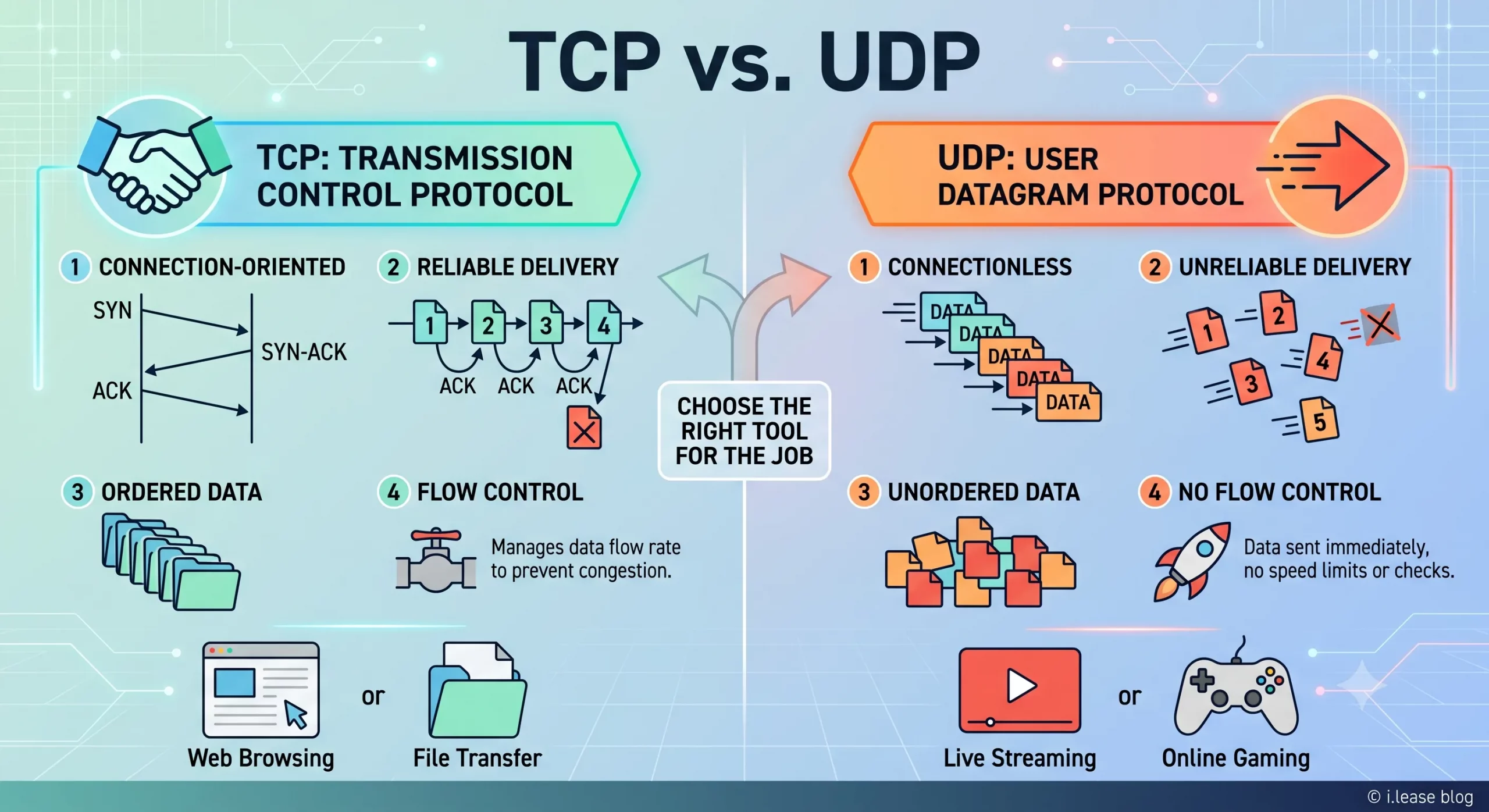
TCP 和 UDP 是互联网中最重要的两种传输层协议。它们决定数据如何在设备、服务器、云平台、VPN 网关、DNS 解析器、电子邮件系统、流媒体平台以及企业应用程序之间传输。 对于企业而言,TCP 和 UDP 不仅仅是技术术语,它们会直接影响实际的基础设施性能。公网 IPv4 地址提供可从互联网访问的网络端点,而 TCP 和 UDP 则决定流量如何通过该端点进行传输。 这对于租用或购买 IPv4 地址的企业尤为重要。企业租用 IPv4 地址并不是单纯为了持有这些地址,而是为了运行网站、API、VPN 隧道、DNS 服务、电子邮件平台、SaaS 应用程序、游戏服务器、流媒体系统、安全工具以及云端工作负载。不同类型的服务决定了需要使用 TCP、UDP,还是同时使用两者。 通过 i.lease,企业可以使用 IPv4 租赁服务获取用于实际网络部署的公网 IPv4 资源。需要长期控制 IP 地址资源的企业也可以购买 IP 地址,而拥有闲置 IPv4 资源的组织则可以出售 IP 地址。 TCP和UDP是什么? TCP 和 UDP 都是传输层协议。它们位于 IP 协议之上,帮助应用程序通过网络发送和接收数据。 IP 地址用于确定流量应该发送到哪里,而 TCP 和 UDP 则决定这些流量如何进行传输。 简单来说: TCP 适用于重视可靠性和按顺序传输数据的场景。 UDP 适用于重视速度、低延迟和轻量化数据传输的场景。 企业可能会使用同一个公网 IPv4 地址来运行不同的服务,但每项服务可能依赖不同的传输协议。例如,网站可能使用 TCP,VPN 网关可能使用 UDP,DNS 解析器可能同时使用 UDP 和 TCP,而游戏服务器则可能更倾向于使用 UDP,因为对于实时游戏而言,延迟造成的影响通常比少量数据包丢失更加明显。 因此,TCPRead more Related Posts 什么是电信公司?电信运营商如何为英国、美国和加拿大提供网络连接支持? 电信公司(Telco Companies),也称为电信运营商(Telecommunications Companies),提供通信与网络连接服务。这些服务包括移动通信网络、宽带互联网、光纤连接、固定电话服务、企业网络连接、云连接、托管网络服务以及数据中心连接等。 对于普通消费者而言,电信公司通常被视为移动通信或宽带互联网服务提供商。对于企业来说,电信公司远不只是一个服务品牌,更是关键的基础设施合作伙伴,帮助企业连接办公室、数据中心、云平台、远程员工、客户应用程序以及各类数字化服务。 随着企业越来越依赖云平台、SaaS 应用、AI 工具、VPN、网络安全系统以及在线服务,电信公司已成为数字基础设施规划中不可或缺的重要组成部分。 电信公司是什么? 电信公司(Telco Companies)是提供电信服务的企业。这些服务让个人、设备、企业和各种系统能够跨越距离进行通信与连接。 一家电信公司可能提供以下服务: 移动通信服务 宽带互联网 光纤连接 固定电话服务 企业互联网接入 企业广域网(WAN)服务 云连接服务 数据中心连接 VPN TCP 与 UDP:IPv4 租赁和企业网络指南 TCP 和 UDP 是互联网中最重要的两种传输层协议。它们决定数据如何在设备、服务器、云平台、VPN 网关、DNS 解析器、电子邮件系统、流媒体平台以及企业应用程序之间传输。 对于企业而言,TCP 和 UDP 不仅仅是技术术语,它们会直接影响实际的基础设施性能。公网 IPv4 地址提供可从互联网访问的网络端点,而 TCP 和 UDP 则决定流量如何通过该端点进行传输。 这对于租用或购买 IPv4 地址的企业尤为重要。企业租用 IPv4 什么是区域互联网注册管理机构(RIR) 区域互联网注册管理机构(Regional Internet Registry, RIR)是负责在特定地理区域内分配和管理互联网编号资源的组织。这些资源主要包括 IP 地址(IPv4 和 IPv6)以及自治系统号(ASN),它们是支撑设备和网络在互联网上相互通信的关键要素。 如果没有一套组织完善的系统来分配唯一的 IP 地址和路由标识符,互联网便无法正常运转。RIR 确保这一过程在各自管辖的区域内保持公平、高效与一致,从而避免冲突,并提升互联网治理的透明度。 全球五大 RIR 目前全球共有五家获官方认可的 RIR,各自负责世界上特定的区域:AFRINIC – 非洲网络信息中心(非洲)APNIC – 亚太网络信息中心(亚太地区)ARIN .related-post {} .related-post .post-list { text-align: left; } .related-post .post-list .item { margin: 5px; padding: 10px; } .related-post .headline { font-size: 18px !important; color: #999999 !important; } .related-post .post-list .item .post_thumb { max-height: 220px; margin: 10px 0px; padding: 0px; display: block; } .related-post .post-list .item .post_title { font-size: 16px; color: #3f3f3f; margin: 10px 0px; padding: 0px; display: block; text-decoration: none; } .related-post .post-list .item .post_excerpt { font-size: 13px; color: #3f3f3f; margin: 10px 0px; padding: 0px; display: block; text-decoration: none; } @media only screen and (min-width: 1024px) { .related-post .post-list .item { width: 30%; } } @media only screen and (min-width: 768px) and (max-width: 1023px) { .related-post .post-list .item { width: 90%; } } @media only screen and (min-width: 0px) and (max-width: 767px) { .related-post .post-list .item { width: 90%; } }
什么是BYOIP(自备IP地址)?
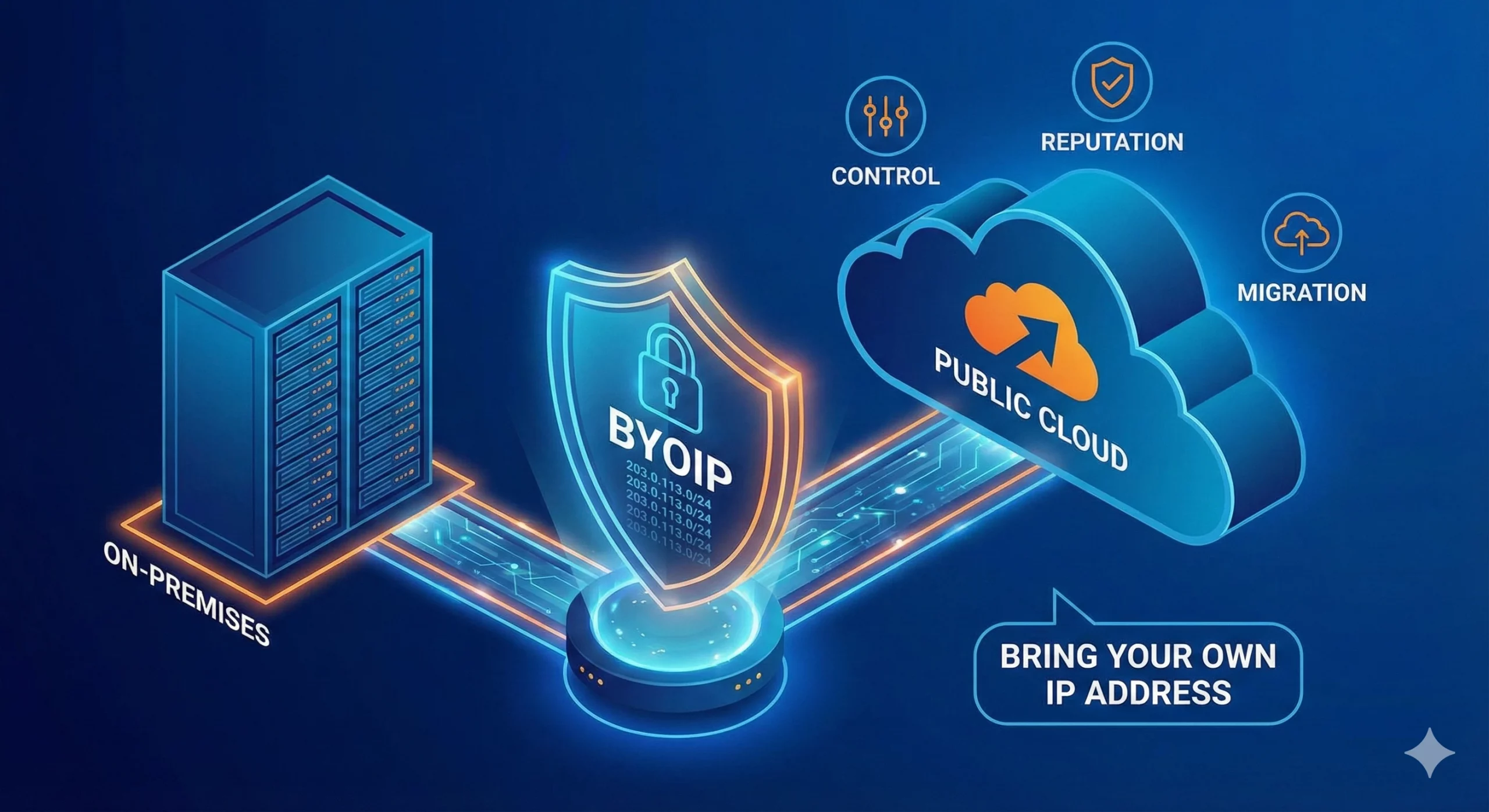
自带 IP(Bring Your Own IP,简称 BYOIP)是一种网络部署方式,允许企业将自己现有的公网 IP 地址段应用于云服务提供商、数据中心、内容分发网络(CDN)或其他基础设施平台。 企业无需使用服务提供商分配的新公网 IP 地址,而是可以使用自己已拥有或已获授权使用的 IPv4 或 IPv6 地址前缀。服务提供商会验证该组织对该地址段的使用权限,并在支持的情况下,通过其自身网络对该地址段进行路由公告(Advertise)。 BYOIP 有助于企业在迁移至云平台时保留现有的防火墙规则、白名单(Allowlists)、客户系统集成、IP 信誉(IP Reputation)、DNS 配置以及既有的网络身份。这不仅能够减少因更换 IP 地址而带来的业务中断,还能降低对服务提供商分配 IP 的依赖,使未来的基础设施迁移与扩展更加灵活且易于管理。 对于需要 BYOIP 地址资源的企业,可选择 购买 IPv4 地址(Buy IP),以获得长期控制权;如果更重视灵活性,也可采用 IPv4 租赁(IPv4 Leasing),按业务需求获取公网 IP 资源。 什么是BYOIP? BYOIP 是 Bring Your Own IP(自带 IP)的缩写。这是一种网络部署模式,允许组织将现有的公网 IP 地址段带入云服务提供商或其他基础设施平台使用。 在 BYOIP 模式下,组织仍然拥有或保留该 IP 地址段的使用权,而平台则获得授权,可在其基础设施中对该地址段进行路由公告(Advertise)和使用。随后,这些 IP 地址可分配给虚拟机(Virtual Machines)、负载均衡器(Load Balancers)、VPN 网关、内容分发服务(CDN)、安全平台以及公网应用程序端点等受支持的服务。 例如,一家企业将应用程序从本地数据中心迁移到云环境时,可能并不希望更换现有的公网 IP 地址。这些 IP 地址可能已经存在于客户白名单(Allowlists)、防火墙策略、DNS 记录、合作伙伴配置以及电子邮件信誉(Email Reputation)数据库中。 BYOIP 使企业能够在迁移工作负载的同时,继续使用原有的公网 IP 地址,从而保持更一致的网络身份,并减少因更换 IP 地址而带来的配置调整和业务影响。 Related Posts 什么是电信公司?电信运营商如何为英国、美国和加拿大提供网络连接支持? 电信公司(Telco Companies),也称为电信运营商(Telecommunications Companies),提供通信与网络连接服务。这些服务包括移动通信网络、宽带互联网、光纤连接、固定电话服务、企业网络连接、云连接、托管网络服务以及数据中心连接等。 对于普通消费者而言,电信公司通常被视为移动通信或宽带互联网服务提供商。对于企业来说,电信公司远不只是一个服务品牌,更是关键的基础设施合作伙伴,帮助企业连接办公室、数据中心、云平台、远程员工、客户应用程序以及各类数字化服务。 随着企业越来越依赖云平台、SaaS 应用、AI 工具、VPN、网络安全系统以及在线服务,电信公司已成为数字基础设施规划中不可或缺的重要组成部分。 电信公司是什么? 电信公司(Telco Companies)是提供电信服务的企业。这些服务让个人、设备、企业和各种系统能够跨越距离进行通信与连接。 一家电信公司可能提供以下服务: 移动通信服务 宽带互联网 光纤连接 固定电话服务 企业互联网接入 企业广域网(WAN)服务 云连接服务 数据中心连接 VPN TCP 与 UDP:IPv4 租赁和企业网络指南 TCP 和 UDP 是互联网中最重要的两种传输层协议。它们决定数据如何在设备、服务器、云平台、VPN 网关、DNS 解析器、电子邮件系统、流媒体平台以及企业应用程序之间传输。 对于企业而言,TCP 和 UDP 不仅仅是技术术语,它们会直接影响实际的基础设施性能。公网 IPv4 地址提供可从互联网访问的网络端点,而 TCP 和 UDP 则决定流量如何通过该端点进行传输。 这对于租用或购买 IPv4 地址的企业尤为重要。企业租用 IPv4 什么是区域互联网注册管理机构(RIR) 区域互联网注册管理机构(Regional Internet Registry, RIR)是负责在特定地理区域内分配和管理互联网编号资源的组织。这些资源主要包括 IP 地址(IPv4 和 IPv6)以及自治系统号(ASN),它们是支撑设备和网络在互联网上相互通信的关键要素。 如果没有一套组织完善的系统来分配唯一的 IP 地址和路由标识符,互联网便无法正常运转。RIR 确保这一过程在各自管辖的区域内保持公平、高效与一致,从而避免冲突,并提升互联网治理的透明度。 全球五大 RIR 目前全球共有五家获官方认可的 RIR,各自负责世界上特定的区域:AFRINIC – 非洲网络信息中心(非洲)APNIC – 亚太网络信息中心(亚太地区)ARIN .related-post {} .related-post .post-list { text-align: left; } .related-post .post-list .item { margin: 5px; padding: 10px; } .related-post .headline { font-size: 18px !important; color: #999999 !important; } .related-post .post-list .item .post_thumb { max-height: 220px; margin: 10px 0px; padding: 0px; display: block; } .related-post .post-list .item .post_title { font-size: 16px; color: #3f3f3f; margin: 10px 0px; padding: 0px; display: block; text-decoration: none; } .related-post .post-list .item .post_excerpt { font-size: 13px; color: #3f3f3f; margin: 10px 0px; padding: 0px; display: block; text-decoration: none; } @media only screen and (min-width: 1024px) { .related-post .post-list .item { width: 30%; } } @media only screen and (min-width: 768px) and (max-width: 1023px) { .related-post .post-list .item { width: 90%; } } @media only screen and (min-width: 0px) and (max-width: 767px) { .related-post .post-list .item { width: 90%; } }
