IP Allocation Challenges in Developing Regions
 Stephanie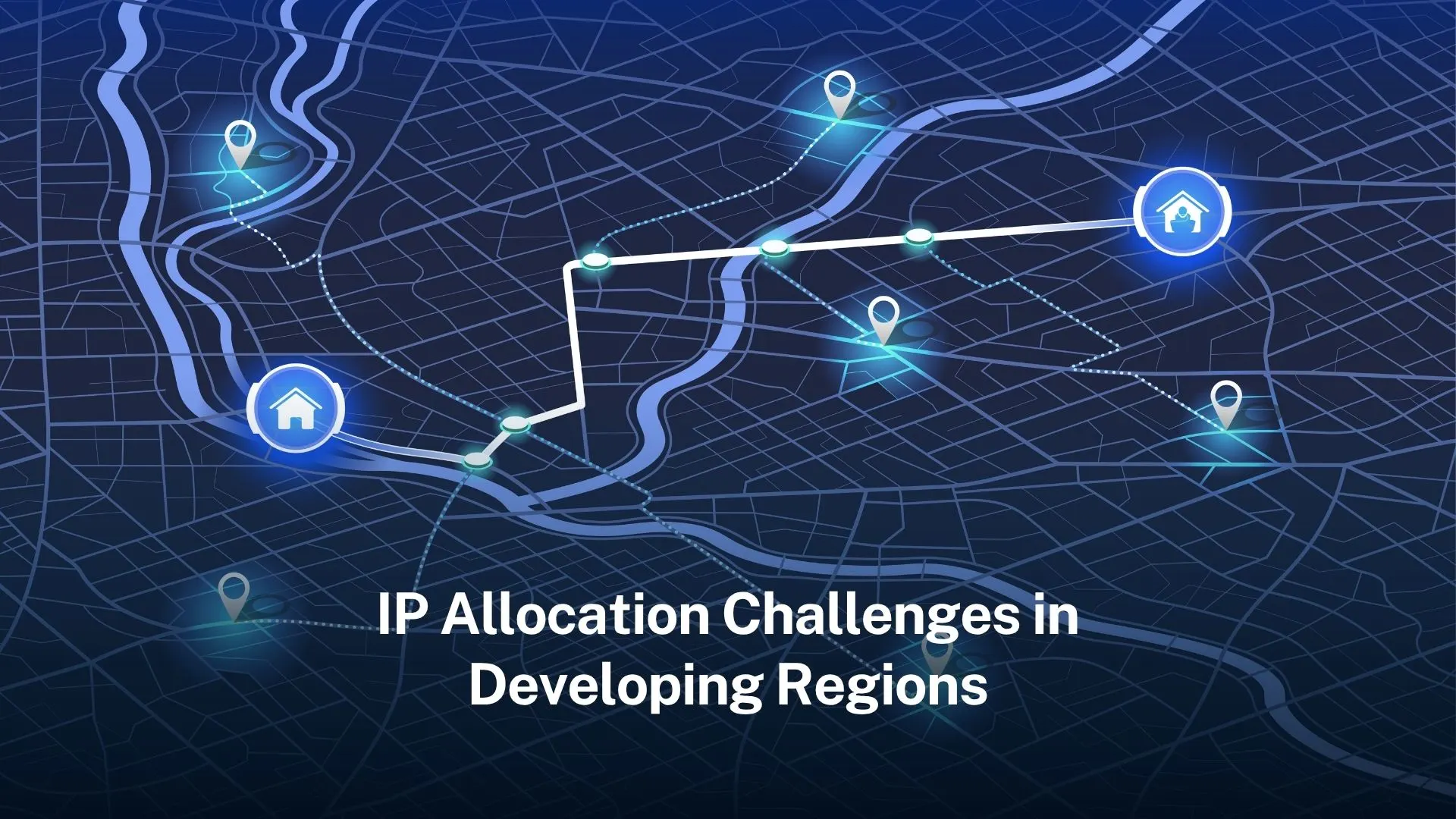
Introduction to the Idea of IP Allocation
An IP address is what allows your device to join the Internet. It is a number that points to your location in the network. Each time you open a web page or send an email, that number helps data find its way. The act of giving out these numbers is called IP allocation. It may look like a simple job, but in many developing areas, it remains one of the hardest problems for service providers.
Table of Contents
The system used today was planned when only a few countries were online. At that time, most address blocks went to large firms and research groups in North America and Europe. When Internet use grew in other regions, most of the pool had already been taken. This left a shortage that still affects many parts of the world, forcing newer networks to share or rent from older ones.
Administrative and Policy Barriers
Policy plays a key role in fair distribution. In many developing countries, the process for applying for IP addresses is slow and filled with paperwork. Each application may require business licences, tax documents, and government clearance. Some governments see IP addresses as national assets, so they want to review every step. These checks create extra layers that delay growth.
Even when regional policies are clear, national rules often conflict. A provider may need local permits before they can even send a request to the registry. This extra time hurts smaller companies most because they lack lawyers or policy teams to handle forms. When approvals drag on for months, many give up and rent from brokers instead. The result is an uneven system that favours large players and slows Internet expansion.
Technical and Infrastructure Limitations
Infrastructure is another major challenge. Some countries have poor power grids and unreliable connections. Network outages are common, and many rural areas rely on old equipment. Even if these places receive new IP space, they cannot use it properly without stable hardware and trained staff.
Technical knowledge is also uneven. Urban centres may have skilled engineers, but small towns often do not. When a technician leaves, the system can fall apart. Many networks still depend on devices that cannot support IPv6, the newer Internet standard. These older routers and modems lock users into IPv4, which is already full. Upgrading costs money, and for small companies, that expense is often too high.
Economic and Market Constraints
Money shapes every part of Internet growth. In developing regions, building a network is expensive because most equipment must be imported. Taxes and transport add more cost. Bandwidth is also costly because international cables are owned by foreign companies. All of this makes it hard for small providers to join the market.
When few companies can afford to grow, competition stays low. Big players hold most of the IP space and can charge more for access. Small firms depend on leases or resellers who raise prices even higher. This creates a cycle where expansion stays limited to those who already have resources. The result is slow progress, uneven access, and continued digital gaps between cities and rural areas.
The Impact on Businesses and ISPs
For Internet providers, a lack of IP addresses means slower growth. Each new user or server needs its own number. If none are available, the company cannot expand. Some providers try to stretch their space by using shared addressing methods, but this makes networks complex and harder to manage. Customers may experience slow speeds, unstable connections, or blocked apps.
Local businesses also feel the effect. Startups that rely on cloud or hosting services often pay extra for stable IP space. If they cannot afford it, they host their websites abroad, which increases delay and weakens local innovation. Larger companies may move their operations to regions with better allocation, taking jobs and investment with them. In the long run, this shortage limits not just networks but the wider economy.
Community and Education Gaps
The Internet depends on a strong community to set fair rules. In many developing regions, that community is still small. Meetings about IP policy are often held in distant cities or online, and few local voices join. When participation is low, policies may not reflect real needs. A few active members end up speaking for everyone, and the result can feel disconnected from daily realities.
“Most of the new expansion of the Internet will happen in the developing world. So the need of the hour is... to design in cyber space a system which is collaborative, consultative, inclusive and consensual.”
— Dr. Govind, Former CEO of National Internet Exchange of India (NIXI)
Education also plays a part. Schools and training centres rarely teach how IP systems work. Many young engineers know how to connect a router but not how to manage address pools or request space from a registry. This lack of skill leads to mistakes, such as wasting addresses or using them without permission. More training and open workshops could help fill this gap and build local capacity for fair and smart allocation.
The Role of Government in Resource Planning
Governments can make a difference if they see Internet growth as infrastructure, not luxury. Some have started national registries to track address use, while others include IP planning in broadband policy. When leaders understand that IP addresses are as critical as roads or power lines, budgets follow. But when control becomes political, transparency suffers, and allocation turns into a closed process.
Public agencies also need coordination. Ministries of communication, education, and industry often act separately. One may plan fibre rollout while another blocks IP applications for “security reasons.” This lack of alignment wastes time and confuses operators. A shared plan and regular review between agencies can prevent such deadlocks and keep resources moving.
Regional Cooperation and Cross-Border Networks
Many Internet routes in developing areas cross borders. When one country has poor allocation, neighbouring networks feel it too. Cross-border links need consistent policies and shared address space to stay stable. Regional cooperation helps make that possible. Peering agreements and shared Internet exchange points reduce dependency on external transit and keep local traffic local.
Projects like these also encourage mutual learning. Engineers from different countries meet, share mistakes, and adjust their systems. When they work together, they build regional resilience that no single provider could achieve alone. This cooperation supports fairer IP distribution and strengthens the entire network ecosystem.
Private Sector and Broker Influence
Because of slow public allocation, private brokers have become active in developing markets. They connect holders of unused IPv4 space with buyers who need it. While this trade fills a gap, it also shifts control away from local registries. Prices rise fast, and transparency drops. Some brokers hold large pools purely for speculation, driving costs higher.
Local companies often have no choice but to buy through these channels. This dependence keeps prices unstable and weakens regional autonomy. If local RIRs and governments can streamline allocation, they can draw operators back into formal systems. Open pricing and record-keeping would restore balance and reduce abuse.
Training, Research, and Local Solutions
Education remains one of the strongest tools for change. Some universities now include modules on Internet governance and IP management. Students learn how global registries work and why fair distribution matters. These lessons create future engineers who can manage resources responsibly.
Research projects also explore new models of sharing. Community networks in rural areas experiment with address reuse and local routing to make better use of small allocations. Such innovations may not solve global scarcity, but they prove that smart design can stretch limited resources further. As these local examples grow, they inspire national policy updates that fit real needs.
Technology Transitions and Dual Stack Networks
Switching to IPv6 cannot happen overnight. Many providers run dual stack systems where IPv4 and IPv6 work together. This keeps compatibility with old devices while slowly introducing the new standard. The challenge is cost. Each router, firewall, and monitoring tool needs upgrades. For small operators, this can be more than they can afford in one year.
Some governments and donors offer financial help or free equipment to speed up this change. When local ISPs see working examples nearby, they are more likely to follow. Over time, the dual stack model will fade as IPv6 becomes normal. But until then, proper training and planning remain critical so that both systems can run smoothly side by side.
The Problem of Uneven Distribution Across Regions
Not all developing countries face the same situation. Some have managed to get small address blocks early and built systems to manage them. Others joined much later and had to depend on whatever was left. This uneven start means that two places on the same continent may have completely different levels of access and cost. One may offer cheap broadband, while the other struggles to connect a single town.
The lack of coordination also makes it hard to share or recover unused space. Some networks sit on idle addresses because they do not have tools to release them. Others cannot reach the registry in time to request what they need. The distance between regions, slow communication, and weak local support turn a global pool into isolated pockets. This imbalance keeps the Internet map unequal, even when there is unused capacity in nearby places.
How Delayed Allocation Slows Innovation
When a startup cannot get IP space, it cannot launch online services. It may try to rent from foreign brokers, but prices are high. Many give up or move their operations abroad. This loss of local innovation hurts entire economies because talent and ideas leave with the company.
Research centres also face limits. Many science projects need stable addresses to connect with global partners. If they cannot get them, they are left out of important data exchanges. This keeps developing countries behind in science and technology. The issue is not just about numbers—it is about opportunity and inclusion in the global digital world.
The Role of Government in Resource Planning
Governments can make a big difference if they treat Internet access as public infrastructure. When leaders see IP allocation as part of national growth, they can create policies that support it. They can fund training, simplify paperwork, and make sure agencies work together.
But when control becomes political, problems grow. Some states try to take over registry work or set rules that conflict with international policy. This confuses providers and scares away investors. The best results come from cooperation, not control. Clear roles between governments and registries keep the system stable and trusted.
Technology Transitions and Dual Stack Networks
IPv6 will not replace IPv4 overnight. Most providers now use dual stack systems, which run both at the same time. This allows old and new devices to work together. It also helps networks prepare for full migration later. But running two systems adds cost and requires careful setup.
Some governments and donors now provide help by funding pilot projects or donating routers that support IPv6. When smaller providers see working examples, they follow faster. Over time, the dual system will fade as IPv6 takes over. The key is patience and steady training, not quick jumps that risk outages.
Monitoring and Accountability
Keeping track of who holds which IP blocks is vital. Without clear records, registries cannot reclaim unused space or stop abuse. Many developing regions still rely on old spreadsheets or manual updates. These methods cause confusion and can lead to disputes. Upgrading to digital systems with public access builds trust and helps the community see what is happening.
Regular audits also matter. When allocations are checked, it stops hoarding and ensures fair use. Publishing simple reports can show if policies are working. Transparency is the best defence against corruption. Once people can see how space is used, confidence returns, and more companies will join the official process.
The Challenge of Tracking and Data Accuracy
One of the biggest silent problems is missing or outdated data. Many registries in developing regions still depend on manual updates or inconsistent reporting. When addresses are assigned, some records never return with usage details. Over time, the database fills with numbers that appear active but are not.
This lack of accuracy makes it hard to plan future allocation. A registry may think it has no free space while in fact thousands of addresses sit idle. Cleaning up these records takes time and skilled staff, both of which are limited. Without precise tracking, the same blocks can be claimed twice or lost entirely. This causes delays, disputes, and waste that small regions can least afford.
FAQs
What does IP allocation mean?
It is the process of giving out Internet addresses to networks and users.
Why is it harder in developing regions?
Because space is limited, costs are high, and policies move slowly.
Who manages these addresses?
Regional Internet Registries handle the distribution and keep public records.
Why is IPv4 still used?
Because many devices and networks still depend on it.
What makes IPv6 important?
It provides far more addresses, solving most shortages.
相关文章

什么是电信公司?电信运营商如何为英国、美国和加拿大提供网络连接支持?
电信公司(Telco Companies),也称为电信运营商(Telecommunications Companies),提供通信与网络连接服务。这些服务包括移动通信网络、宽带互联网、光纤连接、固定电话服务、企业网络连接、云连接、托管网络服务以及数据中心连接等。 对于普通消费者而言,电信公司通常被视为移动通信或宽带互联网服务提供商。对于企业来说,电信公司远不只是一个服务品牌,更是关键的基础设施合作伙伴,帮助企业连接办公室、数据中心、云平台、远程员工、客户应用程序以及各类数字化服务。 随着企业越来越依赖云平台、SaaS 应用、AI 工具、VPN、网络安全系统以及在线服务,电信公司已成为数字基础设施规划中不可或缺的重要组成部分。 电信公司是什么? 电信公司(Telco Companies)是提供电信服务的企业。这些服务让个人、设备、企业和各种系统能够跨越距离进行通信与连接。 一家电信公司可能提供以下服务: 移动通信服务 宽带互联网 光纤连接 固定电话服务 企业互联网接入 企业广域网(WAN)服务 云连接服务 数据中心连接 VPN 服务 托管网络解决方案 互联网传输(Internet Transit) 电信批发服务 部分电信公司拥有并运营大规模的实体网络基础设施;另一些则通过批发接入、租用基础设施或与网络运营商合作来提供电信服务。 电信公司提供哪些服务? 电信公司同时为个人消费者和企业客户提供服务。 面向消费者的服务通常包括移动通信套餐、家庭宽带、光纤互联网、固定电话以及通信组合套餐。 面向企业的服务则可能包括专线互联网接入、企业光纤、专用网络、云连接、托管安全服务、数据中心连接、物联网(IoT)连接以及企业移动通信方案。 对于大型企业客户,电信公司还可提供: 多地点办公室网络连接 远程员工接入 私有云连接 SD-WAN(软件定义广域网) 灾难恢复连接 低延迟网络路由 互联网传输(Internet Transit) 网络监控 托管防火墙服务 正因如此,电信公司不仅对日常通信至关重要,也是现代企业建设先进数字基础设施的重要支柱。 电信公司 vs 互联网服务提供商 vs 网络运营商 电信公司(Telco)、互联网服务提供商(ISP)和网络运营商(Network Operator)之间可能存在重叠,但它们并不完全相同。 电信公司提供电信服务。 互联网服务提供商(ISP)提供互联网接入服务。 网络运营商负责建设、运营和管理网络基础设施。 一些大型电信公司同时承担这三种角色。它们拥有基础设施、运营网络,并向市场提供互联网、移动通信以及企业网络服务。 规模较小的服务提供商则可能专注于其中某一层。例如,互联网服务提供商(ISP)可以销售宽带服务,而无需拥有所有实体网络基础设施;网络运营商可能负责建设和运营光纤网络,并向电信公司或 ISP 提供批发网络接入;电信公司则可能结合自有网络与合作伙伴网络,为客户提供移动通信和企业服务。 对于企业而言,理解这些区别非常重要,因为服务质量不仅取决于销售该方案的品牌,还受到其底层网络、路由设计、网络覆盖范围以及技术支持体系等因素的影响。 为什么电信公司对企业至关重要 电信公司之所以重要,是因为几乎所有现代企业都依赖稳定的网络连接。 企业可能需要电信服务来支持: 办公室互联网接入 移动网络连接 远程办公 客户支持系统 云应用程序 SaaS 平台 支付系统 VPNRead more Related Posts 什么是电信公司?电信运营商如何为英国、美国和加拿大提供网络连接支持? 电信公司(Telco Companies),也称为电信运营商(Telecommunications Companies),提供通信与网络连接服务。这些服务包括移动通信网络、宽带互联网、光纤连接、固定电话服务、企业网络连接、云连接、托管网络服务以及数据中心连接等。 对于普通消费者而言,电信公司通常被视为移动通信或宽带互联网服务提供商。对于企业来说,电信公司远不只是一个服务品牌,更是关键的基础设施合作伙伴,帮助企业连接办公室、数据中心、云平台、远程员工、客户应用程序以及各类数字化服务。 随着企业越来越依赖云平台、SaaS 应用、AI 工具、VPN、网络安全系统以及在线服务,电信公司已成为数字基础设施规划中不可或缺的重要组成部分。 电信公司是什么? 电信公司(Telco Companies)是提供电信服务的企业。这些服务让个人、设备、企业和各种系统能够跨越距离进行通信与连接。 一家电信公司可能提供以下服务: 移动通信服务 宽带互联网 光纤连接 固定电话服务 企业互联网接入 企业广域网(WAN)服务 云连接服务 数据中心连接 VPN TCP 与 UDP:IPv4 租赁和企业网络指南 TCP 和 UDP 是互联网中最重要的两种传输层协议。它们决定数据如何在设备、服务器、云平台、VPN 网关、DNS 解析器、电子邮件系统、流媒体平台以及企业应用程序之间传输。 对于企业而言,TCP 和 UDP 不仅仅是技术术语,它们会直接影响实际的基础设施性能。公网 IPv4 地址提供可从互联网访问的网络端点,而 TCP 和 UDP 则决定流量如何通过该端点进行传输。 这对于租用或购买 IPv4 地址的企业尤为重要。企业租用 IPv4 什么是区域互联网注册管理机构(RIR) 区域互联网注册管理机构(Regional Internet Registry, RIR)是负责在特定地理区域内分配和管理互联网编号资源的组织。这些资源主要包括 IP 地址(IPv4 和 IPv6)以及自治系统号(ASN),它们是支撑设备和网络在互联网上相互通信的关键要素。 如果没有一套组织完善的系统来分配唯一的 IP 地址和路由标识符,互联网便无法正常运转。RIR 确保这一过程在各自管辖的区域内保持公平、高效与一致,从而避免冲突,并提升互联网治理的透明度。 全球五大 RIR 目前全球共有五家获官方认可的 RIR,各自负责世界上特定的区域:AFRINIC – 非洲网络信息中心(非洲)APNIC – 亚太网络信息中心(亚太地区)ARIN .related-post {} .related-post .post-list { text-align: left; } .related-post .post-list .item { margin: 5px; padding: 10px; } .related-post .headline { font-size: 18px !important; color: #999999 !important; } .related-post .post-list .item .post_thumb { max-height: 220px; margin: 10px 0px; padding: 0px; display: block; } .related-post .post-list .item .post_title { font-size: 16px; color: #3f3f3f; margin: 10px 0px; padding: 0px; display: block; text-decoration: none; } .related-post .post-list .item .post_excerpt { font-size: 13px; color: #3f3f3f; margin: 10px 0px; padding: 0px; display: block; text-decoration: none; } @media only screen and (min-width: 1024px) { .related-post .post-list .item { width: 30%; } } @media only screen and (min-width: 768px) and (max-width: 1023px) { .related-post .post-list .item { width: 90%; } } @media only screen and (min-width: 0px) and (max-width: 767px) { .related-post .post-list .item { width: 90%; } }
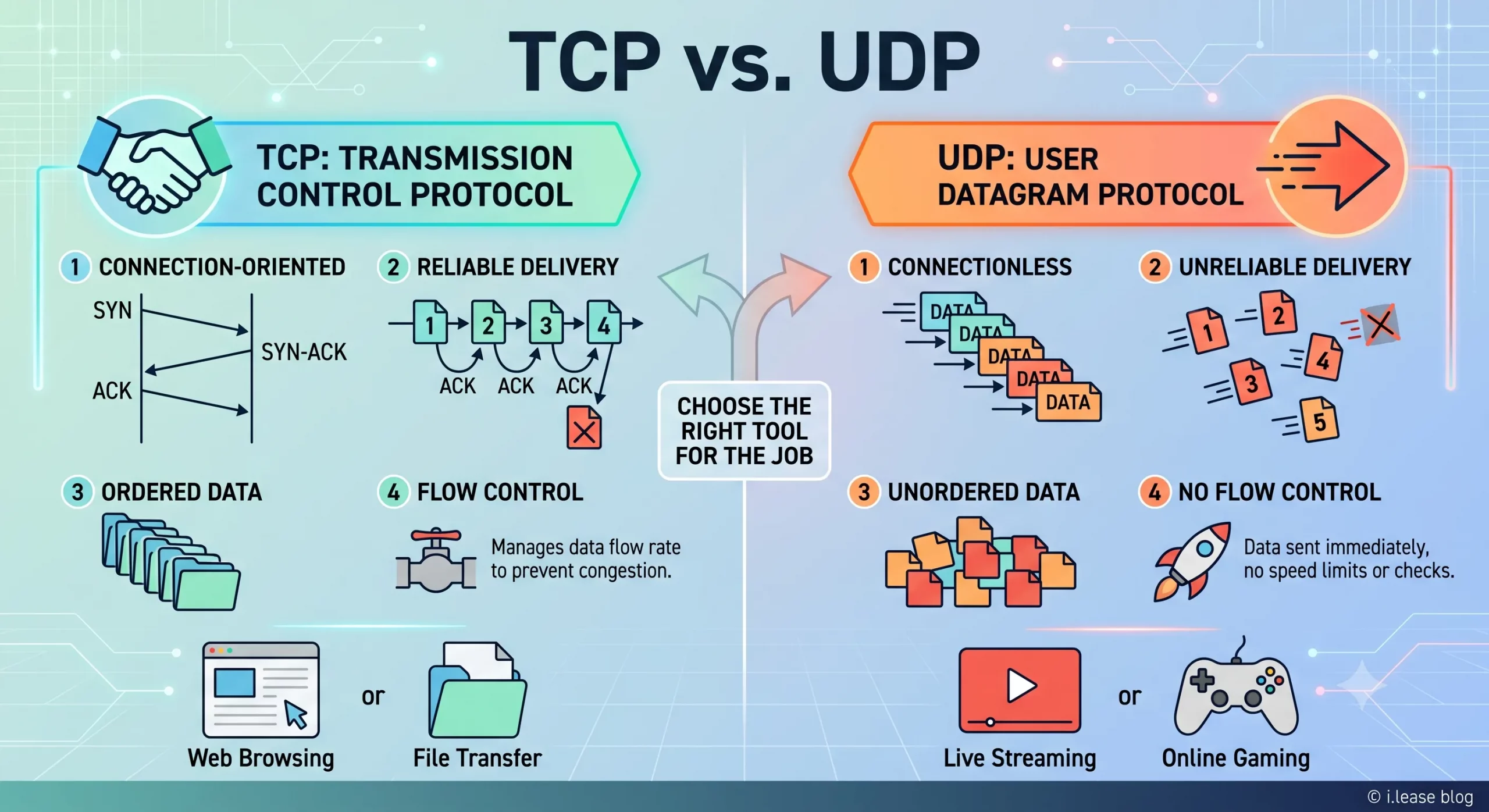
TCP 与 UDP:IPv4 租赁和企业网络指南
TCP 和 UDP 是互联网中最重要的两种传输层协议。它们决定数据如何在设备、服务器、云平台、VPN 网关、DNS 解析器、电子邮件系统、流媒体平台以及企业应用程序之间传输。 对于企业而言,TCP 和 UDP 不仅仅是技术术语,它们会直接影响实际的基础设施性能。公网 IPv4 地址提供可从互联网访问的网络端点,而 TCP 和 UDP 则决定流量如何通过该端点进行传输。 这对于租用或购买 IPv4 地址的企业尤为重要。企业租用 IPv4 地址并不是单纯为了持有这些地址,而是为了运行网站、API、VPN 隧道、DNS 服务、电子邮件平台、SaaS 应用程序、游戏服务器、流媒体系统、安全工具以及云端工作负载。不同类型的服务决定了需要使用 TCP、UDP,还是同时使用两者。 通过 i.lease,企业可以使用 IPv4 租赁服务获取用于实际网络部署的公网 IPv4 资源。需要长期控制 IP 地址资源的企业也可以购买 IP 地址,而拥有闲置 IPv4 资源的组织则可以出售 IP 地址。 TCP和UDP是什么? TCP 和 UDP 都是传输层协议。它们位于 IP 协议之上,帮助应用程序通过网络发送和接收数据。 IP 地址用于确定流量应该发送到哪里,而 TCP 和 UDP 则决定这些流量如何进行传输。 简单来说: TCP 适用于重视可靠性和按顺序传输数据的场景。 UDP 适用于重视速度、低延迟和轻量化数据传输的场景。 企业可能会使用同一个公网 IPv4 地址来运行不同的服务,但每项服务可能依赖不同的传输协议。例如,网站可能使用 TCP,VPN 网关可能使用 UDP,DNS 解析器可能同时使用 UDP 和 TCP,而游戏服务器则可能更倾向于使用 UDP,因为对于实时游戏而言,延迟造成的影响通常比少量数据包丢失更加明显。 因此,TCPRead more Related Posts 什么是电信公司?电信运营商如何为英国、美国和加拿大提供网络连接支持? 电信公司(Telco Companies),也称为电信运营商(Telecommunications Companies),提供通信与网络连接服务。这些服务包括移动通信网络、宽带互联网、光纤连接、固定电话服务、企业网络连接、云连接、托管网络服务以及数据中心连接等。 对于普通消费者而言,电信公司通常被视为移动通信或宽带互联网服务提供商。对于企业来说,电信公司远不只是一个服务品牌,更是关键的基础设施合作伙伴,帮助企业连接办公室、数据中心、云平台、远程员工、客户应用程序以及各类数字化服务。 随着企业越来越依赖云平台、SaaS 应用、AI 工具、VPN、网络安全系统以及在线服务,电信公司已成为数字基础设施规划中不可或缺的重要组成部分。 电信公司是什么? 电信公司(Telco Companies)是提供电信服务的企业。这些服务让个人、设备、企业和各种系统能够跨越距离进行通信与连接。 一家电信公司可能提供以下服务: 移动通信服务 宽带互联网 光纤连接 固定电话服务 企业互联网接入 企业广域网(WAN)服务 云连接服务 数据中心连接 VPN TCP 与 UDP:IPv4 租赁和企业网络指南 TCP 和 UDP 是互联网中最重要的两种传输层协议。它们决定数据如何在设备、服务器、云平台、VPN 网关、DNS 解析器、电子邮件系统、流媒体平台以及企业应用程序之间传输。 对于企业而言,TCP 和 UDP 不仅仅是技术术语,它们会直接影响实际的基础设施性能。公网 IPv4 地址提供可从互联网访问的网络端点,而 TCP 和 UDP 则决定流量如何通过该端点进行传输。 这对于租用或购买 IPv4 地址的企业尤为重要。企业租用 IPv4 什么是区域互联网注册管理机构(RIR) 区域互联网注册管理机构(Regional Internet Registry, RIR)是负责在特定地理区域内分配和管理互联网编号资源的组织。这些资源主要包括 IP 地址(IPv4 和 IPv6)以及自治系统号(ASN),它们是支撑设备和网络在互联网上相互通信的关键要素。 如果没有一套组织完善的系统来分配唯一的 IP 地址和路由标识符,互联网便无法正常运转。RIR 确保这一过程在各自管辖的区域内保持公平、高效与一致,从而避免冲突,并提升互联网治理的透明度。 全球五大 RIR 目前全球共有五家获官方认可的 RIR,各自负责世界上特定的区域:AFRINIC – 非洲网络信息中心(非洲)APNIC – 亚太网络信息中心(亚太地区)ARIN .related-post {} .related-post .post-list { text-align: left; } .related-post .post-list .item { margin: 5px; padding: 10px; } .related-post .headline { font-size: 18px !important; color: #999999 !important; } .related-post .post-list .item .post_thumb { max-height: 220px; margin: 10px 0px; padding: 0px; display: block; } .related-post .post-list .item .post_title { font-size: 16px; color: #3f3f3f; margin: 10px 0px; padding: 0px; display: block; text-decoration: none; } .related-post .post-list .item .post_excerpt { font-size: 13px; color: #3f3f3f; margin: 10px 0px; padding: 0px; display: block; text-decoration: none; } @media only screen and (min-width: 1024px) { .related-post .post-list .item { width: 30%; } } @media only screen and (min-width: 768px) and (max-width: 1023px) { .related-post .post-list .item { width: 90%; } } @media only screen and (min-width: 0px) and (max-width: 767px) { .related-post .post-list .item { width: 90%; } }
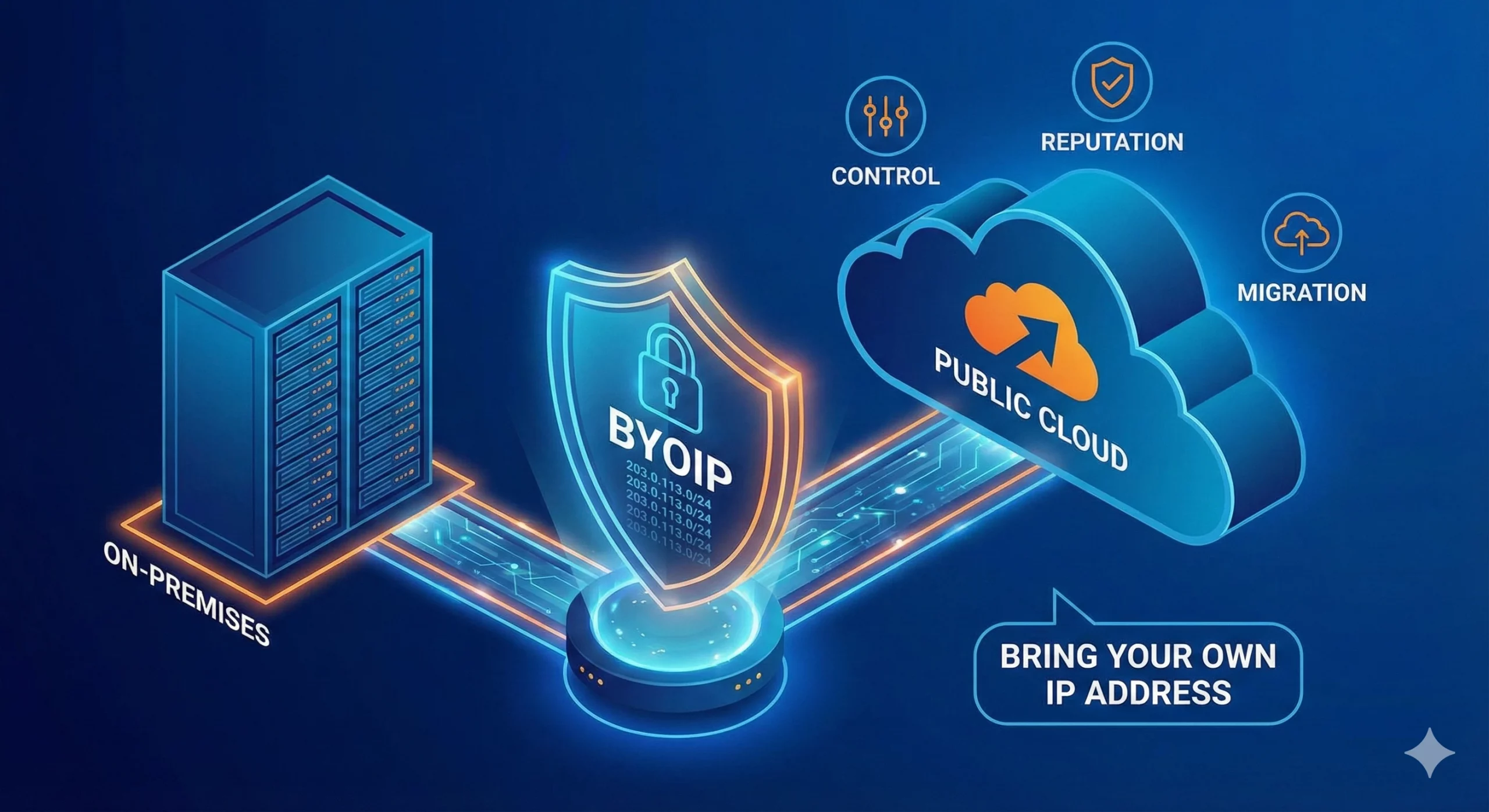
什么是BYOIP(自备IP地址)?
自带 IP(Bring Your Own IP,简称 BYOIP)是一种网络部署方式,允许企业将自己现有的公网 IP 地址段应用于云服务提供商、数据中心、内容分发网络(CDN)或其他基础设施平台。 企业无需使用服务提供商分配的新公网 IP 地址,而是可以使用自己已拥有或已获授权使用的 IPv4 或 IPv6 地址前缀。服务提供商会验证该组织对该地址段的使用权限,并在支持的情况下,通过其自身网络对该地址段进行路由公告(Advertise)。 BYOIP 有助于企业在迁移至云平台时保留现有的防火墙规则、白名单(Allowlists)、客户系统集成、IP 信誉(IP Reputation)、DNS 配置以及既有的网络身份。这不仅能够减少因更换 IP 地址而带来的业务中断,还能降低对服务提供商分配 IP 的依赖,使未来的基础设施迁移与扩展更加灵活且易于管理。 对于需要 BYOIP 地址资源的企业,可选择 购买 IPv4 地址(Buy IP),以获得长期控制权;如果更重视灵活性,也可采用 IPv4 租赁(IPv4 Leasing),按业务需求获取公网 IP 资源。 什么是BYOIP? BYOIP 是 Bring Your Own IP(自带 IP)的缩写。这是一种网络部署模式,允许组织将现有的公网 IP 地址段带入云服务提供商或其他基础设施平台使用。 在 BYOIP 模式下,组织仍然拥有或保留该 IP 地址段的使用权,而平台则获得授权,可在其基础设施中对该地址段进行路由公告(Advertise)和使用。随后,这些 IP 地址可分配给虚拟机(Virtual Machines)、负载均衡器(Load Balancers)、VPN 网关、内容分发服务(CDN)、安全平台以及公网应用程序端点等受支持的服务。 例如,一家企业将应用程序从本地数据中心迁移到云环境时,可能并不希望更换现有的公网 IP 地址。这些 IP 地址可能已经存在于客户白名单(Allowlists)、防火墙策略、DNS 记录、合作伙伴配置以及电子邮件信誉(Email Reputation)数据库中。 BYOIP 使企业能够在迁移工作负载的同时,继续使用原有的公网 IP 地址,从而保持更一致的网络身份,并减少因更换 IP 地址而带来的配置调整和业务影响。 Related Posts 什么是电信公司?电信运营商如何为英国、美国和加拿大提供网络连接支持? 电信公司(Telco Companies),也称为电信运营商(Telecommunications Companies),提供通信与网络连接服务。这些服务包括移动通信网络、宽带互联网、光纤连接、固定电话服务、企业网络连接、云连接、托管网络服务以及数据中心连接等。 对于普通消费者而言,电信公司通常被视为移动通信或宽带互联网服务提供商。对于企业来说,电信公司远不只是一个服务品牌,更是关键的基础设施合作伙伴,帮助企业连接办公室、数据中心、云平台、远程员工、客户应用程序以及各类数字化服务。 随着企业越来越依赖云平台、SaaS 应用、AI 工具、VPN、网络安全系统以及在线服务,电信公司已成为数字基础设施规划中不可或缺的重要组成部分。 电信公司是什么? 电信公司(Telco Companies)是提供电信服务的企业。这些服务让个人、设备、企业和各种系统能够跨越距离进行通信与连接。 一家电信公司可能提供以下服务: 移动通信服务 宽带互联网 光纤连接 固定电话服务 企业互联网接入 企业广域网(WAN)服务 云连接服务 数据中心连接 VPN TCP 与 UDP:IPv4 租赁和企业网络指南 TCP 和 UDP 是互联网中最重要的两种传输层协议。它们决定数据如何在设备、服务器、云平台、VPN 网关、DNS 解析器、电子邮件系统、流媒体平台以及企业应用程序之间传输。 对于企业而言,TCP 和 UDP 不仅仅是技术术语,它们会直接影响实际的基础设施性能。公网 IPv4 地址提供可从互联网访问的网络端点,而 TCP 和 UDP 则决定流量如何通过该端点进行传输。 这对于租用或购买 IPv4 地址的企业尤为重要。企业租用 IPv4 什么是区域互联网注册管理机构(RIR) 区域互联网注册管理机构(Regional Internet Registry, RIR)是负责在特定地理区域内分配和管理互联网编号资源的组织。这些资源主要包括 IP 地址(IPv4 和 IPv6)以及自治系统号(ASN),它们是支撑设备和网络在互联网上相互通信的关键要素。 如果没有一套组织完善的系统来分配唯一的 IP 地址和路由标识符,互联网便无法正常运转。RIR 确保这一过程在各自管辖的区域内保持公平、高效与一致,从而避免冲突,并提升互联网治理的透明度。 全球五大 RIR 目前全球共有五家获官方认可的 RIR,各自负责世界上特定的区域:AFRINIC – 非洲网络信息中心(非洲)APNIC – 亚太网络信息中心(亚太地区)ARIN .related-post {} .related-post .post-list { text-align: left; } .related-post .post-list .item { margin: 5px; padding: 10px; } .related-post .headline { font-size: 18px !important; color: #999999 !important; } .related-post .post-list .item .post_thumb { max-height: 220px; margin: 10px 0px; padding: 0px; display: block; } .related-post .post-list .item .post_title { font-size: 16px; color: #3f3f3f; margin: 10px 0px; padding: 0px; display: block; text-decoration: none; } .related-post .post-list .item .post_excerpt { font-size: 13px; color: #3f3f3f; margin: 10px 0px; padding: 0px; display: block; text-decoration: none; } @media only screen and (min-width: 1024px) { .related-post .post-list .item { width: 30%; } } @media only screen and (min-width: 768px) and (max-width: 1023px) { .related-post .post-list .item { width: 90%; } } @media only screen and (min-width: 0px) and (max-width: 767px) { .related-post .post-list .item { width: 90%; } }
