How to Prevent IPv4 Hijacking During a Transfer: 10 Security Steps
 Stephanie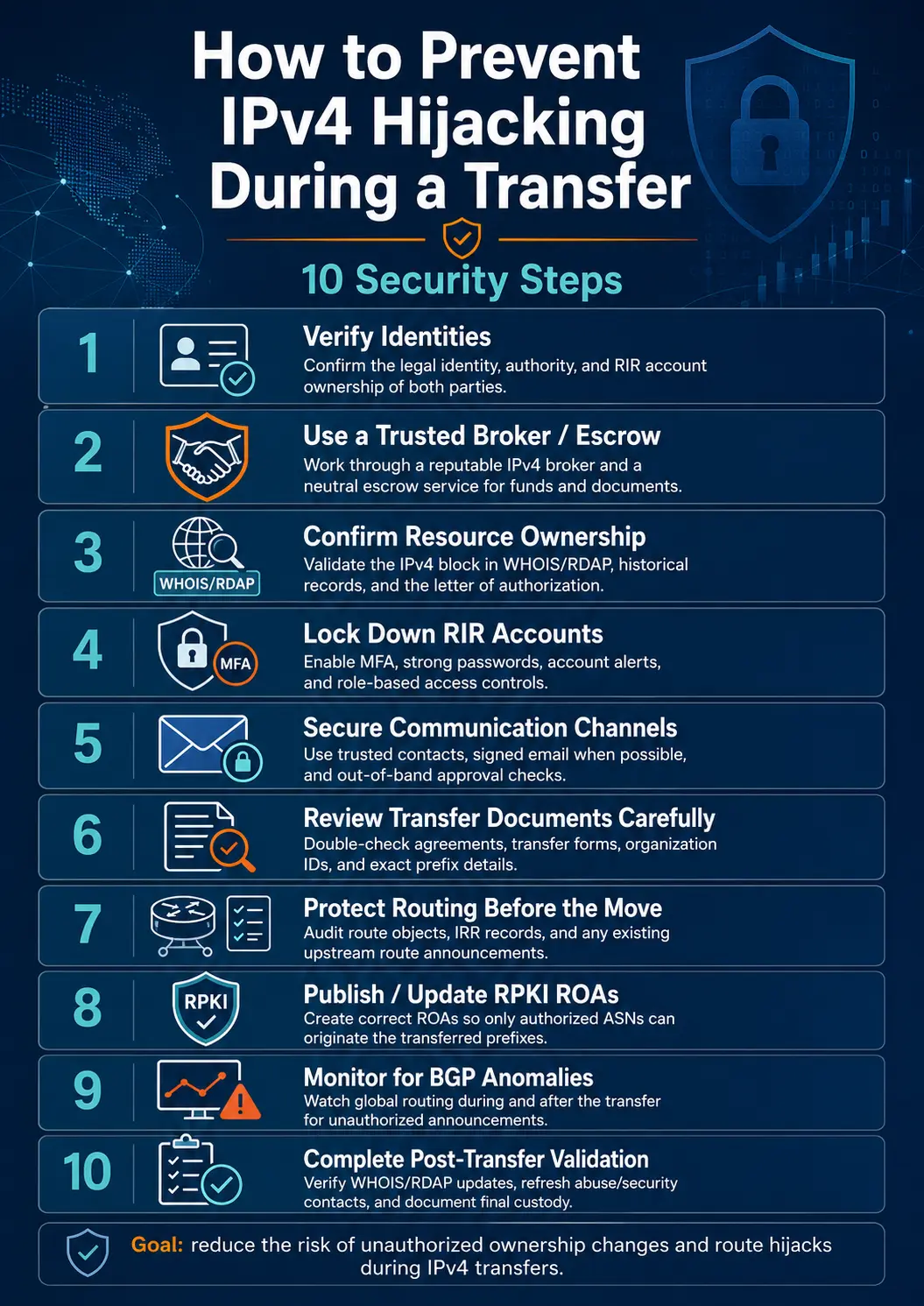
Transferring IPv4 address space is not only a commercial and registry process. It is also a sensitive routing operation.
Table of Contents
During an IPv4 transfer, control of a prefix moves from one organization to another. Registry records, Route Origin Authorizations, Internet Routing Registry objects, upstream-provider filters, reverse DNS settings, and live BGP announcements may all need to change.
When these changes are completed in the wrong order—or when identity and authorization checks are weak—the address block can become unreachable, incorrectly announced, or exposed to an IPv4 hijacking attempt.
Organizations that plan to buy IPv4 addresses or sell IPv4 addresses should therefore treat routing security as a core part of the transaction, not as a post-transfer administrative task.
This guide explains how buyers, sellers, brokers, hosting providers, data centers, and network operators can prevent IPv4 hijacking during a transfer.
What Is IPv4 Hijacking?
IPv4 hijacking, commonly called BGP prefix hijacking, occurs when an Autonomous System announces an IPv4 prefix that it is not legitimately authorized to originate.
The Border Gateway Protocol, or BGP, is used by autonomous networks to exchange Internet reachability information. However, traditional BGP does not independently prove that the organization announcing a prefix is the legitimate resource holder. RPKI-based origin validation was developed to help networks verify whether an origin ASN is authorized to announce a particular prefix.
A hijacked route can cause Internet traffic to be:
- Redirected to an unauthorized network
- Intercepted or inspected
- Dropped, creating an outage
- Used for impersonation, spam, fraud, or other abuse
- Divided between the legitimate and unauthorized networks
Some incidents are deliberate attacks. Others result from configuration errors, stale routing records, incorrect prefix lengths, or a former holder continuing to announce transferred space.
For the affected organization, the practical outcome may be the same: instability, lost traffic, damaged IP reputation, and customer disruption.
Why Is an IPv4 Transfer a Sensitive Routing Period?
An IPv4 transfer changes administrative control, but the global routing system does not automatically update every associated routing authorization, filter, and operational record at the same moment.
For example, the seller may still have an old ROA or IRR route object associated with the block. The buyer’s upstream provider may not yet have updated its prefix filters. The buyer may announce the block before its new ROA becomes visible to validators.
This creates a temporary mismatch between:
- The registered resource holder
- The authorized origin ASN
- The ASN visible in BGP
- The information published in an IRR
- The prefix filters used by upstream providers
- The organization shown in operational contact records
ARIN specifically advises transfer sources to review affected ROAs and IRR records before a transfer. After completion, the recipient is responsible for creating or updating its ROAs, authoritative IRR entries, and reverse DNS settings.
A secure transfer process must therefore coordinate both the registry layer and the routing layer.
1. Verify the Registered IPv4 Holder
Before signing an agreement, sending funds, or submitting a provider Letter of Authorization, verify that the seller has the authority to transfer the address block.
Review the relevant Regional Internet Registry’s records and confirm:
- The registered organization
- The exact IPv4 prefix and prefix length
- The organization identifier or registry account
- The administrative and technical contacts
- The resource’s transfer eligibility
- Whether the block is involved in a dispute
- Whether additional parties must authorize the transaction
For ARIN transfers, the source must be the current registered holder and must not be involved in a dispute concerning the resource. Transfer requests must also come from an account connected to an authorized point of contact for the organization.
Registry data should be checked directly. Screenshots, forwarded emails, invoices, and privately created ownership documents should not be treated as substitutes for registry verification.
For higher-risk or legacy resources, organizations should also examine the chain of authority, historical registration documents, corporate changes, and the identity of the individuals approving the transfer.
2. Create a Written Transfer and Routing Runbook
A secure IPv4 transfer should have a documented sequence of actions.
The runbook should identify:
- The seller’s technical and registry contacts
- The buyer’s technical and registry contacts
- The old origin ASN
- The intended new origin ASN
- The exact prefixes that will be announced
- The planned ROA configuration
- Required IRR changes
- Upstream-provider approval requirements
- The BGP withdrawal and announcement sequence
- Monitoring tools and escalation contacts
- Rollback conditions
- Evidence required before funds are released
Every action should have a named owner and a completion status.
Avoid vague instructions such as “update routing after approval.” Specify which party will update each object, when the change will happen, how it will be verified, and what must occur before the next step begins.
3. Record the Pre-Transfer Routing Baseline
Before changing anything, record the existing state of the address block.
The baseline should include:
- Current BGP origin ASN
- Visible AS paths
- Existing ROA status
- ROA prefix and maximum-length values
- Existing IRR route objects
- WHOIS or RDAP registration data
- Reverse DNS delegations
- Route visibility across multiple regions
- Current upstream and peering relationships
- Blacklist and abuse-reputation status
- Known subprefix announcements
This provides evidence of the block’s condition before the transfer and makes unauthorized changes easier to identify.
Do not rely on a single route collector or monitoring platform. A prefix may appear normal from one region while being incorrectly announced or partially hijacked elsewhere.
4. Review and Remove the Seller’s Old ROAs
A Route Origin Authorization, or ROA, specifies which ASN is authorized to originate an IP prefix. It can also define the maximum prefix length that the ASN is allowed to announce.
Old ROAs must be handled carefully during a transfer.
Under ARIN’s published guidance, a source organization should confirm that transferring resources are not included in active ROAs before submitting the transfer. A prefix in a multiprefix ROA should be removed from that ROA, while a single-prefix ROA is removed automatically when the transfer occurs.
The exact procedure may vary by RIR and resource type, so both parties should follow the applicable registry’s current instructions.
Failure to address an old ROA can lead to:
- A valid announcement becoming RPKI invalid
- The former ASN remaining authorized longer than intended
- Conflicting routing intent
- Delays in creating the recipient’s new authorization
- Reachability problems on networks that reject RPKI-invalid routes
The seller should not simply delete every routing object without coordination. Removing authorization too early may disrupt a legitimate transition announcement. The timing must be agreed upon by the seller, buyer, RIR, and relevant network providers.
5. Create a Precise ROA for the New Origin ASN
After the recipient has the registry authority required to manage RPKI for the resource, it should create a ROA matching the intended production announcement.
The ROA should specify:
- The correct IPv4 prefix
- The correct new origin ASN
- The narrowest operationally appropriate maximum length
- Only the announcements that the buyer genuinely intends to originate
Avoid setting an unnecessarily broad maxLength.
For example, authorizing a /24 maximum length for a much larger aggregate may permit numerous more-specific routes to appear RPKI valid. Current RPKI best-practice guidance recommends configuring a maximum length that covers the prefixes actually announced—and nothing more. Overly liberal values can increase exposure to forged-origin subprefix hijacking.
After creating the ROA, verify that:
- It has been published.
- The prefix-origin pair is shown as valid.
- The intended BGP announcement will not be classified as invalid.
- No unrelated announcements have been unintentionally authorized.
Do not assume that clicking “create” means every relying party has immediately received the updated record. Confirm the published result with independent validation and routing-monitoring tools before relying on it operationally.
6. Update IRR Route Objects and Provider Filters
Internet Routing Registries allow network operators to document intended routing information. A route object associates an IPv4 prefix with the ASN expected to originate it. Network providers frequently use IRR data to generate customer prefix filters.
Before the transfer, the seller should review route objects that reference the transferred prefix and remove or update records that will no longer apply.
After the transfer, the buyer should publish authoritative route objects for the new origin ASN.
The buyer should then confirm that each upstream provider has regenerated or manually updated its filters. Otherwise, the new announcement may be rejected even when the registry transfer and ROA are correct.
Check all relevant systems, including:
- RIR-operated routing registries
- RADB or other mirrored IRRs
- Provider-specific customer portals
- AS-SET objects
- Prefix lists
- Maximum-prefix limits
- Route-server authorization
- Peering configuration
RPKI and IRR are complementary controls. RPKI provides cryptographically verifiable origin authorization, while IRR records continue to be used by many networks to construct routing policies and filters.
7. Strengthen LOA and Provider-Onboarding Verification
A Letter of Authorization is often used to show that a network is permitted to originate a prefix. However, an LOA is only as reliable as the identity-verification process behind it.
Attackers may submit forged documents, impersonate authorized staff, compromise email accounts, or exploit weak provider-onboarding processes.
An APNIC case study published in 2026 described how social engineering and weaknesses in provider onboarding contributed to unauthorized routing activity despite the availability of routing-security tools. The case highlights that cryptographic controls must be combined with strong identity checks and operational coordination.
Providers should verify authorization through multiple channels:
- Match the organization against current RIR records.
- Contact a known registry-listed or contract-listed representative.
- Use an out-of-band callback for sensitive changes.
- Confirm the prefix and ASN independently.
- Verify corporate domains and email headers.
- Require approval from more than one authorized person.
- Check that the signatory has authority to approve routing.
- Reject documents containing unexplained edits or mismatched details.
- Record who approved the request and when.
- Revalidate authorization after the registry transfer is complete.
An emailed PDF alone should not be sufficient authorization for a high-value IPv4 block.
8. Require Strict Prefix-Level Filtering
Upstream providers should allow customers to announce only prefixes and ASNs they are legitimately authorized to originate.
MANRS recommends explicit prefix-level filtering or equivalent controls for customer routes. It also notes that AS-path filtering alone is not sufficient to prevent serious routing problems.
For a transferred IPv4 block, the provider should configure filters that match:
- The exact authorized prefix
- The approved origin ASN
- The permitted prefix lengths
- The expected customer session
- Any approved downstream relationships
The provider should reject:
- Unauthorized more-specific announcements
- Announcements from an unexpected ASN
- Prefixes not included in the customer authorization
- RPKI-invalid routes, in accordance with its published routing policy
- Routes received through an unauthorized session
Buyers should ask prospective upstream providers how they validate customer resources and how quickly filters can be updated during a transfer.
9. Coordinate the BGP Cutover
The live routing cutover should take place only after the registry and authorization prerequisites have been confirmed.
A controlled sequence may include:
- Confirming that the registry transfer is complete.
- Confirming that the recipient can manage the resource.
- Publishing and validating the recipient’s ROA.
- Publishing the new IRR route object.
- Confirming that upstream filters have been updated.
- Withdrawing the seller’s old announcement.
- Announcing the prefix from the approved new ASN.
- Monitoring route propagation and RPKI status.
- Confirming reachability from several networks and regions.
- Closing old sessions and access paths after stability is established.
Avoid extended, unexplained simultaneous announcements from the old and new origin ASNs. Although controlled multi-origin routing can be legitimate, it can also make anomalies harder to distinguish from unauthorized activity.
Any overlap should have a documented reason, limited duration, explicit authorization, and active monitoring.
10. Monitor the Prefix Before, During, and After Transfer
Routing monitoring should begin before the cutover and continue after the transaction is commercially complete.
Configure alerts for:
- A new or unexpected origin ASN
- RPKI-invalid status
- A change from valid to not found
- More-specific prefix announcements
- Unusual AS-path changes
- Loss of global visibility
- Sudden regional reachability differences
- Unauthorized IRR modifications
- Changes to registry contacts
- Unexpected reverse DNS changes
- New abuse or blacklist listings
Keep current NOC, technical, and abuse contacts in the appropriate registry and network databases. MANRS recommends maintaining operational contact details so other network operators can quickly coordinate during a routing incident.
A monitoring alert is useful only when someone is responsible for responding to it. Define who will investigate, who can contact providers, who can change ROAs, and who has authority to initiate a rollback.
What RPKI Can—and Cannot—Prevent
RPKI is one of the most important defenses against IPv4 origin hijacking, but it is not a complete BGP-security solution.
A valid ROA allows networks performing Route Origin Validation to determine whether the originating ASN is authorized for the prefix. This can help prevent an unauthorized origin announcement from being accepted and propagated.
However, RPKI origin validation does not independently validate the entire AS path. BGPsec was designed to supplement origin validation by adding protection for BGP path information, although deployment and operational support differ across networks.
RPKI also cannot compensate for:
- A compromised authorized ASN
- An overly broad ROA maximum length
- Incorrect ROA configuration
- Weak provider identity verification
- Compromised registry credentials
- Social-engineering attacks
- Failure by networks to enforce Route Origin Validation
- Internal routing or access-control failures
The strongest defense is layered: registry verification, RPKI, IRR accuracy, provider filtering, secure onboarding, controlled BGP changes, credential security, and continuous monitoring.
Common IPv4 Transfer Security Mistakes
Announcing the Prefix Before the ROA Is Ready
The new route may become RPKI invalid and be rejected by networks enforcing origin validation.
Leaving Old IRR Objects Active
Providers may continue building filters from incorrect or outdated routing information.
Using an Overly Broad Maximum Length
This can authorize more-specific announcements that are not operationally required.
Trusting an LOA Without Independent Verification
A professional-looking document does not prove that the sender controls the resource.
Releasing Funds Before Registry Completion
Payment milestones should be linked to objective transfer conditions, not only emails or screenshots.
Failing to Confirm Upstream Filters
A correct ROA does not guarantee that a provider’s customer prefix list has been updated.
Monitoring from Only One Location
Partial or regional hijacks may not be visible from every route collector.
Keeping Former Staff and Vendors Authorized
Old registry accounts, API keys, email accounts, provider portals, and RPKI access should be removed during the final handover.
IPv4 Transfer Security Checklist
Before the Transfer
- Verify the registered holder directly with the applicable RIR.
- Confirm the exact prefixes and intended recipient.
- Review transfer eligibility and any disputes.
- Record current BGP, RPKI, IRR, registry, rDNS, and reputation data.
- Identify the old and new origin ASNs.
- Agree on the routing cutover plan.
- Review the seller’s ROAs and IRR objects.
- Obtain upstream-provider requirements.
- Establish escrow and registry-based release conditions.
- Confirm incident and escalation contacts.
During the Transfer
- Monitor registry-record changes.
- Protect registry accounts with strong authentication.
- Validate communications through known contacts.
- Do not approve unexpected ASN or prefix changes.
- Confirm the registry transfer before the production cutover.
- Create the recipient’s precise ROA.
- Verify the published RPKI state.
- Publish authoritative IRR records.
- Confirm upstream filters have been updated.
- Coordinate withdrawal and announcement timing.
After the Transfer
- Confirm the prefix is originated only by the intended ASN.
- Verify RPKI-valid status.
- Test global and regional reachability.
- Remove obsolete ROAs and IRR records.
- Update reverse DNS delegations.
- Update NOC and abuse contacts.
- Revoke seller and former-provider access.
- Archive transfer and routing evidence.
- Keep route-change alerts active.
- Conduct a post-transfer security review.
How i.lease Supports a More Secure IPv4 Transfer
The safest IPv4 transactions combine commercial controls with registry compliance and operational readiness.
The i.lease marketplace provides a structured process for organizations seeking to acquire IPv4 address space. Its published buying workflow includes ownership and reputation screening, escrow protection, RIR-aligned documentation, coordinated registry transfers, and an operational handover covering RPKI, reverse DNS, and routing configuration.
For buyers, this helps reduce the risks associated with unknown counterparties, incomplete documentation, and poorly coordinated routing changes.
For sellers, a structured process helps establish a clear chain of custody and ensures that obsolete routing authorizations are addressed as the resource moves to its new holder.
Explore verified IPv4 blocks on the i.lease marketplace or list unused IPv4 address space for sale.
Frequently Asked Questions
Can RPKI completely prevent IPv4 hijacking?
No. RPKI can validate whether an ASN is authorized to originate a prefix, which makes it an important defense against origin hijacking. It does not validate every part of the BGP path and cannot replace provider filtering, identity checks, credential security, or route monitoring.
When should the buyer create the new ROA?
The buyer should create the new ROA after obtaining the registry authority required to manage RPKI for the transferred resource and before depending on the new production announcement. The exact sequence should follow the relevant RIR’s procedures.
What happens if the old ROA is not removed?
An old or conflicting ROA may cause the new announcement to become invalid, preserve outdated authorization, or create routing confusion. Sellers and buyers should review ROAs as part of the formal transfer runbook.
Is an LOA enough to authorize a BGP announcement?
An LOA can support the authorization process, but it should not be accepted without independent identity and registry verification. Providers should confirm the resource holder, signatory authority, prefix, ASN, and transfer status through trusted channels.
Why are IRR records important when RPKI is available?
Many network operators use IRR data to create prefix filters. An accurate ROA may not prevent reachability problems when a provider’s IRR-derived filters still reference the old origin ASN.
How long should an IPv4 prefix be monitored after a transfer?
There is no universal monitoring period. At minimum, active monitoring should continue throughout the transfer, cutover, and stabilization period. Long-term route-origin, RPKI-status, and more-specific-announcement alerts provide stronger protection.
Conclusion
Preventing IPv4 hijacking during a transfer requires more than updating the name of the registered resource holder.
The seller must remove obsolete authorizations. The buyer must publish accurate routing intent. Upstream providers must verify the customer and update their filters. Both parties must coordinate the BGP cutover and monitor the prefix from multiple locations.
The essential controls are:
- Verified registry authority
- Precise RPKI ROAs
- Accurate IRR route objects
- Strong LOA and identity validation
- Strict provider prefix filtering
- Coordinated BGP withdrawals and announcements
- Continuous route monitoring
- Complete post-transfer access cleanup
When these controls are built into the transaction from the beginning, organizations can reduce the risk of hijacking, outages, routing invalids, and delayed deployment.
Secure your next IPv4 transaction with a structured, RIR-aligned process. Start buying verified IPv4 address space through i.lease.
Frequent Asked Questions
1. Why are some IPv4 leases cheaper than others?
IPv4 lease prices vary according to block size, lease duration, region, demand, address history, reputation, routing readiness, support and renewal conditions. A lower price may also mean that fewer operational services are included.
2. Is a cheap IPv4 lease always risky?
No. A low-cost lease may be suitable for temporary, non-critical or easily replaceable workloads. The risk depends on the block’s history, routing configuration, documentation, support and the cost of disruption to the customer.
3. What hidden fees should I check before leasing IPv4 addresses?
Check for setup fees, deposits, LOA charges, ROA or routing fees, reverse-DNS fees, abuse-management charges, geolocation support, reputation remediation, renewal increases, early termination and replacement-address costs.
4. How can I check an IPv4 block’s reputation?
Check the full prefix against recognised blocklists and reputation services, examine its prior routing and registration history, and test it against platforms important to the intended workload. Tools such as the Spamhaus Reputation Checker can be part of this process.
5. What is an LOA in IPv4 leasing?
A Letter of Authorization is a document allowing a network operator to perform a defined action involving an IPv4 prefix, commonly announcing it from a specified ASN. The receiving provider should confirm that the issuer has authority to grant that permission.
相关文章
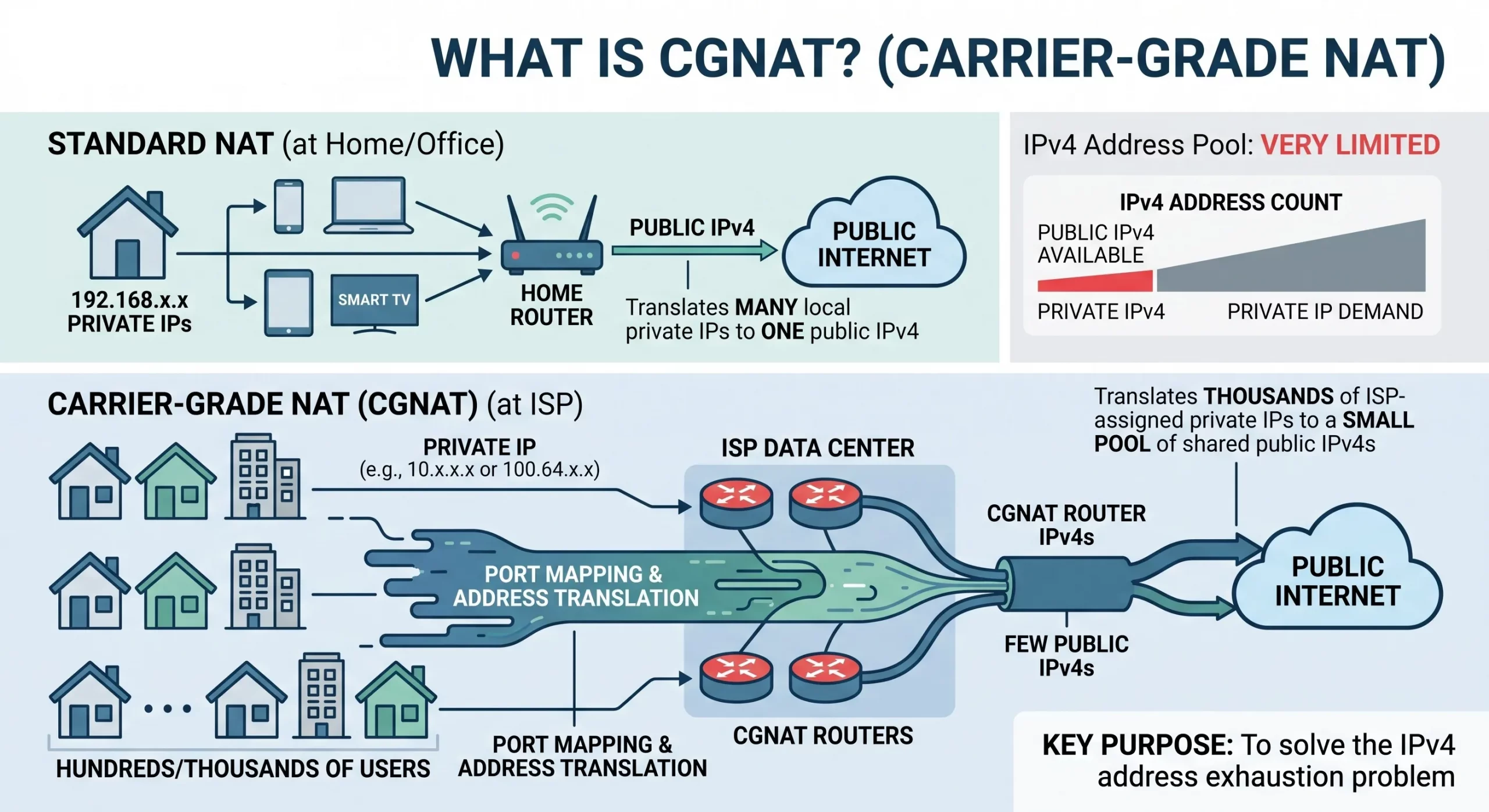
什么是 CGNAT(运营商级 NAT)?它为何会影响主机托管、游戏和入站服务?
CGNAT(Carrier-Grade NAT,运营商级网络地址转换)是一种技术,它允许互联网服务提供商让多个客户同时共享同一个公共 IPv4 地址,而不是为每位客户单独分配一个公共 IPv4 地址。 它会在服务提供商的网络内部增加第二层网络地址转换,因此数百甚至数千名用户都位于同一个公共地址之后,而外部互联网看到的只是这个共享的公共地址。 对于日常网页浏览、流媒体播放和应用程序使用来说,CGNAT 通常不会被用户察觉。问题会在外部网络需要主动连接到你时出现,例如托管服务器、进行端口转发、运行游戏服务器、接收 VoIP 或 VPN 连接,或启用远程访问。由于你不再拥有属于自己的公共地址——而是与其他陌生用户共享同一个地址——传入连接无法明确知道应该被转发到哪一个用户,因此这些服务可能无法正常工作或变得不稳定。 CGNAT 并不是程序错误或配置错误。它是针对一个结构性现实而采取的有意解决方案:全球 IPv4 地址已经不足,而互联网服务提供商仍需要在公共地址数量有限的情况下继续连接新的客户。这使 CGNAT 成为普通用户最容易接触到的一个明显迹象,说明公共 IPv4 地址是一种有限且竞争激烈的资源;同时也清楚说明了为什么运行对外服务的企业需要拥有自己的专用公共地址空间。本文将介绍什么是 CGNAT、它如何运作、具体会影响哪些功能、如何判断自己是否处于 CGNAT 环境中,以及对于无法接受这些限制的企业来说,有哪些可行的解决方案。 什么是 CGNAT CGNAT,也写作 CGN,有时也称为 Large-Scale NAT(LSN,大规模网络地址转换),是一种在运营商层面执行的网络地址转换技术,使 ISP 能够让多个客户共享同一个公共 IPv4 地址。 它延伸了家庭路由器中 NAT 的基本原理——多个私有设备共享一个地址——但会在服务提供商的网络层面再次执行一次,并同时覆盖大量客户。 这样一来,处于 CGNAT 后方的客户并不拥有一个唯一的公共地址。外部互联网所看到、并与其流量关联的地址,是与其他用户共享的,而且该地址由 ISP 控制,而不是由客户控制。对于由用户主动发起的出站连接,这通常不会造成问题。但对于任何依赖外部网络能够单独连接到该用户的服务来说,这个由服务提供商控制的共享地址正是问题的根源。 从一开始就明确区分这一点会很有帮助,因为它几乎解释了 CGNAT 会破坏的所有功能:由你主动发起的出站连接通常可以正常工作;而由其他人从外部主动尝试连接到你的入站连接,才是容易失败的部分。 从根本上来说,CGNAT 对客户端友好,却对服务器并不友好。 CGNAT 的工作原理是什么? CGNAT 的工作方式是在客户网络与公共互联网之间增加第二层地址转换,因此流量会经过两次转换:第一次发生在家庭路由器上,第二次发生在 ISP 的运营商级 NAT 设备上。 在传统网络环境中,家庭路由器会在设备的私有地址与 ISP 分配给你的单个公共地址之间执行 NAT。此时,你仍然拥有一个公共地址,而且可以通过端口转发,将外部传入连接定向到路由器后方的某台设备——这也是自托管以及许多网络服务能够正常运行的重要机制。关于私有地址与公共地址之间的关系,可以参考我们的 公共 IP 与私有 IP 指南。 CGNAT 会加入第二个转换阶段。ISP 不再直接为你的路由器分配公共地址,而是先分配一个来自共享中间地址范围的地址,然后通过运营商 NAT 设备,将大量这类客户的流量转换到一个规模更小的真实公共地址池中。因此,数据路径会变成:你的私有设备地址 Related Posts 什么是 CGNAT(运营商级 NAT)?它为何会影响主机托管、游戏和入站服务? CGNAT(Carrier-Grade NAT,运营商级网络地址转换)是一种技术,它允许互联网服务提供商让多个客户同时共享同一个公共 IPv4 地址,而不是为每位客户单独分配一个公共 IPv4 地址。 它会在服务提供商的网络内部增加第二层网络地址转换,因此数百甚至数千名用户都位于同一个公共地址之后,而外部互联网看到的只是这个共享的公共地址。对于日常网页浏览、流媒体播放和应用程序使用来说,CGNAT 通常不会被用户察觉。问题会在外部网络需要主动连接到你时出现,例如托管服务器、进行端口转发、运行游戏服务器、接收 VoIP 或 VPN 连接,或启用远程访问。由于你不再拥有属于自己的公共地址——而是与其他陌生用户共享同一个地址——传入连接无法明确知道应该被转发到哪一个用户,因此这些服务可能无法正常工作或变得不稳定。CGNAT 并不是程序错误或配置错误。它是针对一个结构性现实而采取的有意解决方案:全球 IPv4 地址已经不足,而互联网服务提供商仍需要在公共地址数量有限的情况下继续连接新的客户。这使 CGNAT 成为普通用户最容易接触到的一个明显迹象,说明公共 IPv4 地址是一种有限且竞争激烈的资源;同时也清楚说明了为什么运行对外服务的企业需要拥有自己的专用公共地址空间。本文将介绍什么是 CGNAT、它如何运作、具体会影响哪些功能、如何判断自己是否处于 什么是电信公司?电信运营商如何为英国、美国和加拿大提供网络连接支持? 电信公司(Telco Companies),也称为电信运营商(Telecommunications Companies),提供通信与网络连接服务。这些服务包括移动通信网络、宽带互联网、光纤连接、固定电话服务、企业网络连接、云连接、托管网络服务以及数据中心连接等。 对于普通消费者而言,电信公司通常被视为移动通信或宽带互联网服务提供商。对于企业来说,电信公司远不只是一个服务品牌,更是关键的基础设施合作伙伴,帮助企业连接办公室、数据中心、云平台、远程员工、客户应用程序以及各类数字化服务。 随着企业越来越依赖云平台、SaaS 应用、AI 工具、VPN、网络安全系统以及在线服务,电信公司已成为数字基础设施规划中不可或缺的重要组成部分。 电信公司是什么? 电信公司(Telco Companies)是提供电信服务的企业。这些服务让个人、设备、企业和各种系统能够跨越距离进行通信与连接。 一家电信公司可能提供以下服务: 移动通信服务 宽带互联网 光纤连接 固定电话服务 企业互联网接入 企业广域网(WAN)服务 云连接服务 数据中心连接 VPN TCP 与 UDP:IPv4 租赁和企业网络指南 TCP 和 UDP 是互联网中最重要的两种传输层协议。它们决定数据如何在设备、服务器、云平台、VPN 网关、DNS 解析器、电子邮件系统、流媒体平台以及企业应用程序之间传输。 对于企业而言,TCP 和 UDP 不仅仅是技术术语,它们会直接影响实际的基础设施性能。公网 IPv4 地址提供可从互联网访问的网络端点,而 TCP 和 UDP 则决定流量如何通过该端点进行传输。 这对于租用或购买 IPv4 地址的企业尤为重要。企业租用 IPv4 .related-post {} .related-post .post-list { text-align: left; } .related-post .post-list .item { margin: 5px; padding: 10px; } .related-post .headline { font-size: 18px !important; color: #999999 !important; } .related-post .post-list .item .post_thumb { max-height: 220px; margin: 10px 0px; padding: 0px; display: block; } .related-post .post-list .item .post_title { font-size: 16px; color: #3f3f3f; margin: 10px 0px; padding: 0px; display: block; text-decoration: none; } .related-post .post-list .item .post_excerpt { font-size: 13px; color: #3f3f3f; margin: 10px 0px; padding: 0px; display: block; text-decoration: none; } @media only screen and (min-width: 1024px) { .related-post .post-list .item { width: 30%; } } @media only screen and (min-width: 768px) and (max-width: 1023px) { .related-post .post-list .item { width: 90%; } } @media only screen and (min-width: 0px) and (max-width: 767px) { .related-post .post-list .item { width: 90%; } }

什么是电信公司?电信运营商如何为英国、美国和加拿大提供网络连接支持?
电信公司(Telco Companies),也称为电信运营商(Telecommunications Companies),提供通信与网络连接服务。这些服务包括移动通信网络、宽带互联网、光纤连接、固定电话服务、企业网络连接、云连接、托管网络服务以及数据中心连接等。 对于普通消费者而言,电信公司通常被视为移动通信或宽带互联网服务提供商。对于企业来说,电信公司远不只是一个服务品牌,更是关键的基础设施合作伙伴,帮助企业连接办公室、数据中心、云平台、远程员工、客户应用程序以及各类数字化服务。 随着企业越来越依赖云平台、SaaS 应用、AI 工具、VPN、网络安全系统以及在线服务,电信公司已成为数字基础设施规划中不可或缺的重要组成部分。 电信公司是什么? 电信公司(Telco Companies)是提供电信服务的企业。这些服务让个人、设备、企业和各种系统能够跨越距离进行通信与连接。 一家电信公司可能提供以下服务: 移动通信服务 宽带互联网 光纤连接 固定电话服务 企业互联网接入 企业广域网(WAN)服务 云连接服务 数据中心连接 VPN 服务 托管网络解决方案 互联网传输(Internet Transit) 电信批发服务 部分电信公司拥有并运营大规模的实体网络基础设施;另一些则通过批发接入、租用基础设施或与网络运营商合作来提供电信服务。 电信公司提供哪些服务? 电信公司同时为个人消费者和企业客户提供服务。 面向消费者的服务通常包括移动通信套餐、家庭宽带、光纤互联网、固定电话以及通信组合套餐。 面向企业的服务则可能包括专线互联网接入、企业光纤、专用网络、云连接、托管安全服务、数据中心连接、物联网(IoT)连接以及企业移动通信方案。 对于大型企业客户,电信公司还可提供: 多地点办公室网络连接 远程员工接入 私有云连接 SD-WAN(软件定义广域网) 灾难恢复连接 低延迟网络路由 互联网传输(Internet Transit) 网络监控 托管防火墙服务 正因如此,电信公司不仅对日常通信至关重要,也是现代企业建设先进数字基础设施的重要支柱。 电信公司 vs 互联网服务提供商 vs 网络运营商 电信公司(Telco)、互联网服务提供商(ISP)和网络运营商(Network Operator)之间可能存在重叠,但它们并不完全相同。 电信公司提供电信服务。 互联网服务提供商(ISP)提供互联网接入服务。 网络运营商负责建设、运营和管理网络基础设施。 一些大型电信公司同时承担这三种角色。它们拥有基础设施、运营网络,并向市场提供互联网、移动通信以及企业网络服务。 规模较小的服务提供商则可能专注于其中某一层。例如,互联网服务提供商(ISP)可以销售宽带服务,而无需拥有所有实体网络基础设施;网络运营商可能负责建设和运营光纤网络,并向电信公司或 ISP 提供批发网络接入;电信公司则可能结合自有网络与合作伙伴网络,为客户提供移动通信和企业服务。 对于企业而言,理解这些区别非常重要,因为服务质量不仅取决于销售该方案的品牌,还受到其底层网络、路由设计、网络覆盖范围以及技术支持体系等因素的影响。 为什么电信公司对企业至关重要 电信公司之所以重要,是因为几乎所有现代企业都依赖稳定的网络连接。 企业可能需要电信服务来支持: 办公室互联网接入 移动网络连接 远程办公 客户支持系统 云应用程序 SaaS 平台 支付系统 VPNRead more Related Posts 什么是 CGNAT(运营商级 NAT)?它为何会影响主机托管、游戏和入站服务? CGNAT(Carrier-Grade NAT,运营商级网络地址转换)是一种技术,它允许互联网服务提供商让多个客户同时共享同一个公共 IPv4 地址,而不是为每位客户单独分配一个公共 IPv4 地址。 它会在服务提供商的网络内部增加第二层网络地址转换,因此数百甚至数千名用户都位于同一个公共地址之后,而外部互联网看到的只是这个共享的公共地址。对于日常网页浏览、流媒体播放和应用程序使用来说,CGNAT 通常不会被用户察觉。问题会在外部网络需要主动连接到你时出现,例如托管服务器、进行端口转发、运行游戏服务器、接收 VoIP 或 VPN 连接,或启用远程访问。由于你不再拥有属于自己的公共地址——而是与其他陌生用户共享同一个地址——传入连接无法明确知道应该被转发到哪一个用户,因此这些服务可能无法正常工作或变得不稳定。CGNAT 并不是程序错误或配置错误。它是针对一个结构性现实而采取的有意解决方案:全球 IPv4 地址已经不足,而互联网服务提供商仍需要在公共地址数量有限的情况下继续连接新的客户。这使 CGNAT 成为普通用户最容易接触到的一个明显迹象,说明公共 IPv4 地址是一种有限且竞争激烈的资源;同时也清楚说明了为什么运行对外服务的企业需要拥有自己的专用公共地址空间。本文将介绍什么是 CGNAT、它如何运作、具体会影响哪些功能、如何判断自己是否处于 什么是电信公司?电信运营商如何为英国、美国和加拿大提供网络连接支持? 电信公司(Telco Companies),也称为电信运营商(Telecommunications Companies),提供通信与网络连接服务。这些服务包括移动通信网络、宽带互联网、光纤连接、固定电话服务、企业网络连接、云连接、托管网络服务以及数据中心连接等。 对于普通消费者而言,电信公司通常被视为移动通信或宽带互联网服务提供商。对于企业来说,电信公司远不只是一个服务品牌,更是关键的基础设施合作伙伴,帮助企业连接办公室、数据中心、云平台、远程员工、客户应用程序以及各类数字化服务。 随着企业越来越依赖云平台、SaaS 应用、AI 工具、VPN、网络安全系统以及在线服务,电信公司已成为数字基础设施规划中不可或缺的重要组成部分。 电信公司是什么? 电信公司(Telco Companies)是提供电信服务的企业。这些服务让个人、设备、企业和各种系统能够跨越距离进行通信与连接。 一家电信公司可能提供以下服务: 移动通信服务 宽带互联网 光纤连接 固定电话服务 企业互联网接入 企业广域网(WAN)服务 云连接服务 数据中心连接 VPN TCP 与 UDP:IPv4 租赁和企业网络指南 TCP 和 UDP 是互联网中最重要的两种传输层协议。它们决定数据如何在设备、服务器、云平台、VPN 网关、DNS 解析器、电子邮件系统、流媒体平台以及企业应用程序之间传输。 对于企业而言,TCP 和 UDP 不仅仅是技术术语,它们会直接影响实际的基础设施性能。公网 IPv4 地址提供可从互联网访问的网络端点,而 TCP 和 UDP 则决定流量如何通过该端点进行传输。 这对于租用或购买 IPv4 地址的企业尤为重要。企业租用 IPv4 .related-post {} .related-post .post-list { text-align: left; } .related-post .post-list .item { margin: 5px; padding: 10px; } .related-post .headline { font-size: 18px !important; color: #999999 !important; } .related-post .post-list .item .post_thumb { max-height: 220px; margin: 10px 0px; padding: 0px; display: block; } .related-post .post-list .item .post_title { font-size: 16px; color: #3f3f3f; margin: 10px 0px; padding: 0px; display: block; text-decoration: none; } .related-post .post-list .item .post_excerpt { font-size: 13px; color: #3f3f3f; margin: 10px 0px; padding: 0px; display: block; text-decoration: none; } @media only screen and (min-width: 1024px) { .related-post .post-list .item { width: 30%; } } @media only screen and (min-width: 768px) and (max-width: 1023px) { .related-post .post-list .item { width: 90%; } } @media only screen and (min-width: 0px) and (max-width: 767px) { .related-post .post-list .item { width: 90%; } }
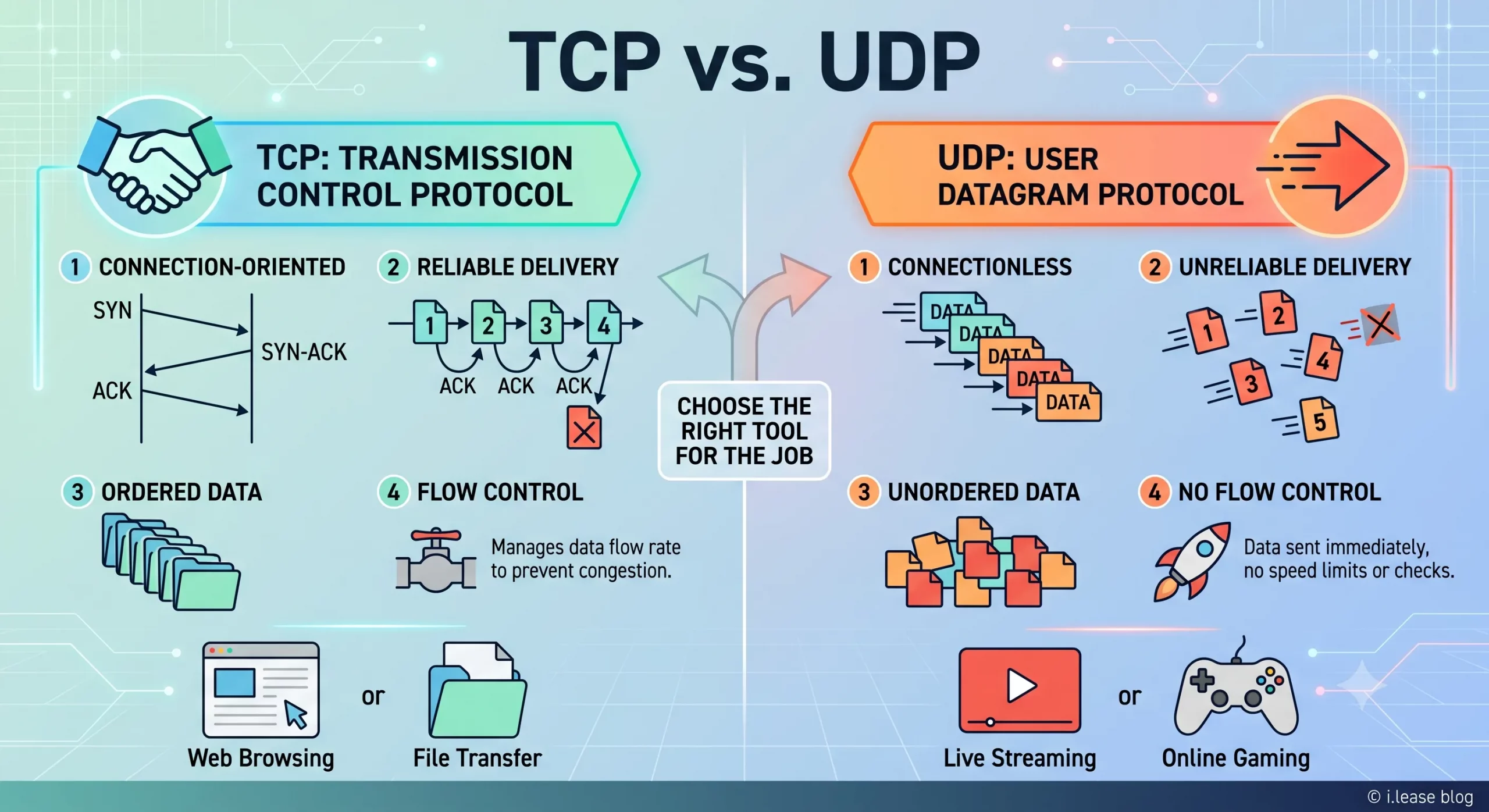
TCP 与 UDP:IPv4 租赁和企业网络指南
TCP 和 UDP 是互联网中最重要的两种传输层协议。它们决定数据如何在设备、服务器、云平台、VPN 网关、DNS 解析器、电子邮件系统、流媒体平台以及企业应用程序之间传输。 对于企业而言,TCP 和 UDP 不仅仅是技术术语,它们会直接影响实际的基础设施性能。公网 IPv4 地址提供可从互联网访问的网络端点,而 TCP 和 UDP 则决定流量如何通过该端点进行传输。 这对于租用或购买 IPv4 地址的企业尤为重要。企业租用 IPv4 地址并不是单纯为了持有这些地址,而是为了运行网站、API、VPN 隧道、DNS 服务、电子邮件平台、SaaS 应用程序、游戏服务器、流媒体系统、安全工具以及云端工作负载。不同类型的服务决定了需要使用 TCP、UDP,还是同时使用两者。 通过 i.lease,企业可以使用 IPv4 租赁服务获取用于实际网络部署的公网 IPv4 资源。需要长期控制 IP 地址资源的企业也可以购买 IP 地址,而拥有闲置 IPv4 资源的组织则可以出售 IP 地址。 TCP和UDP是什么? TCP 和 UDP 都是传输层协议。它们位于 IP 协议之上,帮助应用程序通过网络发送和接收数据。 IP 地址用于确定流量应该发送到哪里,而 TCP 和 UDP 则决定这些流量如何进行传输。 简单来说: TCP 适用于重视可靠性和按顺序传输数据的场景。 UDP 适用于重视速度、低延迟和轻量化数据传输的场景。 企业可能会使用同一个公网 IPv4 地址来运行不同的服务,但每项服务可能依赖不同的传输协议。例如,网站可能使用 TCP,VPN 网关可能使用 UDP,DNS 解析器可能同时使用 UDP 和 TCP,而游戏服务器则可能更倾向于使用 UDP,因为对于实时游戏而言,延迟造成的影响通常比少量数据包丢失更加明显。 因此,TCPRead more Related Posts 什么是 CGNAT(运营商级 NAT)?它为何会影响主机托管、游戏和入站服务? CGNAT(Carrier-Grade NAT,运营商级网络地址转换)是一种技术,它允许互联网服务提供商让多个客户同时共享同一个公共 IPv4 地址,而不是为每位客户单独分配一个公共 IPv4 地址。 它会在服务提供商的网络内部增加第二层网络地址转换,因此数百甚至数千名用户都位于同一个公共地址之后,而外部互联网看到的只是这个共享的公共地址。对于日常网页浏览、流媒体播放和应用程序使用来说,CGNAT 通常不会被用户察觉。问题会在外部网络需要主动连接到你时出现,例如托管服务器、进行端口转发、运行游戏服务器、接收 VoIP 或 VPN 连接,或启用远程访问。由于你不再拥有属于自己的公共地址——而是与其他陌生用户共享同一个地址——传入连接无法明确知道应该被转发到哪一个用户,因此这些服务可能无法正常工作或变得不稳定。CGNAT 并不是程序错误或配置错误。它是针对一个结构性现实而采取的有意解决方案:全球 IPv4 地址已经不足,而互联网服务提供商仍需要在公共地址数量有限的情况下继续连接新的客户。这使 CGNAT 成为普通用户最容易接触到的一个明显迹象,说明公共 IPv4 地址是一种有限且竞争激烈的资源;同时也清楚说明了为什么运行对外服务的企业需要拥有自己的专用公共地址空间。本文将介绍什么是 CGNAT、它如何运作、具体会影响哪些功能、如何判断自己是否处于 什么是电信公司?电信运营商如何为英国、美国和加拿大提供网络连接支持? 电信公司(Telco Companies),也称为电信运营商(Telecommunications Companies),提供通信与网络连接服务。这些服务包括移动通信网络、宽带互联网、光纤连接、固定电话服务、企业网络连接、云连接、托管网络服务以及数据中心连接等。 对于普通消费者而言,电信公司通常被视为移动通信或宽带互联网服务提供商。对于企业来说,电信公司远不只是一个服务品牌,更是关键的基础设施合作伙伴,帮助企业连接办公室、数据中心、云平台、远程员工、客户应用程序以及各类数字化服务。 随着企业越来越依赖云平台、SaaS 应用、AI 工具、VPN、网络安全系统以及在线服务,电信公司已成为数字基础设施规划中不可或缺的重要组成部分。 电信公司是什么? 电信公司(Telco Companies)是提供电信服务的企业。这些服务让个人、设备、企业和各种系统能够跨越距离进行通信与连接。 一家电信公司可能提供以下服务: 移动通信服务 宽带互联网 光纤连接 固定电话服务 企业互联网接入 企业广域网(WAN)服务 云连接服务 数据中心连接 VPN 什么是BYOIP(自备IP地址)? 自带 IP(Bring Your Own IP,简称 BYOIP)是一种网络部署方式,允许企业将自己现有的公网 IP 地址段应用于云服务提供商、数据中心、内容分发网络(CDN)或其他基础设施平台。 企业无需使用服务提供商分配的新公网 IP 地址,而是可以使用自己已拥有或已获授权使用的 IPv4 或 IPv6 地址前缀。服务提供商会验证该组织对该地址段的使用权限,并在支持的情况下,通过其自身网络对该地址段进行路由公告(Advertise)。 BYOIP 有助于企业在迁移至云平台时保留现有的防火墙规则、白名单(Allowlists)、客户系统集成、IP 信誉(IP Reputation)、DNS 配置以及既有的网络身份。这不仅能够减少因更换 .related-post {} .related-post .post-list { text-align: left; } .related-post .post-list .item { margin: 5px; padding: 10px; } .related-post .headline { font-size: 18px !important; color: #999999 !important; } .related-post .post-list .item .post_thumb { max-height: 220px; margin: 10px 0px; padding: 0px; display: block; } .related-post .post-list .item .post_title { font-size: 16px; color: #3f3f3f; margin: 10px 0px; padding: 0px; display: block; text-decoration: none; } .related-post .post-list .item .post_excerpt { font-size: 13px; color: #3f3f3f; margin: 10px 0px; padding: 0px; display: block; text-decoration: none; } @media only screen and (min-width: 1024px) { .related-post .post-list .item { width: 30%; } } @media only screen and (min-width: 768px) and (max-width: 1023px) { .related-post .post-list .item { width: 90%; } } @media only screen and (min-width: 0px) and (max-width: 767px) { .related-post .post-list .item { width: 90%; } }
