How RIR Policy Differences Shape IPv4 Transactions Across Regions
 Stephanie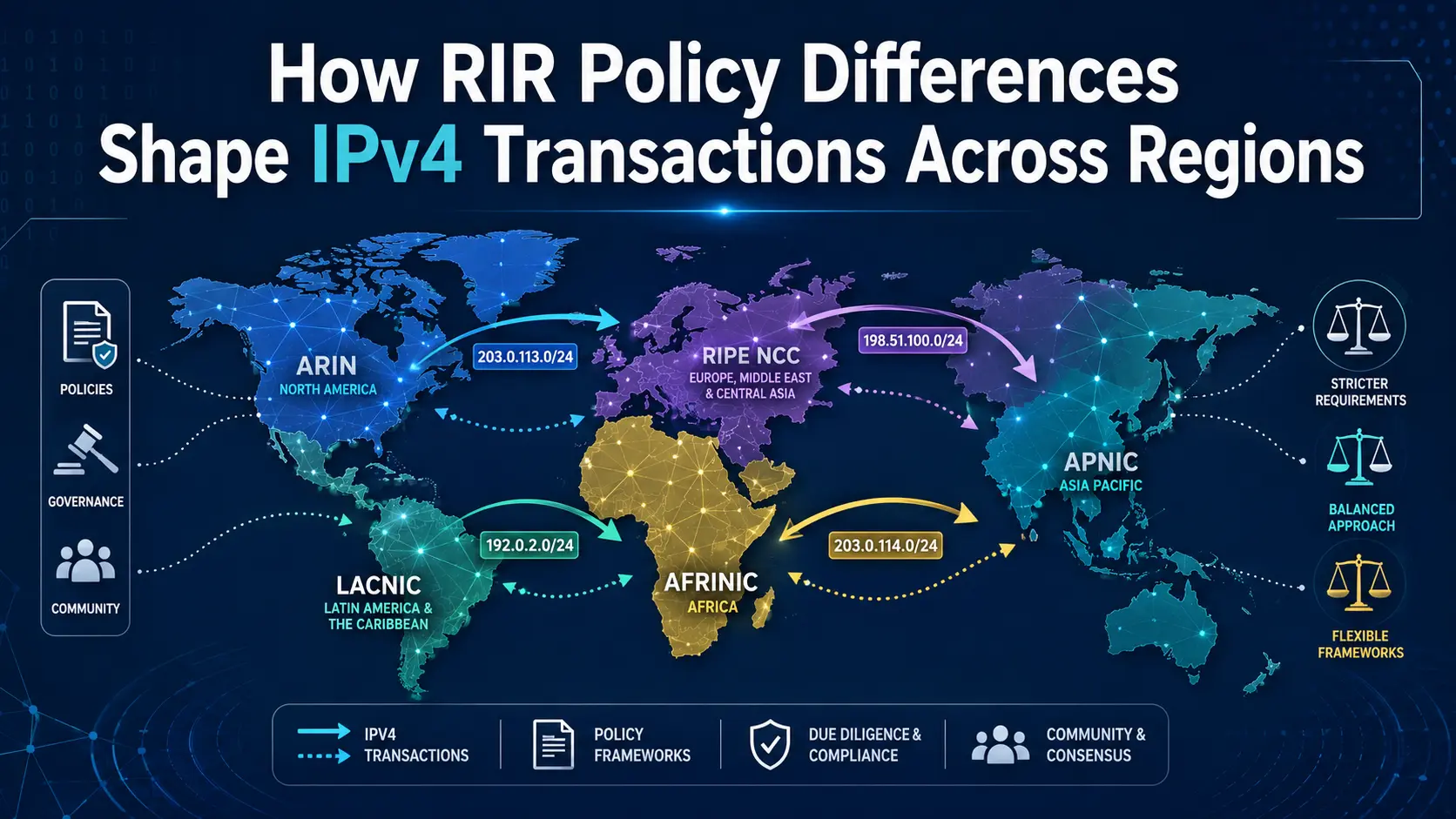
Two IPv4 blocks can have the same prefix size, similar market value, and equally willing buyers and sellers—yet require different transaction preparation.
Table of Contents
The reason is that an IPv4 transaction does not exist only at the commercial layer. The address block is also registered within a Regional Internet Registry framework, and the applicable policies can affect whether the resource is currently transferable, what the recipient must prepare, which records need to be verified, and how an inter-RIR transaction should be sequenced.
For buyers and sellers, the useful question is therefore not:
Which RIR has the easiest transfer rules?
It is:
What does the applicable RIR policy require this specific transaction to have ready before it can move from commercial agreement to registry completion and operational handover?
That distinction turns RIR policy from a background compliance topic into a practical transaction-planning input.
For a region-by-region overview of the individual registry frameworks, see i.LEASE’s guide to RIR transfer rules across regions. This article takes a different approach: it focuses on how those differences change transaction readiness and execution.
RIR policy affects the transaction before paperwork is submitted
A common mistake is to treat registry requirements as something to check after the buyer and seller have agreed on the block and price.
In practice, policy review should happen earlier. Recipient readiness, transfer-path selection, organizational records, and documentation can all affect what happens after the first commercial agreement, as discussed in i.LEASE’s analysis of why IPv4 deals can stall after agreement.
Before a transaction structure is finalized, the parties should already know:
- where the IPv4 block is currently registered;
- what type and status of resource is involved;
- whether the current holder is correctly reflected in registry records;
- whether the resource has recent transfer or delegation history;
- which RIR will serve the receiving organization;
- what recipient requirements may apply;
- and whether the proposed source-to-destination transfer path is currently available.
Different RIR frameworks handle these questions differently.
For example, RIPE NCC’s current transfer policy applies a 24-month transfer restriction to scarce resources such as IPv4 after they are received by a holder, while APNIC applies a five-year restriction to IPv4 addresses originally delegated from its 103/8 free pool.
LACNIC’s current policy requires an organization in its region receiving a transfer to justify the IPv4 resources it intends to receive. ARIN’s transfer framework, meanwhile, defines separate transfer paths for organizational changes, specified-recipient transfers, and qualifying inter-RIR transfers.
These are not reasons to rank one registry against another. They are reasons to perform policy due diligence before designing the transaction.
How policy differences change buyer readiness
A buyer can be financially ready to purchase IPv4 without yet being registry-ready to receive it.
That difference matters.
Depending on the relevant registry and transfer path, buyer preparation can involve:
- creating or maintaining the appropriate RIR account or organizational relationship;
- confirming corporate registration information;
- establishing the correct recipient organization;
- preparing utilization or needs information where required;
- determining the intended resource size;
- identifying the destination RIR;
- and ensuring that the proposed transaction fits an available transfer mechanism.
APNIC’s resource transfer policy, for example, requires participating organizations in applicable transfers to meet its transfer-policy criteria and requires recipients under its unused-resource transfer framework to demonstrate need. LACNIC likewise requires a recipient within its region to justify the IPv4 resources it will receive.
RIPE NCC takes a different approach in its own region, but its inter-RIR policy provides for a utilization plan when the source RIR requires the receiving region to operate a needs-based policy.
The operational lesson is straightforward:
Buyer readiness should be checked against the specific transaction path, not assumed from the buyer’s ability to pay.
This becomes particularly important when a buyer is acquiring IPv4 from another RIR region.
How policy differences change seller readiness
Seller readiness is more than having unused IPv4 space.
Before presenting a block as transaction-ready, the seller should understand whether the registry-side facts support the intended transfer.
That review can include:
- confirming the registered holder;
- checking whether corporate names and registry information still align;
- identifying the exact prefix proposed for transfer;
- reviewing how and when the resource was received;
- confirming whether a policy restriction or voluntary lock applies;
- establishing whether a dispute affects the resource;
- and determining whether the block can follow the intended intra-RIR or inter-RIR path.
Resource history is especially important because a block that looks commercially available may still be subject to a transfer condition.
RIPE NCC’s current policy, for example, prevents scarce resources such as IPv4 from being transferred for 24 months after receipt, subject to stated exceptions. It also provides a voluntary transfer-lock mechanism that prevents a locked resource from being transferred during the agreed period.
APNIC’s rules provide another example: IPv4 originally delegated from its 103/8 free pool cannot be transferred for five years after the original delegation.
These checks are not criticism of registry policy. They are normal asset and transaction due diligence.
A seller who understands the resource history can set more realistic expectations with potential buyers.
Policy differences can change the structure of the deal
RIR policy can influence more than whether a transfer is possible. It can also affect how the commercial transaction should be structured.
Consider a transaction involving:
- a purchase agreement;
- buyer and seller documentation;
- escrow;
- registry submission;
- registry review;
- registry-record completion;
- settlement;
- and operational handover.
Those events should not be treated as unrelated tasks.
The commercial agreement should define milestones that make sense for the applicable transfer process.
For example, the parties may need to determine:
- what must be verified before funds enter escrow;
- which registry conditions are prerequisites to closing;
- what constitutes successful registry completion;
- whether payment releases immediately after registry update or after another agreed condition;
- what happens if additional documentation is requested;
- and when operational responsibilities pass from seller to buyer.
The i.LEASE IPv4 buying workflow reflects this type of sequencing: inventory selection is followed by escrow, preparation for applicable RIR policy requirements, registry transfer, and then operational handover.
The principle is more important than any single workflow:
Registry requirements and commercial milestones should be designed to fit together.
A transaction becomes harder to manage when the contract assumes one sequence while the actual registry process requires another.
Three IPv4 deals can look identical and still require different preparation
The effect becomes clearer when comparing three hypothetical transactions.
Scenario 1: Buyer and seller are in the same RIR environment
A hosting company wants to acquire a /20 from another organization operating within the same RIR framework.
Commercially, the transaction may be relatively straightforward:
- confirm seller authority;
- confirm buyer eligibility;
- verify resource status;
- prepare required documentation;
- align settlement with the transfer process;
- complete registry and operational handover.
Only one RIR framework is directly involved in the source-to-recipient transfer.
That does not eliminate due diligence, but it reduces the number of policy interfaces involved.
Scenario 2: Buyer and seller are in different RIR regions
Now assume the same /20 is being acquired by an organization in another RIR region.
The prefix size and price may be unchanged.
The transaction architecture is not.
The parties now need to consider:
- requirements on the source side;
- requirements on the receiving side;
- whether an inter-RIR pathway exists between the two;
- what information each registry expects;
- how responsibility moves between the registries;
- and how the transaction timeline should accommodate both processes.
APNIC explicitly states that inter-RIR transfers depend on the counterpart RIR having an appropriate inter-RIR transfer policy, with source and recipient conditions determined by the applicable RIRs.
ARIN similarly recognizes inter-RIR transfers where the recipient qualifies under the recipient RIR’s policy.
The deal may still be fully executable. It simply requires two-sided preparation.
Scenario 3: The block has recent transfer history
Now assume the buyer and seller are in a compatible registry environment, but the /20 recently changed hands.
Commercially, it may look no different from another /20.
Policy review may produce a different answer.
If the resource is subject to a current transfer restriction, voluntary lock, or other condition, the timing of the proposed transaction may need to change.
This is why an IPv4 marketplace listing should not be assessed from prefix size, reputation, and price alone.
Resource history is part of transaction readiness.
Inter-RIR compatibility should be checked before closing assumptions are made
An inter-RIR transaction involves two registry environments, so a statement such as “this RIR supports inter-RIR transfers” is not enough by itself.
The relevant question is whether the specific source-destination combination and resource category can follow a supported path at the time of the transaction.
Policies can also evolve.
AFRINIC, for example, ratified a new Number Resources Transfer Policy in February 2026 covering intra-regional transfers, certain legacy-resource transfers, and inter-RIR transfers where reciprocal arrangements exist. The ratified framework also distinguishes resource categories when determining transfer eligibility.
That is why inter-RIR planning should verify the current official position of the registries involved instead of relying on an old transaction, article, or assumption.
For buyers and sellers, the practical sequence is:
identify the source RIR;
identify the destination RIR;
classify the resource;
verify source-side eligibility;
verify recipient-side readiness;
confirm that the current inter-RIR path supports the proposed transaction;
then align commercial and settlement milestones.
This approach treats policy verification as part of transaction design rather than as a final compliance check.
Policy differences can affect timing without creating a fixed timeline
It is tempting to ask:
How long does an IPv4 transfer take?
A single universal answer is not very useful.
Transaction timing can depend on:
- whether one or two RIRs are involved;
- whether buyer documentation is already complete;
- whether organizational records match;
- whether resource history requires additional review;
- whether the recipient must provide supporting information;
- how quickly both parties respond to requests;
- and how the commercial settlement process is structured.
APNIC’s operational transfer guide, for example, notes that the recipient must acknowledge an initiated transfer within 30 days and that APNIC evaluates the request after recipient acknowledgement.
This illustrates why timing should be managed as a workflow rather than reduced to one advertised number.
A well-prepared transaction can still involve registry processing. A poorly prepared transaction can add avoidable back-and-forth before that process can move forward.
The goal should therefore be readiness, not a promise of a universal closing time.
Where RIR policy ends and transaction execution begins
Understanding the applicable RIR policy tells the parties what conditions and processes apply.
Execution is the work of making sure the transaction is actually prepared around those requirements.
That can include:
- buyer and seller verification;
- transaction documentation;
- resource-history review;
- registry preparation;
- escrow coordination;
- transfer submission;
- settlement;
- registry-record updates;
- routing authorization;
- RPKI and ROA preparation;
- reverse DNS;
- and operational handover.
For a deeper discussion of why registry, routing, documentation, and lifecycle dependencies remain relevant beyond simple marketplace matching, see Understanding Operational Risk in IPv4 Address Markets.
This distinction is central to the current i.LEASE operating model.
i.LEASE describes itself as an IPv4 secondary-market platform supporting buying, selling, leasing-in, and leasing-out, while using authorization-based workflows to connect transactions with registry and lifecycle operations.
That does not replace the relevant RIR.
It means the transaction is organized around the applicable RIR process instead of leaving registry and operational requirements as disconnected follow-up tasks.
The difference can be expressed simply:
Policy defines the applicable requirements. Execution aligns the parties, documents, settlement, registry process, and operational handover with those requirements.
A transaction-readiness matrix
Instead of comparing RIRs as “easy” or “difficult,” buyers and sellers can evaluate whether each side of a specific transaction is ready.
| Transaction question | Buyer | Seller | Why it matters |
|---|---|---|---|
| Source RIR identified | ✓ | ✓ | Establishes the starting registry framework |
| Destination RIR identified | ✓ | ✓ | Defines the receiving-side process |
| Resource holder verified | ✓ | Confirms source authority | |
| Resource history reviewed | ✓ | ✓ | Can reveal transfer restrictions or status issues |
| Recipient eligibility prepared | ✓ | Determines receiving-side readiness | |
| Corporate records aligned | ✓ | ✓ | Reduces identity and authorization questions |
| Inter-RIR compatibility confirmed | ✓ | ✓ | Establishes whether the intended cross-region path is available |
| Required documentation prepared | ✓ | ✓ | Supports efficient submission |
| Escrow milestones aligned | ✓ | ✓ | Keeps settlement synchronized with execution |
| Registry completion condition defined | ✓ | ✓ | Clarifies when the transfer milestone has been reached |
| Operational handover planned | ✓ | ✓ | Prepares the resource for actual deployment |
The matrix changes the question from:
“Which RIR is easier?”
to:
“What needs to be ready for this transaction?”
That is a more useful way to plan an IPv4 acquisition or sale.
What buyers should confirm before signing
A buyer considering IPv4 across multiple regions should know:
- the exact prefix being purchased;
- the current RIR;
- the intended destination RIR;
- current resource status;
- recent transfer history;
- recipient requirements;
- whether an inter-RIR path is currently supported;
- the evidence required before settlement;
- and what operational handover is included after registry completion.
The buyer should also distinguish registry completion from production readiness.
A successfully updated registry record does not automatically configure the network that will use the new block.
Depending on the deployment, post-transfer work can still include RPKI, rDNS, routing, IRR, geolocation, reputation, security, and internal IPAM changes.
What sellers should confirm before listing
A seller can improve transaction readiness by verifying:
- the precise resources available;
- correct organization and registry records;
- resource history;
- current transfer eligibility;
- any applicable lock or restriction;
- corporate authority;
- expected buyer documentation;
- inter-RIR options where relevant;
- and the handover responsibilities that follow completion.
This preparation helps prevent a block from being marketed using assumptions that later need to be revised during execution.
It also gives buyers a clearer basis for evaluating the opportunity.
The practical takeaway
RIR policy differences matter because IPv4 transactions cross both a commercial layer and a registry layer.
Those differences can change:
- what a buyer must prepare;
- what a seller must verify;
- whether a specific transaction path is currently available;
- how settlement conditions should be structured;
- how much documentation is required;
- and how the registry process fits into operational handover.
They do not require buyers to decide that one RIR is better or worse than another.
Each transaction should instead be evaluated against the policies that actually apply to its source resource and receiving organization.
When policy review happens early, it becomes a planning tool rather than a late-stage surprise.
For organizations sourcing IPv4 across different registry regions, i.LEASE combines secondary-market access with authorized transaction and lifecycle workflows designed to coordinate the commercial, registry, and operational stages around the applicable requirements.
Explore IPv4 buying opportunities through i.LEASE when your transaction requires coordinated marketplace, registry, and operational execution.
Frequent Asked Questions
1. How do RIR policy differences affect an IPv4 transaction?
RIR policy differences can affect resource eligibility, recipient preparation, documentation, inter-RIR compatibility, transfer restrictions, and the sequence between commercial settlement and registry completion. The exact impact depends on the source resource and receiving organization.
2. Does a different RIR mean an IPv4 transaction is more difficult?
Not necessarily. Different RIR frameworks require different preparation. The relevant question is whether the buyer, seller, resource, and proposed transfer path satisfy the policies that apply to that transaction.
3. Why should RIR policy be checked before the buyer and seller agree on closing terms?
Early policy review can identify recipient requirements, resource-history restrictions, inter-RIR compatibility, or documentation needs before settlement milestones are fixed. This allows the commercial structure to reflect the actual transaction path.
4. Can two IPv4 blocks of the same size have different transfer readiness?
Yes. Two /20 blocks, for example, can have different registration histories, resource categories, transfer dates, holder records, locks, or source RIRs. Prefix size alone does not establish transaction readiness.
5. Does i.LEASE determine whether an RIR approves or processes a transfer?
No. Applicable RIR policies and procedures remain authoritative for the relevant registry process. i.LEASE provides marketplace and authorized execution workflows that help coordinate the parties, documentation, settlement, registry steps, and operational handover around those requirements.
相关文章
什么是 CGNAT(运营商级 NAT)?它为何会影响主机托管、游戏和入站服务?
CGNAT(Carrier-Grade NAT,运营商级网络地址转换)是一种技术,它允许互联网服务提供商让多个客户同时共享同一个公共 IPv4 地址,而不是为每位客户单独分配一个公共 IPv4 地址。 它会在服务提供商的网络内部增加第二层网络地址转换,因此数百甚至数千名用户都位于同一个公共地址之后,而外部互联网看到的只是这个共享的公共地址。 对于日常网页浏览、流媒体播放和应用程序使用来说,CGNAT 通常不会被用户察觉。问题会在外部网络需要主动连接到你时出现,例如托管服务器、进行端口转发、运行游戏服务器、接收 VoIP 或 VPN 连接,或启用远程访问。由于你不再拥有属于自己的公共地址——而是与其他陌生用户共享同一个地址——传入连接无法明确知道应该被转发到哪一个用户,因此这些服务可能无法正常工作或变得不稳定。 CGNAT 并不是程序错误或配置错误。它是针对一个结构性现实而采取的有意解决方案:全球 IPv4 地址已经不足,而互联网服务提供商仍需要在公共地址数量有限的情况下继续连接新的客户。这使 CGNAT 成为普通用户最容易接触到的一个明显迹象,说明公共 IPv4 地址是一种有限且竞争激烈的资源;同时也清楚说明了为什么运行对外服务的企业需要拥有自己的专用公共地址空间。本文将介绍什么是 CGNAT、它如何运作、具体会影响哪些功能、如何判断自己是否处于 CGNAT 环境中,以及对于无法接受这些限制的企业来说,有哪些可行的解决方案。 什么是 CGNAT CGNAT,也写作 CGN,有时也称为 Large-Scale NAT(LSN,大规模网络地址转换),是一种在运营商层面执行的网络地址转换技术,使 ISP 能够让多个客户共享同一个公共 IPv4 地址。 它延伸了家庭路由器中 NAT 的基本原理——多个私有设备共享一个地址——但会在服务提供商的网络层面再次执行一次,并同时覆盖大量客户。 这样一来,处于 CGNAT 后方的客户并不拥有一个唯一的公共地址。外部互联网所看到、并与其流量关联的地址,是与其他用户共享的,而且该地址由 ISP 控制,而不是由客户控制。对于由用户主动发起的出站连接,这通常不会造成问题。但对于任何依赖外部网络能够单独连接到该用户的服务来说,这个由服务提供商控制的共享地址正是问题的根源。 从一开始就明确区分这一点会很有帮助,因为它几乎解释了 CGNAT 会破坏的所有功能:由你主动发起的出站连接通常可以正常工作;而由其他人从外部主动尝试连接到你的入站连接,才是容易失败的部分。 从根本上来说,CGNAT 对客户端友好,却对服务器并不友好。 CGNAT 的工作原理是什么? CGNAT 的工作方式是在客户网络与公共互联网之间增加第二层地址转换,因此流量会经过两次转换:第一次发生在家庭路由器上,第二次发生在 ISP 的运营商级 NAT 设备上。 在传统网络环境中,家庭路由器会在设备的私有地址与 ISP 分配给你的单个公共地址之间执行 NAT。此时,你仍然拥有一个公共地址,而且可以通过端口转发,将外部传入连接定向到路由器后方的某台设备——这也是自托管以及许多网络服务能够正常运行的重要机制。关于私有地址与公共地址之间的关系,可以参考我们的 公共 IP 与私有 IP 指南。 CGNAT 会加入第二个转换阶段。ISP 不再直接为你的路由器分配公共地址,而是先分配一个来自共享中间地址范围的地址,然后通过运营商 NAT 设备,将大量这类客户的流量转换到一个规模更小的真实公共地址池中。因此,数据路径会变成:你的私有设备地址 Related Posts 什么是 CGNAT(运营商级 NAT)?它为何会影响主机托管、游戏和入站服务? CGNAT(Carrier-Grade NAT,运营商级网络地址转换)是一种技术,它允许互联网服务提供商让多个客户同时共享同一个公共 IPv4 地址,而不是为每位客户单独分配一个公共 IPv4 地址。 它会在服务提供商的网络内部增加第二层网络地址转换,因此数百甚至数千名用户都位于同一个公共地址之后,而外部互联网看到的只是这个共享的公共地址。对于日常网页浏览、流媒体播放和应用程序使用来说,CGNAT 通常不会被用户察觉。问题会在外部网络需要主动连接到你时出现,例如托管服务器、进行端口转发、运行游戏服务器、接收 VoIP 或 VPN 连接,或启用远程访问。由于你不再拥有属于自己的公共地址——而是与其他陌生用户共享同一个地址——传入连接无法明确知道应该被转发到哪一个用户,因此这些服务可能无法正常工作或变得不稳定。CGNAT 并不是程序错误或配置错误。它是针对一个结构性现实而采取的有意解决方案:全球 IPv4 地址已经不足,而互联网服务提供商仍需要在公共地址数量有限的情况下继续连接新的客户。这使 CGNAT 成为普通用户最容易接触到的一个明显迹象,说明公共 IPv4 地址是一种有限且竞争激烈的资源;同时也清楚说明了为什么运行对外服务的企业需要拥有自己的专用公共地址空间。本文将介绍什么是 CGNAT、它如何运作、具体会影响哪些功能、如何判断自己是否处于 什么是电信公司?电信运营商如何为英国、美国和加拿大提供网络连接支持? 电信公司(Telco Companies),也称为电信运营商(Telecommunications Companies),提供通信与网络连接服务。这些服务包括移动通信网络、宽带互联网、光纤连接、固定电话服务、企业网络连接、云连接、托管网络服务以及数据中心连接等。 对于普通消费者而言,电信公司通常被视为移动通信或宽带互联网服务提供商。对于企业来说,电信公司远不只是一个服务品牌,更是关键的基础设施合作伙伴,帮助企业连接办公室、数据中心、云平台、远程员工、客户应用程序以及各类数字化服务。 随着企业越来越依赖云平台、SaaS 应用、AI 工具、VPN、网络安全系统以及在线服务,电信公司已成为数字基础设施规划中不可或缺的重要组成部分。 电信公司是什么? 电信公司(Telco Companies)是提供电信服务的企业。这些服务让个人、设备、企业和各种系统能够跨越距离进行通信与连接。 一家电信公司可能提供以下服务: 移动通信服务 宽带互联网 光纤连接 固定电话服务 企业互联网接入 企业广域网(WAN)服务 云连接服务 数据中心连接 VPN TCP 与 UDP:IPv4 租赁和企业网络指南 TCP 和 UDP 是互联网中最重要的两种传输层协议。它们决定数据如何在设备、服务器、云平台、VPN 网关、DNS 解析器、电子邮件系统、流媒体平台以及企业应用程序之间传输。 对于企业而言,TCP 和 UDP 不仅仅是技术术语,它们会直接影响实际的基础设施性能。公网 IPv4 地址提供可从互联网访问的网络端点,而 TCP 和 UDP 则决定流量如何通过该端点进行传输。 这对于租用或购买 IPv4 地址的企业尤为重要。企业租用 IPv4 .related-post {} .related-post .post-list { text-align: left; } .related-post .post-list .item { margin: 5px; padding: 10px; } .related-post .headline { font-size: 18px !important; color: #999999 !important; } .related-post .post-list .item .post_thumb { max-height: 220px; margin: 10px 0px; padding: 0px; display: block; } .related-post .post-list .item .post_title { font-size: 16px; color: #3f3f3f; margin: 10px 0px; padding: 0px; display: block; text-decoration: none; } .related-post .post-list .item .post_excerpt { font-size: 13px; color: #3f3f3f; margin: 10px 0px; padding: 0px; display: block; text-decoration: none; } @media only screen and (min-width: 1024px) { .related-post .post-list .item { width: 30%; } } @media only screen and (min-width: 768px) and (max-width: 1023px) { .related-post .post-list .item { width: 90%; } } @media only screen and (min-width: 0px) and (max-width: 767px) { .related-post .post-list .item { width: 90%; } }

什么是电信公司?电信运营商如何为英国、美国和加拿大提供网络连接支持?
电信公司(Telco Companies),也称为电信运营商(Telecommunications Companies),提供通信与网络连接服务。这些服务包括移动通信网络、宽带互联网、光纤连接、固定电话服务、企业网络连接、云连接、托管网络服务以及数据中心连接等。 对于普通消费者而言,电信公司通常被视为移动通信或宽带互联网服务提供商。对于企业来说,电信公司远不只是一个服务品牌,更是关键的基础设施合作伙伴,帮助企业连接办公室、数据中心、云平台、远程员工、客户应用程序以及各类数字化服务。 随着企业越来越依赖云平台、SaaS 应用、AI 工具、VPN、网络安全系统以及在线服务,电信公司已成为数字基础设施规划中不可或缺的重要组成部分。 电信公司是什么? 电信公司(Telco Companies)是提供电信服务的企业。这些服务让个人、设备、企业和各种系统能够跨越距离进行通信与连接。 一家电信公司可能提供以下服务: 移动通信服务 宽带互联网 光纤连接 固定电话服务 企业互联网接入 企业广域网(WAN)服务 云连接服务 数据中心连接 VPN 服务 托管网络解决方案 互联网传输(Internet Transit) 电信批发服务 部分电信公司拥有并运营大规模的实体网络基础设施;另一些则通过批发接入、租用基础设施或与网络运营商合作来提供电信服务。 电信公司提供哪些服务? 电信公司同时为个人消费者和企业客户提供服务。 面向消费者的服务通常包括移动通信套餐、家庭宽带、光纤互联网、固定电话以及通信组合套餐。 面向企业的服务则可能包括专线互联网接入、企业光纤、专用网络、云连接、托管安全服务、数据中心连接、物联网(IoT)连接以及企业移动通信方案。 对于大型企业客户,电信公司还可提供: 多地点办公室网络连接 远程员工接入 私有云连接 SD-WAN(软件定义广域网) 灾难恢复连接 低延迟网络路由 互联网传输(Internet Transit) 网络监控 托管防火墙服务 正因如此,电信公司不仅对日常通信至关重要,也是现代企业建设先进数字基础设施的重要支柱。 电信公司 vs 互联网服务提供商 vs 网络运营商 电信公司(Telco)、互联网服务提供商(ISP)和网络运营商(Network Operator)之间可能存在重叠,但它们并不完全相同。 电信公司提供电信服务。 互联网服务提供商(ISP)提供互联网接入服务。 网络运营商负责建设、运营和管理网络基础设施。 一些大型电信公司同时承担这三种角色。它们拥有基础设施、运营网络,并向市场提供互联网、移动通信以及企业网络服务。 规模较小的服务提供商则可能专注于其中某一层。例如,互联网服务提供商(ISP)可以销售宽带服务,而无需拥有所有实体网络基础设施;网络运营商可能负责建设和运营光纤网络,并向电信公司或 ISP 提供批发网络接入;电信公司则可能结合自有网络与合作伙伴网络,为客户提供移动通信和企业服务。 对于企业而言,理解这些区别非常重要,因为服务质量不仅取决于销售该方案的品牌,还受到其底层网络、路由设计、网络覆盖范围以及技术支持体系等因素的影响。 为什么电信公司对企业至关重要 电信公司之所以重要,是因为几乎所有现代企业都依赖稳定的网络连接。 企业可能需要电信服务来支持: 办公室互联网接入 移动网络连接 远程办公 客户支持系统 云应用程序 SaaS 平台 支付系统 VPNRead more Related Posts 什么是 CGNAT(运营商级 NAT)?它为何会影响主机托管、游戏和入站服务? CGNAT(Carrier-Grade NAT,运营商级网络地址转换)是一种技术,它允许互联网服务提供商让多个客户同时共享同一个公共 IPv4 地址,而不是为每位客户单独分配一个公共 IPv4 地址。 它会在服务提供商的网络内部增加第二层网络地址转换,因此数百甚至数千名用户都位于同一个公共地址之后,而外部互联网看到的只是这个共享的公共地址。对于日常网页浏览、流媒体播放和应用程序使用来说,CGNAT 通常不会被用户察觉。问题会在外部网络需要主动连接到你时出现,例如托管服务器、进行端口转发、运行游戏服务器、接收 VoIP 或 VPN 连接,或启用远程访问。由于你不再拥有属于自己的公共地址——而是与其他陌生用户共享同一个地址——传入连接无法明确知道应该被转发到哪一个用户,因此这些服务可能无法正常工作或变得不稳定。CGNAT 并不是程序错误或配置错误。它是针对一个结构性现实而采取的有意解决方案:全球 IPv4 地址已经不足,而互联网服务提供商仍需要在公共地址数量有限的情况下继续连接新的客户。这使 CGNAT 成为普通用户最容易接触到的一个明显迹象,说明公共 IPv4 地址是一种有限且竞争激烈的资源;同时也清楚说明了为什么运行对外服务的企业需要拥有自己的专用公共地址空间。本文将介绍什么是 CGNAT、它如何运作、具体会影响哪些功能、如何判断自己是否处于 什么是电信公司?电信运营商如何为英国、美国和加拿大提供网络连接支持? 电信公司(Telco Companies),也称为电信运营商(Telecommunications Companies),提供通信与网络连接服务。这些服务包括移动通信网络、宽带互联网、光纤连接、固定电话服务、企业网络连接、云连接、托管网络服务以及数据中心连接等。 对于普通消费者而言,电信公司通常被视为移动通信或宽带互联网服务提供商。对于企业来说,电信公司远不只是一个服务品牌,更是关键的基础设施合作伙伴,帮助企业连接办公室、数据中心、云平台、远程员工、客户应用程序以及各类数字化服务。 随着企业越来越依赖云平台、SaaS 应用、AI 工具、VPN、网络安全系统以及在线服务,电信公司已成为数字基础设施规划中不可或缺的重要组成部分。 电信公司是什么? 电信公司(Telco Companies)是提供电信服务的企业。这些服务让个人、设备、企业和各种系统能够跨越距离进行通信与连接。 一家电信公司可能提供以下服务: 移动通信服务 宽带互联网 光纤连接 固定电话服务 企业互联网接入 企业广域网(WAN)服务 云连接服务 数据中心连接 VPN TCP 与 UDP:IPv4 租赁和企业网络指南 TCP 和 UDP 是互联网中最重要的两种传输层协议。它们决定数据如何在设备、服务器、云平台、VPN 网关、DNS 解析器、电子邮件系统、流媒体平台以及企业应用程序之间传输。 对于企业而言,TCP 和 UDP 不仅仅是技术术语,它们会直接影响实际的基础设施性能。公网 IPv4 地址提供可从互联网访问的网络端点,而 TCP 和 UDP 则决定流量如何通过该端点进行传输。 这对于租用或购买 IPv4 地址的企业尤为重要。企业租用 IPv4 .related-post {} .related-post .post-list { text-align: left; } .related-post .post-list .item { margin: 5px; padding: 10px; } .related-post .headline { font-size: 18px !important; color: #999999 !important; } .related-post .post-list .item .post_thumb { max-height: 220px; margin: 10px 0px; padding: 0px; display: block; } .related-post .post-list .item .post_title { font-size: 16px; color: #3f3f3f; margin: 10px 0px; padding: 0px; display: block; text-decoration: none; } .related-post .post-list .item .post_excerpt { font-size: 13px; color: #3f3f3f; margin: 10px 0px; padding: 0px; display: block; text-decoration: none; } @media only screen and (min-width: 1024px) { .related-post .post-list .item { width: 30%; } } @media only screen and (min-width: 768px) and (max-width: 1023px) { .related-post .post-list .item { width: 90%; } } @media only screen and (min-width: 0px) and (max-width: 767px) { .related-post .post-list .item { width: 90%; } }
TCP 与 UDP:IPv4 租赁和企业网络指南
TCP 和 UDP 是互联网中最重要的两种传输层协议。它们决定数据如何在设备、服务器、云平台、VPN 网关、DNS 解析器、电子邮件系统、流媒体平台以及企业应用程序之间传输。 对于企业而言,TCP 和 UDP 不仅仅是技术术语,它们会直接影响实际的基础设施性能。公网 IPv4 地址提供可从互联网访问的网络端点,而 TCP 和 UDP 则决定流量如何通过该端点进行传输。 这对于租用或购买 IPv4 地址的企业尤为重要。企业租用 IPv4 地址并不是单纯为了持有这些地址,而是为了运行网站、API、VPN 隧道、DNS 服务、电子邮件平台、SaaS 应用程序、游戏服务器、流媒体系统、安全工具以及云端工作负载。不同类型的服务决定了需要使用 TCP、UDP,还是同时使用两者。 通过 i.lease,企业可以使用 IPv4 租赁服务获取用于实际网络部署的公网 IPv4 资源。需要长期控制 IP 地址资源的企业也可以购买 IP 地址,而拥有闲置 IPv4 资源的组织则可以出售 IP 地址。 TCP和UDP是什么? TCP 和 UDP 都是传输层协议。它们位于 IP 协议之上,帮助应用程序通过网络发送和接收数据。 IP 地址用于确定流量应该发送到哪里,而 TCP 和 UDP 则决定这些流量如何进行传输。 简单来说: TCP 适用于重视可靠性和按顺序传输数据的场景。 UDP 适用于重视速度、低延迟和轻量化数据传输的场景。 企业可能会使用同一个公网 IPv4 地址来运行不同的服务,但每项服务可能依赖不同的传输协议。例如,网站可能使用 TCP,VPN 网关可能使用 UDP,DNS 解析器可能同时使用 UDP 和 TCP,而游戏服务器则可能更倾向于使用 UDP,因为对于实时游戏而言,延迟造成的影响通常比少量数据包丢失更加明显。 因此,TCPRead more Related Posts 什么是 CGNAT(运营商级 NAT)?它为何会影响主机托管、游戏和入站服务? CGNAT(Carrier-Grade NAT,运营商级网络地址转换)是一种技术,它允许互联网服务提供商让多个客户同时共享同一个公共 IPv4 地址,而不是为每位客户单独分配一个公共 IPv4 地址。 它会在服务提供商的网络内部增加第二层网络地址转换,因此数百甚至数千名用户都位于同一个公共地址之后,而外部互联网看到的只是这个共享的公共地址。对于日常网页浏览、流媒体播放和应用程序使用来说,CGNAT 通常不会被用户察觉。问题会在外部网络需要主动连接到你时出现,例如托管服务器、进行端口转发、运行游戏服务器、接收 VoIP 或 VPN 连接,或启用远程访问。由于你不再拥有属于自己的公共地址——而是与其他陌生用户共享同一个地址——传入连接无法明确知道应该被转发到哪一个用户,因此这些服务可能无法正常工作或变得不稳定。CGNAT 并不是程序错误或配置错误。它是针对一个结构性现实而采取的有意解决方案:全球 IPv4 地址已经不足,而互联网服务提供商仍需要在公共地址数量有限的情况下继续连接新的客户。这使 CGNAT 成为普通用户最容易接触到的一个明显迹象,说明公共 IPv4 地址是一种有限且竞争激烈的资源;同时也清楚说明了为什么运行对外服务的企业需要拥有自己的专用公共地址空间。本文将介绍什么是 CGNAT、它如何运作、具体会影响哪些功能、如何判断自己是否处于 什么是电信公司?电信运营商如何为英国、美国和加拿大提供网络连接支持? 电信公司(Telco Companies),也称为电信运营商(Telecommunications Companies),提供通信与网络连接服务。这些服务包括移动通信网络、宽带互联网、光纤连接、固定电话服务、企业网络连接、云连接、托管网络服务以及数据中心连接等。 对于普通消费者而言,电信公司通常被视为移动通信或宽带互联网服务提供商。对于企业来说,电信公司远不只是一个服务品牌,更是关键的基础设施合作伙伴,帮助企业连接办公室、数据中心、云平台、远程员工、客户应用程序以及各类数字化服务。 随着企业越来越依赖云平台、SaaS 应用、AI 工具、VPN、网络安全系统以及在线服务,电信公司已成为数字基础设施规划中不可或缺的重要组成部分。 电信公司是什么? 电信公司(Telco Companies)是提供电信服务的企业。这些服务让个人、设备、企业和各种系统能够跨越距离进行通信与连接。 一家电信公司可能提供以下服务: 移动通信服务 宽带互联网 光纤连接 固定电话服务 企业互联网接入 企业广域网(WAN)服务 云连接服务 数据中心连接 VPN 什么是BYOIP(自备IP地址)? 自带 IP(Bring Your Own IP,简称 BYOIP)是一种网络部署方式,允许企业将自己现有的公网 IP 地址段应用于云服务提供商、数据中心、内容分发网络(CDN)或其他基础设施平台。 企业无需使用服务提供商分配的新公网 IP 地址,而是可以使用自己已拥有或已获授权使用的 IPv4 或 IPv6 地址前缀。服务提供商会验证该组织对该地址段的使用权限,并在支持的情况下,通过其自身网络对该地址段进行路由公告(Advertise)。 BYOIP 有助于企业在迁移至云平台时保留现有的防火墙规则、白名单(Allowlists)、客户系统集成、IP 信誉(IP Reputation)、DNS 配置以及既有的网络身份。这不仅能够减少因更换 .related-post {} .related-post .post-list { text-align: left; } .related-post .post-list .item { margin: 5px; padding: 10px; } .related-post .headline { font-size: 18px !important; color: #999999 !important; } .related-post .post-list .item .post_thumb { max-height: 220px; margin: 10px 0px; padding: 0px; display: block; } .related-post .post-list .item .post_title { font-size: 16px; color: #3f3f3f; margin: 10px 0px; padding: 0px; display: block; text-decoration: none; } .related-post .post-list .item .post_excerpt { font-size: 13px; color: #3f3f3f; margin: 10px 0px; padding: 0px; display: block; text-decoration: none; } @media only screen and (min-width: 1024px) { .related-post .post-list .item { width: 30%; } } @media only screen and (min-width: 768px) and (max-width: 1023px) { .related-post .post-list .item { width: 90%; } } @media only screen and (min-width: 0px) and (max-width: 767px) { .related-post .post-list .item { width: 90%; } }
