Guía completa del mercado de direcciones IP
 Stephanie
¿Qué es un mercado de direcciones IP?
Un mercado de direcciones IP es una plataforma estructurada donde las organizaciones pueden comprar, vender o arrendar espacio de direcciones IP. En la mayoría de los casos, el enfoque principal es IPv4, porque las direcciones IPv4 siguen siendo ampliamente utilizadas y tienen una oferta limitada.
Table of Contents
En lugar de buscar manualmente compradores, vendedores, brokers o proveedores de arrendamiento, las empresas pueden usar un mercado para comparar bloques IPv4 disponibles, revisar opciones de transacción y completar acuerdos mediante un proceso más organizado.
Un mercado de direcciones IP puede admitir diferentes tipos de transacciones, incluyendo compras de IPv4, ventas de IPv4, subastas de IPv4 y arrendamiento de IPv4. Para las empresas, esto crea una forma más práctica de acceder al espacio de direcciones según el presupuesto, el calendario y las necesidades de infraestructura.
¿Por qué existen los mercados de IPv4?
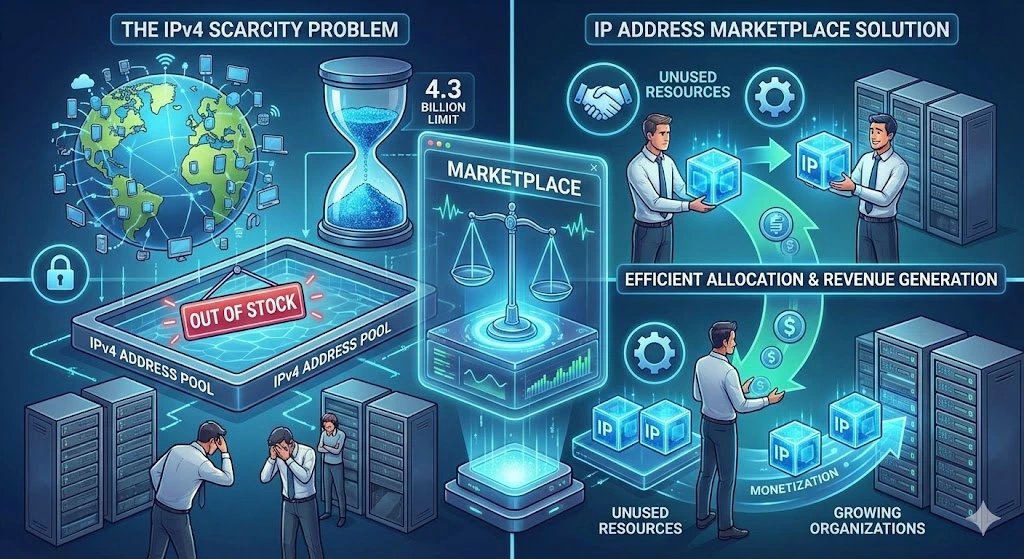
Los mercados de IPv4 existen porque el espacio de direcciones IPv4 sigue siendo importante desde el punto de vista operativo. Muchos proveedores de hosting, plataformas cloud, centros de datos, proveedores de VPN, ISP, empresas SaaS y redes empresariales todavía necesitan conectividad IPv4.
Aunque la adopción de IPv6 continúa creciendo, IPv4 sigue siendo necesario para la compatibilidad con muchos usuarios, sistemas y aplicaciones. Por eso IPv4 sigue comprándose, vendiéndose, transfiriéndose y arrendándose.
Los Registros Regionales de Internet respaldan procesos formales de transferencia. Por ejemplo, RIPE NCC afirma que una transferencia de recursos cambia la titularidad de los recursos numéricos de Internet de una parte a otra, mientras que APNIC describe las transferencias como una forma de que las direcciones IPv4 y los números AS no utilizados o excedentes pasen a organizaciones que los necesitan. IPv4 respalda ingresos, infraestructura, servicios, clientes, financiación y continuidad.
Cómo funciona un mercado de direcciones IP
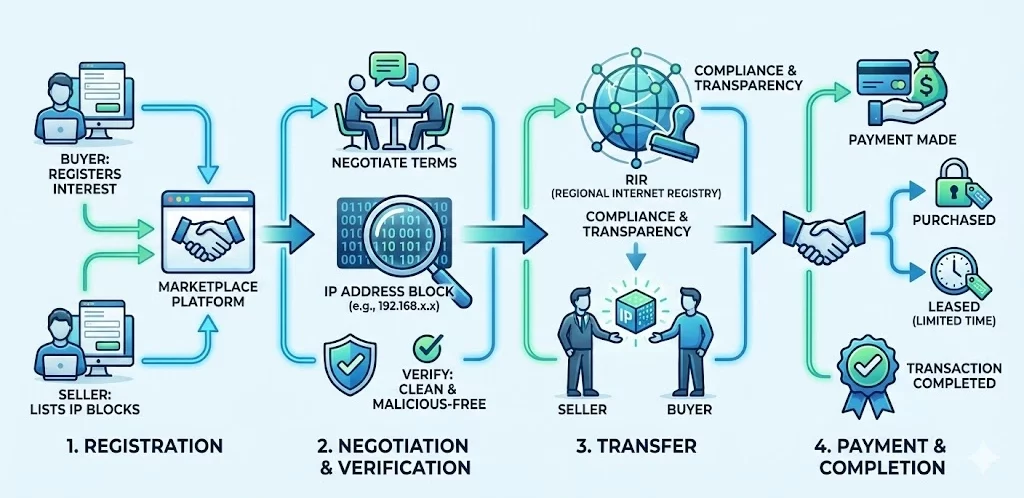
Un mercado de direcciones IP normalmente conecta a tres tipos de usuarios:
- Compradores que necesitan espacio de direcciones IPv4 para uso de infraestructura a largo plazo.
- Vendedores que poseen recursos IPv4 no utilizados o infrautilizados y desean monetizarlos.
- Arrendatarios que necesitan acceso a IPv4 sin comprarlas directamente.
Un proceso típico de mercado incluye:
1. Publicación de inventario o envío de solicitud del comprador
2. Verificación de propiedad o control
3. Revisión de reputación IP y listas negras
4. Negociación de precio o participación en subasta
5. Acuerdo de depósito en garantía o pago
6. Documentación de transferencia o arrendamiento alineada con el registro
7. Enrutamiento, LOA y configuración operativa cuando sea necesario
El proceso exacto depende de si el usuario está comprando, vendiendo o arrendando.
Comprar direcciones IPv4 a través de un mercado
Buying IPv4 addresses may be suitable for organizations that need long-term address control for infrastructure, hosting, customer services, or network expansion.
On i.lease, businesses can buy IP through a marketplace process designed around verified IPv4 blocks, reputation checks, escrow protection, and RIR-aligned transfers.
Before buying IPv4 addresses, businesses should check:
- Whether the seller has authority to transfer the IP block
- Whether the IP range has blacklist or abuse history
- Whether the block is suitable for routing and BGP announcement
- Which RIR policy applies to the transaction
- Whether the buyer needs pre-approval or documentation
- How payment and transfer completion will be protected
Buying IPv4 can provide long-term control, but it also places more responsibility on the buyer. The buyer must manage registry requirements, routing, reputation, renewal obligations, and operational use. Learn how to Buy IP Address on i.lease
Selling IPv4 addresses through a marketplace
Selling IPv4 addresses may be useful for organizations that hold unused or underused address space. Instead of leaving address blocks idle, sellers can convert them into capital by listing them for qualified buyers.
Through i.lease, organizations can sell IP using a structured marketplace process that supports reputation screening, buyer access, escrow protection, and policy-aligned transfer handling.
Sellers should prepare the following before listing IPv4 resources:
- Proof of valid control or holdership
- Accurate registry records
- Clear block size and prefix information
- Reputation and blacklist review
- Transfer eligibility checks
- Expected price range and transaction timeline
A clean and well-documented IPv4 block is usually easier for buyers to evaluate. Sellers should also understand the relevant transfer rules in their RIR region. ARIN, RIPE NCC, and APNIC each maintain their own transfer frameworks and requirements. Learn how to Sell IP Address on i.lease
Leasing IPv4 Addresses Marketplace
IPv4 leasing allows businesses to use address space without buying it outright. This is often useful for companies that need flexibility, faster deployment, or temporary capacity.
i.lease provides IPv4 leasing for organizations that need managed access to IPv4 address space. This can support hosting, VPN services, data centres, SaaS platforms, enterprise networks, and infrastructure expansion.
Leasing can be suitable when:
- The business needs IPv4 quickly
- The project has a temporary or scalable requirement
- The company wants to avoid a large upfront purchase
- The network needs IPv4 continuity during IPv6 transition
- The organization prefers managed documentation and support
This aligns with the doctrine that ownership alone does not automatically remove operational risk. Structure, continuity, routing readiness, and documentation matter. The Larus core note specifically frames leasing as a continuity structure where risk can be managed through contract, control, and operational preparedness.
What to check before using an IP address marketplace
Before buying, selling, or leasing IPv4 addresses, businesses should review both the commercial and technical quality of the transaction.
- Ownership or control: Confirm the party listing the IP block has the authority to sell or lease it.
- Registry eligibility: Check whether the transfer or lease structure aligns with the relevant RIR process.
- IP reputation: Review blacklist, spam, abuse, and routing history.
- Routing readiness: Confirm whether the IP block can be announced and used as expected.
- LOA support: For leasing, check whether a Letter of Authorization is available if needed.
- Escrow or payment protection: Use structured payment protection for purchase transactions.
- Contract clarity: Review term, renewal, acceptable use, termination, and support obligations.
These checks are important because IP addresses are tied to real infrastructure. A poor transaction can affect routing, email deliverability, customer access, platform stability, or business continuity.
Common risks in IP address marketplaces
An IP address marketplace can make transactions easier, but users still need to manage risk carefully.
1. Unclear ownership or control
If the seller or lessor does not have clear authority over the IP block, the transaction may fail or create future disputes.
2. Poor IP reputation
Some IP ranges may have abuse, spam, malware, or blacklist history. This can affect hosting, email, VPN, and customer-facing services.
3. Transfer delays
RIR requirements, documentation issues, or policy restrictions may delay a transfer. RIPE NCC, APNIC, and ARIN all operate under specific transfer procedures.
4. Routing and LOA problems
Even after a commercial agreement is signed, the IP block still needs to be routed correctly. For leased IPv4, LOA support and BGP readiness are especially important.
5. Treating IP addresses as simple commodities
IPv4 addresses are not only numbers on a list. They are used by running networks, services, customers, and revenue systems. The heng.lu doctrine warns against treating number resources as merely clerical records when they are embedded in functioning networks.
Why Use i.lease?
i.lease is designed for organizations that need a structured way to access IPv4 address space through buying, selling, or leasing.
Instead of treating IPv4 as a simple listing item, i.lease focuses on practical transaction quality: verified listings, reputation awareness, policy alignment, escrow support, leasing documentation, and operational usability.
Businesses can use i.lease to:
- buy IP for long-term infrastructure needs
- sell IP to monetize unused IPv4 assets
- IPv4 leasing for flexible, managed address access
This makes i.lease different from a general broker directory. It should be positioned as a marketplace for structured IPv4 access, where users can evaluate transaction type, operational needs, and risk before committing.
Final thoughts
An IP address marketplace helps organizations buy, sell, and lease IPv4 addresses in a more structured way. It supports buyers that need address space, sellers that want to monetize unused resources, and businesses that prefer leasing for flexibility.
However, the quality of the marketplace matters. Businesses should check ownership, registry eligibility, IP reputation, routing readiness, LOA support, escrow protection, and contract clarity before completing a transaction.
IPv4 address space remains part of real network operations. It supports hosting, cloud services, VPNs, data centres, customers, and business continuity. That is why the best marketplace is not only a place to list addresses. It is a platform that helps users manage access, risk, and operational readiness.
Also Read
- Lease IP Addresses: Why Businesses Lease IPv4 and What to Check First
- IPv4 Leasing vs Purchasing: Structural Risk in the IPv4 Address Market
- What Are the Risks of Buying IPv4 from the Wrong Source?
- IPv4 Leasing for Data Centres: What You Need To Know
Frequently Asked Questions (FAQs)
What is an IP address marketplace?
An IP address marketplace is a platform where organizations can buy, sell, or lease IP address space, especially IPv4 addresses.
Why do businesses use an IPv4 marketplace?
Businesses use an IPv4 marketplace to access address space for hosting, cloud services, VPNs, data centres, ISP networks, SaaS platforms, and enterprise infrastructure.
Can I buy IPv4 addresses on i.lease?
Yes. Businesses can buy IP through i.lease using a structured marketplace process for verified IPv4 blocks and policy-aligned transfers.
Can I sell IPv4 addresses on i.lease?
Yes. Organizations with unused or underused IPv4 address space can sell IP through i.lease and reach potential buyers through a structured marketplace.
Does i.lease provide IPv4 leasing?
Yes. i.lease provides IPv4 leasing for businesses that need flexible access to IPv4 address space without buying it outright.
What should I check before buying IPv4 addresses?
You should check seller authority, registry transfer eligibility, IP reputation, blacklist history, routing readiness, escrow protection, and transfer documentation.
What should I check before leasing IPv4 addresses?
You should check lease terms, LOA availability, routing support, IP reputation, acceptable-use rules, renewal conditions, and provider reliability.
Is IPv4 still needed if IPv6 exists?
Yes. IPv6 adoption is growing, but many networks, applications, customers, and services still rely on IPv4. Many businesses continue to use IPv4 and IPv6 together.
相关文章

全球企业租赁IP地址的五大好处
租赁 IP 地址对全球企业意味着什么? IP 地址租赁并不是一次性购买整个 IPv4 或 IPv6 地址块,而是向供应商租用这些地址。这种方式可以让企业快速获得不同地区的地址资源。由于 IPv4 资源短缺,这对跨国企业尤其重要。 通过租赁,企业可以更容易满足扩展需求和短期项目需求,同时把原本需要大量资本投入的成本,转化为更容易管理的运营支出。随着 IPv4 免费地址池已经完全耗尽,从区域互联网注册机构(RIR)或经纪商处租用 IP 地址,已经成为一种常见策略。 无需大量资本支出即可快速扩展 租赁 IP 地址最明显的优势之一,是财务灵活性。 企业不必花费数万甚至数十万英镑购买 /18 或 /19 地址块,而是可以按需租用实际需要的地址数量。近期分析显示,IPv4 地址租赁价格约为每个 IP 每月 0.30 至 2.50 美元,而购买即使是较小的地址块,也可能需要每个 IP 35 至 60 美元。 这对初创公司或正在部署临时基础设施的组织尤其有价值,因为它可以降低前期成本,并让预算更有效地用于其他业务领域。 地理多样性与更好的本地化 对于全球业务而言,拥有看起来位于目标市场的 IP 地址,可以显著改善服务交付效果。 租赁允许企业快速获得来自不同地区的 IP 地址块。Pacific Connect 指出,地理多样性有助于建立本地化的线上存在,并支持特定地区的营销或内容策略。 无论是需要在多个大洲建立节点的 CDN,还是希望呈现“本地化”形象的电商平台,IP 租赁都能提供更强的地理灵活性。 部署速度与运营敏捷性 购买 IP 地址块通常需要数周甚至数月时间,过程涉及注册机构转让和复杂文件流程。 相比之下,租赁速度更快。部分租赁平台可以在数天甚至数小时内完成设置。LARUS 表示可在 48 小时内交付 IPv4 地址空间,包括授权书(Letter of Authorisation, LOA)和全球路由设置。 这种即时性对企业非常关键,尤其是在应对突然增加的容量需求时,例如启动营销活动、扩展基础设施到新站点,或在旺季扩大支持能力。 地址清洁度与安全运营 可靠的租赁供应商通常会进行黑名单检查,并提供滥用管理服务,以保护客户免受问题 IP 地址段的影响。 InterLIRRead more Related Posts Les 5 principaux avantages de la location d’adresses IP pour les entreprises internationales La location d'adresses IP offre un accès évolutif et économique à un espace d'adressage sans les contraintes liées à la Read more Votre bail IPv4 n’est pas sûr si personne n’assume le risque de renouvellement Qui est réellement responsable du maintien de cet accès IPv4 ? Ni celui qui l’a vendu. Ni celui qui l’a mis Read more Principaux points à prendre en compte lors du commerce d’adresses IPv4 sur le marché secondaire Naviguer sur le marché secondaire de l’IPv4 exige une attention particulière à la légalité, à la réputation, à la tarification, Read more .related-post {} .related-post .post-list { text-align: left; } .related-post .post-list .item { margin: 5px; padding: 10px; } .related-post .headline { font-size: 18px !important; color: #999999 !important; } .related-post .post-list .item .post_thumb { max-height: 220px; margin: 10px 0px; padding: 0px; display: block; } .related-post .post-list .item .post_title { font-size: 16px; color: #3f3f3f; margin: 10px 0px; padding: 0px; display: block; text-decoration: none; } .related-post .post-list .item .post_excerpt { font-size: 13px; color: #3f3f3f; margin: 10px 0px; padding: 0px; display: block; text-decoration: none; } @media only screen and (min-width: 1024px) { .related-post .post-list .item { width: 30%; } } @media only screen and (min-width: 768px) and (max-width: 1023px) { .related-post .post-list .item { width: 90%; } } @media only screen and (min-width: 0px) and (max-width: 767px) { .related-post .post-list .item { width: 90%; } }
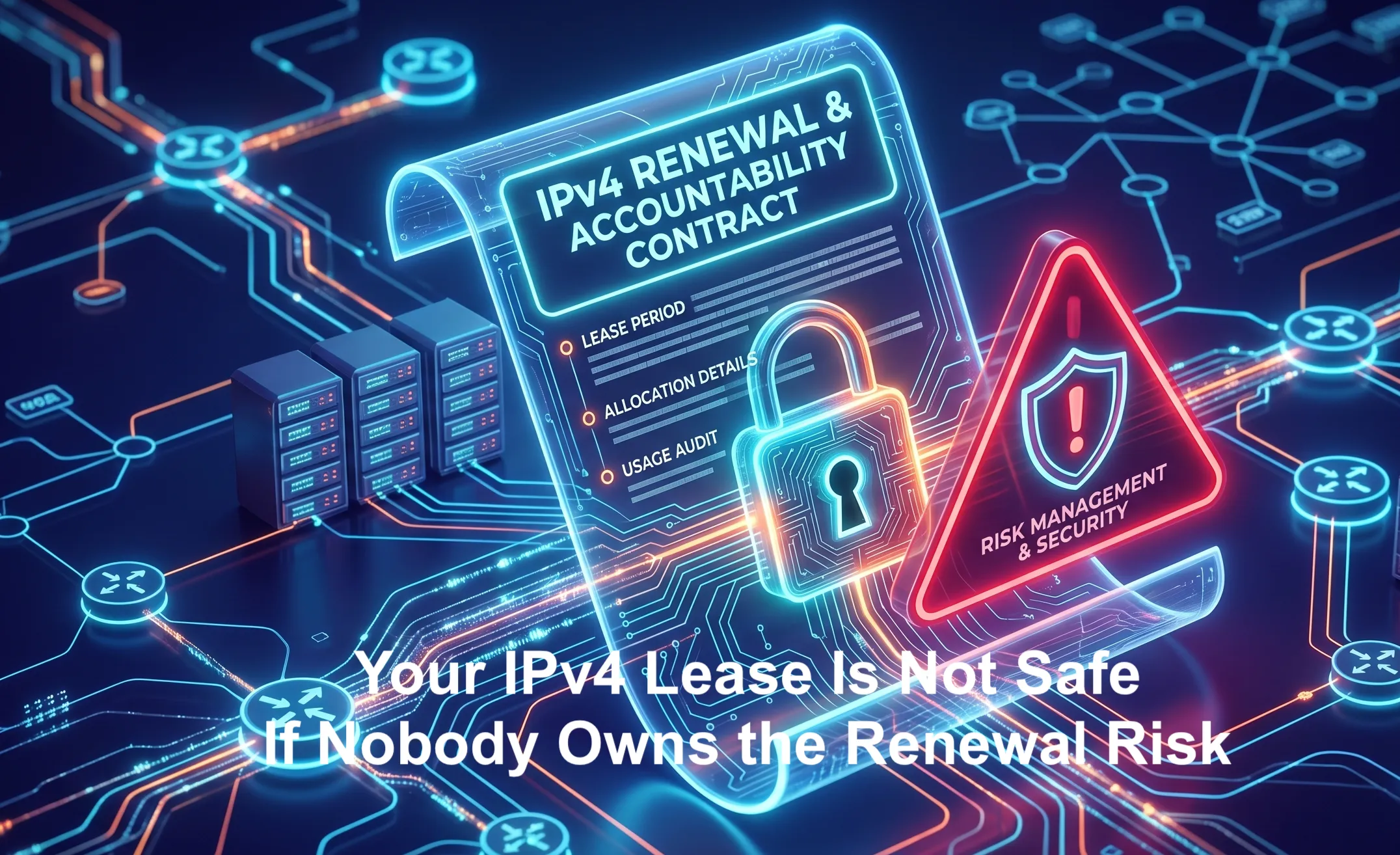
如果无人承担续约风险,您的 IPv4 租约就不安全。
对于依赖 IPv4 进行托管、SaaS、VPN、电信、云服务、安全防护、电子邮件发送或客户访问的企业而言,这并非无关紧要的管理问题。 这关乎业务连续性。 如果续约机制薄弱,您的 IPv4 地址租约就会变成一个隐形的倒计时。 为什么 IPv4 续约风险容易被忽视 大多数公司今天都会检查 IPv4 地址块是否可用。 他们会检查 IP 地址是否可路由。 他们会检查地址块是否干净。 他们会检查价格是否合理。 他们会检查服务提供商能否快速交付。 这些检查固然重要。 但这还不够。 IPv4 风险通常会在企业围绕这些地址构建服务之后才显现出来。到那时,IP 地址可能已经与客户账户、防火墙规则、邮件信誉、白名单、DNS 记录、应用程序基础设施、合规性记录和内部操作流程绑定在一起。 到了这个阶段,更换 IP 地址就变得不再简单。 这可能意味着停机、客户投诉、声誉损失、工程工作量增加以及合同中断。 这就是续约如此重要的原因。 IPv4 租约的第一个月只能证明已安排了访问权限。 续约期才能证明该架构是否可靠。 实力较弱的服务提供商在客户注册初期可能看起来很强大。真正的考验在于租约需要续签、维护、记录、延期或升级之时。 访问与连续性之间的危险区别 IPv4 访问意味着您可以立即使用这些地址。 IPv4 连续性意味着您可以持续自信地使用这些地址。 许多公司混淆了这两者。 访问是短期的。 连续性是结构性的。 访问回答以下问题: 我今天可以路由这些 IP 地址吗? 我现在可以部署服务器吗? 我可以收到授权书 (LOA) 吗? 我可以开始使用该地址块吗? 连续性提出更深层次的问题: 谁控制源关系? 谁负责续约责任? 谁支持路由变更? 如果文档受到质疑,谁来回应? 谁在上游压力到达客户之前将其消除? 谁具备保护连续性的法律、运营和注册管理机构意识? 这种区别至关重要,因为 IPv4 不再仅仅是一个随意的技术投入。它支持实际的业务活动、客户访问、收入、基础设施和运营连续性。注册层和识别层可以凌驾于宝贵的网络资源之上,而一旦业务中断,运营商和客户将承担实际的业务后果。 这就是为什么最便宜的 IPv4 租约并不总是最安全的 IPv4 租约。 真正的问题不仅仅是: 这家提供商能否给我分配 IPRead more Related Posts Les 5 principaux avantages de la location d’adresses IP pour les entreprises internationales La location d'adresses IP offre un accès évolutif et économique à un espace d'adressage sans les contraintes liées à la Read more Votre bail IPv4 n’est pas sûr si personne n’assume le risque de renouvellement Qui est réellement responsable du maintien de cet accès IPv4 ? Ni celui qui l’a vendu. Ni celui qui l’a mis Read more Que se passe-t-il lorsque les ressources IP sont mal gérées ? Une mauvaise gestion des ressources IP peut entraîner des pannes, des failles de sécurité, des mises sur liste noire, une Read more .related-post {} .related-post .post-list { text-align: left; } .related-post .post-list .item { margin: 5px; padding: 10px; } .related-post .headline { font-size: 18px !important; color: #999999 !important; } .related-post .post-list .item .post_thumb { max-height: 220px; margin: 10px 0px; padding: 0px; display: block; } .related-post .post-list .item .post_title { font-size: 16px; color: #3f3f3f; margin: 10px 0px; padding: 0px; display: block; text-decoration: none; } .related-post .post-list .item .post_excerpt { font-size: 13px; color: #3f3f3f; margin: 10px 0px; padding: 0px; display: block; text-decoration: none; } @media only screen and (min-width: 1024px) { .related-post .post-list .item { width: 30%; } } @media only screen and (min-width: 768px) and (max-width: 1023px) { .related-post .post-list .item { width: 90%; } } @media only screen and (min-width: 0px) and (max-width: 767px) { .related-post .post-list .item { width: 90%; } }

短期与长期 IPv4 租赁
在面临 IPv4 短缺的情况下,企业在选择租赁方案时必须权衡成本、速度以及网络增长。 短期租赁可以让你轻松地扩展或缩减资源,但长期来看成本更高,且供应稳定性较低。 长期租赁提供稳定的价格和更可靠的资源获取,但随着需求变化,调整配置会变得更困难。 引言:为什么租用 IPv4 地址是合理的 IPv4 已从一种技术资源演变为一种稀缺的经济资产。 尽管 IPv6 的普及仍在继续,但 IPv4 仍然是大多数生产网络的核心。过渡过程较为缓慢,受到迁移挑战、遗留系统依赖和兼容性问题的阻碍。与此同时,全球未分配的 IPv4 地址池几乎耗尽,迫使企业转向二级市场。 这就是 IPv4 地址租赁的用武之地。企业可以根据需要租赁 IPv4 资源,从而避免购买地址块。 并非所有 IPv4 地址租赁策略都相同。您需要在短期租赁和长期租赁之间做出选择。这一选择会影响您的支出、灵活性和风险承受能力。对于企业而言,在短期租赁和长期租赁之间做出选择至关重要,这关系到其基础设施和财务规划。 了解 IPv4 租约:超越简单的 IP 资源访问 从本质上讲,IPv4 租赁让组织能够访问 IP 地址空间,而无需拥有它。 但在实际应用中,它提供的远不止这些: 将大额前期成本转化为可管理的运营支出 加快网络部署 实现可扩展的基础设施规划 在当今受限的市场环境中,租赁已经从临时解决方案转变为数字增长的核心策略。 IPv4租赁市场的发展历程 过去十年,IPv4 市场发生了翻天覆地的变化。 曾经松散的、以经纪人为主导的生态系统,如今已发展成为一个结构更加完善的租赁市场——其驱动因素包括: 持续的供应短缺 云服务和托管服务提供商日益增长的需求 对合规性和 IP 信誉的日益重视 如今,像 i.lease 这样的平台的功能远不止简单的交易。它们支持端到端的功能——包括资源获取、验证、路由就绪和持续可用性——这些功能至关重要,却常常被忽视。 短期IPv4租赁:在快速变化的环境中保持敏捷性 短期 IPv4 租赁通常持续几周到几个月不等,帮助企业快速适应变化。 企业为何选择短期 IPv4 租赁 最大灵活性 组织可以在最小承诺下灵活增加或减少 IP 使用量。 更快的上线速度 适用于服务上线、测试环境搭建或应对流量高峰。 更低的即时风险 短期承诺意味着企业不会被长期不确定性锁定。 需要权衡的取舍 溢价定价短期合同通常每个Read more Related Posts Les 5 principaux avantages de la location d’adresses IP pour les entreprises internationales La location d'adresses IP offre un accès évolutif et économique à un espace d'adressage sans les contraintes liées à la Read more Votre bail IPv4 n’est pas sûr si personne n’assume le risque de renouvellement Qui est réellement responsable du maintien de cet accès IPv4 ? Ni celui qui l’a vendu. Ni celui qui l’a mis Read more Que se passe-t-il lorsque les ressources IP sont mal gérées ? Une mauvaise gestion des ressources IP peut entraîner des pannes, des failles de sécurité, des mises sur liste noire, une Read more .related-post {} .related-post .post-list { text-align: left; } .related-post .post-list .item { margin: 5px; padding: 10px; } .related-post .headline { font-size: 18px !important; color: #999999 !important; } .related-post .post-list .item .post_thumb { max-height: 220px; margin: 10px 0px; padding: 0px; display: block; } .related-post .post-list .item .post_title { font-size: 16px; color: #3f3f3f; margin: 10px 0px; padding: 0px; display: block; text-decoration: none; } .related-post .post-list .item .post_excerpt { font-size: 13px; color: #3f3f3f; margin: 10px 0px; padding: 0px; display: block; text-decoration: none; } @media only screen and (min-width: 1024px) { .related-post .post-list .item { width: 30%; } } @media only screen and (min-width: 768px) and (max-width: 1023px) { .related-post .post-list .item { width: 90%; } } @media only screen and (min-width: 0px) and (max-width: 767px) { .related-post .post-list .item { width: 90%; } }
