Raisons courantes pour lesquelles les entreprises achètent des blocs IP
 Stephanie
Introduction au concept d'achat de blocs IP
Table of Contents
In the early years of the Internet, there were enough addresses for everyone. But as online use grew, free space ran out. Because new addresses are limited, many companies now choose to buy IP blocks from others instead of waiting for fresh allocations.
Buying IP blocks has become part of modern network planning. A company that buys addresses can support its customers, grow its infrastructure, and protect itself from shortage. The market for IPv4 space now works much like real estate. A company with unused addresses can sell them, and another can buy them to keep its services running. The transaction takes place through regional Internet registries, or RIRs, such as ARIN, APNIC, RIPE NCC, and AFRINIC. Each region follows its own policy, but the idea is the same everywhere — to move address space from low-use holders to active networks that need it.
Développement des réseaux et des infrastructures
The first and most common reason for buying IP blocks is simple growth. Every new server, router, or online service needs an address. When a company’s customer base grows, its existing pool of addresses can quickly become too small. Buying additional IP space is often the fastest way to keep up. It allows the network to expand without changing its basic design. The company can add new clients or machines while keeping its systems stable.
Internet service providers, hosting companies, and cloud platforms often buy IP blocks to support their expansion plans. Without more addresses, they cannot connect new customers or deploy new data centres. Even with private addressing and NAT technology, public IPv4 space is still essential for external connectivity. Buying extra blocks helps these companies avoid service limits. It also gives them more flexibility when they launch products in new cities or countries.
Supporting Data Centres and Hosting Services
Data centres and hosting companies often purchase IP blocks because their clients demand direct assignments. A customer who hosts websites or applications under a provider expects dedicated addresses for each project. Shared IPs can lead to security issues or poor reputation. By owning more addresses, the provider can offer cleaner segmentation between clients. Each customer’s traffic stays separate, which improves both safety and traceability.
Another reason hosting providers buy IP space is scalability. When they open a new facility, they need a block ready to assign to servers on day one. Waiting for a registry allocation can take months, and there is no guarantee of approval. Buying addresses on the secondary market solves this timing problem.
Compliance with Regional and Legal Requirements
In some cases, companies buy IP blocks to meet regulatory needs. Certain regions require that online services hosted in their territory use address space registered under the same jurisdiction. For example, a company that moves operations from North America to Asia may need addresses registered with APNIC instead of ARIN. Buying IP blocks already under APNIC’s control helps meet this requirement without changing the entire system design.
Data protection and localisation laws also play a role. Some countries prefer that user data stays inside their borders and that the network addresses reflect this geography. Using a local IP block can simplify compliance and reduce scrutiny from regulators. It also improves trust with customers who prefer services that appear local. By buying a regional IP block, a business aligns its digital footprint with its physical presence.
Managing Corporate Mergers and Acquisitions
Often they discover that one has too few addresses to support the combined operations. Buying extra IP blocks becomes a practical solution. It allows the new entity to unify its systems without relying on temporary leases. The purchased block can serve as a neutral pool that both teams migrate into. This approach avoids conflicts over which legacy addresses to keep and which to release.
In acquisitions, a company may buy IP blocks to integrate a newly purchased business. The acquired company’s network may use private space or overlapping addresses. Buying a clean public block gives the parent company a fresh range for migration. It also helps separate the traffic of different departments while integration continues. For large mergers that span multiple countries, owning enough public IPv4 space simplifies routing and makes policy enforcement easier. It provides a stable base for growth without disrupting existing customers.
Improving Network Reputation and Email Deliverability
Another reason companies buy IP blocks is to control reputation. On the Internet, each IP address carries a reputation score based on its past use. If an address was previously used for spam or abuse, mail servers may block it. Organisations that rely on email marketing or high-volume messaging prefer to own clean addresses. Buying a fresh or well-maintained IP block ensures their messages reach inboxes rather than spam folders.
Reputation also affects website ranking and online visibility. Search engines may lower trust for websites hosted on blacklisted addresses. By buying their own IP space, companies isolate themselves from shared environments that may include risky users. They can build their reputation from zero and maintain it through consistent behaviour. Clean IPs also make it easier to pass security audits and obtain SSL certificates. Over time, having good-standing addresses becomes part of a brand’s digital identity.
Controlling Costs and Avoiding Dependence on Leases
Many providers offer IPv4 addresses for rent, but long-term leasing can become expensive. The monthly cost may seem low at first, yet over several years it often exceeds the price of ownership. Companies that expect stable or growing demand find it cheaper to buy their own blocks. Once purchased, there are only minor registry fees to maintain them. Ownership also means there is no risk of sudden withdrawal if the lessor changes terms or raises prices.
Owning IP space gives financial predictability. It transforms a recurring expense into a one-time investment. This helps in budgeting and valuation because the IP block becomes an asset on the balance sheet. For some firms, these assets can even be resold later if needs change. In a market where address scarcity increases, the value of owned IP space often rises over time. Buying rather than renting can thus provide both operational freedom and long-term return.
Enabling Cloud and Virtualization Projects
Cloud computing has made IP management more dynamic. Virtual machines appear and disappear in seconds, each needing an address. If a company depends only on limited leased space, its automation systems may fail when no free addresses remain. Buying its own IP block removes that risk. It gives the freedom to assign and release addresses as fast as the infrastructure requires. The process becomes simpler because all addresses belong to the same organisation.
Large cloud providers often buy multiple IP blocks to segment services. One block may serve public instances, another internal control systems, and another customer APIs. This separation enhances security and makes troubleshooting easier. It also allows clear reporting for usage and billing. For smaller enterprises that build private clouds, owning their own block ensures stable internal routing. It avoids conflicts with external providers and supports hybrid models that connect data centres to public clouds without overlap.
Supporting Internet of Things and Mobile Growth
Buying IP blocks lets them plan for long-term growth rather than relying on temporary allocations. Without enough addresses, scaling to millions of devices becomes impossible.
Mobile operators face a similar issue. Each subscriber session may need a public address for a short time. With billions of users online, demand never stops growing. Operators buy large IP blocks to manage this flow efficiently. It lets them assign space dynamically while keeping proper records. The extra capacity also helps them support modern applications that depend on stable connections. In both IoT and mobile networks, owning sufficient IP resources ensures smooth performance as the user base expands.
Protecting Against Market Scarcity
IPv4 scarcity is a major driver behind corporate purchases. Companies buy now to secure their needs before costs increase further. The logic is similar to stocking raw materials before they become expensive or hard to find. Scarcity also affects timing. Waiting until a crisis occurs can disrupt service and cost far more than buying early.
Strengthening Brand Identity and Customer Trust
For many online businesses, owning IP addresses is more than a technical step. It signals credibility and permanence. Customers associate stable, dedicated infrastructure with reliability. A company that uses its own IP space shows that it invests in long-term service rather than temporary hosting. This perception can improve trust, especially in industries where data security matters.
A unique IP block can also become part of a company’s brand identity. Just as phone numbers or domain names reflect ownership, IP ranges represent digital property. When customers or partners look up a company’s network, they see consistent registration under the same organisation. This consistency supports brand recognition and helps build professional reputation. Over time, it becomes another layer of credibility that separates established companies from short-term operators.
Simplifying Security and Access Control
Owning IP space simplifies many security tasks. When a company controls its entire address range, it can define firewall rules, VPN policies, and monitoring systems more easily. It can restrict sensitive resources to specific IPs it owns. It can also detect intrusions faster because unknown addresses stand out. This visibility improves defence against cyber threats.
Third-party services often trust traffic from known IP ranges more than from shared ones. By using its own addresses, a company can whitelist access to partners and customers more securely. Centralised management also reduces errors caused by inconsistent address records. Security teams gain a single source of truth for all assets. This makes audits smoother and compliance checks easier. The clear ownership of IP blocks thus becomes a foundation for better security governance.
Meeting the Needs of Emerging Industries
New digital industries like blockchain, edge computing, and content delivery networks depend heavily on IP resources. Blockchain nodes, for instance, need static IPs to maintain stable connections. Edge platforms require multiple small networks across cities. Each site needs public addresses for control and traffic management. Buying IP blocks lets these industries grow at their own speed instead of waiting for limited allocations.
Media streaming companies also need many IPs to balance content delivery across servers. By owning enough space, they can manage global traffic better and handle sudden spikes in demand. The entertainment, gaming, and fintech sectors follow similar logic. Their services rely on smooth, always-on connectivity. IP ownership allows them to plan capacity months or years ahead, ensuring the network never becomes a bottleneck.
Encouraging Investment and Market Value Growth
IP addresses have become digital assets with real market value. Investors now treat them like property that can appreciate over time. Companies buy IP blocks not only for use but also as a form of investment. As IPv4 scarcity increases, the price per address rises. Owning a large block today can generate profit in the future if resold.
Some corporations include their IP portfolios as part of company valuation. Just as patents or trademarks add intangible worth, IP blocks contribute to digital asset strength. This perception attracts investors who value technological stability. A well-managed IP portfolio can become a strategic advantage in negotiations or mergers. It represents both technical capacity and potential financial return.
Building Partnerships and Service Integration
Service providers often need to interconnect with partners, resellers, or clients. Having their own IP blocks simplifies integration. Each partner can receive sub-ranges without involving third-party registries. This flexibility helps in managed-service agreements, white-label hosting, and cooperative network projects. It keeps control within the same administrative domain.
Buying IP blocks also improves coordination between subsidiaries or regional branches. Each branch can operate independently while staying under one ownership record. The parent company can monitor usage and reallocate space when necessary. It becomes easier to share resources across departments and keep consistent policy enforcement. Strong internal ownership of IP space supports smoother collaboration across complex business structures.
Enhancing Customer Experience and Localisation
Users often trust services that seem geographically close. When a company owns IP blocks that match the region of its customers, web pages load faster and applications respond better. Regional IP ownership improves latency and helps content delivery networks optimise routes. It also ensures that local search engines and social platforms detect the right location, enhancing visibility to local users.
Owning local IP blocks supports multi-language and regional content strategies. Websites can show correct currencies, offers, and rules automatically. It also improves accuracy for analytics and fraud detection because the address space reflects real geography. Many e-commerce and fintech companies buy IP blocks in target markets to deliver faster and more personal experiences. This direct connection between network design and customer satisfaction drives many corporate purchases.
Encouraging Digital Transformation and Innovation
Digital transformation requires flexible infrastructure. As companies automate operations and expand into online platforms, they need stable network foundations. Owning IP blocks supports this shift by removing limits on connectivity. It allows teams to build new applications, IoT systems, or private networks without waiting for provider approval. This autonomy accelerates innovation.
When developers have direct access to an organisation’s IP resources, they can test new systems safely. They can launch pilot services, connect experimental devices, or create micro-data centres. The company no longer depends on external allocations or restrictions. The freedom to innovate within owned address space speeds up digital progress. In competitive industries, this agility can decide who stays ahead.
Trusted IPv4 Leasing for Business Growth
Get enterprise-grade IPv4 space quickly, with seamless deployment and end-to-end management.
Get Started with i.leaseFAQs
Where do businesses find IP blocks to buy?
Usually they talk to brokers or check listings with regional Internet registries. These brokers act as middlemen and make sure both sides are real. They check ownership papers and help send documents to the registry so the transfer is clean and safe.
What decides how much an IP block costs?
The size and the history make the difference. Big blocks cost more because they are harder to find. Clean space with no abuse record also sells for a higher price. Some regions are more expensive because demand is stronger there, and prices keep changing every few months.
Does owning IP blocks really make networks safer?
It helps a lot. When the space belongs only to one company, it knows exactly who uses each address. This makes it easier to find strange traffic or stop unwanted access. Shared addresses make that harder because you never know who else is behind them.
Can the value of IPv4 blocks drop later?
It rarely happens. IPv4 supply keeps shrinking, and that makes each address more valuable. Some companies hold onto their blocks for years because prices usually rise. The only time value goes down is when the space gets a bad reputation for spam or abuse.
What kind of papers do buyers and sellers need?
They need simple proof of ownership and permission to transfer. That can include company registration, IDs of authorised people, and signed forms. The Internet registry checks everything before approving the move.
When can the new owner start using the IPs?
As soon as the transfer is complete, the new owner can start routing the space. Sometimes they keep using the same setup for a short time until DNS and system records are updated. The addresses themselves never stop working.
Are there any costs after buying the block?
There are small yearly fees. Registries charge maintenance costs to keep ownership records current. These payments are minor compared to monthly rental costs, and they make sure the holder stays listed as the legal owner.
Related Blogs
相关文章

什么是电信公司?电信运营商如何为英国、美国和加拿大提供网络连接支持?
电信公司(Telco Companies),也称为电信运营商(Telecommunications Companies),提供通信与网络连接服务。这些服务包括移动通信网络、宽带互联网、光纤连接、固定电话服务、企业网络连接、云连接、托管网络服务以及数据中心连接等。 对于普通消费者而言,电信公司通常被视为移动通信或宽带互联网服务提供商。对于企业来说,电信公司远不只是一个服务品牌,更是关键的基础设施合作伙伴,帮助企业连接办公室、数据中心、云平台、远程员工、客户应用程序以及各类数字化服务。 随着企业越来越依赖云平台、SaaS 应用、AI 工具、VPN、网络安全系统以及在线服务,电信公司已成为数字基础设施规划中不可或缺的重要组成部分。 电信公司是什么? 电信公司(Telco Companies)是提供电信服务的企业。这些服务让个人、设备、企业和各种系统能够跨越距离进行通信与连接。 一家电信公司可能提供以下服务: 移动通信服务 宽带互联网 光纤连接 固定电话服务 企业互联网接入 企业广域网(WAN)服务 云连接服务 数据中心连接 VPN 服务 托管网络解决方案 互联网传输(Internet Transit) 电信批发服务 部分电信公司拥有并运营大规模的实体网络基础设施;另一些则通过批发接入、租用基础设施或与网络运营商合作来提供电信服务。 电信公司提供哪些服务? 电信公司同时为个人消费者和企业客户提供服务。 面向消费者的服务通常包括移动通信套餐、家庭宽带、光纤互联网、固定电话以及通信组合套餐。 面向企业的服务则可能包括专线互联网接入、企业光纤、专用网络、云连接、托管安全服务、数据中心连接、物联网(IoT)连接以及企业移动通信方案。 对于大型企业客户,电信公司还可提供: 多地点办公室网络连接 远程员工接入 私有云连接 SD-WAN(软件定义广域网) 灾难恢复连接 低延迟网络路由 互联网传输(Internet Transit) 网络监控 托管防火墙服务 正因如此,电信公司不仅对日常通信至关重要,也是现代企业建设先进数字基础设施的重要支柱。 电信公司 vs 互联网服务提供商 vs 网络运营商 电信公司(Telco)、互联网服务提供商(ISP)和网络运营商(Network Operator)之间可能存在重叠,但它们并不完全相同。 电信公司提供电信服务。 互联网服务提供商(ISP)提供互联网接入服务。 网络运营商负责建设、运营和管理网络基础设施。 一些大型电信公司同时承担这三种角色。它们拥有基础设施、运营网络,并向市场提供互联网、移动通信以及企业网络服务。 规模较小的服务提供商则可能专注于其中某一层。例如,互联网服务提供商(ISP)可以销售宽带服务,而无需拥有所有实体网络基础设施;网络运营商可能负责建设和运营光纤网络,并向电信公司或 ISP 提供批发网络接入;电信公司则可能结合自有网络与合作伙伴网络,为客户提供移动通信和企业服务。 对于企业而言,理解这些区别非常重要,因为服务质量不仅取决于销售该方案的品牌,还受到其底层网络、路由设计、网络覆盖范围以及技术支持体系等因素的影响。 为什么电信公司对企业至关重要 电信公司之所以重要,是因为几乎所有现代企业都依赖稳定的网络连接。 企业可能需要电信服务来支持: 办公室互联网接入 移动网络连接 远程办公 客户支持系统 云应用程序 SaaS 平台 支付系统 VPNRead more Related Posts 什么是电信公司?电信运营商如何为英国、美国和加拿大提供网络连接支持? 电信公司(Telco Companies),也称为电信运营商(Telecommunications Companies),提供通信与网络连接服务。这些服务包括移动通信网络、宽带互联网、光纤连接、固定电话服务、企业网络连接、云连接、托管网络服务以及数据中心连接等。 对于普通消费者而言,电信公司通常被视为移动通信或宽带互联网服务提供商。对于企业来说,电信公司远不只是一个服务品牌,更是关键的基础设施合作伙伴,帮助企业连接办公室、数据中心、云平台、远程员工、客户应用程序以及各类数字化服务。 随着企业越来越依赖云平台、SaaS 应用、AI 工具、VPN、网络安全系统以及在线服务,电信公司已成为数字基础设施规划中不可或缺的重要组成部分。 电信公司是什么? 电信公司(Telco Companies)是提供电信服务的企业。这些服务让个人、设备、企业和各种系统能够跨越距离进行通信与连接。 一家电信公司可能提供以下服务: 移动通信服务 宽带互联网 光纤连接 固定电话服务 企业互联网接入 企业广域网(WAN)服务 云连接服务 数据中心连接 VPN TCP 与 UDP:IPv4 租赁和企业网络指南 TCP 和 UDP 是互联网中最重要的两种传输层协议。它们决定数据如何在设备、服务器、云平台、VPN 网关、DNS 解析器、电子邮件系统、流媒体平台以及企业应用程序之间传输。 对于企业而言,TCP 和 UDP 不仅仅是技术术语,它们会直接影响实际的基础设施性能。公网 IPv4 地址提供可从互联网访问的网络端点,而 TCP 和 UDP 则决定流量如何通过该端点进行传输。 这对于租用或购买 IPv4 地址的企业尤为重要。企业租用 IPv4 什么是区域互联网注册管理机构(RIR) 区域互联网注册管理机构(Regional Internet Registry, RIR)是负责在特定地理区域内分配和管理互联网编号资源的组织。这些资源主要包括 IP 地址(IPv4 和 IPv6)以及自治系统号(ASN),它们是支撑设备和网络在互联网上相互通信的关键要素。 如果没有一套组织完善的系统来分配唯一的 IP 地址和路由标识符,互联网便无法正常运转。RIR 确保这一过程在各自管辖的区域内保持公平、高效与一致,从而避免冲突,并提升互联网治理的透明度。 全球五大 RIR 目前全球共有五家获官方认可的 RIR,各自负责世界上特定的区域:AFRINIC – 非洲网络信息中心(非洲)APNIC – 亚太网络信息中心(亚太地区)ARIN .related-post {} .related-post .post-list { text-align: left; } .related-post .post-list .item { margin: 5px; padding: 10px; } .related-post .headline { font-size: 18px !important; color: #999999 !important; } .related-post .post-list .item .post_thumb { max-height: 220px; margin: 10px 0px; padding: 0px; display: block; } .related-post .post-list .item .post_title { font-size: 16px; color: #3f3f3f; margin: 10px 0px; padding: 0px; display: block; text-decoration: none; } .related-post .post-list .item .post_excerpt { font-size: 13px; color: #3f3f3f; margin: 10px 0px; padding: 0px; display: block; text-decoration: none; } @media only screen and (min-width: 1024px) { .related-post .post-list .item { width: 30%; } } @media only screen and (min-width: 768px) and (max-width: 1023px) { .related-post .post-list .item { width: 90%; } } @media only screen and (min-width: 0px) and (max-width: 767px) { .related-post .post-list .item { width: 90%; } }
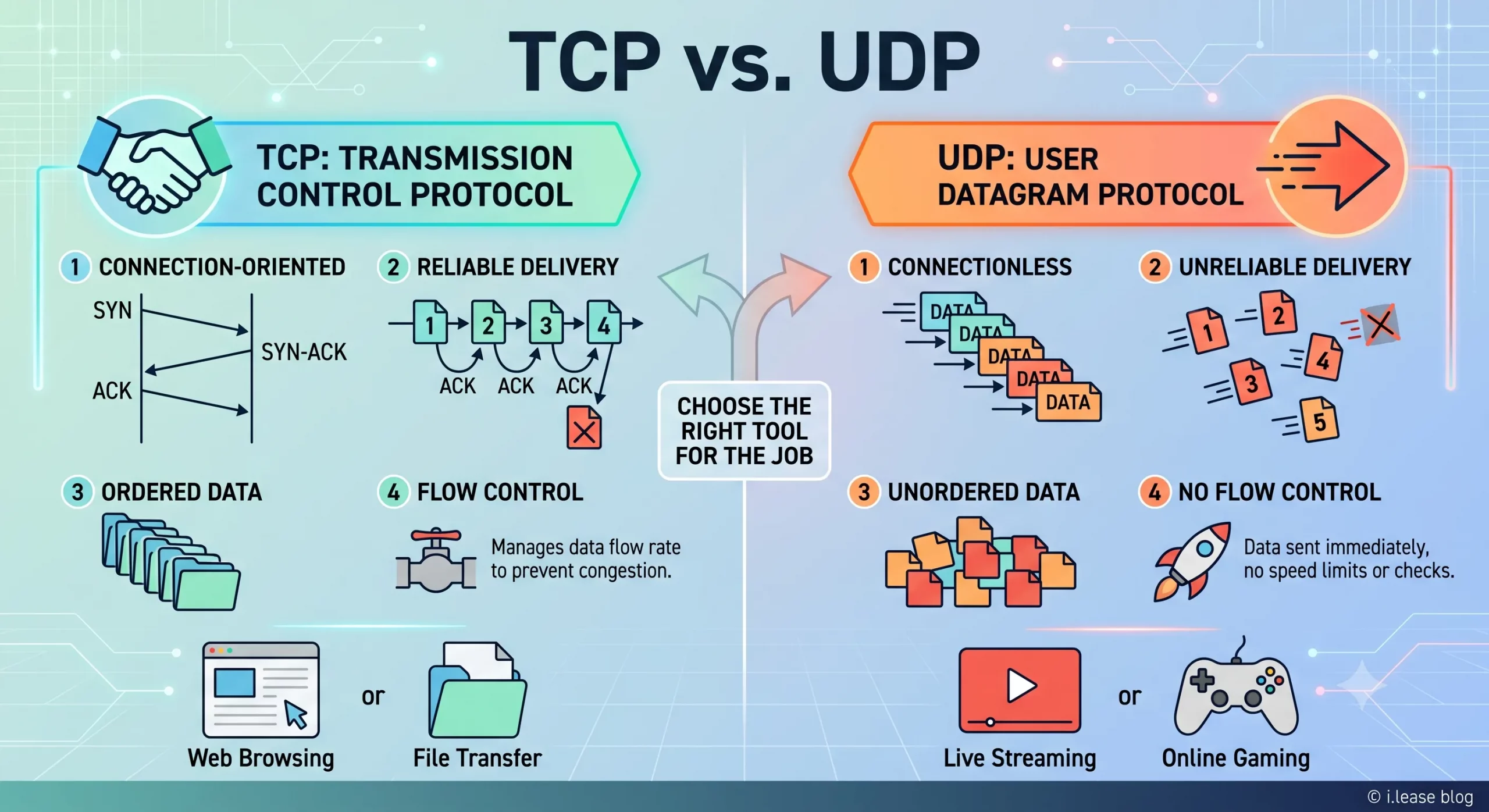
TCP 与 UDP:IPv4 租赁和企业网络指南
TCP 和 UDP 是互联网中最重要的两种传输层协议。它们决定数据如何在设备、服务器、云平台、VPN 网关、DNS 解析器、电子邮件系统、流媒体平台以及企业应用程序之间传输。 对于企业而言,TCP 和 UDP 不仅仅是技术术语,它们会直接影响实际的基础设施性能。公网 IPv4 地址提供可从互联网访问的网络端点,而 TCP 和 UDP 则决定流量如何通过该端点进行传输。 这对于租用或购买 IPv4 地址的企业尤为重要。企业租用 IPv4 地址并不是单纯为了持有这些地址,而是为了运行网站、API、VPN 隧道、DNS 服务、电子邮件平台、SaaS 应用程序、游戏服务器、流媒体系统、安全工具以及云端工作负载。不同类型的服务决定了需要使用 TCP、UDP,还是同时使用两者。 通过 i.lease,企业可以使用 IPv4 租赁服务获取用于实际网络部署的公网 IPv4 资源。需要长期控制 IP 地址资源的企业也可以购买 IP 地址,而拥有闲置 IPv4 资源的组织则可以出售 IP 地址。 TCP和UDP是什么? TCP 和 UDP 都是传输层协议。它们位于 IP 协议之上,帮助应用程序通过网络发送和接收数据。 IP 地址用于确定流量应该发送到哪里,而 TCP 和 UDP 则决定这些流量如何进行传输。 简单来说: TCP 适用于重视可靠性和按顺序传输数据的场景。 UDP 适用于重视速度、低延迟和轻量化数据传输的场景。 企业可能会使用同一个公网 IPv4 地址来运行不同的服务,但每项服务可能依赖不同的传输协议。例如,网站可能使用 TCP,VPN 网关可能使用 UDP,DNS 解析器可能同时使用 UDP 和 TCP,而游戏服务器则可能更倾向于使用 UDP,因为对于实时游戏而言,延迟造成的影响通常比少量数据包丢失更加明显。 因此,TCPRead more Related Posts 什么是电信公司?电信运营商如何为英国、美国和加拿大提供网络连接支持? 电信公司(Telco Companies),也称为电信运营商(Telecommunications Companies),提供通信与网络连接服务。这些服务包括移动通信网络、宽带互联网、光纤连接、固定电话服务、企业网络连接、云连接、托管网络服务以及数据中心连接等。 对于普通消费者而言,电信公司通常被视为移动通信或宽带互联网服务提供商。对于企业来说,电信公司远不只是一个服务品牌,更是关键的基础设施合作伙伴,帮助企业连接办公室、数据中心、云平台、远程员工、客户应用程序以及各类数字化服务。 随着企业越来越依赖云平台、SaaS 应用、AI 工具、VPN、网络安全系统以及在线服务,电信公司已成为数字基础设施规划中不可或缺的重要组成部分。 电信公司是什么? 电信公司(Telco Companies)是提供电信服务的企业。这些服务让个人、设备、企业和各种系统能够跨越距离进行通信与连接。 一家电信公司可能提供以下服务: 移动通信服务 宽带互联网 光纤连接 固定电话服务 企业互联网接入 企业广域网(WAN)服务 云连接服务 数据中心连接 VPN TCP 与 UDP:IPv4 租赁和企业网络指南 TCP 和 UDP 是互联网中最重要的两种传输层协议。它们决定数据如何在设备、服务器、云平台、VPN 网关、DNS 解析器、电子邮件系统、流媒体平台以及企业应用程序之间传输。 对于企业而言,TCP 和 UDP 不仅仅是技术术语,它们会直接影响实际的基础设施性能。公网 IPv4 地址提供可从互联网访问的网络端点,而 TCP 和 UDP 则决定流量如何通过该端点进行传输。 这对于租用或购买 IPv4 地址的企业尤为重要。企业租用 IPv4 什么是区域互联网注册管理机构(RIR) 区域互联网注册管理机构(Regional Internet Registry, RIR)是负责在特定地理区域内分配和管理互联网编号资源的组织。这些资源主要包括 IP 地址(IPv4 和 IPv6)以及自治系统号(ASN),它们是支撑设备和网络在互联网上相互通信的关键要素。 如果没有一套组织完善的系统来分配唯一的 IP 地址和路由标识符,互联网便无法正常运转。RIR 确保这一过程在各自管辖的区域内保持公平、高效与一致,从而避免冲突,并提升互联网治理的透明度。 全球五大 RIR 目前全球共有五家获官方认可的 RIR,各自负责世界上特定的区域:AFRINIC – 非洲网络信息中心(非洲)APNIC – 亚太网络信息中心(亚太地区)ARIN .related-post {} .related-post .post-list { text-align: left; } .related-post .post-list .item { margin: 5px; padding: 10px; } .related-post .headline { font-size: 18px !important; color: #999999 !important; } .related-post .post-list .item .post_thumb { max-height: 220px; margin: 10px 0px; padding: 0px; display: block; } .related-post .post-list .item .post_title { font-size: 16px; color: #3f3f3f; margin: 10px 0px; padding: 0px; display: block; text-decoration: none; } .related-post .post-list .item .post_excerpt { font-size: 13px; color: #3f3f3f; margin: 10px 0px; padding: 0px; display: block; text-decoration: none; } @media only screen and (min-width: 1024px) { .related-post .post-list .item { width: 30%; } } @media only screen and (min-width: 768px) and (max-width: 1023px) { .related-post .post-list .item { width: 90%; } } @media only screen and (min-width: 0px) and (max-width: 767px) { .related-post .post-list .item { width: 90%; } }
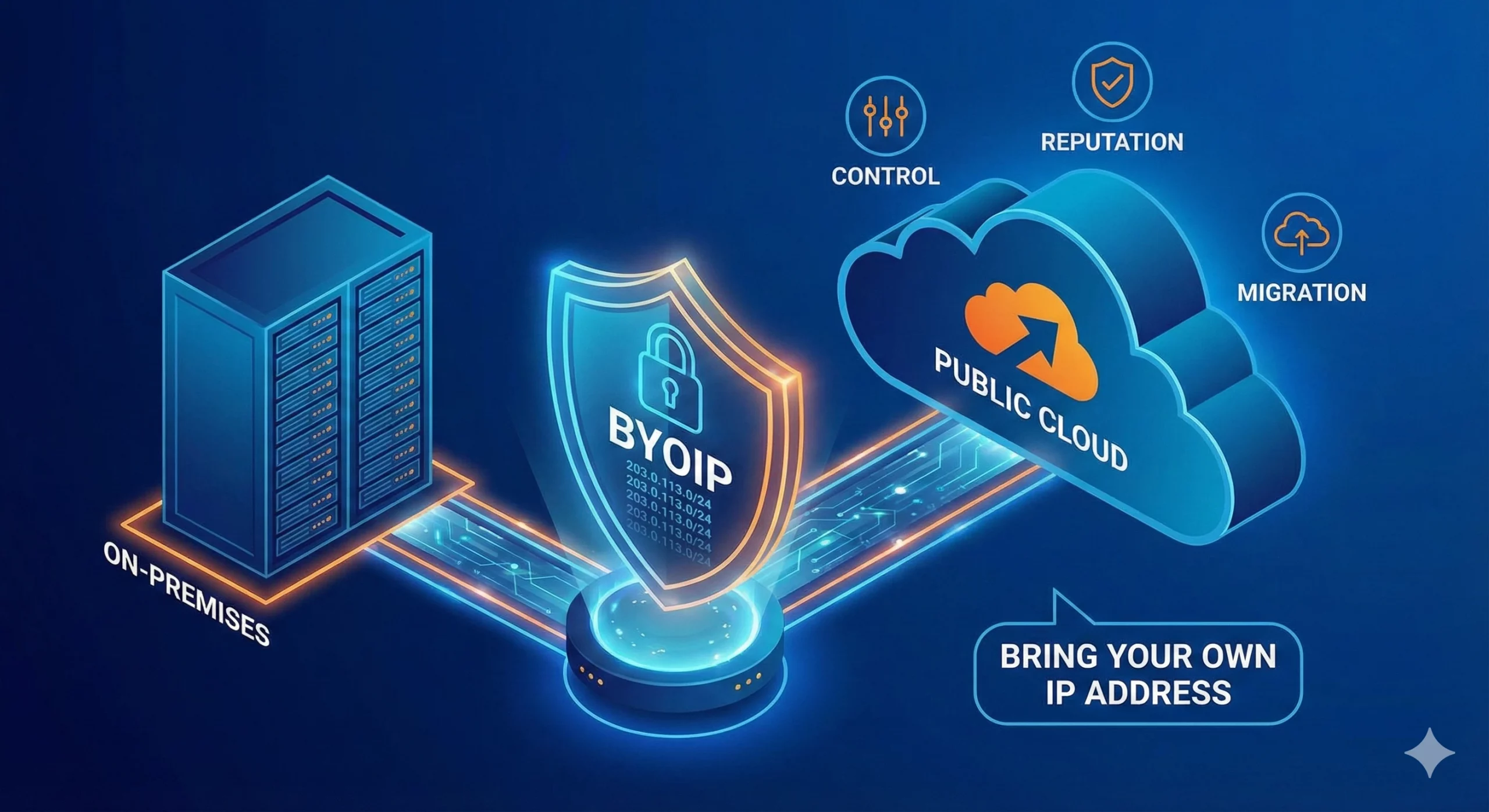
什么是BYOIP(自备IP地址)?
自带 IP(Bring Your Own IP,简称 BYOIP)是一种网络部署方式,允许企业将自己现有的公网 IP 地址段应用于云服务提供商、数据中心、内容分发网络(CDN)或其他基础设施平台。 企业无需使用服务提供商分配的新公网 IP 地址,而是可以使用自己已拥有或已获授权使用的 IPv4 或 IPv6 地址前缀。服务提供商会验证该组织对该地址段的使用权限,并在支持的情况下,通过其自身网络对该地址段进行路由公告(Advertise)。 BYOIP 有助于企业在迁移至云平台时保留现有的防火墙规则、白名单(Allowlists)、客户系统集成、IP 信誉(IP Reputation)、DNS 配置以及既有的网络身份。这不仅能够减少因更换 IP 地址而带来的业务中断,还能降低对服务提供商分配 IP 的依赖,使未来的基础设施迁移与扩展更加灵活且易于管理。 对于需要 BYOIP 地址资源的企业,可选择 购买 IPv4 地址(Buy IP),以获得长期控制权;如果更重视灵活性,也可采用 IPv4 租赁(IPv4 Leasing),按业务需求获取公网 IP 资源。 什么是BYOIP? BYOIP 是 Bring Your Own IP(自带 IP)的缩写。这是一种网络部署模式,允许组织将现有的公网 IP 地址段带入云服务提供商或其他基础设施平台使用。 在 BYOIP 模式下,组织仍然拥有或保留该 IP 地址段的使用权,而平台则获得授权,可在其基础设施中对该地址段进行路由公告(Advertise)和使用。随后,这些 IP 地址可分配给虚拟机(Virtual Machines)、负载均衡器(Load Balancers)、VPN 网关、内容分发服务(CDN)、安全平台以及公网应用程序端点等受支持的服务。 例如,一家企业将应用程序从本地数据中心迁移到云环境时,可能并不希望更换现有的公网 IP 地址。这些 IP 地址可能已经存在于客户白名单(Allowlists)、防火墙策略、DNS 记录、合作伙伴配置以及电子邮件信誉(Email Reputation)数据库中。 BYOIP 使企业能够在迁移工作负载的同时,继续使用原有的公网 IP 地址,从而保持更一致的网络身份,并减少因更换 IP 地址而带来的配置调整和业务影响。 Related Posts 什么是电信公司?电信运营商如何为英国、美国和加拿大提供网络连接支持? 电信公司(Telco Companies),也称为电信运营商(Telecommunications Companies),提供通信与网络连接服务。这些服务包括移动通信网络、宽带互联网、光纤连接、固定电话服务、企业网络连接、云连接、托管网络服务以及数据中心连接等。 对于普通消费者而言,电信公司通常被视为移动通信或宽带互联网服务提供商。对于企业来说,电信公司远不只是一个服务品牌,更是关键的基础设施合作伙伴,帮助企业连接办公室、数据中心、云平台、远程员工、客户应用程序以及各类数字化服务。 随着企业越来越依赖云平台、SaaS 应用、AI 工具、VPN、网络安全系统以及在线服务,电信公司已成为数字基础设施规划中不可或缺的重要组成部分。 电信公司是什么? 电信公司(Telco Companies)是提供电信服务的企业。这些服务让个人、设备、企业和各种系统能够跨越距离进行通信与连接。 一家电信公司可能提供以下服务: 移动通信服务 宽带互联网 光纤连接 固定电话服务 企业互联网接入 企业广域网(WAN)服务 云连接服务 数据中心连接 VPN TCP 与 UDP:IPv4 租赁和企业网络指南 TCP 和 UDP 是互联网中最重要的两种传输层协议。它们决定数据如何在设备、服务器、云平台、VPN 网关、DNS 解析器、电子邮件系统、流媒体平台以及企业应用程序之间传输。 对于企业而言,TCP 和 UDP 不仅仅是技术术语,它们会直接影响实际的基础设施性能。公网 IPv4 地址提供可从互联网访问的网络端点,而 TCP 和 UDP 则决定流量如何通过该端点进行传输。 这对于租用或购买 IPv4 地址的企业尤为重要。企业租用 IPv4 什么是区域互联网注册管理机构(RIR) 区域互联网注册管理机构(Regional Internet Registry, RIR)是负责在特定地理区域内分配和管理互联网编号资源的组织。这些资源主要包括 IP 地址(IPv4 和 IPv6)以及自治系统号(ASN),它们是支撑设备和网络在互联网上相互通信的关键要素。 如果没有一套组织完善的系统来分配唯一的 IP 地址和路由标识符,互联网便无法正常运转。RIR 确保这一过程在各自管辖的区域内保持公平、高效与一致,从而避免冲突,并提升互联网治理的透明度。 全球五大 RIR 目前全球共有五家获官方认可的 RIR,各自负责世界上特定的区域:AFRINIC – 非洲网络信息中心(非洲)APNIC – 亚太网络信息中心(亚太地区)ARIN .related-post {} .related-post .post-list { text-align: left; } .related-post .post-list .item { margin: 5px; padding: 10px; } .related-post .headline { font-size: 18px !important; color: #999999 !important; } .related-post .post-list .item .post_thumb { max-height: 220px; margin: 10px 0px; padding: 0px; display: block; } .related-post .post-list .item .post_title { font-size: 16px; color: #3f3f3f; margin: 10px 0px; padding: 0px; display: block; text-decoration: none; } .related-post .post-list .item .post_excerpt { font-size: 13px; color: #3f3f3f; margin: 10px 0px; padding: 0px; display: block; text-decoration: none; } @media only screen and (min-width: 1024px) { .related-post .post-list .item { width: 30%; } } @media only screen and (min-width: 768px) and (max-width: 1023px) { .related-post .post-list .item { width: 90%; } } @media only screen and (min-width: 0px) and (max-width: 767px) { .related-post .post-list .item { width: 90%; } }
