What Is an Autonomous System Number (ASN)? A Business Guide to Internet Routing
 Stephanie
An Autonomous System Number (ASN) is one of the most important building blocks of the Internet, yet it is often overlooked outside networking teams. Businesses planning cloud deployments, operating data centres, running Internet Service Providers (ISPs), providing VPN services, or managing their own public IPv4 resources will eventually encounter ASNs as part of Internet routing.
Table of Contents
While an IPv4 address identifies where Internet traffic should be delivered, an ASN identifies the network responsible for advertising that address space to the global Internet. The two work together but serve different purposes. One provides reachability, while the other provides routing identity.
This distinction becomes increasingly important as organisations expand their infrastructure across multiple providers, deploy redundant Internet connections, or begin using Bring Your Own IP (BYOIP) strategies. In these situations, simply owning or leasing IPv4 addresses is often not enough. Businesses may also need an ASN and the ability to participate in Border Gateway Protocol (BGP) routing.
For many organisations, leasing IPv4 addresses remains the simplest way to expand public address capacity. As routing requirements become more advanced, an ASN can provide greater control over how those addresses are announced across the Internet.
This guide explains what an ASN is, how it works, why businesses need one, and how it relates to IPv4 leasing and Internet routing.
ASN in simple business terms
Businesses often understand IPv4 addresses because they are assigned to servers, firewalls, VPN gateways, websites, or cloud workloads.
An ASN is different.
Rather than identifying a single server, it identifies the organisation operating a routing policy.
This allows Internet routers around the world to recognise:
- Which organisation owns the routing policy
- Which IP prefixes are being advertised
- Which paths are available to reach those prefixes
- How traffic should move between independent networks
Without ASNs, global Internet routing between thousands of independent networks would be extremely difficult to manage.
Who typically has an ASN?
Many different organisations operate their own Autonomous Systems, including:
- Internet Service Providers (ISPs)
- Cloud providers
- Data centre operators
- Content Delivery Networks (CDNs)
- Universities
- Government agencies
- Financial institutions
- Large enterprises
- Telecommunications companies
- Managed network providers
These organisations often manage multiple Internet connections and advertise their own IPv4 or IPv6 prefixes using BGP.
What Is an Autonomous System?
Before understanding an Autonomous System Number, it helps to understand what an Autonomous System (AS) actually is.
An Autonomous System is a collection of IP networks operated by a single organisation under one common routing policy.
Instead of treating every router on the Internet individually, the Internet groups networks into Autonomous Systems.
Each Autonomous System becomes one identifiable participant in global Internet routing.
For example, an Internet Service Provider may operate hundreds of routers across multiple cities. Although those routers are physically separate, they all belong to the same Autonomous System because they follow one routing policy managed by the provider.
The same concept applies to cloud providers, multinational enterprises, universities, and large hosting companies.
Every Autonomous System has its own identity
Just as every company has a registration number, every Autonomous System participating in global Internet routing receives its own ASN.
That ASN allows routers worldwide to recognise:
- Which network is advertising an IP prefix
- Where routing information originated
- How traffic should flow between networks
- Alternative routing paths if one connection becomes unavailable
Autonomous does not mean isolated
The word “autonomous” sometimes causes confusion.
It does not mean disconnected from the Internet.
Instead, it means the organisation controls its own routing decisions.
For example, a business operating its own ASN can decide:
- Which Internet providers to connect to
- Which routes should be preferred
- Which backup routes should be used during failures
- How traffic enters and leaves its network
This level of routing independence is one reason larger organisations obtain their own ASN as they expand their infrastructure.
Real-world examples
Many well-known Internet companies operate their own Autonomous Systems.
Cloud providers, telecommunications companies, content delivery networks, social media platforms, search engines, and streaming services all announce their own networks through one or more ASNs.
Even large enterprises increasingly operate their own Autonomous Systems to support hybrid cloud environments, multiple Internet providers, disaster recovery planning, and international connectivity.
Key takeaway
An IPv4 address tells the Internet where a service is located.
An Autonomous System tells the Internet who is responsible for advertising that route.
Together with BGP, these two components form the foundation of global Internet routing.
Why Does an ASN Exist?
The Internet is not operated by a single company or government. Instead, it is made up of tens of thousands of independently managed networks that exchange traffic with one another every second.
Without a common routing system, these networks would have no reliable way to determine who is responsible for a particular IP address block or how traffic should travel across multiple providers.
An Autonomous System Number exists to solve this problem.
Rather than identifying individual devices, an ASN identifies the organisation responsible for announcing a group of IP addresses to the global Internet.
When Internet routers exchange routing information through Border Gateway Protocol (BGP), they advertise not only IP prefixes but also the ASN responsible for those prefixes.
This enables routers worldwide to answer several important questions:
- Who is announcing this IP address block?
- Which network should traffic be sent to?
- Which path is currently available?
- Is there a shorter or more reliable route?
- If one provider fails, is there another available path?
Without ASNs, Internet routers would know that an IP address exists, but they would not know which network is responsible for delivering traffic to it.
Internet routing is similar to international logistics
Imagine shipping a package from Kuala Lumpur to New York.
The destination address alone is not enough.
The shipping companies also need to know which logistics network will transport the parcel across different countries before it reaches the final destination.
The Internet works in a similar way.
An IPv4 address identifies the destination.
An ASN identifies the network responsible for transporting traffic toward that destination.
Each participating network exchanges routing information with neighbouring networks until traffic reaches the correct Autonomous System.
Why routing identity matters
As organisations expand across multiple cloud providers, data centres, and Internet carriers, routing becomes more complex.
A company may have:
- Two Internet providers for redundancy
- Multiple data centres in different countries
- Cloud deployments across several regions
- Disaster recovery sites
- Private WAN connectivity
An ASN allows these organisations to maintain a consistent routing identity regardless of which provider is currently carrying the traffic.
This flexibility is one reason ASNs are widely used by Internet Service Providers, cloud providers, telecommunications companies, content delivery networks, and enterprises operating critical infrastructure.
ASN vs IP Address
Many people assume an ASN and an IP address serve the same purpose because both are associated with Internet connectivity. In reality, they solve two completely different problems.
An IP address identifies the destination of network traffic.
An ASN identifies the network responsible for advertising and routing that destination.
They complement one another rather than replace one another.
| Feature | Autonomous System Number (ASN) | IPv4 Address |
|---|---|---|
| Primary purpose | Identifies a network participating in Internet routing. | Identifies a reachable device, server, or network endpoint. |
| Assigned by | Regional Internet Registry (RIR). | Regional Internet Registry, ISP, or network operator. |
| Used by | BGP routers. | Every Internet-connected device. |
| Represents | A routing identity. | A network location. |
| Main function | Advertises IP prefixes across the Internet. | Sends and receives traffic. |
| Required for Internet access | No. Most businesses connect through their ISP’s ASN. | Yes. Public services require reachable IP addresses. |
| Used in BGP | Yes. | Advertised through BGP. |
| Business examples | ISPs, cloud providers, CDNs, enterprises with independent routing. | Websites, VPN servers, email systems, cloud instances, firewalls. |
Think of ASN and IPv4 as identity and location
A useful way to understand the difference is:
- An IPv4 address tells the Internet where to send traffic.
- An ASN tells the Internet who is responsible for advertising that route.
Neither replaces the other.
Businesses deploying Internet-facing infrastructure often require both. Public IPv4 addresses provide reachable services, while an ASN allows those address blocks to be advertised independently through BGP when appropriate.
Do all businesses need an ASN?
No.
Most organisations that lease IPv4 addresses for websites, email servers, SaaS applications, or cloud workloads do not operate their own ASN.
Instead, their Internet Service Provider or hosting provider announces the leased IPv4 addresses using the provider’s ASN.
This arrangement is sufficient for many businesses because it removes the complexity of managing BGP routing directly.
However, organisations requiring greater routing control may eventually deploy their own public ASN alongside their IPv4 resources.
Public ASN vs Private ASN
Not every Autonomous System Number is visible on the global Internet.
ASNs are divided into two broad categories:
- Public ASNs
- Private ASNs
Understanding the difference helps businesses determine whether they need an ASN for internal routing only or for participation in global Internet routing.
Public ASN
A public ASN is globally unique and is registered through a Regional Internet Registry (RIR).
Public ASNs are used when an organisation exchanges routing information with external networks over BGP.
Typical users include:
- Internet Service Providers
- Cloud providers
- Large enterprises
- Data centre operators
- Telecommunications companies
- Content Delivery Networks
Public ASNs appear in global routing tables and are recognised by routers throughout the Internet.
Private ASN
A private ASN is intended for internal routing between organisations or within private networks.
Like private IP addresses, private ASNs are not intended to appear in the global Internet routing table.
They are commonly used:
- Inside enterprise networks
- For testing environments
- Between organisations with private BGP connections
- Inside large internal infrastructures
If routes using a private ASN are eventually advertised to the public Internet, the private ASN is normally removed or replaced before those routes leave the organisation.
Which type do businesses usually need?
The answer depends on the organisation’s routing objectives.
If a company simply leases IPv4 addresses for hosting, websites, cloud servers, VPN gateways, or email infrastructure, it usually does not require its own public ASN because the upstream provider handles Internet route announcements.
Businesses seeking independent Internet routing, multi-homing across multiple carriers, or BYOIP deployments are more likely to require a public ASN.
Business insight
Leasing IPv4 addresses and obtaining an ASN are separate decisions.
Many organisations successfully lease public IPv4 addresses without operating their own ASN. Others combine leased IPv4 resources with a public ASN to gain greater routing flexibility, especially when deploying BGP across multiple providers or cloud environments.
Advantages and Disadvantages of Having Your Own ASN
| Advantages | Disadvantages |
|---|---|
| Independent Internet routing | Additional operational complexity |
| Supports multi-homing | Requires BGP knowledge |
| Greater provider independence | Configuration and monitoring responsibilities |
| Better routing flexibility | May not benefit smaller organisations |
| Supports BYOIP strategies | Application and policy requirements |
| Improves long-term infrastructure scalability | Ongoing routing management |
For many organisations, an ASN is unnecessary until network operations become sufficiently complex. Leasing IPv4 addresses through an experienced provider is often enough to support production services without independently managing Internet routing.
Final Thoughts
An Autonomous System Number is much more than a number assigned to a network. It represents a network’s identity within the global Internet routing system.
While IPv4 addresses tell the Internet where traffic should be delivered, an ASN tells the Internet who is responsible for advertising those routes.
For many organisations, leasing IPv4 addresses provides everything needed to operate public services. As infrastructure grows and routing requirements become more sophisticated, combining IPv4 resources with an ASN and BGP can provide greater resilience, scalability, and operational independence.
Understanding these technologies allows businesses to make informed decisions as they expand cloud infrastructure, data centre operations, hosting platforms, or enterprise networks.
i.lease helps organisations access public IPv4 resources for hosting, cloud infrastructure, VPN services, SaaS platforms, enterprise networks, and data centre deployments. Whether your organisation simply needs additional IPv4 capacity or is preparing for more advanced Internet routing, understanding the relationship between IPv4 addresses, ASNs, and BGP enables better infrastructure planning.
Frequent Asked Questions
What is an Autonomous System Number (ASN)?
An Autonomous System Number (ASN) is a globally unique identifier assigned to a network that participates in Internet routing. It allows organisations to exchange routing information with other networks using the Border Gateway Protocol (BGP).
What is the difference between an ASN and an IP address?
An IP address identifies a destination on the Internet, while an ASN identifies the network responsible for advertising that destination through BGP. IP addresses provide reachability, whereas ASNs provide routing identity.
Do I need an ASN to lease IPv4 addresses?
No. Most organisations can lease IPv4 addresses without operating their own ASN because their hosting provider, cloud provider, or Internet Service Provider announces the IP addresses on their behalf. An ASN becomes useful when businesses require independent BGP routing.
Who issues Autonomous System Numbers?
Public ASNs are issued by the five Regional Internet Registries (RIRs): AFRINIC, APNIC, ARIN, LACNIC, and RIPE NCC. Each registry manages ASN allocations within its service region.
What is the difference between a public ASN and a private ASN?
A public ASN is globally recognised and used for Internet routing. A private ASN is intended for internal or private routing environments and is normally removed before routes are advertised to the public Internet.
Why do businesses obtain their own ASN?
Businesses commonly obtain an ASN to support multi-homing, independent Internet routing, cloud connectivity, BYOIP deployments, data centre operations, and greater control over how their IP prefixes are advertised.
Is an ASN required for Bring Your Own IP (BYOIP)?
Not always. Some cloud providers can advertise customer-owned IP prefixes on the customer’s behalf. However, organisations implementing independent BYOIP strategies across multiple providers often operate their own public ASN.
How does BGP use an ASN?
BGP exchanges routing information between Autonomous Systems. Every route advertisement includes the ASN responsible for announcing the IP prefix, allowing routers to determine the best path across the Internet.
How does an ASN relate to IPv4 leasing?
IPv4 leasing provides public address resources that organisations use for Internet-facing services. An ASN becomes relevant when those organisations want greater control over how the leased IPv4 addresses are announced through BGP across multiple networks.
相关文章
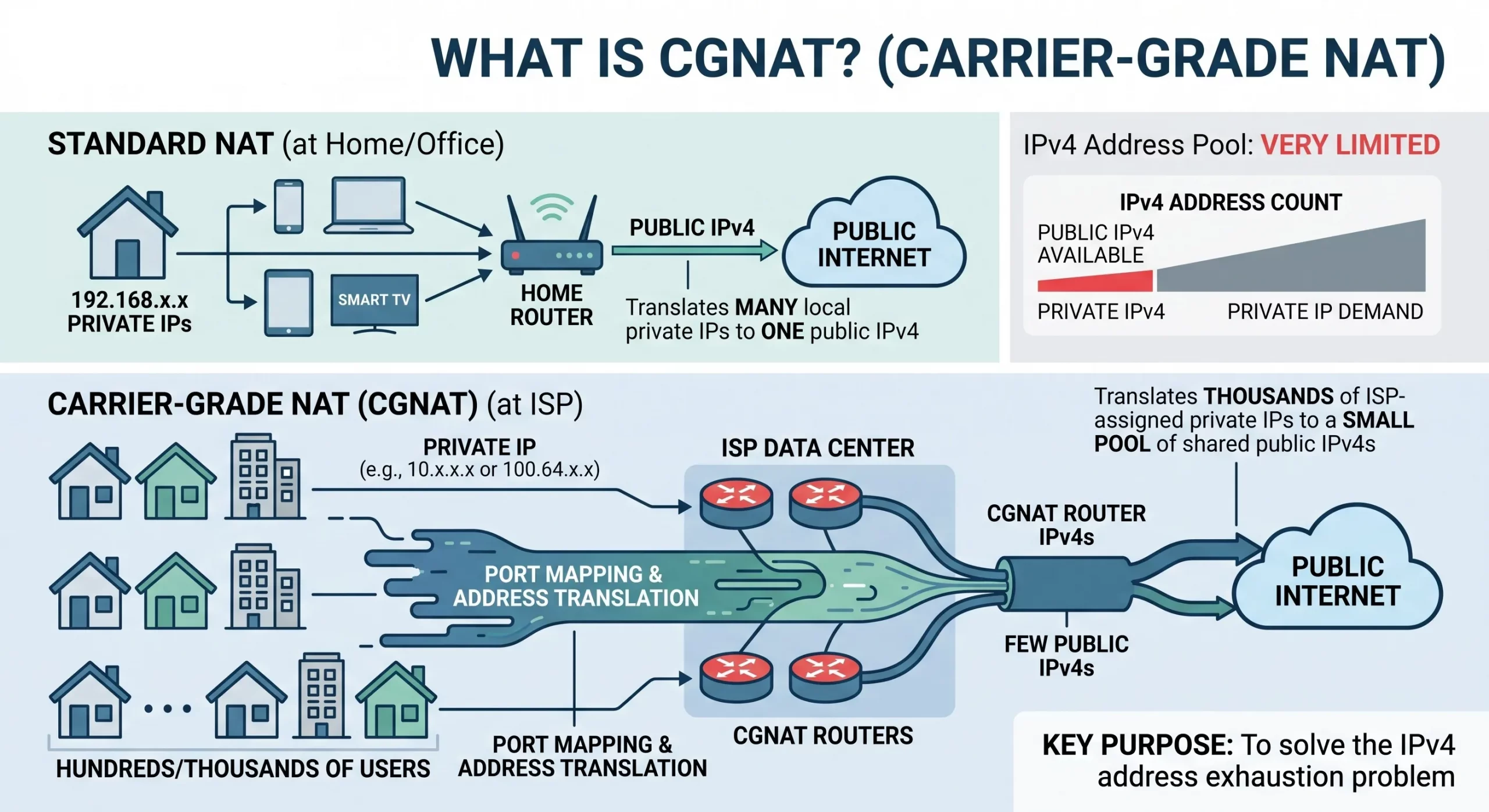
什么是 CGNAT(运营商级 NAT)?它为何会影响主机托管、游戏和入站服务?
CGNAT(Carrier-Grade NAT,运营商级网络地址转换)是一种技术,它允许互联网服务提供商让多个客户同时共享同一个公共 IPv4 地址,而不是为每位客户单独分配一个公共 IPv4 地址。 它会在服务提供商的网络内部增加第二层网络地址转换,因此数百甚至数千名用户都位于同一个公共地址之后,而外部互联网看到的只是这个共享的公共地址。 对于日常网页浏览、流媒体播放和应用程序使用来说,CGNAT 通常不会被用户察觉。问题会在外部网络需要主动连接到你时出现,例如托管服务器、进行端口转发、运行游戏服务器、接收 VoIP 或 VPN 连接,或启用远程访问。由于你不再拥有属于自己的公共地址——而是与其他陌生用户共享同一个地址——传入连接无法明确知道应该被转发到哪一个用户,因此这些服务可能无法正常工作或变得不稳定。 CGNAT 并不是程序错误或配置错误。它是针对一个结构性现实而采取的有意解决方案:全球 IPv4 地址已经不足,而互联网服务提供商仍需要在公共地址数量有限的情况下继续连接新的客户。这使 CGNAT 成为普通用户最容易接触到的一个明显迹象,说明公共 IPv4 地址是一种有限且竞争激烈的资源;同时也清楚说明了为什么运行对外服务的企业需要拥有自己的专用公共地址空间。本文将介绍什么是 CGNAT、它如何运作、具体会影响哪些功能、如何判断自己是否处于 CGNAT 环境中,以及对于无法接受这些限制的企业来说,有哪些可行的解决方案。 什么是 CGNAT CGNAT,也写作 CGN,有时也称为 Large-Scale NAT(LSN,大规模网络地址转换),是一种在运营商层面执行的网络地址转换技术,使 ISP 能够让多个客户共享同一个公共 IPv4 地址。 它延伸了家庭路由器中 NAT 的基本原理——多个私有设备共享一个地址——但会在服务提供商的网络层面再次执行一次,并同时覆盖大量客户。 这样一来,处于 CGNAT 后方的客户并不拥有一个唯一的公共地址。外部互联网所看到、并与其流量关联的地址,是与其他用户共享的,而且该地址由 ISP 控制,而不是由客户控制。对于由用户主动发起的出站连接,这通常不会造成问题。但对于任何依赖外部网络能够单独连接到该用户的服务来说,这个由服务提供商控制的共享地址正是问题的根源。 从一开始就明确区分这一点会很有帮助,因为它几乎解释了 CGNAT 会破坏的所有功能:由你主动发起的出站连接通常可以正常工作;而由其他人从外部主动尝试连接到你的入站连接,才是容易失败的部分。 从根本上来说,CGNAT 对客户端友好,却对服务器并不友好。 CGNAT 的工作原理是什么? CGNAT 的工作方式是在客户网络与公共互联网之间增加第二层地址转换,因此流量会经过两次转换:第一次发生在家庭路由器上,第二次发生在 ISP 的运营商级 NAT 设备上。 在传统网络环境中,家庭路由器会在设备的私有地址与 ISP 分配给你的单个公共地址之间执行 NAT。此时,你仍然拥有一个公共地址,而且可以通过端口转发,将外部传入连接定向到路由器后方的某台设备——这也是自托管以及许多网络服务能够正常运行的重要机制。关于私有地址与公共地址之间的关系,可以参考我们的 公共 IP 与私有 IP 指南。 CGNAT 会加入第二个转换阶段。ISP 不再直接为你的路由器分配公共地址,而是先分配一个来自共享中间地址范围的地址,然后通过运营商 NAT 设备,将大量这类客户的流量转换到一个规模更小的真实公共地址池中。因此,数据路径会变成:你的私有设备地址 Related Posts 什么是 CGNAT(运营商级 NAT)?它为何会影响主机托管、游戏和入站服务? CGNAT(Carrier-Grade NAT,运营商级网络地址转换)是一种技术,它允许互联网服务提供商让多个客户同时共享同一个公共 IPv4 地址,而不是为每位客户单独分配一个公共 IPv4 地址。 它会在服务提供商的网络内部增加第二层网络地址转换,因此数百甚至数千名用户都位于同一个公共地址之后,而外部互联网看到的只是这个共享的公共地址。对于日常网页浏览、流媒体播放和应用程序使用来说,CGNAT 通常不会被用户察觉。问题会在外部网络需要主动连接到你时出现,例如托管服务器、进行端口转发、运行游戏服务器、接收 VoIP 或 VPN 连接,或启用远程访问。由于你不再拥有属于自己的公共地址——而是与其他陌生用户共享同一个地址——传入连接无法明确知道应该被转发到哪一个用户,因此这些服务可能无法正常工作或变得不稳定。CGNAT 并不是程序错误或配置错误。它是针对一个结构性现实而采取的有意解决方案:全球 IPv4 地址已经不足,而互联网服务提供商仍需要在公共地址数量有限的情况下继续连接新的客户。这使 CGNAT 成为普通用户最容易接触到的一个明显迹象,说明公共 IPv4 地址是一种有限且竞争激烈的资源;同时也清楚说明了为什么运行对外服务的企业需要拥有自己的专用公共地址空间。本文将介绍什么是 CGNAT、它如何运作、具体会影响哪些功能、如何判断自己是否处于 什么是电信公司?电信运营商如何为英国、美国和加拿大提供网络连接支持? 电信公司(Telco Companies),也称为电信运营商(Telecommunications Companies),提供通信与网络连接服务。这些服务包括移动通信网络、宽带互联网、光纤连接、固定电话服务、企业网络连接、云连接、托管网络服务以及数据中心连接等。 对于普通消费者而言,电信公司通常被视为移动通信或宽带互联网服务提供商。对于企业来说,电信公司远不只是一个服务品牌,更是关键的基础设施合作伙伴,帮助企业连接办公室、数据中心、云平台、远程员工、客户应用程序以及各类数字化服务。 随着企业越来越依赖云平台、SaaS 应用、AI 工具、VPN、网络安全系统以及在线服务,电信公司已成为数字基础设施规划中不可或缺的重要组成部分。 电信公司是什么? 电信公司(Telco Companies)是提供电信服务的企业。这些服务让个人、设备、企业和各种系统能够跨越距离进行通信与连接。 一家电信公司可能提供以下服务: 移动通信服务 宽带互联网 光纤连接 固定电话服务 企业互联网接入 企业广域网(WAN)服务 云连接服务 数据中心连接 VPN TCP 与 UDP:IPv4 租赁和企业网络指南 TCP 和 UDP 是互联网中最重要的两种传输层协议。它们决定数据如何在设备、服务器、云平台、VPN 网关、DNS 解析器、电子邮件系统、流媒体平台以及企业应用程序之间传输。 对于企业而言,TCP 和 UDP 不仅仅是技术术语,它们会直接影响实际的基础设施性能。公网 IPv4 地址提供可从互联网访问的网络端点,而 TCP 和 UDP 则决定流量如何通过该端点进行传输。 这对于租用或购买 IPv4 地址的企业尤为重要。企业租用 IPv4 .related-post {} .related-post .post-list { text-align: left; } .related-post .post-list .item { margin: 5px; padding: 10px; } .related-post .headline { font-size: 18px !important; color: #999999 !important; } .related-post .post-list .item .post_thumb { max-height: 220px; margin: 10px 0px; padding: 0px; display: block; } .related-post .post-list .item .post_title { font-size: 16px; color: #3f3f3f; margin: 10px 0px; padding: 0px; display: block; text-decoration: none; } .related-post .post-list .item .post_excerpt { font-size: 13px; color: #3f3f3f; margin: 10px 0px; padding: 0px; display: block; text-decoration: none; } @media only screen and (min-width: 1024px) { .related-post .post-list .item { width: 30%; } } @media only screen and (min-width: 768px) and (max-width: 1023px) { .related-post .post-list .item { width: 90%; } } @media only screen and (min-width: 0px) and (max-width: 767px) { .related-post .post-list .item { width: 90%; } }

什么是电信公司?电信运营商如何为英国、美国和加拿大提供网络连接支持?
电信公司(Telco Companies),也称为电信运营商(Telecommunications Companies),提供通信与网络连接服务。这些服务包括移动通信网络、宽带互联网、光纤连接、固定电话服务、企业网络连接、云连接、托管网络服务以及数据中心连接等。 对于普通消费者而言,电信公司通常被视为移动通信或宽带互联网服务提供商。对于企业来说,电信公司远不只是一个服务品牌,更是关键的基础设施合作伙伴,帮助企业连接办公室、数据中心、云平台、远程员工、客户应用程序以及各类数字化服务。 随着企业越来越依赖云平台、SaaS 应用、AI 工具、VPN、网络安全系统以及在线服务,电信公司已成为数字基础设施规划中不可或缺的重要组成部分。 电信公司是什么? 电信公司(Telco Companies)是提供电信服务的企业。这些服务让个人、设备、企业和各种系统能够跨越距离进行通信与连接。 一家电信公司可能提供以下服务: 移动通信服务 宽带互联网 光纤连接 固定电话服务 企业互联网接入 企业广域网(WAN)服务 云连接服务 数据中心连接 VPN 服务 托管网络解决方案 互联网传输(Internet Transit) 电信批发服务 部分电信公司拥有并运营大规模的实体网络基础设施;另一些则通过批发接入、租用基础设施或与网络运营商合作来提供电信服务。 电信公司提供哪些服务? 电信公司同时为个人消费者和企业客户提供服务。 面向消费者的服务通常包括移动通信套餐、家庭宽带、光纤互联网、固定电话以及通信组合套餐。 面向企业的服务则可能包括专线互联网接入、企业光纤、专用网络、云连接、托管安全服务、数据中心连接、物联网(IoT)连接以及企业移动通信方案。 对于大型企业客户,电信公司还可提供: 多地点办公室网络连接 远程员工接入 私有云连接 SD-WAN(软件定义广域网) 灾难恢复连接 低延迟网络路由 互联网传输(Internet Transit) 网络监控 托管防火墙服务 正因如此,电信公司不仅对日常通信至关重要,也是现代企业建设先进数字基础设施的重要支柱。 电信公司 vs 互联网服务提供商 vs 网络运营商 电信公司(Telco)、互联网服务提供商(ISP)和网络运营商(Network Operator)之间可能存在重叠,但它们并不完全相同。 电信公司提供电信服务。 互联网服务提供商(ISP)提供互联网接入服务。 网络运营商负责建设、运营和管理网络基础设施。 一些大型电信公司同时承担这三种角色。它们拥有基础设施、运营网络,并向市场提供互联网、移动通信以及企业网络服务。 规模较小的服务提供商则可能专注于其中某一层。例如,互联网服务提供商(ISP)可以销售宽带服务,而无需拥有所有实体网络基础设施;网络运营商可能负责建设和运营光纤网络,并向电信公司或 ISP 提供批发网络接入;电信公司则可能结合自有网络与合作伙伴网络,为客户提供移动通信和企业服务。 对于企业而言,理解这些区别非常重要,因为服务质量不仅取决于销售该方案的品牌,还受到其底层网络、路由设计、网络覆盖范围以及技术支持体系等因素的影响。 为什么电信公司对企业至关重要 电信公司之所以重要,是因为几乎所有现代企业都依赖稳定的网络连接。 企业可能需要电信服务来支持: 办公室互联网接入 移动网络连接 远程办公 客户支持系统 云应用程序 SaaS 平台 支付系统 VPNRead more Related Posts 什么是 CGNAT(运营商级 NAT)?它为何会影响主机托管、游戏和入站服务? CGNAT(Carrier-Grade NAT,运营商级网络地址转换)是一种技术,它允许互联网服务提供商让多个客户同时共享同一个公共 IPv4 地址,而不是为每位客户单独分配一个公共 IPv4 地址。 它会在服务提供商的网络内部增加第二层网络地址转换,因此数百甚至数千名用户都位于同一个公共地址之后,而外部互联网看到的只是这个共享的公共地址。对于日常网页浏览、流媒体播放和应用程序使用来说,CGNAT 通常不会被用户察觉。问题会在外部网络需要主动连接到你时出现,例如托管服务器、进行端口转发、运行游戏服务器、接收 VoIP 或 VPN 连接,或启用远程访问。由于你不再拥有属于自己的公共地址——而是与其他陌生用户共享同一个地址——传入连接无法明确知道应该被转发到哪一个用户,因此这些服务可能无法正常工作或变得不稳定。CGNAT 并不是程序错误或配置错误。它是针对一个结构性现实而采取的有意解决方案:全球 IPv4 地址已经不足,而互联网服务提供商仍需要在公共地址数量有限的情况下继续连接新的客户。这使 CGNAT 成为普通用户最容易接触到的一个明显迹象,说明公共 IPv4 地址是一种有限且竞争激烈的资源;同时也清楚说明了为什么运行对外服务的企业需要拥有自己的专用公共地址空间。本文将介绍什么是 CGNAT、它如何运作、具体会影响哪些功能、如何判断自己是否处于 什么是电信公司?电信运营商如何为英国、美国和加拿大提供网络连接支持? 电信公司(Telco Companies),也称为电信运营商(Telecommunications Companies),提供通信与网络连接服务。这些服务包括移动通信网络、宽带互联网、光纤连接、固定电话服务、企业网络连接、云连接、托管网络服务以及数据中心连接等。 对于普通消费者而言,电信公司通常被视为移动通信或宽带互联网服务提供商。对于企业来说,电信公司远不只是一个服务品牌,更是关键的基础设施合作伙伴,帮助企业连接办公室、数据中心、云平台、远程员工、客户应用程序以及各类数字化服务。 随着企业越来越依赖云平台、SaaS 应用、AI 工具、VPN、网络安全系统以及在线服务,电信公司已成为数字基础设施规划中不可或缺的重要组成部分。 电信公司是什么? 电信公司(Telco Companies)是提供电信服务的企业。这些服务让个人、设备、企业和各种系统能够跨越距离进行通信与连接。 一家电信公司可能提供以下服务: 移动通信服务 宽带互联网 光纤连接 固定电话服务 企业互联网接入 企业广域网(WAN)服务 云连接服务 数据中心连接 VPN TCP 与 UDP:IPv4 租赁和企业网络指南 TCP 和 UDP 是互联网中最重要的两种传输层协议。它们决定数据如何在设备、服务器、云平台、VPN 网关、DNS 解析器、电子邮件系统、流媒体平台以及企业应用程序之间传输。 对于企业而言,TCP 和 UDP 不仅仅是技术术语,它们会直接影响实际的基础设施性能。公网 IPv4 地址提供可从互联网访问的网络端点,而 TCP 和 UDP 则决定流量如何通过该端点进行传输。 这对于租用或购买 IPv4 地址的企业尤为重要。企业租用 IPv4 .related-post {} .related-post .post-list { text-align: left; } .related-post .post-list .item { margin: 5px; padding: 10px; } .related-post .headline { font-size: 18px !important; color: #999999 !important; } .related-post .post-list .item .post_thumb { max-height: 220px; margin: 10px 0px; padding: 0px; display: block; } .related-post .post-list .item .post_title { font-size: 16px; color: #3f3f3f; margin: 10px 0px; padding: 0px; display: block; text-decoration: none; } .related-post .post-list .item .post_excerpt { font-size: 13px; color: #3f3f3f; margin: 10px 0px; padding: 0px; display: block; text-decoration: none; } @media only screen and (min-width: 1024px) { .related-post .post-list .item { width: 30%; } } @media only screen and (min-width: 768px) and (max-width: 1023px) { .related-post .post-list .item { width: 90%; } } @media only screen and (min-width: 0px) and (max-width: 767px) { .related-post .post-list .item { width: 90%; } }
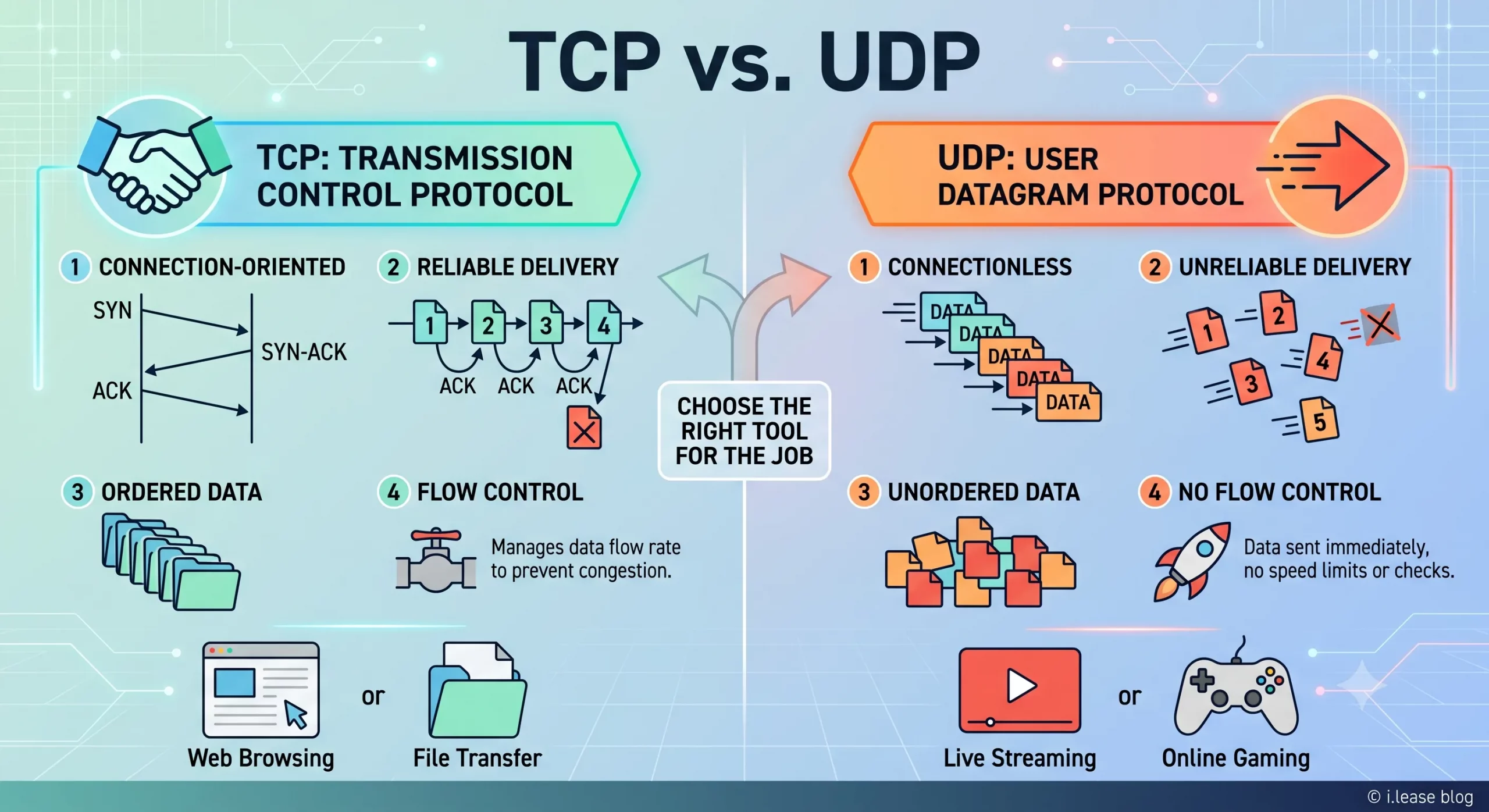
TCP 与 UDP:IPv4 租赁和企业网络指南
TCP 和 UDP 是互联网中最重要的两种传输层协议。它们决定数据如何在设备、服务器、云平台、VPN 网关、DNS 解析器、电子邮件系统、流媒体平台以及企业应用程序之间传输。 对于企业而言,TCP 和 UDP 不仅仅是技术术语,它们会直接影响实际的基础设施性能。公网 IPv4 地址提供可从互联网访问的网络端点,而 TCP 和 UDP 则决定流量如何通过该端点进行传输。 这对于租用或购买 IPv4 地址的企业尤为重要。企业租用 IPv4 地址并不是单纯为了持有这些地址,而是为了运行网站、API、VPN 隧道、DNS 服务、电子邮件平台、SaaS 应用程序、游戏服务器、流媒体系统、安全工具以及云端工作负载。不同类型的服务决定了需要使用 TCP、UDP,还是同时使用两者。 通过 i.lease,企业可以使用 IPv4 租赁服务获取用于实际网络部署的公网 IPv4 资源。需要长期控制 IP 地址资源的企业也可以购买 IP 地址,而拥有闲置 IPv4 资源的组织则可以出售 IP 地址。 TCP和UDP是什么? TCP 和 UDP 都是传输层协议。它们位于 IP 协议之上,帮助应用程序通过网络发送和接收数据。 IP 地址用于确定流量应该发送到哪里,而 TCP 和 UDP 则决定这些流量如何进行传输。 简单来说: TCP 适用于重视可靠性和按顺序传输数据的场景。 UDP 适用于重视速度、低延迟和轻量化数据传输的场景。 企业可能会使用同一个公网 IPv4 地址来运行不同的服务,但每项服务可能依赖不同的传输协议。例如,网站可能使用 TCP,VPN 网关可能使用 UDP,DNS 解析器可能同时使用 UDP 和 TCP,而游戏服务器则可能更倾向于使用 UDP,因为对于实时游戏而言,延迟造成的影响通常比少量数据包丢失更加明显。 因此,TCPRead more Related Posts 什么是 CGNAT(运营商级 NAT)?它为何会影响主机托管、游戏和入站服务? CGNAT(Carrier-Grade NAT,运营商级网络地址转换)是一种技术,它允许互联网服务提供商让多个客户同时共享同一个公共 IPv4 地址,而不是为每位客户单独分配一个公共 IPv4 地址。 它会在服务提供商的网络内部增加第二层网络地址转换,因此数百甚至数千名用户都位于同一个公共地址之后,而外部互联网看到的只是这个共享的公共地址。对于日常网页浏览、流媒体播放和应用程序使用来说,CGNAT 通常不会被用户察觉。问题会在外部网络需要主动连接到你时出现,例如托管服务器、进行端口转发、运行游戏服务器、接收 VoIP 或 VPN 连接,或启用远程访问。由于你不再拥有属于自己的公共地址——而是与其他陌生用户共享同一个地址——传入连接无法明确知道应该被转发到哪一个用户,因此这些服务可能无法正常工作或变得不稳定。CGNAT 并不是程序错误或配置错误。它是针对一个结构性现实而采取的有意解决方案:全球 IPv4 地址已经不足,而互联网服务提供商仍需要在公共地址数量有限的情况下继续连接新的客户。这使 CGNAT 成为普通用户最容易接触到的一个明显迹象,说明公共 IPv4 地址是一种有限且竞争激烈的资源;同时也清楚说明了为什么运行对外服务的企业需要拥有自己的专用公共地址空间。本文将介绍什么是 CGNAT、它如何运作、具体会影响哪些功能、如何判断自己是否处于 什么是电信公司?电信运营商如何为英国、美国和加拿大提供网络连接支持? 电信公司(Telco Companies),也称为电信运营商(Telecommunications Companies),提供通信与网络连接服务。这些服务包括移动通信网络、宽带互联网、光纤连接、固定电话服务、企业网络连接、云连接、托管网络服务以及数据中心连接等。 对于普通消费者而言,电信公司通常被视为移动通信或宽带互联网服务提供商。对于企业来说,电信公司远不只是一个服务品牌,更是关键的基础设施合作伙伴,帮助企业连接办公室、数据中心、云平台、远程员工、客户应用程序以及各类数字化服务。 随着企业越来越依赖云平台、SaaS 应用、AI 工具、VPN、网络安全系统以及在线服务,电信公司已成为数字基础设施规划中不可或缺的重要组成部分。 电信公司是什么? 电信公司(Telco Companies)是提供电信服务的企业。这些服务让个人、设备、企业和各种系统能够跨越距离进行通信与连接。 一家电信公司可能提供以下服务: 移动通信服务 宽带互联网 光纤连接 固定电话服务 企业互联网接入 企业广域网(WAN)服务 云连接服务 数据中心连接 VPN 什么是BYOIP(自备IP地址)? 自带 IP(Bring Your Own IP,简称 BYOIP)是一种网络部署方式,允许企业将自己现有的公网 IP 地址段应用于云服务提供商、数据中心、内容分发网络(CDN)或其他基础设施平台。 企业无需使用服务提供商分配的新公网 IP 地址,而是可以使用自己已拥有或已获授权使用的 IPv4 或 IPv6 地址前缀。服务提供商会验证该组织对该地址段的使用权限,并在支持的情况下,通过其自身网络对该地址段进行路由公告(Advertise)。 BYOIP 有助于企业在迁移至云平台时保留现有的防火墙规则、白名单(Allowlists)、客户系统集成、IP 信誉(IP Reputation)、DNS 配置以及既有的网络身份。这不仅能够减少因更换 .related-post {} .related-post .post-list { text-align: left; } .related-post .post-list .item { margin: 5px; padding: 10px; } .related-post .headline { font-size: 18px !important; color: #999999 !important; } .related-post .post-list .item .post_thumb { max-height: 220px; margin: 10px 0px; padding: 0px; display: block; } .related-post .post-list .item .post_title { font-size: 16px; color: #3f3f3f; margin: 10px 0px; padding: 0px; display: block; text-decoration: none; } .related-post .post-list .item .post_excerpt { font-size: 13px; color: #3f3f3f; margin: 10px 0px; padding: 0px; display: block; text-decoration: none; } @media only screen and (min-width: 1024px) { .related-post .post-list .item { width: 30%; } } @media only screen and (min-width: 768px) and (max-width: 1023px) { .related-post .post-list .item { width: 90%; } } @media only screen and (min-width: 0px) and (max-width: 767px) { .related-post .post-list .item { width: 90%; } }
