About IPv6: What Businesses Need to Know Before the Internet Fully Transitions
IPv6 is the next generation of Internet Protocol addressing. It was created to solve the long-term limitation of IPv4 address space and support the continued growth of the internet, cloud platforms, mobile networks, and connected devices.
Table of Contents
For many businesses, IPv6 is no longer just a future concept. It is already part of modern network planning. Internet service providers, cloud platforms, mobile networks, and large digital platforms increasingly support IPv6. However, the transition is still uneven. Many systems, customers, applications, and enterprise networks continue to rely on IPv4.
That is why understanding IPv6 is important, even if your organization still depends on IPv4 today.
What is IPv6?
IPv6 stands for Internet Protocol version 6. It is an addressing system that allows devices, servers, networks, and online services to communicate across the internet.
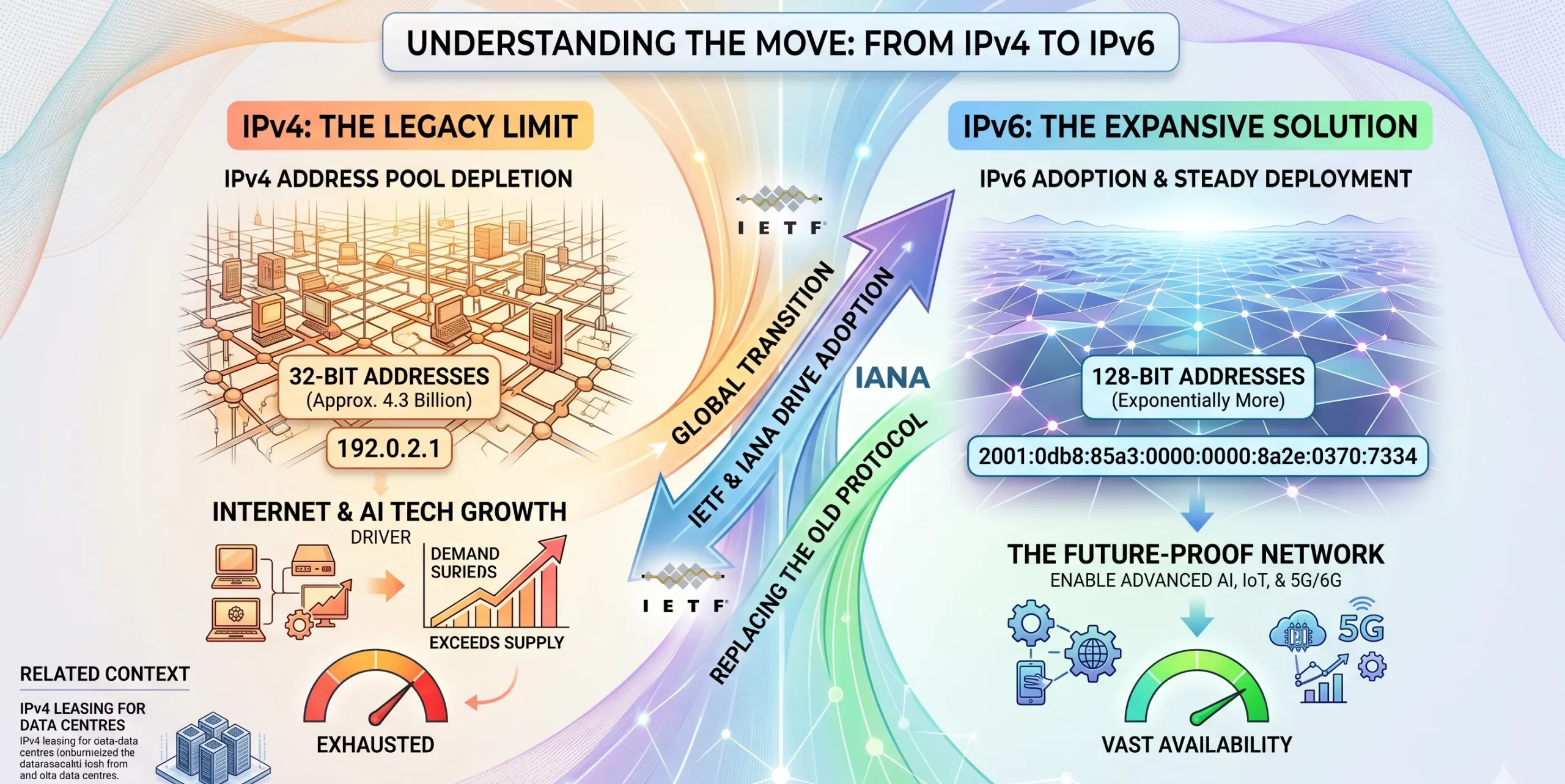
Every internet-connected device needs an IP address to send and receive data. IPv4 uses a 32-bit address format, while IPv6 uses a 128-bit format. This gives IPv6 a much larger address space and makes it suitable for long-term internet growth.
A simple example of an IPv4 address looks like this:
192.0.2.1
A simple example of an IPv6 address looks like this:
2001:db8::1
The longer format may look more complex, but it allows the internet to support far more devices and networks.
Why was IPv6 created?
IPv6 was created because IPv4 has a limited address supply. IPv4 supports around 4.3 billion unique addresses. That number may have seemed large when the internet was still small, but it became insufficient as internet usage expanded globally.
Today, businesses rely on IP addresses for:
-
- Cloud hosting
- Data centres
- SaaS platforms
- E-commerce websites
- Email infrastructure
- VPNs and remote access
- Mobile networks
- IoT and connected devices
- Content delivery and online services
IPv6 helps solve the address capacity problem by providing a much larger pool of available addresses.
How IPv6 is different from IPv4
IPv6 and IPv4 both serve the same basic purpose: they help devices communicate over the internet. However, they are not the same system.
IPv6 provides a much larger address space. It also supports more modern network design and reduces the need for certain IPv4 workarounds, such as Network Address Translation.
However, IPv6 is not simply a direct upgrade that automatically replaces IPv4 everywhere. Many networks still need to support both protocols at the same time. This is known as a dual-stack environment.
In practice, the main differences are:
IPv4 is widely supported across legacy systems and existing infrastructure.
IPv6 offers long-term scalability and more available address space.
IPv4 remains important for compatibility, reachability, and business continuity.
IPv6 adoption depends on network readiness, application support, and customer environment.
Why IPv6 adoption is Increasing
IPv6 adoption has grown because more internet users, service providers, and major platforms now support it. Mobile networks and large content platforms have helped drive adoption, especially in countries where IPv6 deployment is more advanced.
For businesses, IPv6 adoption can support long-term scalability. It can also help future-proof infrastructure as more devices and services become IPv6-ready.
However, adoption is not equal everywhere. Some markets have strong IPv6 usage, while others still rely heavily on IPv4. This means businesses need to plan based on their customers, regions, applications, and network partners.
IPv6 and IPv4 leasing: planning for a Dual-stack world
IPv6 is important for the future, but IPv4 is still important for today’s operations.
During the transition, many businesses need both. IPv6 helps prepare for long-term growth, while IPv4 leasing can support immediate connectivity needs without requiring a large upfront purchase.
IPv4 leasing may be useful for:
-
- Data centres that need public IPv4 addresses
- Hosting providers supporting legacy customers
- SaaS platforms expanding infrastructure
- Companies entering new regions
- Businesses that need flexible short-term or medium-term address capacity
- Networks that need IPv4 continuity while preparing for IPv6
This is where i.lease can position itself differently from a normal IPv6 explainer. The page should not say “IPv6 replaces everything now.” Instead, it should explain the real market situation: IPv6 adoption is rising, but IPv4 remains part of practical internet operations.
A practical approach: prepare for IPv6, protect IPv4 continuity
The best strategy is not to ignore IPv6. It is also not to assume IPv4 is no longer needed.
A practical business approach is:
-
- Plan IPv6 adoption early.
- Test applications and network tools carefully.
- Keep IPv4 available for customers and services that still depend on it.
- Use IPv4 leasing when flexibility is more important than ownership.
- Monitor both IPv4 and IPv6 performance during the transition.
This balanced approach helps businesses stay ready for the future without disrupting current operations.
Why Choose i.lease for IPv4 Marketplace?
i.lease helps businesses approach IPv4 access as a structured market decision instead of a blind dependency on unclear sourcing or informal arrangements.
For companies that need flexibility, Lease IPv4 Address can support deployment with operational assistance, LOA-related workflows, and registry-aware coordination. For organisations that need long-term control, Buy IPv4 Address through a structured marketplace can help reduce sourcing and transfer uncertainty. For holders of unused address space, Sell IPv4 Address through a marketplace can help turn idle resources into business value through a more organized process.
If your business depends on IPv4, do not wait until someone else’s interpretation controls your timeline. Plan your IPv4 access before governance risk becomes a business problem.
Before your IPv4 future is shaped by rules you never approved, explore i.lease for structured IPv4 leasing, buying, and selling options.
Conclusion
IPv6 is an important part of the internet’s future. It provides a much larger address space and supports the continued expansion of global connectivity.
However, IPv4 remains essential for many businesses today. The internet is still in a long transition period, and many organizations need both IPv4 and IPv6 to maintain reliable service.
For businesses, the goal should not be choosing one side too early. The goal should be continuity, scalability, and flexibility.
IPv6 prepares your network for the future. IPv4 leasing helps keep your business connected today.
Frequent Asked Questions (FAQs)
What is IPv6?
IPv6 is the latest version of the Internet Protocol. It provides a much larger address space than IPv4 and supports long-term internet growth.
Why do we need IPv6?
IPv6 was created because IPv4 has a limited number of addresses. As more devices, networks, and services connect to the internet, IPv6 provides more room for expansion.
Is IPv6 replacing IPv4?
IPv6 is growing, but IPv4 is still widely used. Many businesses operate both IPv4 and IPv6 at the same time in a dual-stack environment.
Is IPv6 better than IPv4?
IPv6 provides more address space and supports modern network planning. However, IPv4 remains important because it is still widely supported across existing internet infrastructure.
Do businesses still need IPv4?
Yes. Many businesses still need IPv4 for compatibility, customer access, hosting, email, cloud services, and legacy systems.
What is dual-stack?
Dual-stack means a network supports both IPv4 and IPv6 at the same time. This allows businesses to serve users on both protocols.
How can IPv4 leasing help during IPv6 transition?
IPv4 leasing gives businesses access to IPv4 address space without requiring a large upfront purchase. It can help maintain connectivity while the organization prepares for IPv6.