How to speed up APNIC transfer approvals
 admin
admin
Standfirst
APNIC IPv4 transfers can stall on documentation, timing, and registry hygiene. Preparation, pre-approval, and clean records materially accelerate outcomes.
Table of Contents
- Faster APNIC approvals start with pre-approval, accurate “needs” justification, and prompt acceptance in MyAPNIC within required timeframes.
- i.Lease-aligned operational discipline—clean provenance, strong IPAM, and governance—reduces delays and protects address reputation during transfers.

Why APNIC transfer speed has become a board-level issue
For organisations operating in the Asia-Pacific region, IPv4 transfer approvals are no longer a back-office administrative chore. They are increasingly a gating factor for product launches, data-centre expansion, customer onboarding, security services, and even merger integration. The reason is structural: APNIC’s remaining allocatable IPv4 is constrained, and policy pushes most meaningful growth into transfers. APNIC’s own guidance notes that recipients under the relevant transfer policy “must demonstrate their need for the resources being transferred”, making documentation and process compliance central to approval timelines.
In practice, transfer speed is influenced less by “how fast APNIC works” than by how complete, consistent, and policy-aligned an applicant’s inputs are. APNIC explicitly frames transfer pre-approval as a way to avoid delays: recipient accounts can “better manage the transfer and avoid unexpected delays” by seeking evaluation of their needs before they even find a source block.
This is where many companies stumble. They treat the transfer as a commercial transaction, but APNIC treats it as a registry integrity process. Aligning to that reality is the quickest way to reduce friction.
Understand what APNIC is actually evaluating
Companies often assume the “approval” step is mainly about the seller and the commercial deal. APNIC policy and process make clear that the recipient’s readiness is frequently decisive. APNIC states that, after the recipient acknowledges the transfer in MyAPNIC, it “will evaluate the transfer based on the IPv4 transfer criteria”.
The two most common evaluation dimensions that slow approvals are:
First, the “demonstrated need” test. APNIC’s transfer policy pages emphasise that recipients must show a justified requirement for the address space. If your submission reads like a vague aspiration (“growth”, “new customers”, “future capacity”), you are inviting back-and-forth questions.
Second, registry integrity and account status. APNIC’s transfer guide notes that the transfer fee must be paid before APNIC updates the registration in the Whois database. If internal finance approval is slow, your technical team can be “done” while the transfer still sits idle.
A useful mental model is that APNIC is trying to protect the accuracy of the registry and the policy intent (fair access, conservation, and correctness), not optimise your procurement schedule.
Start with pre-approval: the single biggest lever for speed
If you want a concrete accelerator, it is APNIC transfer pre-approval. APNIC describes pre-approval as a mechanism where recipient accounts ask APNIC to evaluate their IPv4 needs “before they find any sources of IPv4”.
The operational benefit is explicitly stated: once the source is found and the transfer size fits within the approved request, “the process can progress quickly and does not require the recipient to provide justification again.”
From a project-management perspective, pre-approval de-risks the two slowest phases of most transfers: (a) crafting and iterating on a needs justification under time pressure, and (b) dealing with surprises after a commercial agreement is already signed.
Pre-approvals also have a predictable lifecycle. APNIC documentation states that pre-approvals are valid for 24 months. That window is long enough to cover typical procurement cycles, especially if your organisation regularly acquires IPv4 over time.
If your organisation expects recurring IPv4 requirements, pre-approval turns “approval time” from a per-deal crisis into a controllable, recurring governance process.
Get the MyAPNIC timing right: the 30-day trap
A surprisingly large number of transfers fail or reset due to simple timing issues. APNIC’s transfer guide is explicit: the recipient must acknowledge the transfer “within 30 days after it is initiated by the source account, or the transfer request will be cancelled.”
The same 30-day expiry warning is reinforced in APNIC’s policy materials, which state that a transfer “expires after 30 days if the recipient does not acknowledge”.
To speed approvals, companies should operationalise this as a governance control rather than an email notification. In practice that means: ensuring the recipient account is actively monitored; defining who is authorised to acknowledge; and removing bottlenecks created by staff leave, access issues, or internal sign-off chains that block a timely acceptance.
If you are working with intermediaries—brokers, consultants, or leasing platforms such as i.Lease—ensure the responsibility for the acknowledgement step is unambiguous. A perfectly prepared case can still fail if the acknowledgement window is missed.
Fix registry hygiene before you submit anything
APNIC transfers are registry operations, and registry accuracy is treated as a first-order requirement. Third-party summaries of APNIC’s recent posture highlight “enhanced registry object checks”, including validation of organisation records and fee status, and warn that incomplete or outdated objects can trigger denial until corrected.
Even without relying on third-party interpretation, APNIC’s official guidance repeatedly emphasises correct registration and policy compliance as the purpose of transfer rules, stating that these policies ensure resources are “correctly registered to organizations who are using them.”
In practical terms, “registry hygiene” that speeds approvals typically includes:
Ensuring the legal name of the recipient entity is consistent across the APNIC account, supporting documents, and any relevant registration records. Mismatches create the kind of manual validation work that slows approval queues.
Ensuring your contact and organisational objects are current and maintained. If APNIC needs to request clarifications because the registry does not match your claimed entity, you have added days or weeks.
Ensuring the source and recipient parties are properly set up as APNIC account holders where required, since APNIC notes that transfers within the region require both parties to be account holders.
In short: treat registry records like compliance artefacts, not administrative afterthoughts.
Write a “needs” justification APNIC can approve quickly
APNIC is clear that demonstrated need is central to transfer approvals. The fastest approvals tend to come from submissions that read like operational plans rather than aspirational narratives.
While APNIC’s exact evidence requirements vary by circumstance and policy criteria, the common denominator is specificity: what services require the space, what scale, and on what timeline. When recipients fail to provide detail, APNIC’s evaluation naturally becomes iterative—requests for clarification, revised plans, and resubmission.
If you already hold pre-approval, this risk diminishes substantially because APNIC has already assessed the needs case. That is precisely why pre-approval is repeatedly recommended in APNIC materials.
An IP with a poor reputation can disrupt email delivery, block website access, and undermine customer trust. For businesses, this translates into lost revenue, failed customer acquisition, and operational bottlenecks—especially in sensitive industries like banking and healthcare. Repairing a damaged IP reputation is a time-consuming process involving malware removal, strengthened security, and improved sending practices. Even then, it can take weeks or months to fully restore trust, during which careful monitoring is essential to prevent further losses.
-Dr. Evelyn Shaw, Cybersecurity and Network Infrastructure Specialist
Remove the finance bottleneck: pay fees and clear account status early
Transfers are often slowed by non-technical steps. APNIC’s transfer guide states that the transfer fee is “payable before the IPv4 registration in the APNIC Whois Database is updated by APNIC.”
That line matters operationally: your internal procurement and finance processes can become the critical path even after APNIC has concluded its evaluation. If you want speed, treat fee readiness as a prerequisite, not a follow-on activity.
Companies that consistently move quickly typically do two things: they pre-authorise the transfer fee within procurement policy, and they ensure the APNIC account is in good standing before any transfer is initiated. That avoids the “everything is ready except payment” delay that can push timelines well beyond what engineers expect.

Where i.Lease fits: bridging short-term needs while approvals run their course
Even with strong preparation, APNIC transfers can take time—particularly when policy constraints, documentation reviews, or internal approvals stack up. In those cases, some organisations use leasing to cover short-term operational requirements while longer-term transfers are processed.
This is one reason the keyword matters in practice: platforms such as i.Lease are increasingly discussed in industry circles as a way to source IPv4 capacity without depending solely on the timing of registry transfer approvals. This does not eliminate the need for APNIC transfers when you require long-term control of address space, but it can reduce business risk while approvals proceed.
The strategic point is not “lease instead of transfer”, but “avoid making your product roadmap hostage to a single administrative pathway”.
In today’s cloud landscape, providers like AWS, Azure, and Google Cloud shape the reputation of IP addresses. While new IPs can start 'clean,' shared subnets mean the missteps of one user can impact many. To protect business operations, cloud users should prioritize dedicated IPs, maintain clean virtual machines, and actively monitor reputation shifts. Effective IP reputation management in the cloud demands vigilance, proactive measures, and continuous attention
– Alex Mercer, Cloud Security Specialist
Conclusion: faster approvals are built, not begged for
Speeding up APNIC transfer approvals is primarily about preparing inputs that are policy-aligned, time-safe, and registry-clean. APNIC itself provides the blueprint: seek pre-approval to “avoid unexpected delays”; acknowledge transfers within 30 days to prevent cancellation; and ensure fees are ready so registry updates are not held up.
For companies, the competitive advantage lies in operational maturity: disciplined IPAM, documented needs, tight internal controls, and a clear understanding that APNIC is safeguarding registry accuracy, not simply facilitating a commercial trade. Organisations that treat IP resources as governed assets—rather than emergency purchases—will consistently move faster, and with less risk.
Trusted IPv4 Leasing for Business Growth
Get enterprise-grade IPv4 space quickly, with seamless deployment and end-to-end management.
Get Started with i.leaseFrequently Asked Questions
1. What is the fastest way to accelerate an APNIC IPv4 transfer?
Start with APNIC transfer pre-approval. APNIC says pre-approval helps recipients “avoid unexpected delays” and can allow the process to “progress quickly” without re-submitting justification when the transfer size matches the approved need.
2. What happens if the recipient does not acknowledge the transfer in time?
APNIC notes that the recipient must acknowledge within 30 days of initiation, or the transfer request will be cancelled.
3. Can payment really delay a transfer after approval?
Yes. APNIC states the transfer fee is payable before APNIC updates the IPv4 registration in the Whois database. If payment is slow, the registry update is delayed.
4. Why does APNIC ask recipients to demonstrate need?
APNIC’s transfer policy emphasises that recipients “must demonstrate their need for the resources being transferred”, reflecting the registry’s conservation and fairness objectives.
5.How does i.Lease relate to APNIC transfers?
APNIC transfers are a registry process for re-registering address space to a new entity, while leasing platforms such as i.Lease can support short-term IPv4 capacity needs when transfer timelines or policy constraints create delays.
Related Blogs
相关文章

IPv4市场的未来
尽管 IPv6 持续扩展,稀缺性仍使 IPv4 保持价值,并支撑着一个全球性的二级市场,在这个市场中,IP 地址正日益作为可交易的数字资产发挥作用。 有限的 IPv4 供应催生了一个成熟的二级市场,地址段在全球范围内被买卖和租赁。 价格虽会波动,但来自云计算、托管服务和 AI 基础设施的持续需求表明,IPv4 市场未来多年仍将保持活跃。 发生了什么事? 数字商品的崛起 全球 IPv4 地址市场正进入一个新阶段。IPv4 地址曾被视为由互联网注册机构免费分配的技术资源,如今已作为稀缺的数字资产被交易、租赁和管理。 这种转变源于一个简单的结构性事实:IPv4 协议仅支持大约 43 亿个唯一地址,而全球可自由分配的地址池实际上已经耗尽。随着互联网连接需求不断扩大——从智能手机和云计算到物联网设备——可用供应持续减少。 如今,需要额外地址的公司通常通过转让或二级市场获取,而不是直接从注册机构获得分配。其结果是,一个全球性的市场已经形成,在这个市场中,地址段可以被估值、交易,甚至作为金融工具使用。 根据行业数据,IPv4 地址已经从几乎可以忽略不计的基础设施组成部分,演变为一种被认可的商品。分析人士指出,机构如今可以从此前未使用的地址分配中获得可观回报,而某些地址段根据其规模和信誉,有时价值可达数百万美元。 Larus 等服务商以及类似交易平台所提供的经纪与市场服务的出现,表明互联网寻址系统已与现代数字经济紧密交织在一起。 IPv4 如何成为可交易资产 在早期互联网时代,IP 地址市场的概念几乎难以想象。数十年来,组织可以以极低成本、且监管有限的情况下,从区域互联网注册机构(RIR)获得大规模地址段。 然而,IPv4 地址池的耗尽改变了这一格局。 当新的地址分配不再可获得时,需求开始转向组织之间的转让。那些拥有未使用地址段的机构——通常是大学、早期互联网服务提供商或传统科技企业——突然持有了其他组织在运营和扩展中所需的资产。 行业报告显示,IPv4 地址的价值发生了显著变化。2014 年,IPv4 地址的平均交易价格约为每个 15 美元。五年内,这一价格翻倍至约 30 美元,而到 2021–2022 年,一些交易甚至超过每个地址 45 至 60 美元。 正如一位经纪行业高管在分析中所指出的,IPv4 地址实际上已成为数字基础设施经济中的一种“商品”。 这一转变重新塑造了企业管理网络资源的方式。IPv4 地址不再仅仅被视为技术标识符,IPv4 地址资源如今也被计入资产负债表,成为可以变现的资产。 IPv4 市场结构 现代 IPv4 生态系统由多个相互联动的组成部分构成: 区域互联网注册机构(RIR)ARIN、RIPE NCC 和 APNIC 等机构负责监管地址分配,并监督其各自区域内的转让活动。 经纪商和交易平台专业中介机构协助促成交易,帮助买家寻找可用地址段,并确保交易符合注册机构政策要求。 二级市场买家云服务提供商、托管公司、电信运营商和数据平台是 IPv4 资源的主要购买方。 地址转让流程本身类似于受监管的资产交易。买方必须说明其对地址资源的需求,并遵守注册机构的相关要求,而经纪商通常还会提供托管服务和验证流程,以降低欺诈风险。Read more Related Posts IPv4 租赁 vs 购买|2026 年 IPv4 市场结构性风险解析 在 IPv4 稀缺持续加剧的市场中,租赁与购买已不只是价格差异,而是两种不同的风险结构。本文解析 IPv4 租赁与购买的成本、控制权、连续性、市场风险与适用场景,帮助企业制定更合适的 IP 策略。 重点摘要 到了 2026 年,IPv4 租赁已经成为一种更灵活的运营模式,月租价格相对稳定,主要由稀缺性和快速部署需求驱动。IPv4 购买则越来越像一种长期资产策略,但也会暴露在价格周期、流动性变化和资金锁定风险之下。 IPv4 已经不只是基础设施,它是一个稀缺市场 IPv4 地址系统已经完全转入二级市场生态。自从 IANA 的免费分配耗尽后,组织现在主要依赖以下方式取得 IPv4:通过区域互联网注册机构(RIR)的转移经纪撮合的二级市场买卖像 Read more IPv4 leasing vs purchasing: structural risk in the IPv4 address market IPv4 leasing vs purchasing reflects a structural shift in IP address markets, balancing cost, control, scarcity, and operational risk in Read more تأجير IPv4 لمراكز البيانات: ما الذي تحتاج إلى معرفته مع تزايد ندرة IPv4، تعتمد مراكز البيانات بشكل متزايد على التأجير لتوسيع البنية التحتية، والتحكم في التكاليف، والحفاظ على اتصال Read more .related-post {} .related-post .post-list { text-align: left; } .related-post .post-list .item { margin: 5px; padding: 10px; } .related-post .headline { font-size: 18px !important; color: #999999 !important; } .related-post .post-list .item .post_thumb { max-height: 220px; margin: 10px 0px; padding: 0px; display: block; } .related-post .post-list .item .post_title { font-size: 16px; color: #3f3f3f; margin: 10px 0px; padding: 0px; display: block; text-decoration: none; } .related-post .post-list .item .post_excerpt { font-size: 13px; color: #3f3f3f; margin: 10px 0px; padding: 0px; display: block; text-decoration: none; } @media only screen and (min-width: 1024px) { .related-post .post-list .item { width: 30%; } } @media only screen and (min-width: 768px) and (max-width: 1023px) { .related-post .post-list .item { width: 90%; } } @media only screen and (min-width: 0px) and (max-width: 767px) { .related-post .post-list .item { width: 90%; } }

市场上的IPv4定价由哪些因素决定?
IPv4 地址的稀缺性、不断变化的需求以及 i.lease 等租赁平台正在重塑全球 IPv4 地址的价值评估和交易方式。 IPv4 地址的定价主要受稀缺性、区块大小以及不同地区和行业需求波动的影响。 包括 i.lease 在内的租赁模式正在动荡的购买市场中稳定成本。 市场上的IPv4定价由哪些因素决定? 稀缺性塑造的市场 IPv4 地址曾经是自由分配的,如今却已成为一种可交易的数字商品。过去十年间,随着全球 IPv4 地址枯竭的加剧,一个二级市场应运而生,各机构在此买卖和租赁地址块。 如今,IPv4 的定价反映了经济稀缺性、技术限制和制度安排之间复杂的相互作用。虽然 2025-2026 年的平均购买价格大致在每个地址 30 美元到 50 美元之间,但这一价格范围掩盖了因地址块大小、地理位置和使用情况而产生的显著差异。 与此同时,租赁引入了一种更可预测的定价模式。月租费通常在每个 IP 地址 0.30 美元到 0.50 美元左右,形成了一种类似订阅的市场,这与波动较大的购买价格形成鲜明对比。 最终,IPv4 并没有一个单一的“价格”,而是一个受结构性限制塑造的碎片化市场。 稀缺性仍然是根本驱动因素 IPv4 定价最关键的因素很简单:地址数量有限。 IPv4 协议提供约 43 亿个地址,而所有由区域注册机构管理的主要地址池自 2010 年代初以来均已耗尽。剩余的地址只能通过转让或租赁的方式重新分配。正如一份行业分析报告指出,“供应固定,需求增长”是市场价格动态的根本原因。 这种稀缺性已将 IPv4 从基础设施转变为一种资产类别。2020 年至 2022 年间,IPv4 价格飙升,一度达到每个地址 45 至 60 美元的高位,之后近年来有所回落。即使价格出现暂时性调整,有限供应造成的结构性上限仍然支撑着 IPv4 的长期估值。 需求模式正在转变,而不是消失 虽然稀缺性是恒定的,但需求却并非如此。相反,需求变得更加分散且周期性波动。 云计算、移动服务和联网设备的兴起持续支撑着基本需求。与此同时,大型买家(尤其是超大规模数据中心)的行为对价格产生了不成比例的影响。 例如,到 2025 年,IPv4 总传输量增长了 28%,而价格却下降了约 33%,这反映出主要参与者竞价力度的减弱。 这揭示了一个关键的动态:需求并非简单地推高价格,它还会重新分配市场力量。当大型买家退出市场时,小型参与者就会涌入,从而增加交易量,但降低价格压力。 区块大小造成价格不对称 并非所有IPv4地址的价格都相同。地址块大小起着至关重要的作用。Read more Related Posts IPv4 租赁 vs 购买|2026 年 IPv4 市场结构性风险解析 在 IPv4 稀缺持续加剧的市场中,租赁与购买已不只是价格差异,而是两种不同的风险结构。本文解析 IPv4 租赁与购买的成本、控制权、连续性、市场风险与适用场景,帮助企业制定更合适的 IP 策略。 重点摘要 到了 2026 年,IPv4 租赁已经成为一种更灵活的运营模式,月租价格相对稳定,主要由稀缺性和快速部署需求驱动。IPv4 购买则越来越像一种长期资产策略,但也会暴露在价格周期、流动性变化和资金锁定风险之下。 IPv4 已经不只是基础设施,它是一个稀缺市场 IPv4 地址系统已经完全转入二级市场生态。自从 IANA 的免费分配耗尽后,组织现在主要依赖以下方式取得 IPv4:通过区域互联网注册机构(RIR)的转移经纪撮合的二级市场买卖像 Read more IPv4 leasing vs purchasing: structural risk in the IPv4 address market IPv4 leasing vs purchasing reflects a structural shift in IP address markets, balancing cost, control, scarcity, and operational risk in Read more تأجير IPv4 لمراكز البيانات: ما الذي تحتاج إلى معرفته مع تزايد ندرة IPv4، تعتمد مراكز البيانات بشكل متزايد على التأجير لتوسيع البنية التحتية، والتحكم في التكاليف، والحفاظ على اتصال Read more .related-post {} .related-post .post-list { text-align: left; } .related-post .post-list .item { margin: 5px; padding: 10px; } .related-post .headline { font-size: 18px !important; color: #999999 !important; } .related-post .post-list .item .post_thumb { max-height: 220px; margin: 10px 0px; padding: 0px; display: block; } .related-post .post-list .item .post_title { font-size: 16px; color: #3f3f3f; margin: 10px 0px; padding: 0px; display: block; text-decoration: none; } .related-post .post-list .item .post_excerpt { font-size: 13px; color: #3f3f3f; margin: 10px 0px; padding: 0px; display: block; text-decoration: none; } @media only screen and (min-width: 1024px) { .related-post .post-list .item { width: 30%; } } @media only screen and (min-width: 768px) and (max-width: 1023px) { .related-post .post-list .item { width: 90%; } } @media only screen and (min-width: 0px) and (max-width: 767px) { .related-post .post-list .item { width: 90%; } }
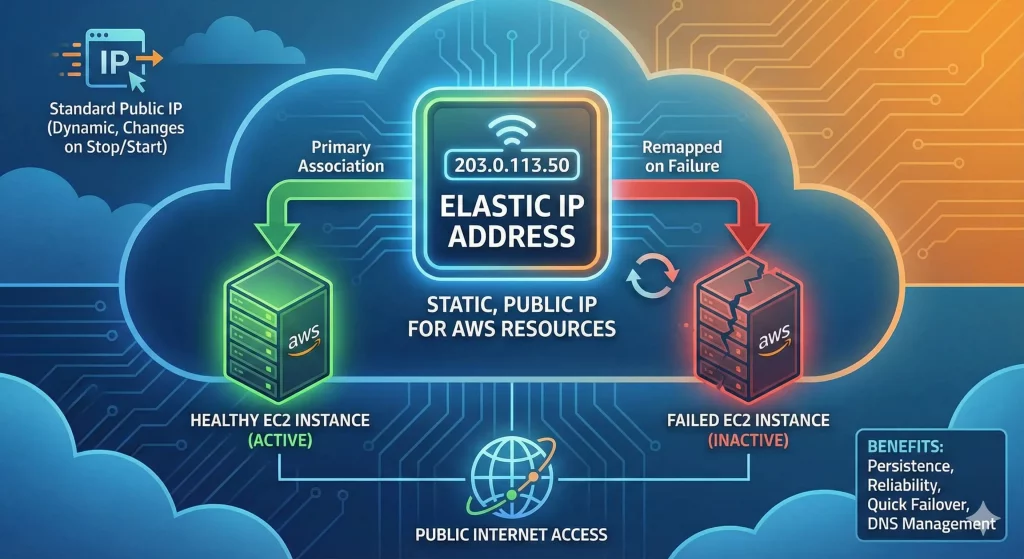
关于 弹性IP地址 Elastic IP address: AWS 用户指南
在云计算中,保持 稳定的 IP 地址 对于 网站托管、应用程序和网络管理 至关重要。这就是 Elastic IP 地址(弹性 IP) 发挥作用的地方。如果你使用 亚马逊云 AWS,了解 Elastic IP 的工作原理,可以帮助你 提高可靠性、防止宕机,并优化云端成本。本文将详细介绍 Elastic IP 的定义、工作方式、优势及最佳实践。 什么是弹性 IP 地址? Elastic IP 地址 是 AWS 提供的静态公网 IPv4 地址,可分配给 Amazon EC2(Elastic Compute Cloud)实例。与普通公网 IP 不同,Elastic IP 在实例重启后不会更改,确保服务稳定运行。 弹性 IP 的工作原理 Elastic IP 地址来自 AWS 的 IP 地址池,并可随时分配给 EC2 实例。如果实例发生故障,你可以 快速将 Elastic IP 重新绑定到另一台实例,从而减少宕机时间,保持业务连续性。 ? Elastic IP 主要特点: ✔ 静态 IP 地址 – 不会随实例重启而改变。✔ 可自由分配 – 可在同一区域内的不同实例间切换。✔Read more Related Posts IPv4 租赁 vs 购买|2026 年 IPv4 市场结构性风险解析 在 IPv4 稀缺持续加剧的市场中,租赁与购买已不只是价格差异,而是两种不同的风险结构。本文解析 IPv4 租赁与购买的成本、控制权、连续性、市场风险与适用场景,帮助企业制定更合适的 IP 策略。 重点摘要 到了 2026 年,IPv4 租赁已经成为一种更灵活的运营模式,月租价格相对稳定,主要由稀缺性和快速部署需求驱动。IPv4 购买则越来越像一种长期资产策略,但也会暴露在价格周期、流动性变化和资金锁定风险之下。 IPv4 已经不只是基础设施,它是一个稀缺市场 IPv4 地址系统已经完全转入二级市场生态。自从 IANA 的免费分配耗尽后,组织现在主要依赖以下方式取得 IPv4:通过区域互联网注册机构(RIR)的转移经纪撮合的二级市场买卖像 Read more IPv4 leasing vs purchasing: structural risk in the IPv4 address market IPv4 leasing vs purchasing reflects a structural shift in IP address markets, balancing cost, control, scarcity, and operational risk in Read more تأجير IPv4 لمراكز البيانات: ما الذي تحتاج إلى معرفته مع تزايد ندرة IPv4، تعتمد مراكز البيانات بشكل متزايد على التأجير لتوسيع البنية التحتية، والتحكم في التكاليف، والحفاظ على اتصال Read more .related-post {} .related-post .post-list { text-align: left; } .related-post .post-list .item { margin: 5px; padding: 10px; } .related-post .headline { font-size: 18px !important; color: #999999 !important; } .related-post .post-list .item .post_thumb { max-height: 220px; margin: 10px 0px; padding: 0px; display: block; } .related-post .post-list .item .post_title { font-size: 16px; color: #3f3f3f; margin: 10px 0px; padding: 0px; display: block; text-decoration: none; } .related-post .post-list .item .post_excerpt { font-size: 13px; color: #3f3f3f; margin: 10px 0px; padding: 0px; display: block; text-decoration: none; } @media only screen and (min-width: 1024px) { .related-post .post-list .item { width: 30%; } } @media only screen and (min-width: 768px) and (max-width: 1023px) { .related-post .post-list .item { width: 90%; } } @media only screen and (min-width: 0px) and (max-width: 767px) { .related-post .post-list .item { width: 90%; } }
