Qu’est-ce que l’attribution d’adresses IP ?
 Stephanie
L’attribution d’adresses IP consiste à attribuer des numéros uniques aux appareils connectés à un réseau. L’IANA attribue de larges blocs d’adresses IP à des groupes régionaux, qui les redistribuent ensuite à des fournisseurs d’accès ou des entreprises de plus petite taille.
Table of Contents
L’objectif est de garantir une utilisation équitable des adresses IP. Ce système, en place depuis de nombreuses années, contribue à prévenir le gaspillage et à maintenir l’organisation d’Internet. Une fois la demande approuvée, l’entreprise reçoit un bloc d’adresses. Ces adresses sont ensuite attribuées aux appareils de son réseau, assurant ainsi une utilisation et une allocation appropriées.
Les RIR traitent les demandes d’adresses IP émanant des FAI et des grandes organisations. Les demandeurs doivent justifier d’un besoin légitime par des exigences documentées. Les RIR évaluent ces demandes selon des politiques établies afin de garantir une distribution équitable.
How IP Address Allocation Works
IP addresses are divided into two main types: IPv4 and IPv6.They are running out because there are too many devices. IPv6 addresses are longer and solve this problem. They provide enough addresses for future growth. The allocation process is similar for both types but focuses on different ranges.
When a company needs IP addresses, it requests them from an RIR or ISP. The request must show why the addresses are needed. The provider checks if the request is valid. If approved, the company gets a block of addresses.
The Role of IANA and RIRs
IANA is the top-level organization for IP address allocation. It manages the global pool of addresses. IANA does not give addresses directly to end users. Instead, it works with RIRs. There are five RIRs around the world. Each one covers a specific region. RIRs take addresses from IANA and distribute them further. They give blocks to ISPs and large organizations. These groups then assign addresses to smaller networks or customers.
Challenges in Modern IP Allocation

The exhaustion of IPv4 addresses remains a significant challenge for many networks. Organizations face rising costs when leasing IPv4 addresses from third parties. This creates barriers for smaller entities needing address resources. Address fraud presents another challenge in allocation systems. Some entities attempt to obtain addresses under false pretenses.
One big challenge is the shortage of IPv4 addresses. There are not enough for all devices. This has led to workarounds like NAT, which lets multiple devices share one IP. But NAT is not a perfect solution.
Another issue is fair distribution. Some regions have more addresses than others but disputes can still happen. Organizations must prove they need addresses before getting them. This helps prevent hoarding and waste.
The Future of IP Address Allocation
The future will rely more on IPv6. It offers enough addresses for all devices. But the transition takes time. Many networks still use IPv4. Dual-stack systems allow both types to work together. This helps during the switch. Over time, IPv6 will become the standard.
Automation will also play a bigger role. Tools can now manage IP allocation with less human input. As networks grow, efficient allocation becomes even more important. The goal is to keep the internet running smoothly for everyone.
Mistakes Many networks suffer from poor documentation of address assignments. This leads to conflicts when duplicate IPs appear on the network. Some administrators assign addresses randomly without proper planning. These practices create ongoing management challenges as networks expand. Another common mistake involves delaying IPv6 adoption.
Organizations clinging to IPv4 systems face increasing limitations. Early planning for IPv6 transition prevents rushed migrations later. Training staff on modern addressing practices helps avoid these pitfalls.
IP Allocation for Home Users
Home users usually get IP addresses from their ISP. The ISP assigns a public IP to the router. The router then gives private IPs to devices at home. This is done automatically using DHCP. Most home users do not need to worry about allocation. The system handles it for them.
Some users might want a static IP for gaming or hosting servers. This requires asking the ISP for a special setup. Static IPs can cost extra. For most people, dynamic allocation is enough. It works well for browsing and streaming. The ISP manages the addresses, so users do not have to.
Best Practices for IP Allocation
Next, choose between static and dynamic allocation. Use static for critical devices and dynamic for others. Regular reviews are important. Remove unused addresses to free them up. Update systems to support IPv6 if possible. Train staff on proper allocation methods.
“The Internet works because a lot of people cooperate to do things together.”
— Jon Postel, Founder of Internet Assigned Numbers Authority (IANA)
Tools for IP Address Management
Many tools can help with IP allocation. They automate the process and reduce errors. Some tools track usage and generate reports. Small networks might use simple software. Large enterprises need advanced systems. The right tools make IP management easier and more reliable.
Case Studies of IP Allocation
ISPs also face unique challenges. They must allocate addresses to many customers. Dynamic allocation helps them manage limited IPv4 addresses.
IP Allocation and Network Performance
Proper allocation improves network performance. It reduces conflicts and delays. Poor allocation can cause slowdowns or outages. For example, duplicate IPs can disrupt communication. Dynamic allocation helps balance load by distributing addresses as needed. Businesses should monitor performance metrics. This helps identify allocation issues. Fixing these issues keeps the network fast and reliable. Good allocation practices lead to better user experiences.
The Role of DHCP in IP Allocation
DHCP is a key tool for dynamic allocation. It automatically assigns addresses to devices. DHCP servers can be set up to reserve addresses for specific devices. This combines the benefits of static and dynamic allocation. DHCP reduces manual work and errors. It is a simple but powerful part of IP management.
“The exhaustion of the free IPv4 pool was inevitable... Luckily, we prepared for this eventuality with IPv6, which contains enough address space to sustain the Internet for generations”
— John Curran, President and CEO of American Registry for Internet Numbers (ARIN)
IP Allocation in Wireless Networks
Wireless networks face unique allocation challenges. Devices connect and disconnect often. Dynamic allocation is common here. DHCP handles the changing demands. Some networks use guest IP ranges to separate traffic.
Security is also a concern. Unauthorized devices might try to join. Proper allocation and monitoring prevent this. Wireless networks must balance convenience and safety. Good practices keep them running well.
IP Allocation for IoT Devices
The Internet of Things adds many devices to networks. Each one needs an IP address. Dynamic allocation is often used because of the large number.
Managing IoT IPs can be complex. Devices may come and go frequently. Automated tools help handle this. Proper allocation ensures that IoT networks remain scalable and efficient.
IP Allocation and Cloud Computing

Cloud services rely heavily on IP allocation. Virtual machines and containers need addresses. Cloud providers use dynamic allocation to meet demand. They also offer tools for customers to manage their own IPs.
Scalability is a key benefit. Customers can get more addresses as needed. The cloud model makes IP allocation flexible and cost-effective. This supports modern business needs.
IP Allocation in Large-Scale Networks
Big networks like universities or governments need careful allocation. They may have thousands of devices.
Centralized tools help track all addresses. Regular audits ensure nothing is wasted. Large networks must plan carefully to avoid problems.
IPv6 adoption is growing but slow. Many networks still use IPv4. Dual-stack systems help during the transition. They allow both types to coexist. Over time, IPv6 will replace IPv4.
The benefits of IPv6 are clear. More addresses and better features make it the future.
Final Thoughts on IP Address Allocation
IP allocation is a vital part of networking. It ensures devices can communicate. The process involves many steps and tools. Good allocation practices help everyone enjoy a smooth internet experience.
Troubleshooting IP Allocation Issues
Address conflicts typically manifest as connectivity problems. They record address assignments, releases, and lease renewals. Timestamped entries help reconstruct events leading to problems. Methodical investigation approaches resolve issues efficiently with minimal downtime.
Cloud Computing IP Requirements Cloud platforms handle IP allocation differently than traditional networks. Virtual machines receive addresses automatically upon creation. Public cloud providers manage enormous address pools dynamically. Customers can scale their address usage based on real-time needs. Cloud IP management emphasizes flexibility and automation. Addresses are constantly assigned and released as workloads change.
Providers offer integrated tools for monitoring and controlling address usage. This model supports agile business operations in virtual environments. Large-Scale Network Allocation Techniques Major institutions like universities require sophisticated IP planning.
Address Allocation for Virtual Environments Virtualization platforms have unique IP requirements. Virtual machines need addresses just like physical devices. Hypervisors often include integrated DHCP services for virtual networks. Some environments use private address spaces for internal communication between virtual components.
Management complexity increases with large virtual deployments. Templates help standardize network configurations across virtual instances. Snapshot features should include network settings to maintain consistency. These measures ensure orderly operation in dynamic virtual environments. IP Allocation in Mergers and Acquisitions Combining networks during corporate transactions presents addressing challenges. Duplicate private address ranges may exist between organizations.
Network Address Translation can provide temporary solutions during integration. Phased migrations allow thorough testing at each stage. Documentation from both organizations aids the integration process. Clear communication ensures all teams understand the new network architecture.
Allocation for Remote Workers
Distributed workforces create new allocation requirements. VPN solutions often assign temporary addresses to remote devices. Some organizations implement split tunneling to reduce address consumption. Cloud-based management tools help oversee dispersed network resources.
Security remains paramount for remote access solutions. Multi-factor authentication complements IP-based controls. Clear usage policies should address home network configurations. These measures protect corporate resources while enabling flexible work arrangements.
Mobile Network Addressing Methods

Cellular networks employ unique IP allocation strategies. Carrier-grade NAT allows sharing addresses among many users. Some providers offer public IP options for business customers. IPv6 adoption is progressing across mobile networks to accommodate growing demand.
Mobile devices frequently change network attachment points during movement. This requires dynamic address assignment systems capable of rapid reallocation. Special considerations apply to always-connected IoT devices on cellular networks.
IP Allocation in Healthcare Networks Medical facilities have strict requirements for network availability. Patient monitoring systems need reliable addressing for continuous operation. HIPAA regulations influence address management practices to protect sensitive data. Separate networks often handle clinical systems and administrative functions. Downtime can have serious consequences in healthcare environments. Redundant addressing schemes support critical failover systems. Detailed change management procedures prevent service disruptions. These measures ensure continuous operation of life-saving technologies.
IP Allocation for Financial Services Banks and trading platforms demand high availability addressing solutions. Low-latency networks require optimized address assignments. Security controls include IP-based restrictions for sensitive systems. Transaction monitoring tracks address patterns to detect potential fraud. Financial networks often use proprietary protocols with specific addressing needs. Disaster recovery plans include detailed addressing documentation. These practices support secure, reliable financial operations in digital environments. IP Allocation in Industrial Networks Manufacturing environments employ specialized network architectures. Programmable logic controllers often require static addressing. Industrial protocols frequently assume specific address ranges in their design. These requirements influence overall network planning in production facilities.
Safety systems typically use completely separate network segments. This isolation prevents interference with production systems. Strict change management controls govern all addressing modifications. These practices ensure safe, reliable industrial operations.
Educational Network Addressing Approaches Academic institutions face unique allocation challenges. Student devices connect and disconnect frequently throughout campuses. Guest networks must accommodate visitor access without compromising security.
Research projects often require special address allocations for experimental setups. These networks typically implement separate subnets for different user groups. Staff, students, and services each receive dedicated address ranges. Wireless networks require particular attention due to high address turnover. These practices maintain service quality across educational facilities. Government Network Allocation Practices Public sector networks emphasize security and accountability in addressing. Many implement strict assignment policies with detailed audit trails.
Some agencies use proprietary addressing schemes for additional protection. These measures support compliance with stringent security requirements. Inter-agency connections require careful coordination. Shared services need compatible addressing schemes. Transition plans must account for bureaucratic processes. These practices ensure continuity of government operations during network changes.
Trusted IPv4 Leasing for Business Growth
Get enterprise-grade IPv4 space quickly, with seamless deployment and end-to-end management.
Get Started with i.leaseFAQs
What is IP address allocation?
IP address allocation is the process of assigning unique IP addresses to devices or networks. At a global level, large blocks of IP addresses are distributed to regional organisations, which then allocate smaller blocks to internet service providers (ISPs) or companies.
Who controls the allocation of IP addresses and how?
The Internet Assigned Numbers Authority (IANA) manages the global IP address pool. It distributes blocks of IP addresses to regional internet registries (RIRs), which cover different geographic regions. These registries then allocate addresses to ISPs or large organisations. When an organisation requests a block of addresses, it must usually demonstrate a legitimate need.
What are the main challenges in modern IP address allocation?
- The exhaustion of IPv4 address space, which has made allocations more limited and costly.
- Ensuring fair distribution and preventing hoarding or misuse.
- Transitioning to IPv6, which offers a much larger address space but requires gradual adoption.
- Managing allocations in large-scale environments like IoT, wireless, and cloud networks.
How does IP address allocation work for home users?
For most home users, the Internet Service Provider (ISP) assigns a public IP address (often dynamic) to the router. The router then uses private IP addresses internally to connect individual devices. If a static public IP is needed—for example, for hosting a server or remote access—it can usually be requested from the ISP.
What are some best practices for managing IP address allocation in a business or network environment?
- Use static IP addresses for critical systems and dynamic allocation for general devices.
- Review address usage regularly and reclaim unused addresses.
- Plan for IPv6 adoption to ensure long-term scalability.
- Implement IP address management (IPAM) tools to track usage and avoid conflicts.
- Maintain proper documentation and conduct periodic audits to prevent duplicate addressing or errors.
Related Blogs
相关文章

什么是电信公司?电信运营商如何为英国、美国和加拿大提供网络连接支持?
电信公司(Telco Companies),也称为电信运营商(Telecommunications Companies),提供通信与网络连接服务。这些服务包括移动通信网络、宽带互联网、光纤连接、固定电话服务、企业网络连接、云连接、托管网络服务以及数据中心连接等。 对于普通消费者而言,电信公司通常被视为移动通信或宽带互联网服务提供商。对于企业来说,电信公司远不只是一个服务品牌,更是关键的基础设施合作伙伴,帮助企业连接办公室、数据中心、云平台、远程员工、客户应用程序以及各类数字化服务。 随着企业越来越依赖云平台、SaaS 应用、AI 工具、VPN、网络安全系统以及在线服务,电信公司已成为数字基础设施规划中不可或缺的重要组成部分。 电信公司是什么? 电信公司(Telco Companies)是提供电信服务的企业。这些服务让个人、设备、企业和各种系统能够跨越距离进行通信与连接。 一家电信公司可能提供以下服务: 移动通信服务 宽带互联网 光纤连接 固定电话服务 企业互联网接入 企业广域网(WAN)服务 云连接服务 数据中心连接 VPN 服务 托管网络解决方案 互联网传输(Internet Transit) 电信批发服务 部分电信公司拥有并运营大规模的实体网络基础设施;另一些则通过批发接入、租用基础设施或与网络运营商合作来提供电信服务。 电信公司提供哪些服务? 电信公司同时为个人消费者和企业客户提供服务。 面向消费者的服务通常包括移动通信套餐、家庭宽带、光纤互联网、固定电话以及通信组合套餐。 面向企业的服务则可能包括专线互联网接入、企业光纤、专用网络、云连接、托管安全服务、数据中心连接、物联网(IoT)连接以及企业移动通信方案。 对于大型企业客户,电信公司还可提供: 多地点办公室网络连接 远程员工接入 私有云连接 SD-WAN(软件定义广域网) 灾难恢复连接 低延迟网络路由 互联网传输(Internet Transit) 网络监控 托管防火墙服务 正因如此,电信公司不仅对日常通信至关重要,也是现代企业建设先进数字基础设施的重要支柱。 电信公司 vs 互联网服务提供商 vs 网络运营商 电信公司(Telco)、互联网服务提供商(ISP)和网络运营商(Network Operator)之间可能存在重叠,但它们并不完全相同。 电信公司提供电信服务。 互联网服务提供商(ISP)提供互联网接入服务。 网络运营商负责建设、运营和管理网络基础设施。 一些大型电信公司同时承担这三种角色。它们拥有基础设施、运营网络,并向市场提供互联网、移动通信以及企业网络服务。 规模较小的服务提供商则可能专注于其中某一层。例如,互联网服务提供商(ISP)可以销售宽带服务,而无需拥有所有实体网络基础设施;网络运营商可能负责建设和运营光纤网络,并向电信公司或 ISP 提供批发网络接入;电信公司则可能结合自有网络与合作伙伴网络,为客户提供移动通信和企业服务。 对于企业而言,理解这些区别非常重要,因为服务质量不仅取决于销售该方案的品牌,还受到其底层网络、路由设计、网络覆盖范围以及技术支持体系等因素的影响。 为什么电信公司对企业至关重要 电信公司之所以重要,是因为几乎所有现代企业都依赖稳定的网络连接。 企业可能需要电信服务来支持: 办公室互联网接入 移动网络连接 远程办公 客户支持系统 云应用程序 SaaS 平台 支付系统 VPNRead more Related Posts 什么是电信公司?电信运营商如何为英国、美国和加拿大提供网络连接支持? 电信公司(Telco Companies),也称为电信运营商(Telecommunications Companies),提供通信与网络连接服务。这些服务包括移动通信网络、宽带互联网、光纤连接、固定电话服务、企业网络连接、云连接、托管网络服务以及数据中心连接等。 对于普通消费者而言,电信公司通常被视为移动通信或宽带互联网服务提供商。对于企业来说,电信公司远不只是一个服务品牌,更是关键的基础设施合作伙伴,帮助企业连接办公室、数据中心、云平台、远程员工、客户应用程序以及各类数字化服务。 随着企业越来越依赖云平台、SaaS 应用、AI 工具、VPN、网络安全系统以及在线服务,电信公司已成为数字基础设施规划中不可或缺的重要组成部分。 电信公司是什么? 电信公司(Telco Companies)是提供电信服务的企业。这些服务让个人、设备、企业和各种系统能够跨越距离进行通信与连接。 一家电信公司可能提供以下服务: 移动通信服务 宽带互联网 光纤连接 固定电话服务 企业互联网接入 企业广域网(WAN)服务 云连接服务 数据中心连接 VPN TCP 与 UDP:IPv4 租赁和企业网络指南 TCP 和 UDP 是互联网中最重要的两种传输层协议。它们决定数据如何在设备、服务器、云平台、VPN 网关、DNS 解析器、电子邮件系统、流媒体平台以及企业应用程序之间传输。 对于企业而言,TCP 和 UDP 不仅仅是技术术语,它们会直接影响实际的基础设施性能。公网 IPv4 地址提供可从互联网访问的网络端点,而 TCP 和 UDP 则决定流量如何通过该端点进行传输。 这对于租用或购买 IPv4 地址的企业尤为重要。企业租用 IPv4 什么是区域互联网注册管理机构(RIR) 区域互联网注册管理机构(Regional Internet Registry, RIR)是负责在特定地理区域内分配和管理互联网编号资源的组织。这些资源主要包括 IP 地址(IPv4 和 IPv6)以及自治系统号(ASN),它们是支撑设备和网络在互联网上相互通信的关键要素。 如果没有一套组织完善的系统来分配唯一的 IP 地址和路由标识符,互联网便无法正常运转。RIR 确保这一过程在各自管辖的区域内保持公平、高效与一致,从而避免冲突,并提升互联网治理的透明度。 全球五大 RIR 目前全球共有五家获官方认可的 RIR,各自负责世界上特定的区域:AFRINIC – 非洲网络信息中心(非洲)APNIC – 亚太网络信息中心(亚太地区)ARIN .related-post {} .related-post .post-list { text-align: left; } .related-post .post-list .item { margin: 5px; padding: 10px; } .related-post .headline { font-size: 18px !important; color: #999999 !important; } .related-post .post-list .item .post_thumb { max-height: 220px; margin: 10px 0px; padding: 0px; display: block; } .related-post .post-list .item .post_title { font-size: 16px; color: #3f3f3f; margin: 10px 0px; padding: 0px; display: block; text-decoration: none; } .related-post .post-list .item .post_excerpt { font-size: 13px; color: #3f3f3f; margin: 10px 0px; padding: 0px; display: block; text-decoration: none; } @media only screen and (min-width: 1024px) { .related-post .post-list .item { width: 30%; } } @media only screen and (min-width: 768px) and (max-width: 1023px) { .related-post .post-list .item { width: 90%; } } @media only screen and (min-width: 0px) and (max-width: 767px) { .related-post .post-list .item { width: 90%; } }
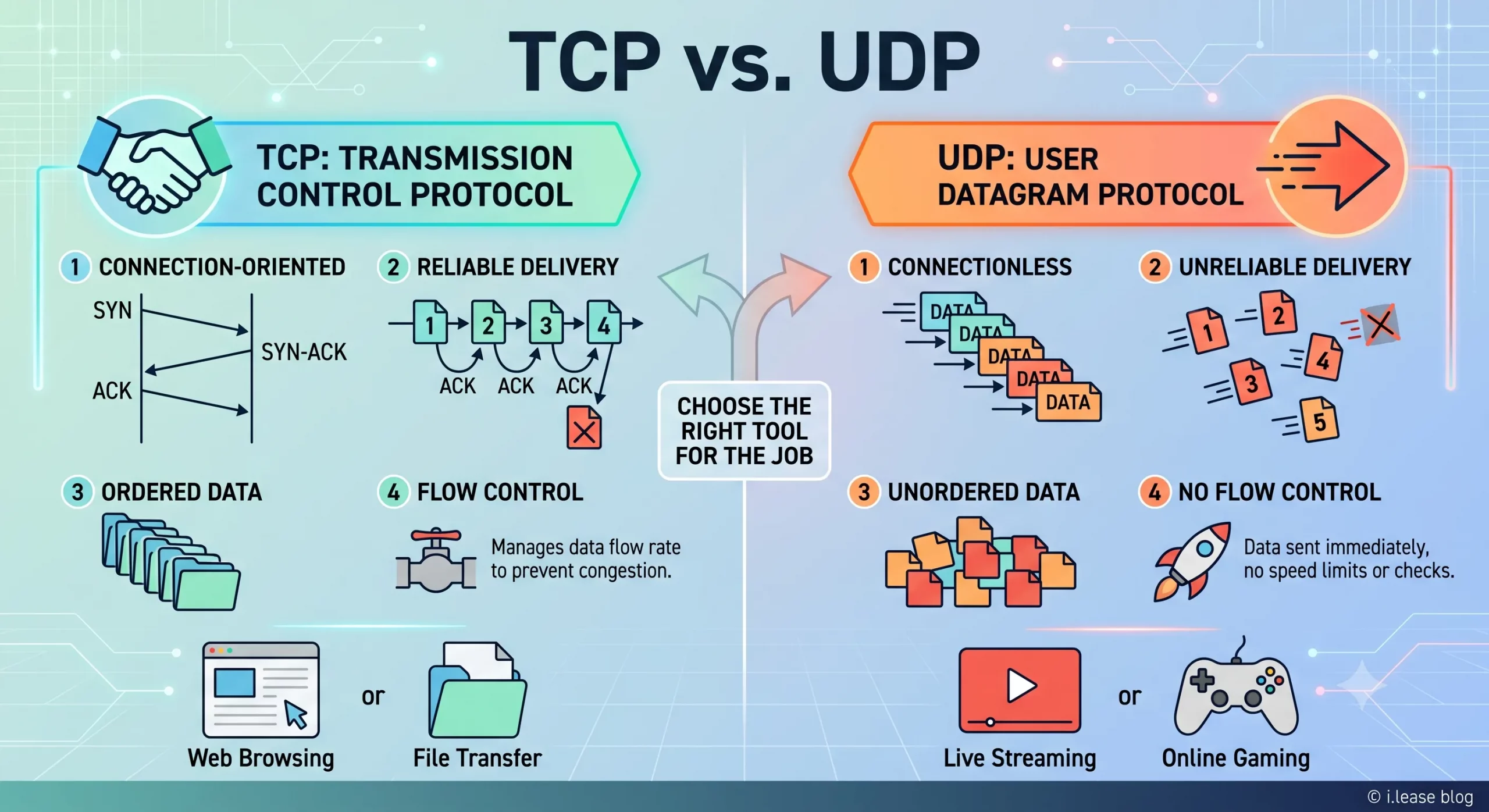
TCP 与 UDP:IPv4 租赁和企业网络指南
TCP 和 UDP 是互联网中最重要的两种传输层协议。它们决定数据如何在设备、服务器、云平台、VPN 网关、DNS 解析器、电子邮件系统、流媒体平台以及企业应用程序之间传输。 对于企业而言,TCP 和 UDP 不仅仅是技术术语,它们会直接影响实际的基础设施性能。公网 IPv4 地址提供可从互联网访问的网络端点,而 TCP 和 UDP 则决定流量如何通过该端点进行传输。 这对于租用或购买 IPv4 地址的企业尤为重要。企业租用 IPv4 地址并不是单纯为了持有这些地址,而是为了运行网站、API、VPN 隧道、DNS 服务、电子邮件平台、SaaS 应用程序、游戏服务器、流媒体系统、安全工具以及云端工作负载。不同类型的服务决定了需要使用 TCP、UDP,还是同时使用两者。 通过 i.lease,企业可以使用 IPv4 租赁服务获取用于实际网络部署的公网 IPv4 资源。需要长期控制 IP 地址资源的企业也可以购买 IP 地址,而拥有闲置 IPv4 资源的组织则可以出售 IP 地址。 TCP和UDP是什么? TCP 和 UDP 都是传输层协议。它们位于 IP 协议之上,帮助应用程序通过网络发送和接收数据。 IP 地址用于确定流量应该发送到哪里,而 TCP 和 UDP 则决定这些流量如何进行传输。 简单来说: TCP 适用于重视可靠性和按顺序传输数据的场景。 UDP 适用于重视速度、低延迟和轻量化数据传输的场景。 企业可能会使用同一个公网 IPv4 地址来运行不同的服务,但每项服务可能依赖不同的传输协议。例如,网站可能使用 TCP,VPN 网关可能使用 UDP,DNS 解析器可能同时使用 UDP 和 TCP,而游戏服务器则可能更倾向于使用 UDP,因为对于实时游戏而言,延迟造成的影响通常比少量数据包丢失更加明显。 因此,TCPRead more Related Posts 什么是电信公司?电信运营商如何为英国、美国和加拿大提供网络连接支持? 电信公司(Telco Companies),也称为电信运营商(Telecommunications Companies),提供通信与网络连接服务。这些服务包括移动通信网络、宽带互联网、光纤连接、固定电话服务、企业网络连接、云连接、托管网络服务以及数据中心连接等。 对于普通消费者而言,电信公司通常被视为移动通信或宽带互联网服务提供商。对于企业来说,电信公司远不只是一个服务品牌,更是关键的基础设施合作伙伴,帮助企业连接办公室、数据中心、云平台、远程员工、客户应用程序以及各类数字化服务。 随着企业越来越依赖云平台、SaaS 应用、AI 工具、VPN、网络安全系统以及在线服务,电信公司已成为数字基础设施规划中不可或缺的重要组成部分。 电信公司是什么? 电信公司(Telco Companies)是提供电信服务的企业。这些服务让个人、设备、企业和各种系统能够跨越距离进行通信与连接。 一家电信公司可能提供以下服务: 移动通信服务 宽带互联网 光纤连接 固定电话服务 企业互联网接入 企业广域网(WAN)服务 云连接服务 数据中心连接 VPN TCP 与 UDP:IPv4 租赁和企业网络指南 TCP 和 UDP 是互联网中最重要的两种传输层协议。它们决定数据如何在设备、服务器、云平台、VPN 网关、DNS 解析器、电子邮件系统、流媒体平台以及企业应用程序之间传输。 对于企业而言,TCP 和 UDP 不仅仅是技术术语,它们会直接影响实际的基础设施性能。公网 IPv4 地址提供可从互联网访问的网络端点,而 TCP 和 UDP 则决定流量如何通过该端点进行传输。 这对于租用或购买 IPv4 地址的企业尤为重要。企业租用 IPv4 什么是区域互联网注册管理机构(RIR) 区域互联网注册管理机构(Regional Internet Registry, RIR)是负责在特定地理区域内分配和管理互联网编号资源的组织。这些资源主要包括 IP 地址(IPv4 和 IPv6)以及自治系统号(ASN),它们是支撑设备和网络在互联网上相互通信的关键要素。 如果没有一套组织完善的系统来分配唯一的 IP 地址和路由标识符,互联网便无法正常运转。RIR 确保这一过程在各自管辖的区域内保持公平、高效与一致,从而避免冲突,并提升互联网治理的透明度。 全球五大 RIR 目前全球共有五家获官方认可的 RIR,各自负责世界上特定的区域:AFRINIC – 非洲网络信息中心(非洲)APNIC – 亚太网络信息中心(亚太地区)ARIN .related-post {} .related-post .post-list { text-align: left; } .related-post .post-list .item { margin: 5px; padding: 10px; } .related-post .headline { font-size: 18px !important; color: #999999 !important; } .related-post .post-list .item .post_thumb { max-height: 220px; margin: 10px 0px; padding: 0px; display: block; } .related-post .post-list .item .post_title { font-size: 16px; color: #3f3f3f; margin: 10px 0px; padding: 0px; display: block; text-decoration: none; } .related-post .post-list .item .post_excerpt { font-size: 13px; color: #3f3f3f; margin: 10px 0px; padding: 0px; display: block; text-decoration: none; } @media only screen and (min-width: 1024px) { .related-post .post-list .item { width: 30%; } } @media only screen and (min-width: 768px) and (max-width: 1023px) { .related-post .post-list .item { width: 90%; } } @media only screen and (min-width: 0px) and (max-width: 767px) { .related-post .post-list .item { width: 90%; } }
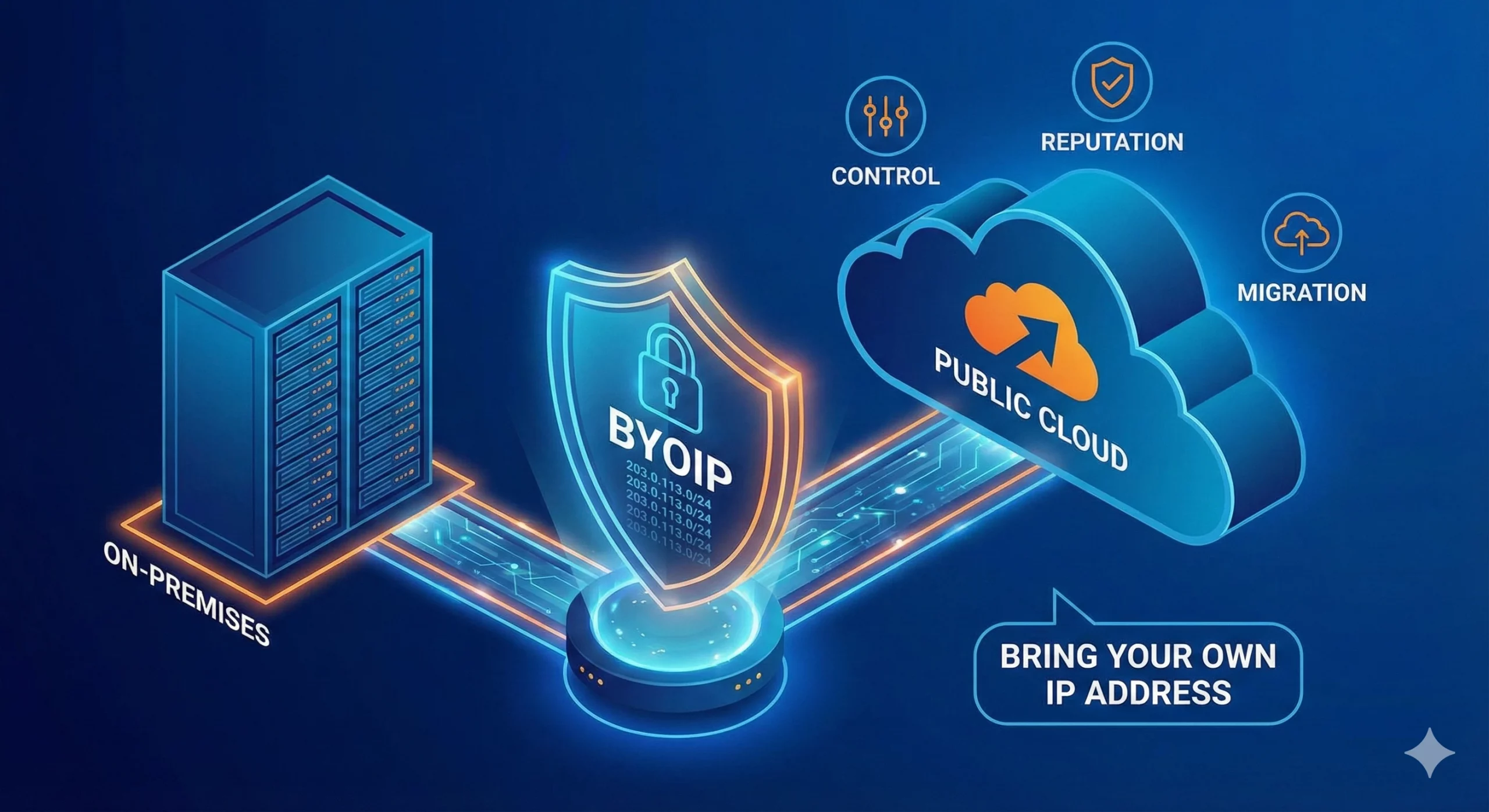
什么是BYOIP(自备IP地址)?
自带 IP(Bring Your Own IP,简称 BYOIP)是一种网络部署方式,允许企业将自己现有的公网 IP 地址段应用于云服务提供商、数据中心、内容分发网络(CDN)或其他基础设施平台。 企业无需使用服务提供商分配的新公网 IP 地址,而是可以使用自己已拥有或已获授权使用的 IPv4 或 IPv6 地址前缀。服务提供商会验证该组织对该地址段的使用权限,并在支持的情况下,通过其自身网络对该地址段进行路由公告(Advertise)。 BYOIP 有助于企业在迁移至云平台时保留现有的防火墙规则、白名单(Allowlists)、客户系统集成、IP 信誉(IP Reputation)、DNS 配置以及既有的网络身份。这不仅能够减少因更换 IP 地址而带来的业务中断,还能降低对服务提供商分配 IP 的依赖,使未来的基础设施迁移与扩展更加灵活且易于管理。 对于需要 BYOIP 地址资源的企业,可选择 购买 IPv4 地址(Buy IP),以获得长期控制权;如果更重视灵活性,也可采用 IPv4 租赁(IPv4 Leasing),按业务需求获取公网 IP 资源。 什么是BYOIP? BYOIP 是 Bring Your Own IP(自带 IP)的缩写。这是一种网络部署模式,允许组织将现有的公网 IP 地址段带入云服务提供商或其他基础设施平台使用。 在 BYOIP 模式下,组织仍然拥有或保留该 IP 地址段的使用权,而平台则获得授权,可在其基础设施中对该地址段进行路由公告(Advertise)和使用。随后,这些 IP 地址可分配给虚拟机(Virtual Machines)、负载均衡器(Load Balancers)、VPN 网关、内容分发服务(CDN)、安全平台以及公网应用程序端点等受支持的服务。 例如,一家企业将应用程序从本地数据中心迁移到云环境时,可能并不希望更换现有的公网 IP 地址。这些 IP 地址可能已经存在于客户白名单(Allowlists)、防火墙策略、DNS 记录、合作伙伴配置以及电子邮件信誉(Email Reputation)数据库中。 BYOIP 使企业能够在迁移工作负载的同时,继续使用原有的公网 IP 地址,从而保持更一致的网络身份,并减少因更换 IP 地址而带来的配置调整和业务影响。 Related Posts 什么是电信公司?电信运营商如何为英国、美国和加拿大提供网络连接支持? 电信公司(Telco Companies),也称为电信运营商(Telecommunications Companies),提供通信与网络连接服务。这些服务包括移动通信网络、宽带互联网、光纤连接、固定电话服务、企业网络连接、云连接、托管网络服务以及数据中心连接等。 对于普通消费者而言,电信公司通常被视为移动通信或宽带互联网服务提供商。对于企业来说,电信公司远不只是一个服务品牌,更是关键的基础设施合作伙伴,帮助企业连接办公室、数据中心、云平台、远程员工、客户应用程序以及各类数字化服务。 随着企业越来越依赖云平台、SaaS 应用、AI 工具、VPN、网络安全系统以及在线服务,电信公司已成为数字基础设施规划中不可或缺的重要组成部分。 电信公司是什么? 电信公司(Telco Companies)是提供电信服务的企业。这些服务让个人、设备、企业和各种系统能够跨越距离进行通信与连接。 一家电信公司可能提供以下服务: 移动通信服务 宽带互联网 光纤连接 固定电话服务 企业互联网接入 企业广域网(WAN)服务 云连接服务 数据中心连接 VPN TCP 与 UDP:IPv4 租赁和企业网络指南 TCP 和 UDP 是互联网中最重要的两种传输层协议。它们决定数据如何在设备、服务器、云平台、VPN 网关、DNS 解析器、电子邮件系统、流媒体平台以及企业应用程序之间传输。 对于企业而言,TCP 和 UDP 不仅仅是技术术语,它们会直接影响实际的基础设施性能。公网 IPv4 地址提供可从互联网访问的网络端点,而 TCP 和 UDP 则决定流量如何通过该端点进行传输。 这对于租用或购买 IPv4 地址的企业尤为重要。企业租用 IPv4 什么是区域互联网注册管理机构(RIR) 区域互联网注册管理机构(Regional Internet Registry, RIR)是负责在特定地理区域内分配和管理互联网编号资源的组织。这些资源主要包括 IP 地址(IPv4 和 IPv6)以及自治系统号(ASN),它们是支撑设备和网络在互联网上相互通信的关键要素。 如果没有一套组织完善的系统来分配唯一的 IP 地址和路由标识符,互联网便无法正常运转。RIR 确保这一过程在各自管辖的区域内保持公平、高效与一致,从而避免冲突,并提升互联网治理的透明度。 全球五大 RIR 目前全球共有五家获官方认可的 RIR,各自负责世界上特定的区域:AFRINIC – 非洲网络信息中心(非洲)APNIC – 亚太网络信息中心(亚太地区)ARIN .related-post {} .related-post .post-list { text-align: left; } .related-post .post-list .item { margin: 5px; padding: 10px; } .related-post .headline { font-size: 18px !important; color: #999999 !important; } .related-post .post-list .item .post_thumb { max-height: 220px; margin: 10px 0px; padding: 0px; display: block; } .related-post .post-list .item .post_title { font-size: 16px; color: #3f3f3f; margin: 10px 0px; padding: 0px; display: block; text-decoration: none; } .related-post .post-list .item .post_excerpt { font-size: 13px; color: #3f3f3f; margin: 10px 0px; padding: 0px; display: block; text-decoration: none; } @media only screen and (min-width: 1024px) { .related-post .post-list .item { width: 30%; } } @media only screen and (min-width: 768px) and (max-width: 1023px) { .related-post .post-list .item { width: 90%; } } @media only screen and (min-width: 0px) and (max-width: 767px) { .related-post .post-list .item { width: 90%; } }
