Comprendre la délégation IP dans les réseaux modernes
 Stephanie
- En optimisant l’allocation des ressources, la délégation d’adresses IP permet de gérer les réseaux de manière sécurisée et évolutive, au-delà des frontières organisationnelles et géographiques.
Table of Contents
- Une délégation d’adresses IP efficace améliore les performances du réseau, favorise l’automatisation et garantit la conformité aux normes internationales de gouvernance d’Internet.
Introduction à la délégation IP
L’attribution et la gestion correctes des adresses IP (Internet Protocol) sont essentielles au bon fonctionnement d’un réseau. L’autorisation IP est un élément central de ce système. Elle consiste à répartir les blocs d’adresses IP des groupes globaux vers des groupes plus restreints, tels que les groupes locaux ou régionaux. Ceci permet une utilisation plus efficace et mieux organisée des adresses IP.
Avec la dépendance croissante des entreprises aux réseaux pour leurs activités, il est crucial de comprendre le fonctionnement de l’autorisation IP. Ce numéro permet à un appareil d’envoyer et de recevoir des données via Internet. Les adresses IPv4 s’épuisent et l’utilisation d’IPv6 se généralise.
De ce fait, la gestion de l’autorisation IP représente aujourd’hui un enjeu majeur pour les équipes réseau. Cet article examine le fonctionnement de l’autorisation IP, son importance dans les réseaux actuels et les bonnes pratiques mises en œuvre pour l’optimiser.
Les principes fondamentaux de la délégation de propriété intellectuelle
La délégation d’adresses IP constitue un cadre hiérarchique de distribution de l’autorité administrative sur les infrastructures d’adressage et de nommage Internet, facilitant ainsi l’évolutivité du réseau. Ce processus prend son origine auprès d’entités centralisées, notamment l’IANA (Internet Assigned Numbers Authority), qui attribue de vastes blocs d’adresses IP, couvrant les protocoles IPv4 et IPv6, aux registres Internet régionaux (IRC) à travers le monde. Ces entités régionales délèguent ensuite des plages d’adresses subdivisées aux registres Internet locaux (LIRR) ou aux fournisseurs d’accès Internet (FAI), responsables de l’attribution finale aux utilisateurs finaux, qu’ils soient organisationnels ou individuels.
Chaque entité déléguée gère la distribution interne des adresses à l’aide de mécanismes tels que le DHCP ou l’attribution statique, tout en assurant la propagation du routage global via des protocoles comme le BGP (Border Gateway Protocol). Parallèlement, la délégation de noms de domaine DNS fonctionne par le biais d’une désignation hiérarchique des serveurs de noms, où les administrateurs de la zone racine délèguent les domaines de premier niveau à des registres désignés.
Ces registres délèguent ensuite les domaines de second niveau à des serveurs de noms faisant autorité, spécifiés par le propriétaire, lui conférant un contrôle complet sur la gestion des sous-domaines et la configuration des enregistrements de ressources, notamment les enregistrements A, MX et CNAME.
La délégation DNS inverse pour la résolution des enregistrements PTR suit des principes structurels parallèles au sein des domaines in-addr.arpa et ip6.arpa, où l’autorité correspond directement aux blocs d’adresses IP alloués, permettant ainsi une correspondance inverse entre les adresses numériques et les identifiants de domaine.
Cette architecture de délégation intégrée, couvrant l’allocation d’adresses IP, la résolution DNS et les systèmes de recherche inverse, élimine les points de contrôle centralisés, limite les interruptions de service pour les segments localisés et répartit les charges de travail administratives sur plusieurs niveaux hiérarchiques. Elle permet une gestion autonome des ressources tout en maintenant l’interopérabilité mondiale d’Internet, sans mécanisme de supervision unifié.
Pourquoi la délégation IP est importante dans les réseaux modernes
Les écosystèmes numériques contemporains, caractérisés par la prolifération du cloud computing, le déploiement omniprésent des objets connectés et l’implémentation des réseaux 5G, nécessitent des mécanismes d’interconnexion étendus où la délégation d’adresses IP revêt une importance opérationnelle cruciale.
Ce cadre garantit une utilisation optimale des ressources limitées d’adresses IP, notamment face aux problèmes d’épuisement des adresses IPv4, tandis que l’adoption d’IPv6, avec sa capacité d’adressage accrue, intensifie les exigences en matière de protocoles de délégation systématiques pour administrer des architectures réseau complexes.
La délégation d’adresses IP établit des fonctions de traçabilité essentielles, soutenant les objectifs de cybersécurité. Les registres détaillant les blocs d’adresses contrôlés par les entités permettent d’atténuer les activités malveillantes, telles que l’usurpation d’adresse IP et les tentatives d’accès non autorisé. Une délégation structurée offre des capacités de suivi précises et une responsabilité opérationnelle, constituant ainsi des contre-mesures fondamentales face aux cybermenaces.
De plus, la délégation d’adresses IP sous-tend l’évolutivité de l’automatisation du réseau grâce à son intégration avec les paradigmes de virtualisation des fonctions réseau et de définition logicielle (SDN). Dans ce cadre, les systèmes automatisés de gestion des adresses IP requièrent des hiérarchies de délégation bien définies pour permettre un provisionnement dynamique et sans conflit des ressources au sein des infrastructures organisationnelles.
Le rôle des registres Internet régionaux
Les registres Internet régionaux (RIOR) jouent un rôle clé dans la gestion de l’Internet mondial. Ces entités reçoivent l’autorisation de l’IANA (Internet Assigned Numbers Authority). Cette autorisation leur permet de contrôler les ressources d’adressage IP publiques au sein de régions géographiques spécifiques. Ces institutions à but non lucratif assurent des opérations techniques essentielles. Elles distribuent les espaces d’adressage IPv4 et IPv6 selon des processus d’allocation structurés. Elles attribuent principalement des blocs d’adresses aux registres Internet locaux (LIOR) et aux fournisseurs d’accès à Internet (FAI).These providers then assign addresses to end-user networks. The registries keep official registration databases. These databases record all resource distribution activities. They provide necessary operational transparency. This transparency comes through public access systems like WHOIS and Registration Data Access Protocol.
Les registres gèrent les opérations DNS inverses pour les blocs d’adresses IP alloués. Ils opèrent au sein de domaines établis : in-addr.arpa pour IPv4 et ip6.arpa pour IPv6. Ces activités garantissent une correspondance cohérente entre les adresses numériques et les noms de domaine.
Les registres Internet régionaux contribuent à l’élaboration de politiques régionales grâce à des plateformes de discussion ouvertes. Opérateurs de réseau, agences gouvernementales, groupes universitaires et organisations de la société civile y participent et élaborent ensemble des politiques concertées. Ces politiques régissent la distribution des adresses IP, les règles de transfert et les normes d’utilisation. Cette approche de gouvernance inclusive permet l’adaptation aux besoins des infrastructures locales et garantit la compatibilité mondiale d’Internet.
Les registres participent à la coordination technique et mettent en œuvre des mesures de sécurité de routage telles que l’infrastructure à clés publiques de ressources (RPKI). Ce système vérifie cryptographiquement l’origine des routes.
Il réduit les risques de détournement du protocole BGP (Border Gateway Protocol). Par le biais du collectif NROO (Number Resource Organization), les registres collaborent avec les instances de gouvernance mondiale d’Internet, notamment l’ICANN (Internet Corporation for Assigned Names and Numbers) et l’IETF (Internet Engineering Task Force).
Délégation IP et adoption d'IPv6
Le nombre d’adresses IPv4 est presque épuisé. Cela a incité de plus en plus de personnes à utiliser l’IPv6. IPv6 possède un nombre d’adresses possibles beaucoup plus important. Il fournit 2 puissance 128 adresses, tandis que l’IPv4 n’en fournit que 2 puissance 32. Mais l’utilisation d’IPv6 pose de nouveaux problèmes. Les blocs d’adresses sont plus grands et la manière dont les adresses sont attribuées est différente.
Pour comprendre le fonctionnement actuel de la délégation d’adresses IP, il est essentiel de prendre en compte ces changements afin de garantir la fonctionnalité et le bon fonctionnement des réseaux. En IPv6, les groupes se voient souvent attribuer des blocs d’adresses tels que /48 ou /56. Cela leur permet de contrôler de nombreuses petites parties de leur réseau. Ces petites parties sont appelées sous-réseaux, et il peut en exister des millions. Cette configuration favorise l’expansion des réseaux, notamment pour les objets connectés et la 5G, qui nécessitent un grand nombre d’adresses uniques. Mais si la délégation IPv6 est mal gérée, le réseau risque d’être ralenti ou de rencontrer des problèmes de sécurité. Le routage peut être perturbé et il peut être plus difficile de bloquer le trafic malveillant. Owen DeLong, de l’ARIN, affirme que la délégation IPv6 nécessite des plans simples et clairs.
Sans cela, l’espace d’adressage risquerait de se fragmenter et le routage de se dégrader. Il est donc essentiel de maintenir une organisation rigoureuse et de veiller à ce que les chemins empruntés par les données restent courts et directs.
Pratiques de délégation de la propriété intellectuelle dans les organisations
Pour tirer pleinement parti de la délégation d’adresses IP, les organisations doivent adopter les meilleures pratiques conformes aux exigences des réseaux modernes. Ces mesures contribuent à une meilleure gestion de la délégation d’adresses IP. L’une d’elles consiste à utiliser des systèmes de gestion d’adresses IP robustes. Ces systèmes réduisent les risques d’erreurs et préviennent les conflits d’adresses. Compatibles avec les protocoles DNS et DHCP, ils facilitent le contrôle de l’ensemble du réseau. Une autre mesure essentielle est la tenue d’un registre précis de l’attribution de chaque adresse IP.
Lorsque chaque adresse est clairement répertoriée, il est plus facile de détecter et de résoudre les problèmes. Cette démarche est également nécessaire pour respecter les règles des organismes attribuant des adresses IP. Anticiper les besoins futurs est primordial. Lorsqu’un organisme demande des blocs d’adresses, il doit tenir compte de leur croissance future. Ceci est d’autant plus vrai pour l’IPv6, où les blocs sont beaucoup plus grands. Une bonne planification permet d’éviter de devoir constamment renouveler son inventaire d’adresses. Garantir la sécurité du réseau est également essentiel.
Une solution consiste à utiliser une infrastructure appelée RPKI (Resource Public Key Infrastructure). Cet outil vérifie qui est le véritable propriétaire d’une adresse IP et empêche les attaquants d’envoyer du trafic malveillant à l’aide d’adresses falsifiées.
Défis liés à la délégation de propriété intellectuelle
IP delegation plays a central role in network resource management, yet it encounters various persistent issues. The limited availability of IPv4 addresses has led to the emergence of unofficial trading markets, which complicate formal and compliant delegation practices. Different policy approaches among Regional Internet Registries (RIRs) also lead to inconsistent application across jurisdictions, which causes operational difficulties for multinational organisations.
There are further challenges in handling IPv6 allocations. Organizations lacking adequate management systems may struggle to monitor and maintain IPv6 address allocations due to the vast address space, potentially leading to inefficient resource allocation.
When it comes to IP address management, security is still an issue. Particularly in extensive networks, threats like IP spoofing and route hijacking continue to exist. Strong security frameworks must be used by organisations. This includes putting in place routing protocols and Resource Public Key Infrastructure (RPKI) to enable safe address origin validation.
Délégation IP et automatisation du réseau
Network automation is becoming a foundational feature in the operation of modern network environments. IP delegation is a key function within this automation process. Automated IP Address Management (IPAM) systems work with software-defined networking (SDN) and network function virtualisation (NFV) frameworks. These systems distribute IP addresses based on network usage in real time. This allows networks to respond to changes in demand with greater efficiency.
Juniper’s Telemetry Interface (JTI) is one example of how real-time visibility into address usage can support accurate and efficient delegation.
L'avenir de la délégation de propriété intellectuelle
The development of IP delegation is undergoing changes in automation, adaptability, and security. The continued deployment of IPv6 leads to a significant increase in available address space. This expansion changes the structure of traditional delegation models and allows broader and more detailed address distribution. It supports more complex technical scenarios, including the application of IP addresses in Internet of Things devices and edge computing environments.
The use of Software-Defined Networking and Network Function Virtualization creates a situation in which IP delegation is no longer fixed. IP address assignment becomes adjustable and can respond to changing traffic volumes, system performance demands, and specific security incidents. The gradual implementation of zero-trust network architecture reduces reliance on IP-based access control. Instead, it brings increased attention to identity-based systems.
This change requires the IP delegation process to incorporate stricter access management and monitoring tools. In cloud infrastructure and environments involving multiple tenants, the delegation of IP addresses often uses interfaces provided by service platforms. This method simplifies configuration and helps manage network resources with more precision.
The growth of decentralization and the emphasis on data ownership influence the design of delegation frameworks. Certain systems explore mechanisms that assign control of IP addresses to individual users or small groups through distributed technologies.
At the same time, developments in artificial intelligence make it possible to apply predictive models to IP allocation tasks. This technology helps adjust network behavior and reduce security threats through continuous analysis. The overall structure of IP delegation changes in parallel with changes in network design, and its functions must now address both technical performance and control.
Trusted IPv4 Leasing for Business Growth
Get enterprise-grade IPv4 space quickly, with seamless deployment and end-to-end management.
Get Started with i.leaseFAQs
What is IP delegation in networking?
IP delegation is the allocation of address blocks by central registries to regional authorities, service providers, or organisations to support structured network planning.
Why is IP delegation important for modern networks?
It helps distribute limited resources, provides traceability, and supports system growth in large and complex networks such as cloud platforms and IoT systems.
How does IPv6 impact IP delegation?
The expanded address space of IPv6 increases the need for careful allocation to ensure routing efficiency and avoid excessive fragmentation.
What tools can assist with IP delegation?
IPAM tools such as Infoblox and SolarWinds provide automation, improve record accuracy, and reduce manual workload in address tracking and assignment.
How can organisations secure their IP delegations?
Using RPKI and authenticated routing protocols enables validation of address ownership and helps prevent unauthorised route announcements.
Related Blogs
相关文章

什么是电信公司?电信运营商如何为英国、美国和加拿大提供网络连接支持?
电信公司(Telco Companies),也称为电信运营商(Telecommunications Companies),提供通信与网络连接服务。这些服务包括移动通信网络、宽带互联网、光纤连接、固定电话服务、企业网络连接、云连接、托管网络服务以及数据中心连接等。 对于普通消费者而言,电信公司通常被视为移动通信或宽带互联网服务提供商。对于企业来说,电信公司远不只是一个服务品牌,更是关键的基础设施合作伙伴,帮助企业连接办公室、数据中心、云平台、远程员工、客户应用程序以及各类数字化服务。 随着企业越来越依赖云平台、SaaS 应用、AI 工具、VPN、网络安全系统以及在线服务,电信公司已成为数字基础设施规划中不可或缺的重要组成部分。 电信公司是什么? 电信公司(Telco Companies)是提供电信服务的企业。这些服务让个人、设备、企业和各种系统能够跨越距离进行通信与连接。 一家电信公司可能提供以下服务: 移动通信服务 宽带互联网 光纤连接 固定电话服务 企业互联网接入 企业广域网(WAN)服务 云连接服务 数据中心连接 VPN 服务 托管网络解决方案 互联网传输(Internet Transit) 电信批发服务 部分电信公司拥有并运营大规模的实体网络基础设施;另一些则通过批发接入、租用基础设施或与网络运营商合作来提供电信服务。 电信公司提供哪些服务? 电信公司同时为个人消费者和企业客户提供服务。 面向消费者的服务通常包括移动通信套餐、家庭宽带、光纤互联网、固定电话以及通信组合套餐。 面向企业的服务则可能包括专线互联网接入、企业光纤、专用网络、云连接、托管安全服务、数据中心连接、物联网(IoT)连接以及企业移动通信方案。 对于大型企业客户,电信公司还可提供: 多地点办公室网络连接 远程员工接入 私有云连接 SD-WAN(软件定义广域网) 灾难恢复连接 低延迟网络路由 互联网传输(Internet Transit) 网络监控 托管防火墙服务 正因如此,电信公司不仅对日常通信至关重要,也是现代企业建设先进数字基础设施的重要支柱。 电信公司 vs 互联网服务提供商 vs 网络运营商 电信公司(Telco)、互联网服务提供商(ISP)和网络运营商(Network Operator)之间可能存在重叠,但它们并不完全相同。 电信公司提供电信服务。 互联网服务提供商(ISP)提供互联网接入服务。 网络运营商负责建设、运营和管理网络基础设施。 一些大型电信公司同时承担这三种角色。它们拥有基础设施、运营网络,并向市场提供互联网、移动通信以及企业网络服务。 规模较小的服务提供商则可能专注于其中某一层。例如,互联网服务提供商(ISP)可以销售宽带服务,而无需拥有所有实体网络基础设施;网络运营商可能负责建设和运营光纤网络,并向电信公司或 ISP 提供批发网络接入;电信公司则可能结合自有网络与合作伙伴网络,为客户提供移动通信和企业服务。 对于企业而言,理解这些区别非常重要,因为服务质量不仅取决于销售该方案的品牌,还受到其底层网络、路由设计、网络覆盖范围以及技术支持体系等因素的影响。 为什么电信公司对企业至关重要 电信公司之所以重要,是因为几乎所有现代企业都依赖稳定的网络连接。 企业可能需要电信服务来支持: 办公室互联网接入 移动网络连接 远程办公 客户支持系统 云应用程序 SaaS 平台 支付系统 VPNRead more Related Posts 什么是电信公司?电信运营商如何为英国、美国和加拿大提供网络连接支持? 电信公司(Telco Companies),也称为电信运营商(Telecommunications Companies),提供通信与网络连接服务。这些服务包括移动通信网络、宽带互联网、光纤连接、固定电话服务、企业网络连接、云连接、托管网络服务以及数据中心连接等。 对于普通消费者而言,电信公司通常被视为移动通信或宽带互联网服务提供商。对于企业来说,电信公司远不只是一个服务品牌,更是关键的基础设施合作伙伴,帮助企业连接办公室、数据中心、云平台、远程员工、客户应用程序以及各类数字化服务。 随着企业越来越依赖云平台、SaaS 应用、AI 工具、VPN、网络安全系统以及在线服务,电信公司已成为数字基础设施规划中不可或缺的重要组成部分。 电信公司是什么? 电信公司(Telco Companies)是提供电信服务的企业。这些服务让个人、设备、企业和各种系统能够跨越距离进行通信与连接。 一家电信公司可能提供以下服务: 移动通信服务 宽带互联网 光纤连接 固定电话服务 企业互联网接入 企业广域网(WAN)服务 云连接服务 数据中心连接 VPN TCP 与 UDP:IPv4 租赁和企业网络指南 TCP 和 UDP 是互联网中最重要的两种传输层协议。它们决定数据如何在设备、服务器、云平台、VPN 网关、DNS 解析器、电子邮件系统、流媒体平台以及企业应用程序之间传输。 对于企业而言,TCP 和 UDP 不仅仅是技术术语,它们会直接影响实际的基础设施性能。公网 IPv4 地址提供可从互联网访问的网络端点,而 TCP 和 UDP 则决定流量如何通过该端点进行传输。 这对于租用或购买 IPv4 地址的企业尤为重要。企业租用 IPv4 什么是区域互联网注册管理机构(RIR) 区域互联网注册管理机构(Regional Internet Registry, RIR)是负责在特定地理区域内分配和管理互联网编号资源的组织。这些资源主要包括 IP 地址(IPv4 和 IPv6)以及自治系统号(ASN),它们是支撑设备和网络在互联网上相互通信的关键要素。 如果没有一套组织完善的系统来分配唯一的 IP 地址和路由标识符,互联网便无法正常运转。RIR 确保这一过程在各自管辖的区域内保持公平、高效与一致,从而避免冲突,并提升互联网治理的透明度。 全球五大 RIR 目前全球共有五家获官方认可的 RIR,各自负责世界上特定的区域:AFRINIC – 非洲网络信息中心(非洲)APNIC – 亚太网络信息中心(亚太地区)ARIN .related-post {} .related-post .post-list { text-align: left; } .related-post .post-list .item { margin: 5px; padding: 10px; } .related-post .headline { font-size: 18px !important; color: #999999 !important; } .related-post .post-list .item .post_thumb { max-height: 220px; margin: 10px 0px; padding: 0px; display: block; } .related-post .post-list .item .post_title { font-size: 16px; color: #3f3f3f; margin: 10px 0px; padding: 0px; display: block; text-decoration: none; } .related-post .post-list .item .post_excerpt { font-size: 13px; color: #3f3f3f; margin: 10px 0px; padding: 0px; display: block; text-decoration: none; } @media only screen and (min-width: 1024px) { .related-post .post-list .item { width: 30%; } } @media only screen and (min-width: 768px) and (max-width: 1023px) { .related-post .post-list .item { width: 90%; } } @media only screen and (min-width: 0px) and (max-width: 767px) { .related-post .post-list .item { width: 90%; } }
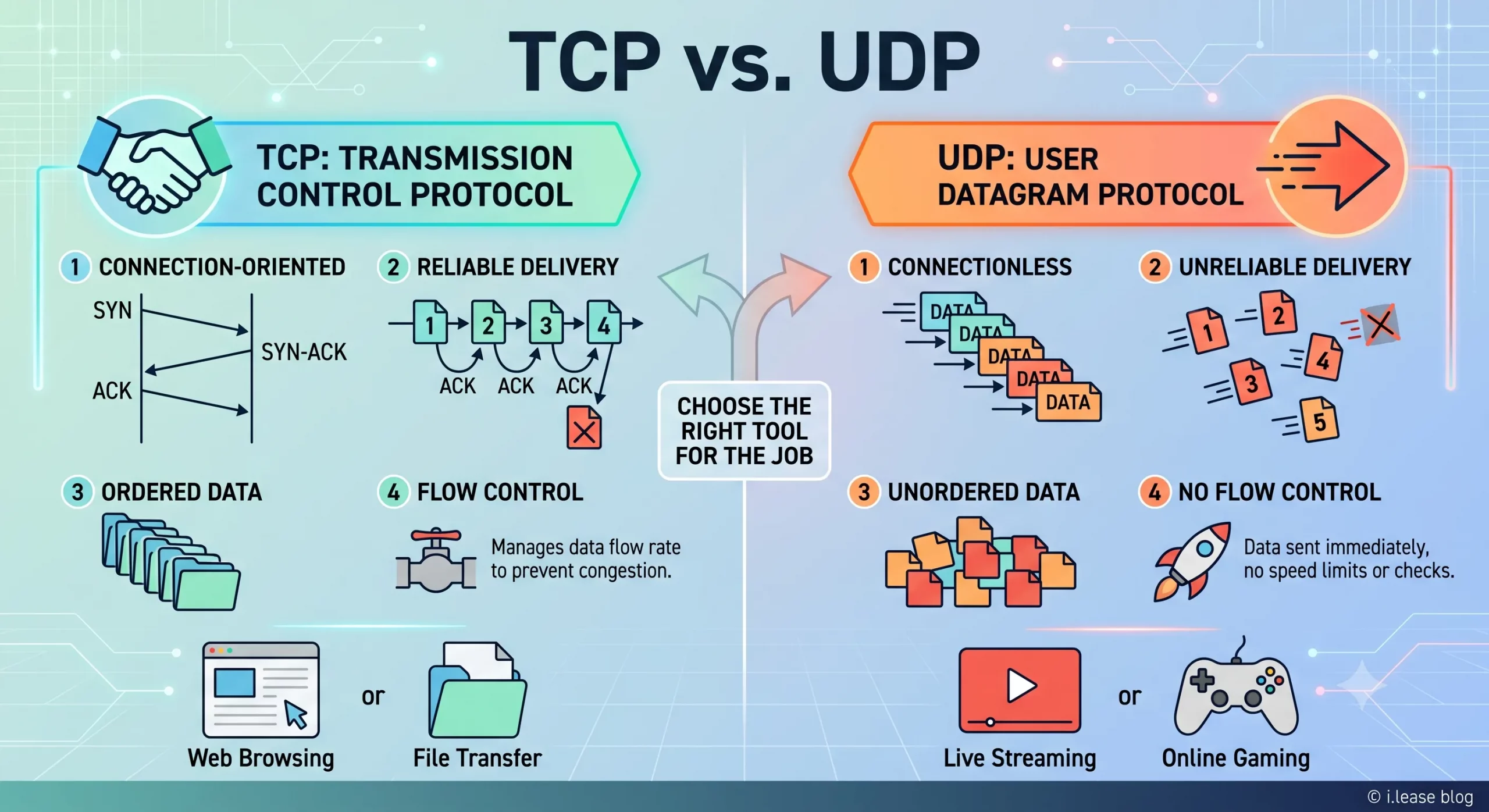
TCP 与 UDP:IPv4 租赁和企业网络指南
TCP 和 UDP 是互联网中最重要的两种传输层协议。它们决定数据如何在设备、服务器、云平台、VPN 网关、DNS 解析器、电子邮件系统、流媒体平台以及企业应用程序之间传输。 对于企业而言,TCP 和 UDP 不仅仅是技术术语,它们会直接影响实际的基础设施性能。公网 IPv4 地址提供可从互联网访问的网络端点,而 TCP 和 UDP 则决定流量如何通过该端点进行传输。 这对于租用或购买 IPv4 地址的企业尤为重要。企业租用 IPv4 地址并不是单纯为了持有这些地址,而是为了运行网站、API、VPN 隧道、DNS 服务、电子邮件平台、SaaS 应用程序、游戏服务器、流媒体系统、安全工具以及云端工作负载。不同类型的服务决定了需要使用 TCP、UDP,还是同时使用两者。 通过 i.lease,企业可以使用 IPv4 租赁服务获取用于实际网络部署的公网 IPv4 资源。需要长期控制 IP 地址资源的企业也可以购买 IP 地址,而拥有闲置 IPv4 资源的组织则可以出售 IP 地址。 TCP和UDP是什么? TCP 和 UDP 都是传输层协议。它们位于 IP 协议之上,帮助应用程序通过网络发送和接收数据。 IP 地址用于确定流量应该发送到哪里,而 TCP 和 UDP 则决定这些流量如何进行传输。 简单来说: TCP 适用于重视可靠性和按顺序传输数据的场景。 UDP 适用于重视速度、低延迟和轻量化数据传输的场景。 企业可能会使用同一个公网 IPv4 地址来运行不同的服务,但每项服务可能依赖不同的传输协议。例如,网站可能使用 TCP,VPN 网关可能使用 UDP,DNS 解析器可能同时使用 UDP 和 TCP,而游戏服务器则可能更倾向于使用 UDP,因为对于实时游戏而言,延迟造成的影响通常比少量数据包丢失更加明显。 因此,TCPRead more Related Posts 什么是电信公司?电信运营商如何为英国、美国和加拿大提供网络连接支持? 电信公司(Telco Companies),也称为电信运营商(Telecommunications Companies),提供通信与网络连接服务。这些服务包括移动通信网络、宽带互联网、光纤连接、固定电话服务、企业网络连接、云连接、托管网络服务以及数据中心连接等。 对于普通消费者而言,电信公司通常被视为移动通信或宽带互联网服务提供商。对于企业来说,电信公司远不只是一个服务品牌,更是关键的基础设施合作伙伴,帮助企业连接办公室、数据中心、云平台、远程员工、客户应用程序以及各类数字化服务。 随着企业越来越依赖云平台、SaaS 应用、AI 工具、VPN、网络安全系统以及在线服务,电信公司已成为数字基础设施规划中不可或缺的重要组成部分。 电信公司是什么? 电信公司(Telco Companies)是提供电信服务的企业。这些服务让个人、设备、企业和各种系统能够跨越距离进行通信与连接。 一家电信公司可能提供以下服务: 移动通信服务 宽带互联网 光纤连接 固定电话服务 企业互联网接入 企业广域网(WAN)服务 云连接服务 数据中心连接 VPN TCP 与 UDP:IPv4 租赁和企业网络指南 TCP 和 UDP 是互联网中最重要的两种传输层协议。它们决定数据如何在设备、服务器、云平台、VPN 网关、DNS 解析器、电子邮件系统、流媒体平台以及企业应用程序之间传输。 对于企业而言,TCP 和 UDP 不仅仅是技术术语,它们会直接影响实际的基础设施性能。公网 IPv4 地址提供可从互联网访问的网络端点,而 TCP 和 UDP 则决定流量如何通过该端点进行传输。 这对于租用或购买 IPv4 地址的企业尤为重要。企业租用 IPv4 什么是区域互联网注册管理机构(RIR) 区域互联网注册管理机构(Regional Internet Registry, RIR)是负责在特定地理区域内分配和管理互联网编号资源的组织。这些资源主要包括 IP 地址(IPv4 和 IPv6)以及自治系统号(ASN),它们是支撑设备和网络在互联网上相互通信的关键要素。 如果没有一套组织完善的系统来分配唯一的 IP 地址和路由标识符,互联网便无法正常运转。RIR 确保这一过程在各自管辖的区域内保持公平、高效与一致,从而避免冲突,并提升互联网治理的透明度。 全球五大 RIR 目前全球共有五家获官方认可的 RIR,各自负责世界上特定的区域:AFRINIC – 非洲网络信息中心(非洲)APNIC – 亚太网络信息中心(亚太地区)ARIN .related-post {} .related-post .post-list { text-align: left; } .related-post .post-list .item { margin: 5px; padding: 10px; } .related-post .headline { font-size: 18px !important; color: #999999 !important; } .related-post .post-list .item .post_thumb { max-height: 220px; margin: 10px 0px; padding: 0px; display: block; } .related-post .post-list .item .post_title { font-size: 16px; color: #3f3f3f; margin: 10px 0px; padding: 0px; display: block; text-decoration: none; } .related-post .post-list .item .post_excerpt { font-size: 13px; color: #3f3f3f; margin: 10px 0px; padding: 0px; display: block; text-decoration: none; } @media only screen and (min-width: 1024px) { .related-post .post-list .item { width: 30%; } } @media only screen and (min-width: 768px) and (max-width: 1023px) { .related-post .post-list .item { width: 90%; } } @media only screen and (min-width: 0px) and (max-width: 767px) { .related-post .post-list .item { width: 90%; } }
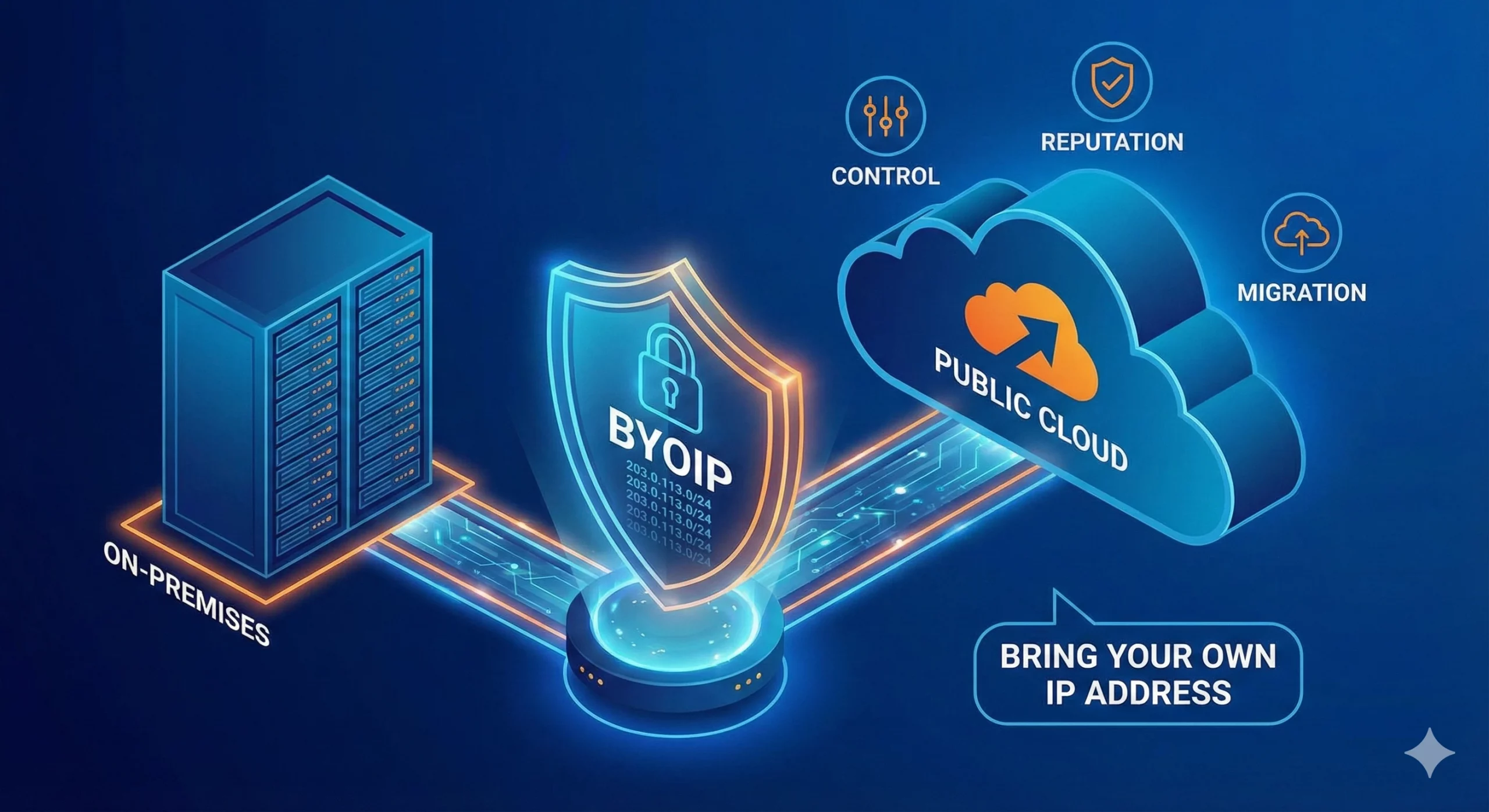
什么是BYOIP(自备IP地址)?
自带 IP(Bring Your Own IP,简称 BYOIP)是一种网络部署方式,允许企业将自己现有的公网 IP 地址段应用于云服务提供商、数据中心、内容分发网络(CDN)或其他基础设施平台。 企业无需使用服务提供商分配的新公网 IP 地址,而是可以使用自己已拥有或已获授权使用的 IPv4 或 IPv6 地址前缀。服务提供商会验证该组织对该地址段的使用权限,并在支持的情况下,通过其自身网络对该地址段进行路由公告(Advertise)。 BYOIP 有助于企业在迁移至云平台时保留现有的防火墙规则、白名单(Allowlists)、客户系统集成、IP 信誉(IP Reputation)、DNS 配置以及既有的网络身份。这不仅能够减少因更换 IP 地址而带来的业务中断,还能降低对服务提供商分配 IP 的依赖,使未来的基础设施迁移与扩展更加灵活且易于管理。 对于需要 BYOIP 地址资源的企业,可选择 购买 IPv4 地址(Buy IP),以获得长期控制权;如果更重视灵活性,也可采用 IPv4 租赁(IPv4 Leasing),按业务需求获取公网 IP 资源。 什么是BYOIP? BYOIP 是 Bring Your Own IP(自带 IP)的缩写。这是一种网络部署模式,允许组织将现有的公网 IP 地址段带入云服务提供商或其他基础设施平台使用。 在 BYOIP 模式下,组织仍然拥有或保留该 IP 地址段的使用权,而平台则获得授权,可在其基础设施中对该地址段进行路由公告(Advertise)和使用。随后,这些 IP 地址可分配给虚拟机(Virtual Machines)、负载均衡器(Load Balancers)、VPN 网关、内容分发服务(CDN)、安全平台以及公网应用程序端点等受支持的服务。 例如,一家企业将应用程序从本地数据中心迁移到云环境时,可能并不希望更换现有的公网 IP 地址。这些 IP 地址可能已经存在于客户白名单(Allowlists)、防火墙策略、DNS 记录、合作伙伴配置以及电子邮件信誉(Email Reputation)数据库中。 BYOIP 使企业能够在迁移工作负载的同时,继续使用原有的公网 IP 地址,从而保持更一致的网络身份,并减少因更换 IP 地址而带来的配置调整和业务影响。 Related Posts 什么是电信公司?电信运营商如何为英国、美国和加拿大提供网络连接支持? 电信公司(Telco Companies),也称为电信运营商(Telecommunications Companies),提供通信与网络连接服务。这些服务包括移动通信网络、宽带互联网、光纤连接、固定电话服务、企业网络连接、云连接、托管网络服务以及数据中心连接等。 对于普通消费者而言,电信公司通常被视为移动通信或宽带互联网服务提供商。对于企业来说,电信公司远不只是一个服务品牌,更是关键的基础设施合作伙伴,帮助企业连接办公室、数据中心、云平台、远程员工、客户应用程序以及各类数字化服务。 随着企业越来越依赖云平台、SaaS 应用、AI 工具、VPN、网络安全系统以及在线服务,电信公司已成为数字基础设施规划中不可或缺的重要组成部分。 电信公司是什么? 电信公司(Telco Companies)是提供电信服务的企业。这些服务让个人、设备、企业和各种系统能够跨越距离进行通信与连接。 一家电信公司可能提供以下服务: 移动通信服务 宽带互联网 光纤连接 固定电话服务 企业互联网接入 企业广域网(WAN)服务 云连接服务 数据中心连接 VPN TCP 与 UDP:IPv4 租赁和企业网络指南 TCP 和 UDP 是互联网中最重要的两种传输层协议。它们决定数据如何在设备、服务器、云平台、VPN 网关、DNS 解析器、电子邮件系统、流媒体平台以及企业应用程序之间传输。 对于企业而言,TCP 和 UDP 不仅仅是技术术语,它们会直接影响实际的基础设施性能。公网 IPv4 地址提供可从互联网访问的网络端点,而 TCP 和 UDP 则决定流量如何通过该端点进行传输。 这对于租用或购买 IPv4 地址的企业尤为重要。企业租用 IPv4 什么是区域互联网注册管理机构(RIR) 区域互联网注册管理机构(Regional Internet Registry, RIR)是负责在特定地理区域内分配和管理互联网编号资源的组织。这些资源主要包括 IP 地址(IPv4 和 IPv6)以及自治系统号(ASN),它们是支撑设备和网络在互联网上相互通信的关键要素。 如果没有一套组织完善的系统来分配唯一的 IP 地址和路由标识符,互联网便无法正常运转。RIR 确保这一过程在各自管辖的区域内保持公平、高效与一致,从而避免冲突,并提升互联网治理的透明度。 全球五大 RIR 目前全球共有五家获官方认可的 RIR,各自负责世界上特定的区域:AFRINIC – 非洲网络信息中心(非洲)APNIC – 亚太网络信息中心(亚太地区)ARIN .related-post {} .related-post .post-list { text-align: left; } .related-post .post-list .item { margin: 5px; padding: 10px; } .related-post .headline { font-size: 18px !important; color: #999999 !important; } .related-post .post-list .item .post_thumb { max-height: 220px; margin: 10px 0px; padding: 0px; display: block; } .related-post .post-list .item .post_title { font-size: 16px; color: #3f3f3f; margin: 10px 0px; padding: 0px; display: block; text-decoration: none; } .related-post .post-list .item .post_excerpt { font-size: 13px; color: #3f3f3f; margin: 10px 0px; padding: 0px; display: block; text-decoration: none; } @media only screen and (min-width: 1024px) { .related-post .post-list .item { width: 30%; } } @media only screen and (min-width: 768px) and (max-width: 1023px) { .related-post .post-list .item { width: 90%; } } @media only screen and (min-width: 0px) and (max-width: 767px) { .related-post .post-list .item { width: 90%; } }
