Historique du prix des adresses IPv4, de l’épuisement des stocks à 2026
 Stephanie
Une analyse des tendances des prix des adresses IPv4, des pics dus à la rareté aux corrections du marché, et de la manière dont l’épuisement a façonné les prix jusqu’en 2026.
Table of Contents
Qu’est-ce que l’épuisement des adresses IPv4 et pourquoi est-ce important ?
L’espace d’adressage IPv4, composé d’environ 4,3 milliards d’adresses uniques, a été créé au début de l’histoire d’Internet sans anticiper la demande future. Au fil des décennies, la croissance rapide du nombre d’utilisateurs, d’appareils et de connexions permanentes a épuisé le stock d’adresses IPv4 non attribuées gérées par les registres mondiaux. Lorsque les registres régionaux, tels que l’American Registry for Internet Numbers (ARIN), n’ont plus eu d’adresses IPv4 disponibles, les organisations n’ont plus pu obtenir de nouvelles adresses directement auprès des registres centraux. Cette pénurie fondamentale a transformé l’IPv4 en un marché secondaire, où les organisations achètent, vendent et louent des blocs d’adresses existants. Face à une demande persistante malgré l’arrivée imminente de l’IPv6, ce marché est devenu un secteur économique important, caractérisé par des fluctuations de prix notables.
Early price trends: post‑exhaustion growth
In the years following IPv4 depletion, IPv4 address prices began to rise steadily. According to historical broker data, average prices were modest in the mid‑2010s but climbed significantly over time. Between 2014 and 2021, a major IPv4 brokerage reported per‑IP sale prices rising from around $6–24 per IP in 2014 to $23–60 per IP by 2021, depending on block size and registry. Smaller blocks such as /24 (256 addresses) typically traded at higher per‑IP prices than larger blocks, reflecting differences in demand, transfer complexity, and utility. This trend underscored the growing premium associated with IPv4 scarcity as organisations sought to secure address space ahead of competitors.
External platforms tracking IPv4 pricing noted a roughly 20% annual growth rate in IPv4 prices over several years, illustrating a market where constrained supply collided with persistent demand.
Year | Approx. Price per IPv4 (Typical Range) |
2014 | ~$6–$24 |
2017 | ~$13–$15 |
2021 | ~$45–$60 |
2024 | ~$32–$36 |
2025 | ~$35–$55 |
This table summarises approximate price levels for IPv4 addresses over time, showing the trend from modest early values to higher market rates following exhaustion.
Price peaks and market volatility
The late 2010s and early 2020s saw notable spikes in IPv4 prices. In 2021 and into 2022, brokers recorded some of the highest per‑IP sale prices on record, with individual IPv4 addresses selling for around $60 or more. This represented both speculation and genuine demand from organisations reluctant to transition fully to IPv6 or those requiring backward compatibility with legacy systems. Price volatility was also influenced by wider market conditions such as the global economic cycle and pandemic disruptions. Following the pandemic slowdown in early 2020, network expansion paused, softening demand slightly before rebounding strongly in 2021 when many economies resumed growth.
The rise of leasing markets
As purchase prices fluctuated, many organisations turned to IPv4 leasing as a more predictable and cost‑effective solution. Leasing allows businesses to secure address space without large upfront costs, and monthly lease rates — often around $0.40–$0.50 per IP — remained relatively stable even while purchase prices fluctuated. Leasing gained traction because it resembles a subscription: predictable costs, scalability, and lower risk compared with long‑term capital investment in scarce assets.
Leasing remains attractive in 2025, especially for smaller and medium‑sized networks that prefer operational flexibility over committing large capital resources to permanent address ownership.
Pricing trends into 2024 and 2025
By 2024, IPv4 purchase prices had consolidated somewhat. Market reports indicated typical ranges of roughly $32–$36 per IPv4 address, with smaller blocks commanding higher per‑IP prices due to demand and convenience. Alternative reports place 2025 purchase price ranges at $35–$55 per IP, influenced by block size, reputation, and regional demand.
In early 2025, an influx of large block inventory led to a notable decline in average prices for large blocks (e.g. /16s), with per‑IP pricing dropping from nearly $50 in mid‑2024 to about $24 by March 2025 for some block sizes. Such shifts reflected market liquidity changes, larger address releases, and evolving buyer strategies.
Simultaneously, data from IPv4.Global and other brokers suggested a gradual downward drift in average prices later in 2025, particularly across smaller and medium blocks. Such shifts reflected market liquidity changes, larger address releases, and evolving buyer strategies.
Supply, demand, and exhaustion economics
The underlying driver of the IPv4 price history is economic: scarcity plus steady demand equals premiums. Because the free pool of IPv4 addresses was completely allocated long ago, nothing new enters the market, and the only way organisations acquire addresses is through transfer from existing holders.
Similar to many commodities with finite supply, IPv4 addresses have exhibited:
- Price appreciation during tight supply periods,
- Greater volatility around market shocks, and
- Differentiation by block size and region.
The existence of both purchase and leasing markets reflects buyers’ different risk appetites and budget constraints.
IPv4 address pricing isn’t just about numbers — it’s about network strategy. With global IPv4 exhaustion now firmly in the past, organizations are making more nuanced decisions between purchasing blocks outright or leasing them to align with growth and transition to IPv6. While peak address prices in the early 2020s underscored scarcity, the market today is responding to smarter utilization, block consolidation, and leasing alternatives. For 2026, we anticipate continued moderation and segmentation in prices as operational agility and IPv6 readiness increasingly shape how enterprises value IPv4 resources.
– David Lim, Network Infrastructure Analyst
Expert views on IPv4 pricing dynamics
Industry observers have weighed in on IPv4 market trends. Analysts note that the IPv4 market’s trajectory reflects more than raw scarcity: it also reveals buyer sentiment about IPv6 transition timelines and how quickly organisations move to embrace IPv6 or depend on dual‑stack networks.
One market commentator noted that fluctuating purchase prices and the durability of leasing arrangements point to evolving network planning philosophies, where firms increasingly treat IPv4 addresses as managed assets rather than indefinite infrastructure investments.
Another perspective emphasises that the resilience of IPv4 demand, despite IPv6’s availability for decades, underscores business needs for compatibility with legacy systems, existing routing infrastructure, and gradual migration strategies.
Future outlook: 2026 and beyond
As we look ahead to 2026 and beyond, several trends are likely to shape IPv4 pricing:
- Continued price moderation, especially if large block inventories remain available.
- Stable leasing markets, with operators preferring predictable costs over speculative purchases.
- Regional pricing variation, reflecting different demand and organisational migration patterns across markets.
Some analysts also forecast potential price rebounds if large block availability tightens, or if one of the major Regional Internet Registries (RIRs) enforces policy changes that affect transfer volumes. However, the coexistence of IPv4 purchase and lease markets suggests that prices may remain dynamic rather than trending uniformly upward.
Implications pour les entreprises et les créateurs de réseaux
For businesses planning network infrastructure, IPv4 price history highlights several practical considerations:
- Budgeting for address acquisition: organisations must weigh the costs of purchase against long‑term leasing.
- IPv6 migration strategy: as IPv6 adoption reduces dependency on IPv4, address acquisition costs become a planning factor rather than a barrier.
- Risk management: leasing can serve as a hedge against market volatility and speculative price spikes.
Organisations should also consider IPv4 address reputation, since poor reputation can affect network deliverability and security policies, further influencing acquisition decisions.
The IPv4 market reflects one of the most compelling examples of economic scarcity in the digital age. After the free pool exhausted, IPv4 addresses transitioned into a mature secondary market where block size, year, and buyer strategy all influence value. Prices surged in the early post‑exhaustion years, peaking as large enterprises competed for limited space. Over time, increased block availability and the rise of leasing solutions have tempered price volatility. Heading into 2026, we’re seeing a more balanced ecosystem — where buyers, sellers, and lessees negotiate not just on price, but on flexibility, timing, and network deployment plans
– Rachel Chen, IP Address Management Expert
Trusted IPv4 Leasing for Business Growth
Get enterprise-grade IPv4 space quickly, with seamless deployment and end-to-end management.
Get Started with i.leaseFrequently Asked Questions
1. 1. Why are IPv4 addresses expensive?
Because the free pool of IPv4 addresses has been fully allocated, they must be transferred between organisations, creating a secondary market with limited supply and steady demand.
2. How much does an IPv4 address cost in 2025?
Typical purchase prices in 2025 are around $35–$55 per IP, depending on block size, reputation and region.
3. What is IPv4 leasing and why use it?
Leasing allows businesses to obtain addresses temporarily, often at around $0.40–$0.50 per IP per month, which can be more predictable and affordable than purchasing outright.
4. Did IPv4 prices ever peak?
Yes — IPv4 sale prices reached approximately $60 per address in 2021‑2022 during peak demand.
5. Will IPv4 prices rise again?
Future prices depend on inventory, demand, and migration to IPv6; if block availability tightens, prices could rebound, but leasing markets may temper upward pressure.
Related Blogs
相关文章

什么是电信公司?电信运营商如何为英国、美国和加拿大提供网络连接支持?
电信公司(Telco Companies),也称为电信运营商(Telecommunications Companies),提供通信与网络连接服务。这些服务包括移动通信网络、宽带互联网、光纤连接、固定电话服务、企业网络连接、云连接、托管网络服务以及数据中心连接等。 对于普通消费者而言,电信公司通常被视为移动通信或宽带互联网服务提供商。对于企业来说,电信公司远不只是一个服务品牌,更是关键的基础设施合作伙伴,帮助企业连接办公室、数据中心、云平台、远程员工、客户应用程序以及各类数字化服务。 随着企业越来越依赖云平台、SaaS 应用、AI 工具、VPN、网络安全系统以及在线服务,电信公司已成为数字基础设施规划中不可或缺的重要组成部分。 电信公司是什么? 电信公司(Telco Companies)是提供电信服务的企业。这些服务让个人、设备、企业和各种系统能够跨越距离进行通信与连接。 一家电信公司可能提供以下服务: 移动通信服务 宽带互联网 光纤连接 固定电话服务 企业互联网接入 企业广域网(WAN)服务 云连接服务 数据中心连接 VPN 服务 托管网络解决方案 互联网传输(Internet Transit) 电信批发服务 部分电信公司拥有并运营大规模的实体网络基础设施;另一些则通过批发接入、租用基础设施或与网络运营商合作来提供电信服务。 电信公司提供哪些服务? 电信公司同时为个人消费者和企业客户提供服务。 面向消费者的服务通常包括移动通信套餐、家庭宽带、光纤互联网、固定电话以及通信组合套餐。 面向企业的服务则可能包括专线互联网接入、企业光纤、专用网络、云连接、托管安全服务、数据中心连接、物联网(IoT)连接以及企业移动通信方案。 对于大型企业客户,电信公司还可提供: 多地点办公室网络连接 远程员工接入 私有云连接 SD-WAN(软件定义广域网) 灾难恢复连接 低延迟网络路由 互联网传输(Internet Transit) 网络监控 托管防火墙服务 正因如此,电信公司不仅对日常通信至关重要,也是现代企业建设先进数字基础设施的重要支柱。 电信公司 vs 互联网服务提供商 vs 网络运营商 电信公司(Telco)、互联网服务提供商(ISP)和网络运营商(Network Operator)之间可能存在重叠,但它们并不完全相同。 电信公司提供电信服务。 互联网服务提供商(ISP)提供互联网接入服务。 网络运营商负责建设、运营和管理网络基础设施。 一些大型电信公司同时承担这三种角色。它们拥有基础设施、运营网络,并向市场提供互联网、移动通信以及企业网络服务。 规模较小的服务提供商则可能专注于其中某一层。例如,互联网服务提供商(ISP)可以销售宽带服务,而无需拥有所有实体网络基础设施;网络运营商可能负责建设和运营光纤网络,并向电信公司或 ISP 提供批发网络接入;电信公司则可能结合自有网络与合作伙伴网络,为客户提供移动通信和企业服务。 对于企业而言,理解这些区别非常重要,因为服务质量不仅取决于销售该方案的品牌,还受到其底层网络、路由设计、网络覆盖范围以及技术支持体系等因素的影响。 为什么电信公司对企业至关重要 电信公司之所以重要,是因为几乎所有现代企业都依赖稳定的网络连接。 企业可能需要电信服务来支持: 办公室互联网接入 移动网络连接 远程办公 客户支持系统 云应用程序 SaaS 平台 支付系统 VPNRead more Related Posts 什么是电信公司?电信运营商如何为英国、美国和加拿大提供网络连接支持? 电信公司(Telco Companies),也称为电信运营商(Telecommunications Companies),提供通信与网络连接服务。这些服务包括移动通信网络、宽带互联网、光纤连接、固定电话服务、企业网络连接、云连接、托管网络服务以及数据中心连接等。 对于普通消费者而言,电信公司通常被视为移动通信或宽带互联网服务提供商。对于企业来说,电信公司远不只是一个服务品牌,更是关键的基础设施合作伙伴,帮助企业连接办公室、数据中心、云平台、远程员工、客户应用程序以及各类数字化服务。 随着企业越来越依赖云平台、SaaS 应用、AI 工具、VPN、网络安全系统以及在线服务,电信公司已成为数字基础设施规划中不可或缺的重要组成部分。 电信公司是什么? 电信公司(Telco Companies)是提供电信服务的企业。这些服务让个人、设备、企业和各种系统能够跨越距离进行通信与连接。 一家电信公司可能提供以下服务: 移动通信服务 宽带互联网 光纤连接 固定电话服务 企业互联网接入 企业广域网(WAN)服务 云连接服务 数据中心连接 VPN TCP 与 UDP:IPv4 租赁和企业网络指南 TCP 和 UDP 是互联网中最重要的两种传输层协议。它们决定数据如何在设备、服务器、云平台、VPN 网关、DNS 解析器、电子邮件系统、流媒体平台以及企业应用程序之间传输。 对于企业而言,TCP 和 UDP 不仅仅是技术术语,它们会直接影响实际的基础设施性能。公网 IPv4 地址提供可从互联网访问的网络端点,而 TCP 和 UDP 则决定流量如何通过该端点进行传输。 这对于租用或购买 IPv4 地址的企业尤为重要。企业租用 IPv4 什么是区域互联网注册管理机构(RIR) 区域互联网注册管理机构(Regional Internet Registry, RIR)是负责在特定地理区域内分配和管理互联网编号资源的组织。这些资源主要包括 IP 地址(IPv4 和 IPv6)以及自治系统号(ASN),它们是支撑设备和网络在互联网上相互通信的关键要素。 如果没有一套组织完善的系统来分配唯一的 IP 地址和路由标识符,互联网便无法正常运转。RIR 确保这一过程在各自管辖的区域内保持公平、高效与一致,从而避免冲突,并提升互联网治理的透明度。 全球五大 RIR 目前全球共有五家获官方认可的 RIR,各自负责世界上特定的区域:AFRINIC – 非洲网络信息中心(非洲)APNIC – 亚太网络信息中心(亚太地区)ARIN .related-post {} .related-post .post-list { text-align: left; } .related-post .post-list .item { margin: 5px; padding: 10px; } .related-post .headline { font-size: 18px !important; color: #999999 !important; } .related-post .post-list .item .post_thumb { max-height: 220px; margin: 10px 0px; padding: 0px; display: block; } .related-post .post-list .item .post_title { font-size: 16px; color: #3f3f3f; margin: 10px 0px; padding: 0px; display: block; text-decoration: none; } .related-post .post-list .item .post_excerpt { font-size: 13px; color: #3f3f3f; margin: 10px 0px; padding: 0px; display: block; text-decoration: none; } @media only screen and (min-width: 1024px) { .related-post .post-list .item { width: 30%; } } @media only screen and (min-width: 768px) and (max-width: 1023px) { .related-post .post-list .item { width: 90%; } } @media only screen and (min-width: 0px) and (max-width: 767px) { .related-post .post-list .item { width: 90%; } }
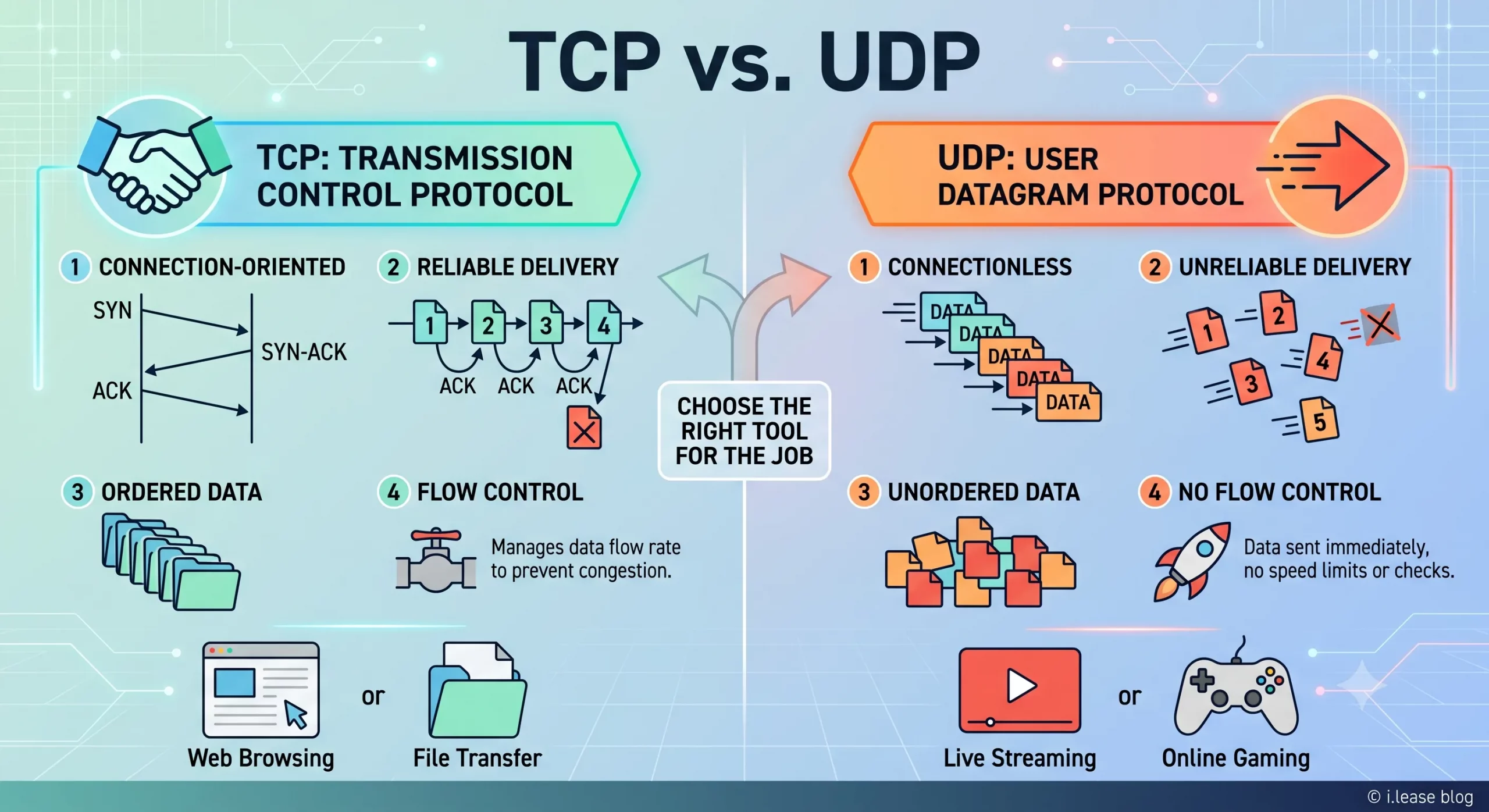
TCP 与 UDP:IPv4 租赁和企业网络指南
TCP 和 UDP 是互联网中最重要的两种传输层协议。它们决定数据如何在设备、服务器、云平台、VPN 网关、DNS 解析器、电子邮件系统、流媒体平台以及企业应用程序之间传输。 对于企业而言,TCP 和 UDP 不仅仅是技术术语,它们会直接影响实际的基础设施性能。公网 IPv4 地址提供可从互联网访问的网络端点,而 TCP 和 UDP 则决定流量如何通过该端点进行传输。 这对于租用或购买 IPv4 地址的企业尤为重要。企业租用 IPv4 地址并不是单纯为了持有这些地址,而是为了运行网站、API、VPN 隧道、DNS 服务、电子邮件平台、SaaS 应用程序、游戏服务器、流媒体系统、安全工具以及云端工作负载。不同类型的服务决定了需要使用 TCP、UDP,还是同时使用两者。 通过 i.lease,企业可以使用 IPv4 租赁服务获取用于实际网络部署的公网 IPv4 资源。需要长期控制 IP 地址资源的企业也可以购买 IP 地址,而拥有闲置 IPv4 资源的组织则可以出售 IP 地址。 TCP和UDP是什么? TCP 和 UDP 都是传输层协议。它们位于 IP 协议之上,帮助应用程序通过网络发送和接收数据。 IP 地址用于确定流量应该发送到哪里,而 TCP 和 UDP 则决定这些流量如何进行传输。 简单来说: TCP 适用于重视可靠性和按顺序传输数据的场景。 UDP 适用于重视速度、低延迟和轻量化数据传输的场景。 企业可能会使用同一个公网 IPv4 地址来运行不同的服务,但每项服务可能依赖不同的传输协议。例如,网站可能使用 TCP,VPN 网关可能使用 UDP,DNS 解析器可能同时使用 UDP 和 TCP,而游戏服务器则可能更倾向于使用 UDP,因为对于实时游戏而言,延迟造成的影响通常比少量数据包丢失更加明显。 因此,TCPRead more Related Posts 什么是电信公司?电信运营商如何为英国、美国和加拿大提供网络连接支持? 电信公司(Telco Companies),也称为电信运营商(Telecommunications Companies),提供通信与网络连接服务。这些服务包括移动通信网络、宽带互联网、光纤连接、固定电话服务、企业网络连接、云连接、托管网络服务以及数据中心连接等。 对于普通消费者而言,电信公司通常被视为移动通信或宽带互联网服务提供商。对于企业来说,电信公司远不只是一个服务品牌,更是关键的基础设施合作伙伴,帮助企业连接办公室、数据中心、云平台、远程员工、客户应用程序以及各类数字化服务。 随着企业越来越依赖云平台、SaaS 应用、AI 工具、VPN、网络安全系统以及在线服务,电信公司已成为数字基础设施规划中不可或缺的重要组成部分。 电信公司是什么? 电信公司(Telco Companies)是提供电信服务的企业。这些服务让个人、设备、企业和各种系统能够跨越距离进行通信与连接。 一家电信公司可能提供以下服务: 移动通信服务 宽带互联网 光纤连接 固定电话服务 企业互联网接入 企业广域网(WAN)服务 云连接服务 数据中心连接 VPN TCP 与 UDP:IPv4 租赁和企业网络指南 TCP 和 UDP 是互联网中最重要的两种传输层协议。它们决定数据如何在设备、服务器、云平台、VPN 网关、DNS 解析器、电子邮件系统、流媒体平台以及企业应用程序之间传输。 对于企业而言,TCP 和 UDP 不仅仅是技术术语,它们会直接影响实际的基础设施性能。公网 IPv4 地址提供可从互联网访问的网络端点,而 TCP 和 UDP 则决定流量如何通过该端点进行传输。 这对于租用或购买 IPv4 地址的企业尤为重要。企业租用 IPv4 什么是区域互联网注册管理机构(RIR) 区域互联网注册管理机构(Regional Internet Registry, RIR)是负责在特定地理区域内分配和管理互联网编号资源的组织。这些资源主要包括 IP 地址(IPv4 和 IPv6)以及自治系统号(ASN),它们是支撑设备和网络在互联网上相互通信的关键要素。 如果没有一套组织完善的系统来分配唯一的 IP 地址和路由标识符,互联网便无法正常运转。RIR 确保这一过程在各自管辖的区域内保持公平、高效与一致,从而避免冲突,并提升互联网治理的透明度。 全球五大 RIR 目前全球共有五家获官方认可的 RIR,各自负责世界上特定的区域:AFRINIC – 非洲网络信息中心(非洲)APNIC – 亚太网络信息中心(亚太地区)ARIN .related-post {} .related-post .post-list { text-align: left; } .related-post .post-list .item { margin: 5px; padding: 10px; } .related-post .headline { font-size: 18px !important; color: #999999 !important; } .related-post .post-list .item .post_thumb { max-height: 220px; margin: 10px 0px; padding: 0px; display: block; } .related-post .post-list .item .post_title { font-size: 16px; color: #3f3f3f; margin: 10px 0px; padding: 0px; display: block; text-decoration: none; } .related-post .post-list .item .post_excerpt { font-size: 13px; color: #3f3f3f; margin: 10px 0px; padding: 0px; display: block; text-decoration: none; } @media only screen and (min-width: 1024px) { .related-post .post-list .item { width: 30%; } } @media only screen and (min-width: 768px) and (max-width: 1023px) { .related-post .post-list .item { width: 90%; } } @media only screen and (min-width: 0px) and (max-width: 767px) { .related-post .post-list .item { width: 90%; } }
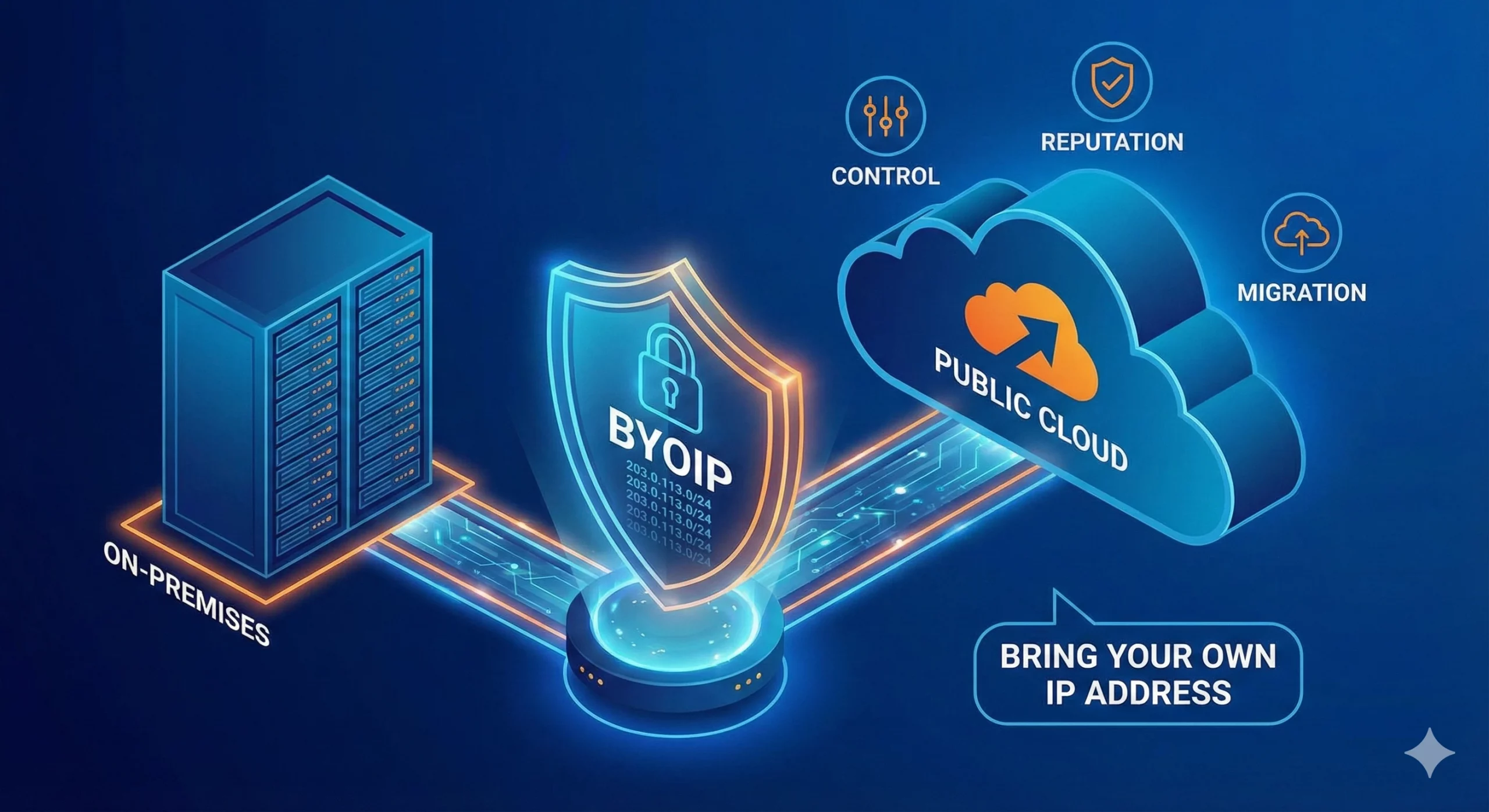
什么是BYOIP(自备IP地址)?
自带 IP(Bring Your Own IP,简称 BYOIP)是一种网络部署方式,允许企业将自己现有的公网 IP 地址段应用于云服务提供商、数据中心、内容分发网络(CDN)或其他基础设施平台。 企业无需使用服务提供商分配的新公网 IP 地址,而是可以使用自己已拥有或已获授权使用的 IPv4 或 IPv6 地址前缀。服务提供商会验证该组织对该地址段的使用权限,并在支持的情况下,通过其自身网络对该地址段进行路由公告(Advertise)。 BYOIP 有助于企业在迁移至云平台时保留现有的防火墙规则、白名单(Allowlists)、客户系统集成、IP 信誉(IP Reputation)、DNS 配置以及既有的网络身份。这不仅能够减少因更换 IP 地址而带来的业务中断,还能降低对服务提供商分配 IP 的依赖,使未来的基础设施迁移与扩展更加灵活且易于管理。 对于需要 BYOIP 地址资源的企业,可选择 购买 IPv4 地址(Buy IP),以获得长期控制权;如果更重视灵活性,也可采用 IPv4 租赁(IPv4 Leasing),按业务需求获取公网 IP 资源。 什么是BYOIP? BYOIP 是 Bring Your Own IP(自带 IP)的缩写。这是一种网络部署模式,允许组织将现有的公网 IP 地址段带入云服务提供商或其他基础设施平台使用。 在 BYOIP 模式下,组织仍然拥有或保留该 IP 地址段的使用权,而平台则获得授权,可在其基础设施中对该地址段进行路由公告(Advertise)和使用。随后,这些 IP 地址可分配给虚拟机(Virtual Machines)、负载均衡器(Load Balancers)、VPN 网关、内容分发服务(CDN)、安全平台以及公网应用程序端点等受支持的服务。 例如,一家企业将应用程序从本地数据中心迁移到云环境时,可能并不希望更换现有的公网 IP 地址。这些 IP 地址可能已经存在于客户白名单(Allowlists)、防火墙策略、DNS 记录、合作伙伴配置以及电子邮件信誉(Email Reputation)数据库中。 BYOIP 使企业能够在迁移工作负载的同时,继续使用原有的公网 IP 地址,从而保持更一致的网络身份,并减少因更换 IP 地址而带来的配置调整和业务影响。 Related Posts 什么是电信公司?电信运营商如何为英国、美国和加拿大提供网络连接支持? 电信公司(Telco Companies),也称为电信运营商(Telecommunications Companies),提供通信与网络连接服务。这些服务包括移动通信网络、宽带互联网、光纤连接、固定电话服务、企业网络连接、云连接、托管网络服务以及数据中心连接等。 对于普通消费者而言,电信公司通常被视为移动通信或宽带互联网服务提供商。对于企业来说,电信公司远不只是一个服务品牌,更是关键的基础设施合作伙伴,帮助企业连接办公室、数据中心、云平台、远程员工、客户应用程序以及各类数字化服务。 随着企业越来越依赖云平台、SaaS 应用、AI 工具、VPN、网络安全系统以及在线服务,电信公司已成为数字基础设施规划中不可或缺的重要组成部分。 电信公司是什么? 电信公司(Telco Companies)是提供电信服务的企业。这些服务让个人、设备、企业和各种系统能够跨越距离进行通信与连接。 一家电信公司可能提供以下服务: 移动通信服务 宽带互联网 光纤连接 固定电话服务 企业互联网接入 企业广域网(WAN)服务 云连接服务 数据中心连接 VPN TCP 与 UDP:IPv4 租赁和企业网络指南 TCP 和 UDP 是互联网中最重要的两种传输层协议。它们决定数据如何在设备、服务器、云平台、VPN 网关、DNS 解析器、电子邮件系统、流媒体平台以及企业应用程序之间传输。 对于企业而言,TCP 和 UDP 不仅仅是技术术语,它们会直接影响实际的基础设施性能。公网 IPv4 地址提供可从互联网访问的网络端点,而 TCP 和 UDP 则决定流量如何通过该端点进行传输。 这对于租用或购买 IPv4 地址的企业尤为重要。企业租用 IPv4 什么是区域互联网注册管理机构(RIR) 区域互联网注册管理机构(Regional Internet Registry, RIR)是负责在特定地理区域内分配和管理互联网编号资源的组织。这些资源主要包括 IP 地址(IPv4 和 IPv6)以及自治系统号(ASN),它们是支撑设备和网络在互联网上相互通信的关键要素。 如果没有一套组织完善的系统来分配唯一的 IP 地址和路由标识符,互联网便无法正常运转。RIR 确保这一过程在各自管辖的区域内保持公平、高效与一致,从而避免冲突,并提升互联网治理的透明度。 全球五大 RIR 目前全球共有五家获官方认可的 RIR,各自负责世界上特定的区域:AFRINIC – 非洲网络信息中心(非洲)APNIC – 亚太网络信息中心(亚太地区)ARIN .related-post {} .related-post .post-list { text-align: left; } .related-post .post-list .item { margin: 5px; padding: 10px; } .related-post .headline { font-size: 18px !important; color: #999999 !important; } .related-post .post-list .item .post_thumb { max-height: 220px; margin: 10px 0px; padding: 0px; display: block; } .related-post .post-list .item .post_title { font-size: 16px; color: #3f3f3f; margin: 10px 0px; padding: 0px; display: block; text-decoration: none; } .related-post .post-list .item .post_excerpt { font-size: 13px; color: #3f3f3f; margin: 10px 0px; padding: 0px; display: block; text-decoration: none; } @media only screen and (min-width: 1024px) { .related-post .post-list .item { width: 30%; } } @media only screen and (min-width: 768px) and (max-width: 1023px) { .related-post .post-list .item { width: 90%; } } @media only screen and (min-width: 0px) and (max-width: 767px) { .related-post .post-list .item { width: 90%; } }
