IP Allocation Best Practices for Enterprises
 Stephanie
Table of Contents
- An essential yet commonly disregarded, crucial component that influences network security and efficient operation is a well-designed IP allocation scheme.
- Scalable growth now calls for the implementation of methodologies like variable-length subnet masking (VLSM) and IPv6 integration planning.
Laying the groundwork with a logical hierarchy
IP address allocation is a more fundamental element that the typically occurs just like an afterthought in the grand architecture of an enterprise network, where debates frequently concentrate on cutting-edge firewalls, zero-trust models, and cloud migrations. The process is historical, organic, as well as chaotic for numerous organizations. Whenever a new office opens, a subnet gets established, and a new project is assigned a random block. However, this ad-hoc approach may result in an intricate network that blocks scalability, creates security policies more challenging to put into effect, and leads to administrative nightmares.
Think about your IP address space as the foundation of your entire digital operation, rather than merely an assortment of numbers. Network engineers must approach IP allocation tactically, just as a city planner would not plan roads without a map. When executed correctly, a well-designed IP scheme is invisible, enabling seamless interaction, simplifying troubleshooting, and providing an established structure for security enforcement. A poorly designed one hinders down innovation and creates risk, becoming an ongoing source of problems. Tim Winters, a senior network architect at the University of New Hampshire InterOperability Laboratory (UNH-IOL), says:
“The biggest mistake we see is companies treating their internal IP address space as an unmanaged wasteland.”
— Tim Winters, University of New Hampshire InterOperability Laboratory (UNH-IOL)
An in-depth review is the initial stage towards successful IP address management. What you do not measure, you cannot under control. This involves documenting each IP subnet which is right now in use, alongside its size, operation, location, and rate of utilization. From fundamental command-line scripts to complicated commercial IP Address Management (IPAM) solutions, there are and are many tools accessible to assist with this discovery process. Inefficiencies could be identified through this starting inventory, such as the wastage of well over 240 addresses while a /24 subnet (254 addresses) gets assigned to a faraway branch office with just ten devices. Establishing a logical hierarchy is the next step shortly after you have a clear picture of where you are now. The strategic allocation of the intellectual property depends regarding this.
The primary goal is to establish an addressing scheme that is compatible with the company’s logical structure. Large companies tend to tailor their IP approach with either geography, business function, or both. For instance, you could figure out that the continent or country code is delimited by the second octet of your private 10.0.0.0/8 space. A specifics city or campus could be represented by the third octet. Individual devices would then be recognized by the fourth octet. This results in concerning right away clarity. An engineer might quickly identify that the device is situated at the main headquarters (12) in London (84) if they observe the address 10.84.12.45. Applying security policies and efficiently routing traffic is made achievable by this hierarchical model.
At this point in time, it’s practically difficult to reach an agreement on technical best practices like Variable-Length Subnet Masking (VLSM).Using the same subnet size everywhere was an accepted method in traditional subnetting, which is highly wasteful. With VLSM, it’s possible to precisely configure subnets of different dimensions by determining the number of hosts required within one’s larger network. A wireless access point might need a /30 subnet (2 addresses) for its point-to-point link, a server rack may need a /29 subnet (6 usable addresses) for its management interfaces, and a large office might need a /23 (510 addresses) for its user devices. All of these can be distributed from a single, perpetual address block with gaps along with inefficiencies thanks to VLSM. As available addresses grow more scarce, mastering VLSM could prove to be the most essential ability for maximizing your IPv4 address space.
The role of dhcp and static assignments
Within these well-designed subnets, the assignment of addresses to individual devices must also be managed carefully. The foundation of user devices that include laptops, phones, and tablets is the Dynamic Host Configuration Protocol (DHCP). It simplifies the process, prevents human error, and enables successful address reuse. Cependant not everything ought to have a dynamic. Establishing a particular range for static assignments within each subnet is the best obviously for action in this instance. In a /24 subnet, for example, you can set separate addresses.1 to.30 for servers and network infrastructure, while DHCP handles addresses.50 to.254. This defines a transparent and consistent pattern that every one of the team’s scientists will understand.
The importance of documentation in ip management
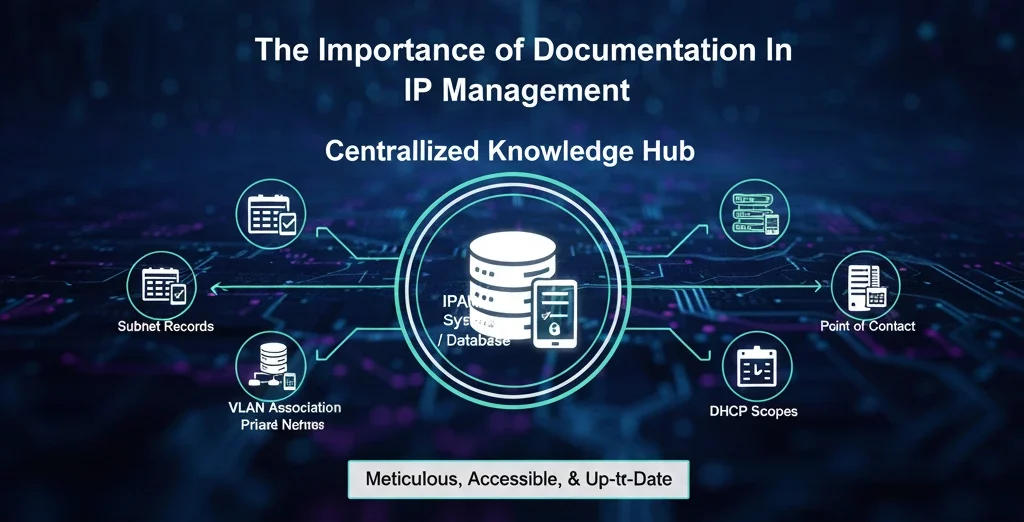
A perfect IP plan is useless if it only exists in one person’s head or in a stale spreadsheet on a forgotten server. Meticulous, accessible, and up-to-date documentation is the glue that holds everything together. The only trustworthy source of knowledge regarding the entirety of your IP address space should be your documentation. This includes an IPAM system or database that maintains records of every subnet, its VLAN association, its DHCP scope, its purpose, and its point of contact, and also detailed network diagrams that graphically depict your subnets and their relationships. The documentation needs to be updated concurrently with each change. Network management becomes transformed from a dark art into a standardized and auditable technique by this discipline.
“The gap between a good network and a great network often comes down to documentation,” notes Jennifer English, a senior analyst at IDC covering enterprise networks. “In times of crisis, when a network is under attack or a critical link has failed, the team does not have time to go on a scavenger hunt for information. Well-maintained IP documentation allows for rapid triage and resolution. It’s a force multiplier for your network operations centre.”
Establishing a robust IP address management policy
Establishing an a thorough IP Address Management (IPAM) policy is a vital—and yet commonly overlooked— component of strategic IP management. This document is your organization’s formal playbook, outlining the standards and procedures that all of your employees—from networking and security to cloud operations and development—must adhere to. Even the most meticulously planned IP plan may rapidly fall aside simply because of ad hoc exceptions, special requests, and a general lack of coordination in the lack of such a governing policy, reintroducing the network to the very state of chaos you attempted to remove. A powerful technical design has been transformed into an operational standard that is both enforceable and permanent from the policy. Clearly establishing roles and duties is the fundamental stage toward establishing an effective IPAM policy.
It ought to indicate who in the business has the right to request a block of IP addresses that remain static or a new subnet. It must additionally state who has the authority to grant these requests, who is in in charge of the technical implementation, as well as—most important of all—who is in in charge of looking after the IPAM system and central documentation. In big businesses, where different parts may have conflicting priorities and have no knowledge of the global network architecture, it is crucial to establish this clear request-and-approval workflow. The process is converted from one of unauthorized requests and tribal knowledge to an uniform, repeatable, and auditable business process by avoiding the uncontrolled proliferation of IP allocations while also making sure that every change is carefully evaluated, supported, and tracked.
The policy have to ask stringent operational standards in along with governance. Strict naming standards have to be obeyed by all network entities in light of this. As opposed to using a mysterious internal code, a subnet should have a name that accurately reflects its location and purpose, such as UK-LON-OFFICE-USER-VLAN110. An engineer are able to rapidly recognize a device from its IP address alone while device hostnames adhere to convention and include location and function codes. The following significantly reduces the mean time to resolution during an outage. Finally, a regular review and reclamation process must be defined in the policy. Projects come to an end, devices is retired, and offices are reduced; networks are natural. These retired assets’ IP addresses need to be meticulously discovered and brought once more to the pool of available addresses.
The looming shadow and bright future of IPv6
Without addressing IPv6, the elephant in the room, no discussion of present-day IP allocation is complete. Organizations are starting to get IPv6 address space from their service providers as an outcome of the concrete reality of IPv4 address exhaustion. It’s a common mistake to make decisions of IPv6 as a separate, future project that can be detached. Planning for IPv6 integration right away as you can is the best option for action. Giving away IPv6 calls for a completely different method of considering. With 340 undecillion addresses, the address space is so broad that conservation is no longer a concern. The entire a focus switches to logical structure and synthesis. Making management and dual-stack operation simple, your IPv6 plan ought to run in parallel with your IPv4 hierarchy, ideally mirroring it.
For the majority of companies, it is recommended to run IPv4 and IPv6 simultaneously (a configuration dubbed dual-stack), to ensure a smooth transition. Developing competence in IPv6 addressing now can assist the way you stay away a hasty, unprepared migration later.
Trusted IPv4 Leasing for Business Growth
Get enterprise-grade IPv4 space quickly, with seamless deployment and end-to-end management.
Get Started with i.leaseFAQs
What is the first step if our current IP allocation is a mess?
The absolute first step is to perform a comprehensive audit using network discovery tools to map out exactly what you have. Include all the networks and network subnets that are at present in use, in addition with their sizes, purposes, and usage rates. What you cannot comprehend, you are unable to fix. Following that, establish a new plan to define the logical hierarchy and start carefully adapting the moving elements of the network to this new scheme, beginning with low-risk areas.
How does good IP allocation improve network security?
A logical and consistent IP scheme allows for the creation of clear and effective security policies. Subnets may be utilized to establish firewall rules, thereby rendering it straightforward to enable or disable traffic from particular places or business units. Furthermore, it makes unusual behavior more apparent; security monitoring systems are going to recognize it right away if a device in the 10.84.0.0/16 range (London) suddenly wants to authenticate from a server subnet in a different country.
What is the difference between public and private IP addressing, and how should we use them?
Public IP addresses are globally routable on the internet and are a finite resource. Only devices that require to be easily accessible from the internet, including your mail servers or public web site, should use them as well. For the purpose to maintain your public IPs and add a layer of anonymity and security through Network Address Translation (NAT), the vast majority of your devices should use private addresses.
When should we consider using an IPAM tool?
An IPAM tool becomes highly recommended if you are in the position to manage more than certain subnets. It offers you an advanced platform for monitoring, distributing, and conserving IP address space, instead of spreadsheets that can be prone to mistakes. For entire lifecycle management of your IP resources, it commonly integrates with DNS and DHCP servers, serves as a centrally located database, and may assist in avoiding disputes.
Why can’t we just put off implementing IPv6?
While NAT and private addressing have delayed the urgency for IPv4, the industry is steadily moving towards IPv6.IPv6 has become native to many new mobile and Internet of Things devices. If you put away planning, you could have to deal with the consequences of rash, expensive, and inadequately carefully planned implementation later. A controlled, strategic dual-stack deployment that was achievable by early planning provides seamless connectivity and secures your network for several decades to come.
Related Blogs
相关文章

什么是电信公司?电信运营商如何为英国、美国和加拿大提供网络连接支持?
电信公司(Telco Companies),也称为电信运营商(Telecommunications Companies),提供通信与网络连接服务。这些服务包括移动通信网络、宽带互联网、光纤连接、固定电话服务、企业网络连接、云连接、托管网络服务以及数据中心连接等。 对于普通消费者而言,电信公司通常被视为移动通信或宽带互联网服务提供商。对于企业来说,电信公司远不只是一个服务品牌,更是关键的基础设施合作伙伴,帮助企业连接办公室、数据中心、云平台、远程员工、客户应用程序以及各类数字化服务。 随着企业越来越依赖云平台、SaaS 应用、AI 工具、VPN、网络安全系统以及在线服务,电信公司已成为数字基础设施规划中不可或缺的重要组成部分。 电信公司是什么? 电信公司(Telco Companies)是提供电信服务的企业。这些服务让个人、设备、企业和各种系统能够跨越距离进行通信与连接。 一家电信公司可能提供以下服务: 移动通信服务 宽带互联网 光纤连接 固定电话服务 企业互联网接入 企业广域网(WAN)服务 云连接服务 数据中心连接 VPN 服务 托管网络解决方案 互联网传输(Internet Transit) 电信批发服务 部分电信公司拥有并运营大规模的实体网络基础设施;另一些则通过批发接入、租用基础设施或与网络运营商合作来提供电信服务。 电信公司提供哪些服务? 电信公司同时为个人消费者和企业客户提供服务。 面向消费者的服务通常包括移动通信套餐、家庭宽带、光纤互联网、固定电话以及通信组合套餐。 面向企业的服务则可能包括专线互联网接入、企业光纤、专用网络、云连接、托管安全服务、数据中心连接、物联网(IoT)连接以及企业移动通信方案。 对于大型企业客户,电信公司还可提供: 多地点办公室网络连接 远程员工接入 私有云连接 SD-WAN(软件定义广域网) 灾难恢复连接 低延迟网络路由 互联网传输(Internet Transit) 网络监控 托管防火墙服务 正因如此,电信公司不仅对日常通信至关重要,也是现代企业建设先进数字基础设施的重要支柱。 电信公司 vs 互联网服务提供商 vs 网络运营商 电信公司(Telco)、互联网服务提供商(ISP)和网络运营商(Network Operator)之间可能存在重叠,但它们并不完全相同。 电信公司提供电信服务。 互联网服务提供商(ISP)提供互联网接入服务。 网络运营商负责建设、运营和管理网络基础设施。 一些大型电信公司同时承担这三种角色。它们拥有基础设施、运营网络,并向市场提供互联网、移动通信以及企业网络服务。 规模较小的服务提供商则可能专注于其中某一层。例如,互联网服务提供商(ISP)可以销售宽带服务,而无需拥有所有实体网络基础设施;网络运营商可能负责建设和运营光纤网络,并向电信公司或 ISP 提供批发网络接入;电信公司则可能结合自有网络与合作伙伴网络,为客户提供移动通信和企业服务。 对于企业而言,理解这些区别非常重要,因为服务质量不仅取决于销售该方案的品牌,还受到其底层网络、路由设计、网络覆盖范围以及技术支持体系等因素的影响。 为什么电信公司对企业至关重要 电信公司之所以重要,是因为几乎所有现代企业都依赖稳定的网络连接。 企业可能需要电信服务来支持: 办公室互联网接入 移动网络连接 远程办公 客户支持系统 云应用程序 SaaS 平台 支付系统 VPNRead more Related Posts 什么是电信公司?电信运营商如何为英国、美国和加拿大提供网络连接支持? 电信公司(Telco Companies),也称为电信运营商(Telecommunications Companies),提供通信与网络连接服务。这些服务包括移动通信网络、宽带互联网、光纤连接、固定电话服务、企业网络连接、云连接、托管网络服务以及数据中心连接等。 对于普通消费者而言,电信公司通常被视为移动通信或宽带互联网服务提供商。对于企业来说,电信公司远不只是一个服务品牌,更是关键的基础设施合作伙伴,帮助企业连接办公室、数据中心、云平台、远程员工、客户应用程序以及各类数字化服务。 随着企业越来越依赖云平台、SaaS 应用、AI 工具、VPN、网络安全系统以及在线服务,电信公司已成为数字基础设施规划中不可或缺的重要组成部分。 电信公司是什么? 电信公司(Telco Companies)是提供电信服务的企业。这些服务让个人、设备、企业和各种系统能够跨越距离进行通信与连接。 一家电信公司可能提供以下服务: 移动通信服务 宽带互联网 光纤连接 固定电话服务 企业互联网接入 企业广域网(WAN)服务 云连接服务 数据中心连接 VPN TCP 与 UDP:IPv4 租赁和企业网络指南 TCP 和 UDP 是互联网中最重要的两种传输层协议。它们决定数据如何在设备、服务器、云平台、VPN 网关、DNS 解析器、电子邮件系统、流媒体平台以及企业应用程序之间传输。 对于企业而言,TCP 和 UDP 不仅仅是技术术语,它们会直接影响实际的基础设施性能。公网 IPv4 地址提供可从互联网访问的网络端点,而 TCP 和 UDP 则决定流量如何通过该端点进行传输。 这对于租用或购买 IPv4 地址的企业尤为重要。企业租用 IPv4 什么是区域互联网注册管理机构(RIR) 区域互联网注册管理机构(Regional Internet Registry, RIR)是负责在特定地理区域内分配和管理互联网编号资源的组织。这些资源主要包括 IP 地址(IPv4 和 IPv6)以及自治系统号(ASN),它们是支撑设备和网络在互联网上相互通信的关键要素。 如果没有一套组织完善的系统来分配唯一的 IP 地址和路由标识符,互联网便无法正常运转。RIR 确保这一过程在各自管辖的区域内保持公平、高效与一致,从而避免冲突,并提升互联网治理的透明度。 全球五大 RIR 目前全球共有五家获官方认可的 RIR,各自负责世界上特定的区域:AFRINIC – 非洲网络信息中心(非洲)APNIC – 亚太网络信息中心(亚太地区)ARIN .related-post {} .related-post .post-list { text-align: left; } .related-post .post-list .item { margin: 5px; padding: 10px; } .related-post .headline { font-size: 18px !important; color: #999999 !important; } .related-post .post-list .item .post_thumb { max-height: 220px; margin: 10px 0px; padding: 0px; display: block; } .related-post .post-list .item .post_title { font-size: 16px; color: #3f3f3f; margin: 10px 0px; padding: 0px; display: block; text-decoration: none; } .related-post .post-list .item .post_excerpt { font-size: 13px; color: #3f3f3f; margin: 10px 0px; padding: 0px; display: block; text-decoration: none; } @media only screen and (min-width: 1024px) { .related-post .post-list .item { width: 30%; } } @media only screen and (min-width: 768px) and (max-width: 1023px) { .related-post .post-list .item { width: 90%; } } @media only screen and (min-width: 0px) and (max-width: 767px) { .related-post .post-list .item { width: 90%; } }
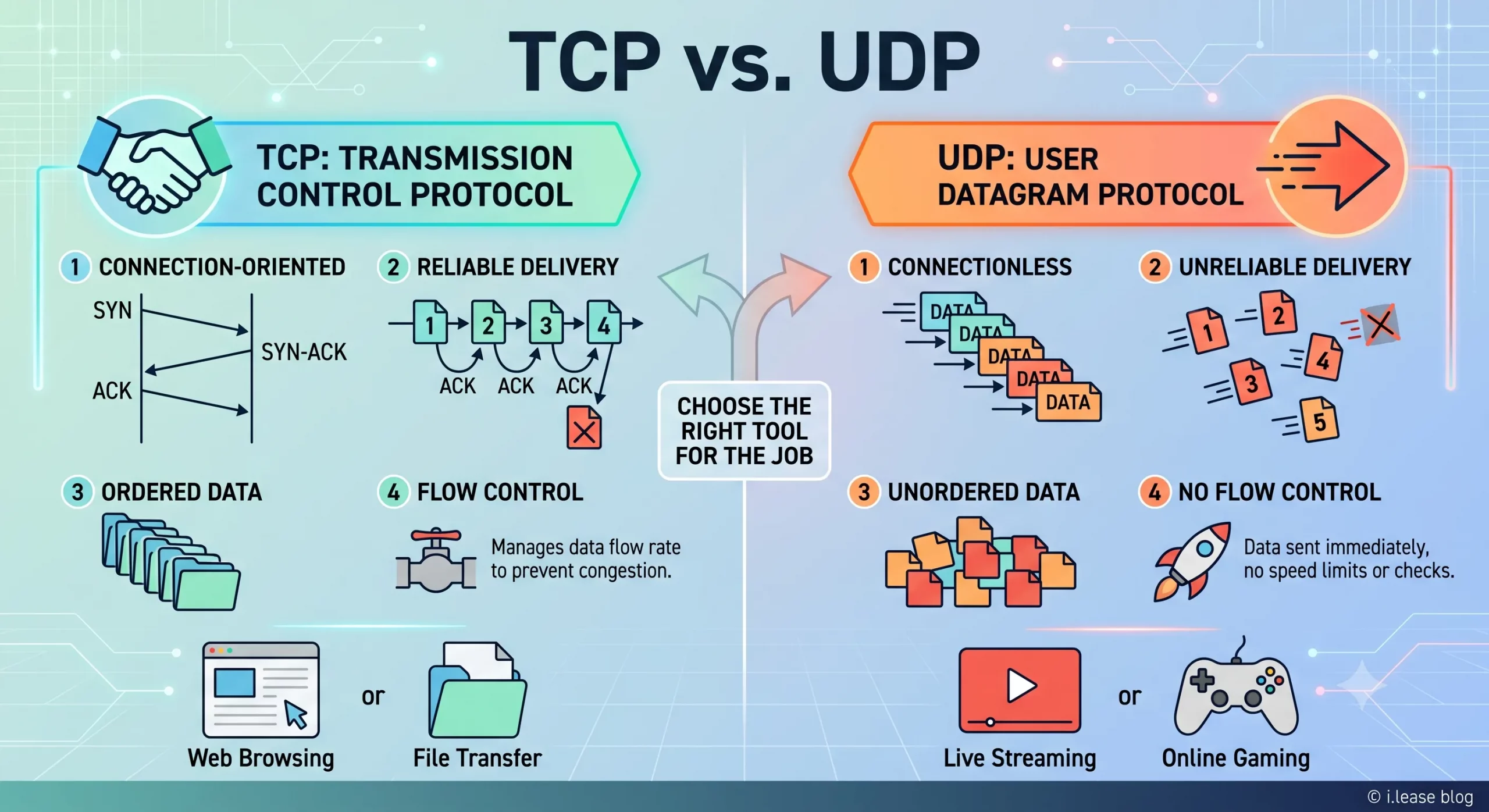
TCP 与 UDP:IPv4 租赁和企业网络指南
TCP 和 UDP 是互联网中最重要的两种传输层协议。它们决定数据如何在设备、服务器、云平台、VPN 网关、DNS 解析器、电子邮件系统、流媒体平台以及企业应用程序之间传输。 对于企业而言,TCP 和 UDP 不仅仅是技术术语,它们会直接影响实际的基础设施性能。公网 IPv4 地址提供可从互联网访问的网络端点,而 TCP 和 UDP 则决定流量如何通过该端点进行传输。 这对于租用或购买 IPv4 地址的企业尤为重要。企业租用 IPv4 地址并不是单纯为了持有这些地址,而是为了运行网站、API、VPN 隧道、DNS 服务、电子邮件平台、SaaS 应用程序、游戏服务器、流媒体系统、安全工具以及云端工作负载。不同类型的服务决定了需要使用 TCP、UDP,还是同时使用两者。 通过 i.lease,企业可以使用 IPv4 租赁服务获取用于实际网络部署的公网 IPv4 资源。需要长期控制 IP 地址资源的企业也可以购买 IP 地址,而拥有闲置 IPv4 资源的组织则可以出售 IP 地址。 TCP和UDP是什么? TCP 和 UDP 都是传输层协议。它们位于 IP 协议之上,帮助应用程序通过网络发送和接收数据。 IP 地址用于确定流量应该发送到哪里,而 TCP 和 UDP 则决定这些流量如何进行传输。 简单来说: TCP 适用于重视可靠性和按顺序传输数据的场景。 UDP 适用于重视速度、低延迟和轻量化数据传输的场景。 企业可能会使用同一个公网 IPv4 地址来运行不同的服务,但每项服务可能依赖不同的传输协议。例如,网站可能使用 TCP,VPN 网关可能使用 UDP,DNS 解析器可能同时使用 UDP 和 TCP,而游戏服务器则可能更倾向于使用 UDP,因为对于实时游戏而言,延迟造成的影响通常比少量数据包丢失更加明显。 因此,TCPRead more Related Posts 什么是电信公司?电信运营商如何为英国、美国和加拿大提供网络连接支持? 电信公司(Telco Companies),也称为电信运营商(Telecommunications Companies),提供通信与网络连接服务。这些服务包括移动通信网络、宽带互联网、光纤连接、固定电话服务、企业网络连接、云连接、托管网络服务以及数据中心连接等。 对于普通消费者而言,电信公司通常被视为移动通信或宽带互联网服务提供商。对于企业来说,电信公司远不只是一个服务品牌,更是关键的基础设施合作伙伴,帮助企业连接办公室、数据中心、云平台、远程员工、客户应用程序以及各类数字化服务。 随着企业越来越依赖云平台、SaaS 应用、AI 工具、VPN、网络安全系统以及在线服务,电信公司已成为数字基础设施规划中不可或缺的重要组成部分。 电信公司是什么? 电信公司(Telco Companies)是提供电信服务的企业。这些服务让个人、设备、企业和各种系统能够跨越距离进行通信与连接。 一家电信公司可能提供以下服务: 移动通信服务 宽带互联网 光纤连接 固定电话服务 企业互联网接入 企业广域网(WAN)服务 云连接服务 数据中心连接 VPN TCP 与 UDP:IPv4 租赁和企业网络指南 TCP 和 UDP 是互联网中最重要的两种传输层协议。它们决定数据如何在设备、服务器、云平台、VPN 网关、DNS 解析器、电子邮件系统、流媒体平台以及企业应用程序之间传输。 对于企业而言,TCP 和 UDP 不仅仅是技术术语,它们会直接影响实际的基础设施性能。公网 IPv4 地址提供可从互联网访问的网络端点,而 TCP 和 UDP 则决定流量如何通过该端点进行传输。 这对于租用或购买 IPv4 地址的企业尤为重要。企业租用 IPv4 什么是区域互联网注册管理机构(RIR) 区域互联网注册管理机构(Regional Internet Registry, RIR)是负责在特定地理区域内分配和管理互联网编号资源的组织。这些资源主要包括 IP 地址(IPv4 和 IPv6)以及自治系统号(ASN),它们是支撑设备和网络在互联网上相互通信的关键要素。 如果没有一套组织完善的系统来分配唯一的 IP 地址和路由标识符,互联网便无法正常运转。RIR 确保这一过程在各自管辖的区域内保持公平、高效与一致,从而避免冲突,并提升互联网治理的透明度。 全球五大 RIR 目前全球共有五家获官方认可的 RIR,各自负责世界上特定的区域:AFRINIC – 非洲网络信息中心(非洲)APNIC – 亚太网络信息中心(亚太地区)ARIN .related-post {} .related-post .post-list { text-align: left; } .related-post .post-list .item { margin: 5px; padding: 10px; } .related-post .headline { font-size: 18px !important; color: #999999 !important; } .related-post .post-list .item .post_thumb { max-height: 220px; margin: 10px 0px; padding: 0px; display: block; } .related-post .post-list .item .post_title { font-size: 16px; color: #3f3f3f; margin: 10px 0px; padding: 0px; display: block; text-decoration: none; } .related-post .post-list .item .post_excerpt { font-size: 13px; color: #3f3f3f; margin: 10px 0px; padding: 0px; display: block; text-decoration: none; } @media only screen and (min-width: 1024px) { .related-post .post-list .item { width: 30%; } } @media only screen and (min-width: 768px) and (max-width: 1023px) { .related-post .post-list .item { width: 90%; } } @media only screen and (min-width: 0px) and (max-width: 767px) { .related-post .post-list .item { width: 90%; } }
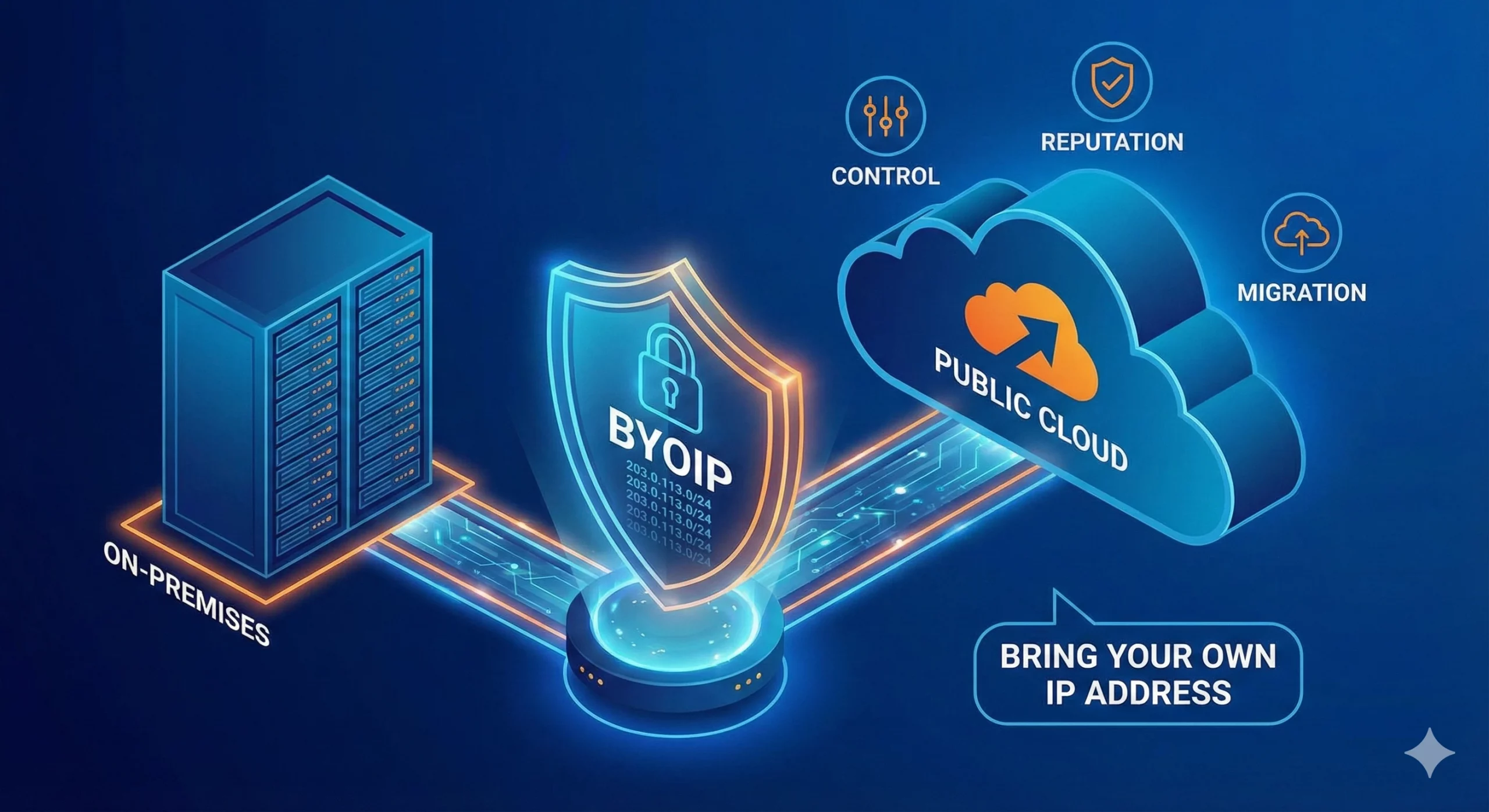
什么是BYOIP(自备IP地址)?
自带 IP(Bring Your Own IP,简称 BYOIP)是一种网络部署方式,允许企业将自己现有的公网 IP 地址段应用于云服务提供商、数据中心、内容分发网络(CDN)或其他基础设施平台。 企业无需使用服务提供商分配的新公网 IP 地址,而是可以使用自己已拥有或已获授权使用的 IPv4 或 IPv6 地址前缀。服务提供商会验证该组织对该地址段的使用权限,并在支持的情况下,通过其自身网络对该地址段进行路由公告(Advertise)。 BYOIP 有助于企业在迁移至云平台时保留现有的防火墙规则、白名单(Allowlists)、客户系统集成、IP 信誉(IP Reputation)、DNS 配置以及既有的网络身份。这不仅能够减少因更换 IP 地址而带来的业务中断,还能降低对服务提供商分配 IP 的依赖,使未来的基础设施迁移与扩展更加灵活且易于管理。 对于需要 BYOIP 地址资源的企业,可选择 购买 IPv4 地址(Buy IP),以获得长期控制权;如果更重视灵活性,也可采用 IPv4 租赁(IPv4 Leasing),按业务需求获取公网 IP 资源。 什么是BYOIP? BYOIP 是 Bring Your Own IP(自带 IP)的缩写。这是一种网络部署模式,允许组织将现有的公网 IP 地址段带入云服务提供商或其他基础设施平台使用。 在 BYOIP 模式下,组织仍然拥有或保留该 IP 地址段的使用权,而平台则获得授权,可在其基础设施中对该地址段进行路由公告(Advertise)和使用。随后,这些 IP 地址可分配给虚拟机(Virtual Machines)、负载均衡器(Load Balancers)、VPN 网关、内容分发服务(CDN)、安全平台以及公网应用程序端点等受支持的服务。 例如,一家企业将应用程序从本地数据中心迁移到云环境时,可能并不希望更换现有的公网 IP 地址。这些 IP 地址可能已经存在于客户白名单(Allowlists)、防火墙策略、DNS 记录、合作伙伴配置以及电子邮件信誉(Email Reputation)数据库中。 BYOIP 使企业能够在迁移工作负载的同时,继续使用原有的公网 IP 地址,从而保持更一致的网络身份,并减少因更换 IP 地址而带来的配置调整和业务影响。 Related Posts 什么是电信公司?电信运营商如何为英国、美国和加拿大提供网络连接支持? 电信公司(Telco Companies),也称为电信运营商(Telecommunications Companies),提供通信与网络连接服务。这些服务包括移动通信网络、宽带互联网、光纤连接、固定电话服务、企业网络连接、云连接、托管网络服务以及数据中心连接等。 对于普通消费者而言,电信公司通常被视为移动通信或宽带互联网服务提供商。对于企业来说,电信公司远不只是一个服务品牌,更是关键的基础设施合作伙伴,帮助企业连接办公室、数据中心、云平台、远程员工、客户应用程序以及各类数字化服务。 随着企业越来越依赖云平台、SaaS 应用、AI 工具、VPN、网络安全系统以及在线服务,电信公司已成为数字基础设施规划中不可或缺的重要组成部分。 电信公司是什么? 电信公司(Telco Companies)是提供电信服务的企业。这些服务让个人、设备、企业和各种系统能够跨越距离进行通信与连接。 一家电信公司可能提供以下服务: 移动通信服务 宽带互联网 光纤连接 固定电话服务 企业互联网接入 企业广域网(WAN)服务 云连接服务 数据中心连接 VPN TCP 与 UDP:IPv4 租赁和企业网络指南 TCP 和 UDP 是互联网中最重要的两种传输层协议。它们决定数据如何在设备、服务器、云平台、VPN 网关、DNS 解析器、电子邮件系统、流媒体平台以及企业应用程序之间传输。 对于企业而言,TCP 和 UDP 不仅仅是技术术语,它们会直接影响实际的基础设施性能。公网 IPv4 地址提供可从互联网访问的网络端点,而 TCP 和 UDP 则决定流量如何通过该端点进行传输。 这对于租用或购买 IPv4 地址的企业尤为重要。企业租用 IPv4 什么是区域互联网注册管理机构(RIR) 区域互联网注册管理机构(Regional Internet Registry, RIR)是负责在特定地理区域内分配和管理互联网编号资源的组织。这些资源主要包括 IP 地址(IPv4 和 IPv6)以及自治系统号(ASN),它们是支撑设备和网络在互联网上相互通信的关键要素。 如果没有一套组织完善的系统来分配唯一的 IP 地址和路由标识符,互联网便无法正常运转。RIR 确保这一过程在各自管辖的区域内保持公平、高效与一致,从而避免冲突,并提升互联网治理的透明度。 全球五大 RIR 目前全球共有五家获官方认可的 RIR,各自负责世界上特定的区域:AFRINIC – 非洲网络信息中心(非洲)APNIC – 亚太网络信息中心(亚太地区)ARIN .related-post {} .related-post .post-list { text-align: left; } .related-post .post-list .item { margin: 5px; padding: 10px; } .related-post .headline { font-size: 18px !important; color: #999999 !important; } .related-post .post-list .item .post_thumb { max-height: 220px; margin: 10px 0px; padding: 0px; display: block; } .related-post .post-list .item .post_title { font-size: 16px; color: #3f3f3f; margin: 10px 0px; padding: 0px; display: block; text-decoration: none; } .related-post .post-list .item .post_excerpt { font-size: 13px; color: #3f3f3f; margin: 10px 0px; padding: 0px; display: block; text-decoration: none; } @media only screen and (min-width: 1024px) { .related-post .post-list .item { width: 30%; } } @media only screen and (min-width: 768px) and (max-width: 1023px) { .related-post .post-list .item { width: 90%; } } @media only screen and (min-width: 0px) and (max-width: 767px) { .related-post .post-list .item { width: 90%; } }
