How Subnetting Impacts IP Allocation
 Stephanie
Table of Contents
Subnetting is a key concept in the field of IP network management. Understanding the way subnetting impacts IP allocation is helpful for optimising network performance. It is also helpful for improving network security.
- Subnetting enables people to use IP addresses in a more efficient way. It also enhances the security of the network.
- Proper subnetting can reduce the occurrence of network congestion. It can also make network management simpler.
Introduction to Subnetting and IP Allocation
Subnetting is a technique. This technique is used in the management of IP networks. Its main function is to divide a larger network into smaller sub-networks.
With this increasing demand, the efficient allocation of IP addresses has become a challenge that is getting more and more prominent. Subnetting provides a solution to this challenge. It allows network administrators to break down a single large network. Through this breakdown, multiple subnetworks are formed. This process of breaking down and forming multiple subnetworks can maximise the efficient use of the available IP addresses.
What is Subnetting?
In its simplest form, subnetting is a process. The core of this process is to divide an IP network into smaller segments. These smaller segments are given a specific name, which is subnets. This process of dividing involves a specific operation. The operation is to manipulate the network mask. The network mask is also known by another name, which is the subnet mask. The purpose of this manipulation is to control the way the available IP addresses are divided. This control ensures that IP addresses are allocated in a reasonable way.
A standard IP address consists of two key parts. The first part is called the network portion. The second part is called the host portion. The network portion has a specific function. It is used to identify the larger network that a device belongs to. Every device connected to the network is part of a larger network. The host portion also has its own function. It is used to identify the specific device within the larger network that the device is in. Each device in the network has a unique host portion to distinguish itself.
Subnetting will make a change to the default subnet mask. This change results in a more granular division of the network. The way subnetting achieves this is by borrowing bits. The bits are borrowed from the host portion of the IP address. After borrowing these bits, subnetting uses them to extend the network portion. This action of borrowing and extending leads to a result. The result is that multiple subnets are created. These multiple subnets are all within a single larger network. This kind of network structure has obvious advantages. It allows for better control over the allocation of IP addresses. At the same time, it enables the efficient use of the address space of the network.
How Subnetting Impacts IP Allocation
Maximising IP Address Usage
One of the main impacts that subnetting has on IP allocation is its ability. This ability is to maximise the use of the available IP addresses. If there is no subnetting, network administrators will face a possible problem. They may run out of available IP addresses within a given address range. Subnetting can solve this problem effectively. It allows for a better distribution of IP addresses. The distribution is carried out across different subnets. This distribution method ensures that each subnet has a certain number of IP addresses. The number of addresses is just right to meet the needs of the devices. These devices are connected to that particular subnet.
Subnetting allocates IP addresses in the form of smaller blocks. This method of allocation helps to ensure one important thing. It ensures that the address space of the network is used in a more efficient way. It also avoids a wasteful situation. The waste is the wastage of valuable IP addresses. Every IP address is valuable, so avoiding wastage is crucial.
Improved Network Performance
Subnetting also plays a crucial role in another aspect. This aspect is the improvement of network performance. Subnetting will segment a large network into smaller subnets. Because of this segmentation, the traffic in the network can be localised. The localisation is within each individual subnet. This localisation of traffic brings a positive effect. It reduces the congestion of the network. Devices that are within the same subnet usually have a certain communication pattern. They only need to communicate with other devices. These other devices are also in the same subnet. As a result of this communication pattern, broadcast traffic is limited. Broadcast traffic has a certain characteristic. It can consume a lot of network resources. Now, it is limited to specific subnets. It will not have an impact on the entire network. This is a great advantage for the smooth operation of the network.
Moreover, subnetting makes routing within a network simpler. Routers have a specific task in the network. They need to direct traffic to the correct destination. With subnetting, routers can complete this task more easily. They can direct traffic to the appropriate subnet accurately. This accurate direction of traffic brings two benefits. It reduces the latency of the network. It also improves the overall efficiency of the network. Network administrators have an important task. They need to carefully plan two aspects of each subnet. The first aspect is the size of the subnet. The second aspect is the structure of the subnet. By doing this careful planning, they can ensure that the network operates in an optimal state.
Enhanced Security
Subnetting has the ability to enhance the security of the network. It achieves this enhancement through a specific way. It creates logical boundaries. These logical boundaries are between different parts of the network. For instance, there is a common scenario in network management. Some specific devices or services may need to be isolated. They are isolated into their own dedicated subnets. In this scenario, a positive security effect is achieved. It becomes much harder for potential attackers. They find it difficult to gain access to other areas of the network. This kind of segmentation has a key role in security. It helps to prevent the lateral movement of threats. When a security breach occurs, it can limit the scope of damage. This limitation of damage is very important for reducing losses caused by security incidents.
Network administrators can make use of subnetting. They use it to create separate subnets. These subnets are designed for different departments or different user groups. After creating these subnets, administrators can take another important step. They can apply specific security policies. These security policies are not universal. They are tailored to the specific needs of each subnet. This level of customisation of security policies has a significant effect. It strengthens the overall security of the network. It also makes two important security tasks easier. The first task is to detect threats in the network. The second task is to mitigate the impact of threats.
Simplified Network Management
Managing a large network is quite daunting. But subnetting changes this situation. It makes the management of large networks more manageable. The way it does this is by dividing the large network. The division results in smaller subnets. These smaller subnets are easier to manage. Each subnet can be managed independently. Each subnet has its own set of devices. These devices are unique to that subnet. Each subnet also has its own configurations. The configurations are set according to the needs of the subnet. Besides, each subnet has its own security measures. These security measures are designed to protect the subnet. This kind of decentralised management has a clear advantage. It simplifies the process of troubleshooting. When a problem occurs in the network, it can often be isolated. The isolation is to a specific subnet. It will not have an impact on the entire network. This reduces the difficulty of solving problems.
Moreover, subnetting provides better visibility of network usage. It also provides better control over network usage. Network administrators have a specific job. They can monitor the traffic within each subnet. They can also monitor the usage of devices within each subnet. By doing this monitoring, they can achieve a goal. They can identify bottlenecks in the network more easily. They can also identify performance issues more easily. This ability to identify problems quickly ensures that the network operates at its peak efficiency.
Key Considerations When Subnetting for IP Allocation
When network administrators are planning a subnetting strategy, they have a responsibility. Different types of traffic have different requirements for network resources. The third factor is the required level of security. Different subnets may need different security levels based on their purpose.
To ensure that subnetting can have the desired effect on IP allocation, there is an important starting point. It is important to start with a clear understanding. The understanding is of the network’s needs. Every network has unique needs that must be considered. For instance, there are different scenarios in network deployment. A small subnet might be sufficient for a certain situation. This situation could be a local office or a single department. However, a larger subnet might be needed for another situation. This situation could be a data centre or a corporate campus. These different scenarios require different subnet sizes.
Careful calculation of the size of each subnet is essential. This calculation has a specific purpose. It is to avoid two undesirable situations. The first situation is over-allocation. Over-allocation leads to a problem. It leads to the wastage of IP addresses. The second situation is under-allocation. Under-allocation also leads to problems. It can lead to network congestion. It can also lead to a lack of available IP addresses when needed. Network administrators have another important consideration.
Common Subnetting Mistakes
Incorrect Subnet Size: Choosing a subnet size unsuitable is a common mistake. This is one of the most common mistakes that occur when subnetting. This mistake can lead to two negative consequences. The first consequence is the wastage of IP addresses. The second consequence is insufficient capacity for the devices that need to connect to the subnet.
Not Considering Future Growth: Failing to take future growth into account is another mistake. This mistake happens when planning a subnetting scheme. This mistake can lead to a serious problem. It can lead to address exhaustion. Address exhaustion means there are no more available IP addresses to allocate. Network administrators have a responsibility. They should ensure that the subnetting strategy they design has a certain property. It is scalable. Scalability means the strategy can adapt to the growth of the network.
Overcomplicating Subnetting: Subnetting is a tool that has great power in network management. But it can have a problem if not handled properly. It can become overly complex. This complexity arises when the subnetting plan is not made carefully. Network administrators have a goal they should aim for. They should keep the structure of the subnetting simple. They should also keep it intuitive. The reason for this is to avoid two issues. The first issue is confusion among the staff who manage the network. The second issue is mistakes that may occur during network operations.
Lack of Documentation: Proper documentation of the subnetting strategy is something that is essential. It is essential for the ongoing management of the network. Without clear records, there will be problems. The records should show how subnets are allocated. Without these records, troubleshooting network issues becomes difficult. Making future changes to the network also becomes difficult and time-consuming. This can delay the progress of network maintenance and upgrades.
Trusted IPv4 Leasing for Business Growth
Get enterprise-grade IPv4 space quickly, with seamless deployment and end-to-end management.
Get Started with i.leaseFAQs
What is subnetting in IP address allocation?
Subnetting is a specific process in the field of IP address management. This process focuses on a key operation. The operation is to divide a larger IP network into smaller parts. These smaller parts of the IP network have a dedicated name. They are called subnets. Each subnet operates as an independent small network. The process of subnetting has clear purposes. The first purpose is to optimise the usage of IP addresses. It ensures that each IP address is used in a reasonable way. No unnecessary wastage of IP addresses occurs. The second purpose is to improve the management of the overall network. It makes the daily management work of the network easier to carry out. Administrators can focus on each subnet independently. This reduces the difficulty of managing a large and complex network.
How does subnetting impact network performance?
Subnetting has a positive impact on the performance of the network. It helps to improve the network’s performance effectively. It achieves this improvement through three main actions. The first action is to reduce network congestion.
Can subnetting improve our network security?
Yes, It has a clear effect on improving network security. It achieves this enhancement through a specific method. The method is to isolate different segments of the network. Each segment becomes an independent subnet. There are boundaries between these subnets. These boundaries prevent unauthorised access between subnets. This isolation brings an important security benefit.
What are key mistakes to avoid in subnetting?
The first mistake is choosing subnet sizes that are incorrect. There are two situations of incorrect subnet sizes.
How does it work with IPv6?
IPV6 has a clear advantage over IPv4. It provides a pool of addresses that is much larger than that of IPv4. The number of IPv6 addresses is almost unlimited. It can meet the needs of a large number of devices connecting to the network. But even so, subnetting can still be used in IPv6 networks. It is not useless because of the large number of IPv6 addresses. Subnetting is used in IPv6 networks for four main purposes. The first purpose is to segment the network. Even with many addresses, a large and unsegmented network is difficult to manage. Subnetting splits the IPv6 network into small subnets.
相关文章

什么是电信公司?电信运营商如何为英国、美国和加拿大提供网络连接支持?
电信公司(Telco Companies),也称为电信运营商(Telecommunications Companies),提供通信与网络连接服务。这些服务包括移动通信网络、宽带互联网、光纤连接、固定电话服务、企业网络连接、云连接、托管网络服务以及数据中心连接等。 对于普通消费者而言,电信公司通常被视为移动通信或宽带互联网服务提供商。对于企业来说,电信公司远不只是一个服务品牌,更是关键的基础设施合作伙伴,帮助企业连接办公室、数据中心、云平台、远程员工、客户应用程序以及各类数字化服务。 随着企业越来越依赖云平台、SaaS 应用、AI 工具、VPN、网络安全系统以及在线服务,电信公司已成为数字基础设施规划中不可或缺的重要组成部分。 电信公司是什么? 电信公司(Telco Companies)是提供电信服务的企业。这些服务让个人、设备、企业和各种系统能够跨越距离进行通信与连接。 一家电信公司可能提供以下服务: 移动通信服务 宽带互联网 光纤连接 固定电话服务 企业互联网接入 企业广域网(WAN)服务 云连接服务 数据中心连接 VPN 服务 托管网络解决方案 互联网传输(Internet Transit) 电信批发服务 部分电信公司拥有并运营大规模的实体网络基础设施;另一些则通过批发接入、租用基础设施或与网络运营商合作来提供电信服务。 电信公司提供哪些服务? 电信公司同时为个人消费者和企业客户提供服务。 面向消费者的服务通常包括移动通信套餐、家庭宽带、光纤互联网、固定电话以及通信组合套餐。 面向企业的服务则可能包括专线互联网接入、企业光纤、专用网络、云连接、托管安全服务、数据中心连接、物联网(IoT)连接以及企业移动通信方案。 对于大型企业客户,电信公司还可提供: 多地点办公室网络连接 远程员工接入 私有云连接 SD-WAN(软件定义广域网) 灾难恢复连接 低延迟网络路由 互联网传输(Internet Transit) 网络监控 托管防火墙服务 正因如此,电信公司不仅对日常通信至关重要,也是现代企业建设先进数字基础设施的重要支柱。 电信公司 vs 互联网服务提供商 vs 网络运营商 电信公司(Telco)、互联网服务提供商(ISP)和网络运营商(Network Operator)之间可能存在重叠,但它们并不完全相同。 电信公司提供电信服务。 互联网服务提供商(ISP)提供互联网接入服务。 网络运营商负责建设、运营和管理网络基础设施。 一些大型电信公司同时承担这三种角色。它们拥有基础设施、运营网络,并向市场提供互联网、移动通信以及企业网络服务。 规模较小的服务提供商则可能专注于其中某一层。例如,互联网服务提供商(ISP)可以销售宽带服务,而无需拥有所有实体网络基础设施;网络运营商可能负责建设和运营光纤网络,并向电信公司或 ISP 提供批发网络接入;电信公司则可能结合自有网络与合作伙伴网络,为客户提供移动通信和企业服务。 对于企业而言,理解这些区别非常重要,因为服务质量不仅取决于销售该方案的品牌,还受到其底层网络、路由设计、网络覆盖范围以及技术支持体系等因素的影响。 为什么电信公司对企业至关重要 电信公司之所以重要,是因为几乎所有现代企业都依赖稳定的网络连接。 企业可能需要电信服务来支持: 办公室互联网接入 移动网络连接 远程办公 客户支持系统 云应用程序 SaaS 平台 支付系统 VPNRead more Related Posts 什么是电信公司?电信运营商如何为英国、美国和加拿大提供网络连接支持? 电信公司(Telco Companies),也称为电信运营商(Telecommunications Companies),提供通信与网络连接服务。这些服务包括移动通信网络、宽带互联网、光纤连接、固定电话服务、企业网络连接、云连接、托管网络服务以及数据中心连接等。 对于普通消费者而言,电信公司通常被视为移动通信或宽带互联网服务提供商。对于企业来说,电信公司远不只是一个服务品牌,更是关键的基础设施合作伙伴,帮助企业连接办公室、数据中心、云平台、远程员工、客户应用程序以及各类数字化服务。 随着企业越来越依赖云平台、SaaS 应用、AI 工具、VPN、网络安全系统以及在线服务,电信公司已成为数字基础设施规划中不可或缺的重要组成部分。 电信公司是什么? 电信公司(Telco Companies)是提供电信服务的企业。这些服务让个人、设备、企业和各种系统能够跨越距离进行通信与连接。 一家电信公司可能提供以下服务: 移动通信服务 宽带互联网 光纤连接 固定电话服务 企业互联网接入 企业广域网(WAN)服务 云连接服务 数据中心连接 VPN TCP 与 UDP:IPv4 租赁和企业网络指南 TCP 和 UDP 是互联网中最重要的两种传输层协议。它们决定数据如何在设备、服务器、云平台、VPN 网关、DNS 解析器、电子邮件系统、流媒体平台以及企业应用程序之间传输。 对于企业而言,TCP 和 UDP 不仅仅是技术术语,它们会直接影响实际的基础设施性能。公网 IPv4 地址提供可从互联网访问的网络端点,而 TCP 和 UDP 则决定流量如何通过该端点进行传输。 这对于租用或购买 IPv4 地址的企业尤为重要。企业租用 IPv4 什么是区域互联网注册管理机构(RIR) 区域互联网注册管理机构(Regional Internet Registry, RIR)是负责在特定地理区域内分配和管理互联网编号资源的组织。这些资源主要包括 IP 地址(IPv4 和 IPv6)以及自治系统号(ASN),它们是支撑设备和网络在互联网上相互通信的关键要素。 如果没有一套组织完善的系统来分配唯一的 IP 地址和路由标识符,互联网便无法正常运转。RIR 确保这一过程在各自管辖的区域内保持公平、高效与一致,从而避免冲突,并提升互联网治理的透明度。 全球五大 RIR 目前全球共有五家获官方认可的 RIR,各自负责世界上特定的区域:AFRINIC – 非洲网络信息中心(非洲)APNIC – 亚太网络信息中心(亚太地区)ARIN .related-post {} .related-post .post-list { text-align: left; } .related-post .post-list .item { margin: 5px; padding: 10px; } .related-post .headline { font-size: 18px !important; color: #999999 !important; } .related-post .post-list .item .post_thumb { max-height: 220px; margin: 10px 0px; padding: 0px; display: block; } .related-post .post-list .item .post_title { font-size: 16px; color: #3f3f3f; margin: 10px 0px; padding: 0px; display: block; text-decoration: none; } .related-post .post-list .item .post_excerpt { font-size: 13px; color: #3f3f3f; margin: 10px 0px; padding: 0px; display: block; text-decoration: none; } @media only screen and (min-width: 1024px) { .related-post .post-list .item { width: 30%; } } @media only screen and (min-width: 768px) and (max-width: 1023px) { .related-post .post-list .item { width: 90%; } } @media only screen and (min-width: 0px) and (max-width: 767px) { .related-post .post-list .item { width: 90%; } }
TCP 与 UDP:IPv4 租赁和企业网络指南
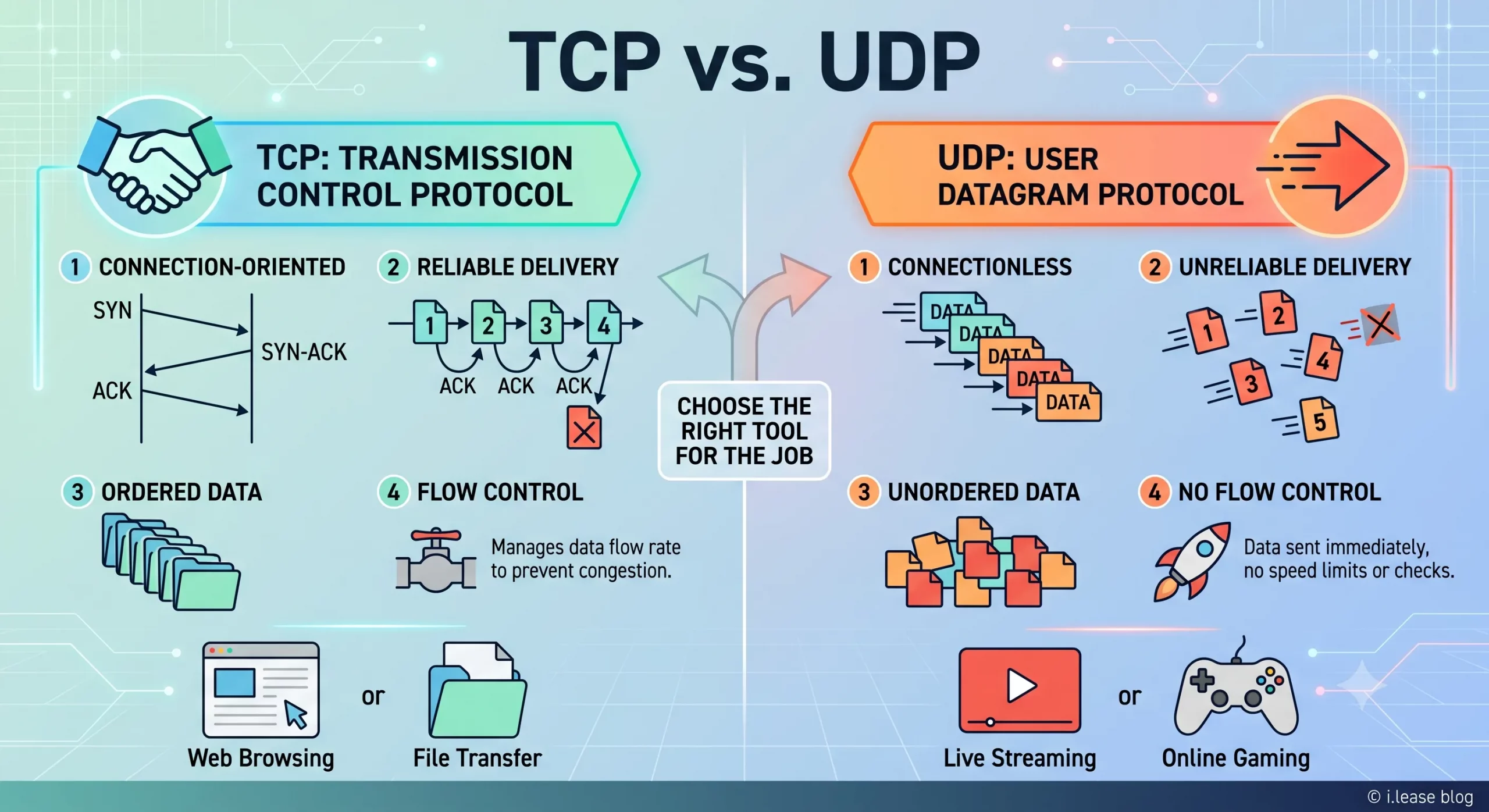
TCP 和 UDP 是互联网中最重要的两种传输层协议。它们决定数据如何在设备、服务器、云平台、VPN 网关、DNS 解析器、电子邮件系统、流媒体平台以及企业应用程序之间传输。 对于企业而言,TCP 和 UDP 不仅仅是技术术语,它们会直接影响实际的基础设施性能。公网 IPv4 地址提供可从互联网访问的网络端点,而 TCP 和 UDP 则决定流量如何通过该端点进行传输。 这对于租用或购买 IPv4 地址的企业尤为重要。企业租用 IPv4 地址并不是单纯为了持有这些地址,而是为了运行网站、API、VPN 隧道、DNS 服务、电子邮件平台、SaaS 应用程序、游戏服务器、流媒体系统、安全工具以及云端工作负载。不同类型的服务决定了需要使用 TCP、UDP,还是同时使用两者。 通过 i.lease,企业可以使用 IPv4 租赁服务获取用于实际网络部署的公网 IPv4 资源。需要长期控制 IP 地址资源的企业也可以购买 IP 地址,而拥有闲置 IPv4 资源的组织则可以出售 IP 地址。 TCP和UDP是什么? TCP 和 UDP 都是传输层协议。它们位于 IP 协议之上,帮助应用程序通过网络发送和接收数据。 IP 地址用于确定流量应该发送到哪里,而 TCP 和 UDP 则决定这些流量如何进行传输。 简单来说: TCP 适用于重视可靠性和按顺序传输数据的场景。 UDP 适用于重视速度、低延迟和轻量化数据传输的场景。 企业可能会使用同一个公网 IPv4 地址来运行不同的服务,但每项服务可能依赖不同的传输协议。例如,网站可能使用 TCP,VPN 网关可能使用 UDP,DNS 解析器可能同时使用 UDP 和 TCP,而游戏服务器则可能更倾向于使用 UDP,因为对于实时游戏而言,延迟造成的影响通常比少量数据包丢失更加明显。 因此,TCPRead more Related Posts 什么是电信公司?电信运营商如何为英国、美国和加拿大提供网络连接支持? 电信公司(Telco Companies),也称为电信运营商(Telecommunications Companies),提供通信与网络连接服务。这些服务包括移动通信网络、宽带互联网、光纤连接、固定电话服务、企业网络连接、云连接、托管网络服务以及数据中心连接等。 对于普通消费者而言,电信公司通常被视为移动通信或宽带互联网服务提供商。对于企业来说,电信公司远不只是一个服务品牌,更是关键的基础设施合作伙伴,帮助企业连接办公室、数据中心、云平台、远程员工、客户应用程序以及各类数字化服务。 随着企业越来越依赖云平台、SaaS 应用、AI 工具、VPN、网络安全系统以及在线服务,电信公司已成为数字基础设施规划中不可或缺的重要组成部分。 电信公司是什么? 电信公司(Telco Companies)是提供电信服务的企业。这些服务让个人、设备、企业和各种系统能够跨越距离进行通信与连接。 一家电信公司可能提供以下服务: 移动通信服务 宽带互联网 光纤连接 固定电话服务 企业互联网接入 企业广域网(WAN)服务 云连接服务 数据中心连接 VPN TCP 与 UDP:IPv4 租赁和企业网络指南 TCP 和 UDP 是互联网中最重要的两种传输层协议。它们决定数据如何在设备、服务器、云平台、VPN 网关、DNS 解析器、电子邮件系统、流媒体平台以及企业应用程序之间传输。 对于企业而言,TCP 和 UDP 不仅仅是技术术语,它们会直接影响实际的基础设施性能。公网 IPv4 地址提供可从互联网访问的网络端点,而 TCP 和 UDP 则决定流量如何通过该端点进行传输。 这对于租用或购买 IPv4 地址的企业尤为重要。企业租用 IPv4 什么是区域互联网注册管理机构(RIR) 区域互联网注册管理机构(Regional Internet Registry, RIR)是负责在特定地理区域内分配和管理互联网编号资源的组织。这些资源主要包括 IP 地址(IPv4 和 IPv6)以及自治系统号(ASN),它们是支撑设备和网络在互联网上相互通信的关键要素。 如果没有一套组织完善的系统来分配唯一的 IP 地址和路由标识符,互联网便无法正常运转。RIR 确保这一过程在各自管辖的区域内保持公平、高效与一致,从而避免冲突,并提升互联网治理的透明度。 全球五大 RIR 目前全球共有五家获官方认可的 RIR,各自负责世界上特定的区域:AFRINIC – 非洲网络信息中心(非洲)APNIC – 亚太网络信息中心(亚太地区)ARIN .related-post {} .related-post .post-list { text-align: left; } .related-post .post-list .item { margin: 5px; padding: 10px; } .related-post .headline { font-size: 18px !important; color: #999999 !important; } .related-post .post-list .item .post_thumb { max-height: 220px; margin: 10px 0px; padding: 0px; display: block; } .related-post .post-list .item .post_title { font-size: 16px; color: #3f3f3f; margin: 10px 0px; padding: 0px; display: block; text-decoration: none; } .related-post .post-list .item .post_excerpt { font-size: 13px; color: #3f3f3f; margin: 10px 0px; padding: 0px; display: block; text-decoration: none; } @media only screen and (min-width: 1024px) { .related-post .post-list .item { width: 30%; } } @media only screen and (min-width: 768px) and (max-width: 1023px) { .related-post .post-list .item { width: 90%; } } @media only screen and (min-width: 0px) and (max-width: 767px) { .related-post .post-list .item { width: 90%; } }
什么是BYOIP(自备IP地址)?
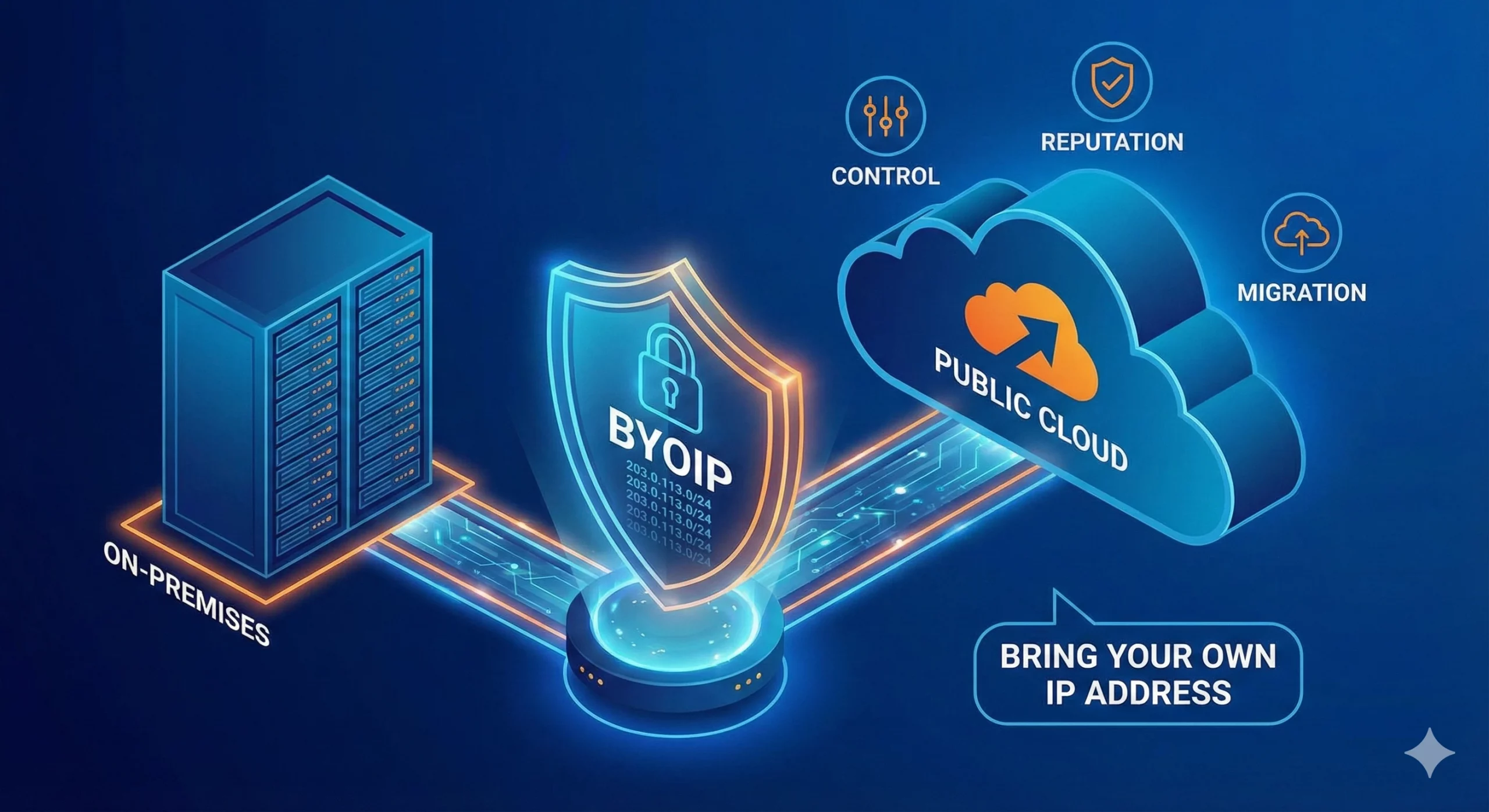
自带 IP(Bring Your Own IP,简称 BYOIP)是一种网络部署方式,允许企业将自己现有的公网 IP 地址段应用于云服务提供商、数据中心、内容分发网络(CDN)或其他基础设施平台。 企业无需使用服务提供商分配的新公网 IP 地址,而是可以使用自己已拥有或已获授权使用的 IPv4 或 IPv6 地址前缀。服务提供商会验证该组织对该地址段的使用权限,并在支持的情况下,通过其自身网络对该地址段进行路由公告(Advertise)。 BYOIP 有助于企业在迁移至云平台时保留现有的防火墙规则、白名单(Allowlists)、客户系统集成、IP 信誉(IP Reputation)、DNS 配置以及既有的网络身份。这不仅能够减少因更换 IP 地址而带来的业务中断,还能降低对服务提供商分配 IP 的依赖,使未来的基础设施迁移与扩展更加灵活且易于管理。 对于需要 BYOIP 地址资源的企业,可选择 购买 IPv4 地址(Buy IP),以获得长期控制权;如果更重视灵活性,也可采用 IPv4 租赁(IPv4 Leasing),按业务需求获取公网 IP 资源。 什么是BYOIP? BYOIP 是 Bring Your Own IP(自带 IP)的缩写。这是一种网络部署模式,允许组织将现有的公网 IP 地址段带入云服务提供商或其他基础设施平台使用。 在 BYOIP 模式下,组织仍然拥有或保留该 IP 地址段的使用权,而平台则获得授权,可在其基础设施中对该地址段进行路由公告(Advertise)和使用。随后,这些 IP 地址可分配给虚拟机(Virtual Machines)、负载均衡器(Load Balancers)、VPN 网关、内容分发服务(CDN)、安全平台以及公网应用程序端点等受支持的服务。 例如,一家企业将应用程序从本地数据中心迁移到云环境时,可能并不希望更换现有的公网 IP 地址。这些 IP 地址可能已经存在于客户白名单(Allowlists)、防火墙策略、DNS 记录、合作伙伴配置以及电子邮件信誉(Email Reputation)数据库中。 BYOIP 使企业能够在迁移工作负载的同时,继续使用原有的公网 IP 地址,从而保持更一致的网络身份,并减少因更换 IP 地址而带来的配置调整和业务影响。 Related Posts 什么是电信公司?电信运营商如何为英国、美国和加拿大提供网络连接支持? 电信公司(Telco Companies),也称为电信运营商(Telecommunications Companies),提供通信与网络连接服务。这些服务包括移动通信网络、宽带互联网、光纤连接、固定电话服务、企业网络连接、云连接、托管网络服务以及数据中心连接等。 对于普通消费者而言,电信公司通常被视为移动通信或宽带互联网服务提供商。对于企业来说,电信公司远不只是一个服务品牌,更是关键的基础设施合作伙伴,帮助企业连接办公室、数据中心、云平台、远程员工、客户应用程序以及各类数字化服务。 随着企业越来越依赖云平台、SaaS 应用、AI 工具、VPN、网络安全系统以及在线服务,电信公司已成为数字基础设施规划中不可或缺的重要组成部分。 电信公司是什么? 电信公司(Telco Companies)是提供电信服务的企业。这些服务让个人、设备、企业和各种系统能够跨越距离进行通信与连接。 一家电信公司可能提供以下服务: 移动通信服务 宽带互联网 光纤连接 固定电话服务 企业互联网接入 企业广域网(WAN)服务 云连接服务 数据中心连接 VPN TCP 与 UDP:IPv4 租赁和企业网络指南 TCP 和 UDP 是互联网中最重要的两种传输层协议。它们决定数据如何在设备、服务器、云平台、VPN 网关、DNS 解析器、电子邮件系统、流媒体平台以及企业应用程序之间传输。 对于企业而言,TCP 和 UDP 不仅仅是技术术语,它们会直接影响实际的基础设施性能。公网 IPv4 地址提供可从互联网访问的网络端点,而 TCP 和 UDP 则决定流量如何通过该端点进行传输。 这对于租用或购买 IPv4 地址的企业尤为重要。企业租用 IPv4 什么是区域互联网注册管理机构(RIR) 区域互联网注册管理机构(Regional Internet Registry, RIR)是负责在特定地理区域内分配和管理互联网编号资源的组织。这些资源主要包括 IP 地址(IPv4 和 IPv6)以及自治系统号(ASN),它们是支撑设备和网络在互联网上相互通信的关键要素。 如果没有一套组织完善的系统来分配唯一的 IP 地址和路由标识符,互联网便无法正常运转。RIR 确保这一过程在各自管辖的区域内保持公平、高效与一致,从而避免冲突,并提升互联网治理的透明度。 全球五大 RIR 目前全球共有五家获官方认可的 RIR,各自负责世界上特定的区域:AFRINIC – 非洲网络信息中心(非洲)APNIC – 亚太网络信息中心(亚太地区)ARIN .related-post {} .related-post .post-list { text-align: left; } .related-post .post-list .item { margin: 5px; padding: 10px; } .related-post .headline { font-size: 18px !important; color: #999999 !important; } .related-post .post-list .item .post_thumb { max-height: 220px; margin: 10px 0px; padding: 0px; display: block; } .related-post .post-list .item .post_title { font-size: 16px; color: #3f3f3f; margin: 10px 0px; padding: 0px; display: block; text-decoration: none; } .related-post .post-list .item .post_excerpt { font-size: 13px; color: #3f3f3f; margin: 10px 0px; padding: 0px; display: block; text-decoration: none; } @media only screen and (min-width: 1024px) { .related-post .post-list .item { width: 30%; } } @media only screen and (min-width: 768px) and (max-width: 1023px) { .related-post .post-list .item { width: 90%; } } @media only screen and (min-width: 0px) and (max-width: 767px) { .related-post .post-list .item { width: 90%; } }
