How Mismanagement of IP Allocation Impacts Network Security
 Stephanie
The Roots of Poor IP Allocation and Its Security Risks
Table of Contents
Every device on a network needs an IP address. The address is like a house number. It shows where data should go. When addresses are managed well, the network stays safe and works fast. When they are managed badly, many problems can happen. Poor IP allocation means the addresses are given, tracked, or used in the wrong way. This can cause confusion and open many holes for attackers.
Some networks have unused IP addresses. These are still active but not assigned to any device. Attackers can find them and take control. They can use them for spam or data theft. When no one watches these addresses, they become easy to misuse. Some attackers hide behind them and make their traffic look normal. These “ghost” addresses often appear in DDoS attacks or botnets. Many old systems never check if their IP blocks are still in use, so attackers use that space freely.
Another problem happens when two devices use the same IP. This is called a conflict. When this happens, data can go to the wrong place. Sometimes, routers cannot decide which device to send data to. The result is lost data or slow connections. In some cases, an attacker can create fake conflicts on purpose. This lets them take over traffic and see private data. Simple mistakes in assignment can turn into big risks.
Reused addresses also cause trouble. When an old address is given to a new device, the new user can get access to data left behind. Some services or logs may still trust that IP. This can lead to privacy leaks or unauthorised access. Bad IP histories can also cause reputation problems. A company may receive an IP that was used before for spam. The new owner can then find that its emails are blocked.
Dynamic IP allocation is common in modern networks. It gives out addresses automatically. But when this process is not managed well, it can break security. Some systems change IPs too often. Some do not record which user had an IP at what time. Attackers use this to hide their activity. They switch IPs quickly and confuse tracking systems. In cloud networks, this risk is even higher. A user can get an IP that another user just used. If the first one left open ports or tokens, the next one can find them.
In large companies, poor coordination makes the problem worse. One team might assign addresses manually. Another team might use automated tools. When records do not match, gaps appear. Attackers can look for these gaps to enter the network. A single wrong record can lead to serious breaches. When systems use both IPv4 and IPv6, the chance of confusion grows even more. Some teams may forget to track both versions.
Old records are another weak point. Some organisations never update their IP lists. Devices that no longer exist still have entries. This creates “dead” addresses that stay reachable from outside. Attackers scan and use them for secret channels. A forgotten printer or old test server can become an open door into a secure system.Each small mistake in allocation can connect with others. One error can lead to many others. A single forgotten block or wrong entry can break the structure of a whole network. So, mismanagement of IP allocation is not just a technical problem. It is a security issue that affects every level of operation.
Each small mistake in allocation can connect with others. One error can lead to many others. A single forgotten block or wrong entry can break the structure of a whole network. So, mismanagement of IP allocation is not just a technical problem. It is a security issue that affects every level of operation.
The Effect of Poor Allocation on Access Control and Protection
Access control systems depend on clear address data. Firewalls, routers, and monitoring tools use IP addresses to decide who can enter and who cannot. When allocation is wrong, these systems can no longer tell friend from enemy. The result is weaker security and more space for attackers.
If an IP address is reused by another user, it can still have permissions from the old one. Firewalls may still think it is trusted. Attackers can use that IP to reach internal data. In some companies, security rules are based only on IP ranges. If a new user receives an address in that range, they can reach parts of the network that should be blocked. This simple mistake can lead to leaks or stolen information.
Audit logs also depend on IPs. Every connection has a source and a destination. If the same IP is used by many devices, it becomes hard to know which one made a connection. Logs then lose value. Security teams cannot find who caused a problem. Attackers often take advantage of this. They use shared or dynamic IPs to hide in normal traffic.
When IP allocation is messy, intrusion detection systems become less useful. These systems watch for strange activity based on IP patterns. If records are outdated, the system might miss signs of attack. It might also mark safe traffic as dangerous. This wastes time and weakens trust in security alerts.
In shared environments like cloud systems, the risk is higher. Tenants often use private address ranges that overlap with others. If the provider does not manage these ranges carefully, one tenant’s traffic can cross into another’s space. Attackers can use this to spy or inject code. A simple overlap in addresses can cause serious leaks. When allocation systems fail to isolate each tenant, the whole infrastructure becomes weak.
Routing errors also happen when allocation data is wrong. Routers send packets based on IP routes. If records are incorrect, data may go to the wrong place. Attackers can use false routes to capture or redirect data. This is called route hijacking. It can happen when address ownership is not verified. In some cases, an entire IP block has been hijacked because no one checked the allocation records.
Poor IP allocation also affects external reputation. Many spam filters and security systems track bad IPs. If a company reuses an address that had bad behaviour before, its traffic might be blocked. Emails might never reach customers. Legitimate business activity can suffer. So, allocation mistakes harm not only safety but also normal operations.Access control depends on trust. IP addresses are one part of that trust. When they are wrong, the whole chain of control breaks. A simple database error can make the firewall blind. A wrong log entry can hide an attack. This shows that IP allocation is not just an administrative job. It is part of the core of network defence.
How Attackers Exploit Allocation Mistakes
Attackers look for simple errors. They do not always need complex tools. A small mistake in IP allocation can give them a way in. When a network has bad records or unmonitored blocks, it becomes an easy target.
One common method is IP hijacking. When a block of IPs is not used or not recorded properly, attackers can announce it through the Border Gateway Protocol. Routers believe them and send traffic to the attacker. This can let the attacker see, change, or drop data. Many cases of hijacking start from poor record management. If ownership records were up to date, hijacks would be harder.
Another trick is abusing unused addresses. Attackers scan networks to find IPs that do not respond. Then they use them to send traffic or hide command-and-control servers. Since those IPs seem empty, monitoring tools often ignore them. This gives attackers a safe zone to act from. When an organisation has many unused or untracked IPs, the risk grows fast.
Attackers also use spoofing. They make a packet look like it comes from another address. If IP management is weak, it is hard to verify which IPs are real. Spoofing helps attackers bypass simple filters or firewalls. They can attack while looking like a trusted device.
Some attackers use scanning attacks. They look for gaps in address blocks, open ports, or weak devices. When address allocation is random or not grouped, scanning becomes easier. Attackers map out the whole range and plan their attack. When allocation is structured and monitored, scanning becomes slower and harder.
In shared networks, attackers can also exploit cross-tenant weaknesses. If two users share overlapping IPs, one can reach the other’s systems. This happens when cloud providers reuse address pools without full cleanup. The first tenant might leave credentials or data behind. The next one can find and use them.
Attackers also use address reuse delays. When an IP is released but not cleaned, old data like DNS records or session tokens may still point to it. The next user can receive traffic meant for the old one. If the old user had login sessions open, attackers can take control.
Poor allocation also helps botnets grow. Attackers register many fake devices with different IPs. If the system does not check the source or range, it accepts them. When addresses are poorly tracked, blocking these bots becomes almost impossible. A single infected device can use hundreds of fake IPs through mismanaged pools.Attackers like confusion. They look for systems that are too large to track each address. When logs are missing or outdated, they can act without being seen. A strong firewall cannot help if the IP records behind it are wrong. Mismanagement gives attackers the time and cover they need to work freely.
How Better Allocation Can Strengthen Security
Good IP management can stop many attacks before they start. It does not need expensive tools. It needs clear rules, accurate records, and constant checks. A network is only as strong as its foundation. IP allocation is part of that foundation.
Each organisation should use a central IP Address Management system. It keeps all address data in one place. It shows which device uses which IP and when it was assigned. It can send alerts when something changes. This helps detect misuse early. It also helps avoid conflicts and gaps.
Administrators should remove or recover idle addresses. If a device no longer needs an IP, it should be released. Idle addresses attract attackers. Regular scans can find them. Once found, they can be marked, blocked, or reassigned. This simple rule can close many security holes.
Dividing address pools helps too. Each department or service should have its own range. Networks should not overlap. Cloud providers should give each customer a separate subnet. When parts are isolated, a problem in one area cannot spread to others. Segmentation also makes it easier to track traffic and detect strange activity.
Clear rules for assigning IPs are important. Each request should be reviewed. The reason for using a new IP should be recorded. When a device is removed, its address should be cleaned from all systems. A short delay between use and release helps avoid reuse problems.
Monitoring and logging must run all the time. A good monitoring system shows which IPs send or receive data. It warns if a new device starts using an old address. Logs should include time, user, and purpose for each change. When an attack happens, these records show what went wrong.
Networks should also prepare for IPv6. IPv6 gives more addresses. It helps reduce sharing and reuse problems. But it still needs the same care. Bad IPv6 management can create the same risks. Dual stack systems that use IPv4 and IPv6 at the same time must have strong tracking for both.
Administrators should keep ownership data public and updated. Tools like WHOIS help others check who owns an address. When this data is old, hijacks are easier. When it is correct, other networks can verify routes faster. This helps stop fraud and spoofing.
Security also improves when companies train their teams. Staff must know how IPs are used, how to assign them safely, and how to find mistakes. Training prevents human errors. Even simple awareness sessions can make a big difference.
Large networks should also test their allocation plans. They can simulate what happens when an IP conflict appears. They can see how the monitoring system reacts. Testing shows where the weak points are before real attacks happen.Good allocation is not only about saving addresses. It is also about trust. When every IP is known and tracked, attackers have no place to hide. The network runs smoothly, and the security tools work better. Each correct record makes the whole system stronger.
Regional Internet Registries: the guardians of allocation
The official body parts in the position of transferring and maintaining IPv4 address space within established geographic areas are regional internet registries. When it comes to transferring IPv4 address blocks, the five her primary source RIRs—APNIC (Asia Pacific), LACNIC (Latin America and the Caribbean), RIPE NCC (Europe, Middle East, Central Asia), AFRINIC (Africa), and ARIN (North America)—each enforce their own policies and procedures. When both parties are under the same RIR, as arises when two European companies transfer an address block within RIPE NCC, this is designated as an intra-RIR transfer.
On the flip side, inter-RIR transfers encompasses cross-registry transfers, such as those from ARIN to RIPE NCC, and demand that both RIRs support individuals and adhere to compatible policies. With solely the receiving RIR’s acceptance, intra-RIR transfers typically happen simpler and quicker. Inter-RIR transfers have more complicated and time-consuming since both source and destination registries have to perform verification, enforce documentation requirements, and guarantee that they adhere to local rules and regulations.Within ARIN, for instance, transfers require an Online account, proper organisational identifiers, signed agreements, processing fees and completion within specific windows of time.
Though thorough and secure, RIR transfers demand administrative effort, policy compliance, and in some cases justification of need. That level of complexity, fuelled by regional nuance and documentation, stimulates demand for intermediaries who can navigate the system more efficiently.
Trusted IPv4 Leasing for Business Growth
Get enterprise-grade IPv4 space quickly, with seamless deployment and end-to-end management.
Get Started with i.leaseFAQs
What problems show that IP allocation is mismanaged?
When networks have unused addresses, duplicate IPs, or missing records, that shows mismanagement. When systems slow down or traffic goes to the wrong device, that is another sign.
Why are unused IPs dangerous for security?
Unused IPs are often forgotten. Attackers can take them and use them for bad actions. The real owner may not notice until the attack has started.
Does IPv6 remove all these problems?
No. IPv6 has more addresses, but it still needs good tracking. Bad allocation can still cause leaks or conflicts even with IPv6.
What should cloud providers do to stay safe?
They should isolate each customer’s addresses, clean reused IPs, and log every change. They should also watch for overlapping ranges and abnormal traffic.
How can small companies manage IPs better?
They can start by keeping a list of all IPs and who uses them. They can check for unused ones each month. They can also use simple IP management tools and plan to use IPv6 in the future.
Related Blogs
相关文章

什么是电信公司?电信运营商如何为英国、美国和加拿大提供网络连接支持?
电信公司(Telco Companies),也称为电信运营商(Telecommunications Companies),提供通信与网络连接服务。这些服务包括移动通信网络、宽带互联网、光纤连接、固定电话服务、企业网络连接、云连接、托管网络服务以及数据中心连接等。 对于普通消费者而言,电信公司通常被视为移动通信或宽带互联网服务提供商。对于企业来说,电信公司远不只是一个服务品牌,更是关键的基础设施合作伙伴,帮助企业连接办公室、数据中心、云平台、远程员工、客户应用程序以及各类数字化服务。 随着企业越来越依赖云平台、SaaS 应用、AI 工具、VPN、网络安全系统以及在线服务,电信公司已成为数字基础设施规划中不可或缺的重要组成部分。 电信公司是什么? 电信公司(Telco Companies)是提供电信服务的企业。这些服务让个人、设备、企业和各种系统能够跨越距离进行通信与连接。 一家电信公司可能提供以下服务: 移动通信服务 宽带互联网 光纤连接 固定电话服务 企业互联网接入 企业广域网(WAN)服务 云连接服务 数据中心连接 VPN 服务 托管网络解决方案 互联网传输(Internet Transit) 电信批发服务 部分电信公司拥有并运营大规模的实体网络基础设施;另一些则通过批发接入、租用基础设施或与网络运营商合作来提供电信服务。 电信公司提供哪些服务? 电信公司同时为个人消费者和企业客户提供服务。 面向消费者的服务通常包括移动通信套餐、家庭宽带、光纤互联网、固定电话以及通信组合套餐。 面向企业的服务则可能包括专线互联网接入、企业光纤、专用网络、云连接、托管安全服务、数据中心连接、物联网(IoT)连接以及企业移动通信方案。 对于大型企业客户,电信公司还可提供: 多地点办公室网络连接 远程员工接入 私有云连接 SD-WAN(软件定义广域网) 灾难恢复连接 低延迟网络路由 互联网传输(Internet Transit) 网络监控 托管防火墙服务 正因如此,电信公司不仅对日常通信至关重要,也是现代企业建设先进数字基础设施的重要支柱。 电信公司 vs 互联网服务提供商 vs 网络运营商 电信公司(Telco)、互联网服务提供商(ISP)和网络运营商(Network Operator)之间可能存在重叠,但它们并不完全相同。 电信公司提供电信服务。 互联网服务提供商(ISP)提供互联网接入服务。 网络运营商负责建设、运营和管理网络基础设施。 一些大型电信公司同时承担这三种角色。它们拥有基础设施、运营网络,并向市场提供互联网、移动通信以及企业网络服务。 规模较小的服务提供商则可能专注于其中某一层。例如,互联网服务提供商(ISP)可以销售宽带服务,而无需拥有所有实体网络基础设施;网络运营商可能负责建设和运营光纤网络,并向电信公司或 ISP 提供批发网络接入;电信公司则可能结合自有网络与合作伙伴网络,为客户提供移动通信和企业服务。 对于企业而言,理解这些区别非常重要,因为服务质量不仅取决于销售该方案的品牌,还受到其底层网络、路由设计、网络覆盖范围以及技术支持体系等因素的影响。 为什么电信公司对企业至关重要 电信公司之所以重要,是因为几乎所有现代企业都依赖稳定的网络连接。 企业可能需要电信服务来支持: 办公室互联网接入 移动网络连接 远程办公 客户支持系统 云应用程序 SaaS 平台 支付系统 VPNRead more Related Posts 什么是电信公司?电信运营商如何为英国、美国和加拿大提供网络连接支持? 电信公司(Telco Companies),也称为电信运营商(Telecommunications Companies),提供通信与网络连接服务。这些服务包括移动通信网络、宽带互联网、光纤连接、固定电话服务、企业网络连接、云连接、托管网络服务以及数据中心连接等。 对于普通消费者而言,电信公司通常被视为移动通信或宽带互联网服务提供商。对于企业来说,电信公司远不只是一个服务品牌,更是关键的基础设施合作伙伴,帮助企业连接办公室、数据中心、云平台、远程员工、客户应用程序以及各类数字化服务。 随着企业越来越依赖云平台、SaaS 应用、AI 工具、VPN、网络安全系统以及在线服务,电信公司已成为数字基础设施规划中不可或缺的重要组成部分。 电信公司是什么? 电信公司(Telco Companies)是提供电信服务的企业。这些服务让个人、设备、企业和各种系统能够跨越距离进行通信与连接。 一家电信公司可能提供以下服务: 移动通信服务 宽带互联网 光纤连接 固定电话服务 企业互联网接入 企业广域网(WAN)服务 云连接服务 数据中心连接 VPN TCP 与 UDP:IPv4 租赁和企业网络指南 TCP 和 UDP 是互联网中最重要的两种传输层协议。它们决定数据如何在设备、服务器、云平台、VPN 网关、DNS 解析器、电子邮件系统、流媒体平台以及企业应用程序之间传输。 对于企业而言,TCP 和 UDP 不仅仅是技术术语,它们会直接影响实际的基础设施性能。公网 IPv4 地址提供可从互联网访问的网络端点,而 TCP 和 UDP 则决定流量如何通过该端点进行传输。 这对于租用或购买 IPv4 地址的企业尤为重要。企业租用 IPv4 什么是区域互联网注册管理机构(RIR) 区域互联网注册管理机构(Regional Internet Registry, RIR)是负责在特定地理区域内分配和管理互联网编号资源的组织。这些资源主要包括 IP 地址(IPv4 和 IPv6)以及自治系统号(ASN),它们是支撑设备和网络在互联网上相互通信的关键要素。 如果没有一套组织完善的系统来分配唯一的 IP 地址和路由标识符,互联网便无法正常运转。RIR 确保这一过程在各自管辖的区域内保持公平、高效与一致,从而避免冲突,并提升互联网治理的透明度。 全球五大 RIR 目前全球共有五家获官方认可的 RIR,各自负责世界上特定的区域:AFRINIC – 非洲网络信息中心(非洲)APNIC – 亚太网络信息中心(亚太地区)ARIN .related-post {} .related-post .post-list { text-align: left; } .related-post .post-list .item { margin: 5px; padding: 10px; } .related-post .headline { font-size: 18px !important; color: #999999 !important; } .related-post .post-list .item .post_thumb { max-height: 220px; margin: 10px 0px; padding: 0px; display: block; } .related-post .post-list .item .post_title { font-size: 16px; color: #3f3f3f; margin: 10px 0px; padding: 0px; display: block; text-decoration: none; } .related-post .post-list .item .post_excerpt { font-size: 13px; color: #3f3f3f; margin: 10px 0px; padding: 0px; display: block; text-decoration: none; } @media only screen and (min-width: 1024px) { .related-post .post-list .item { width: 30%; } } @media only screen and (min-width: 768px) and (max-width: 1023px) { .related-post .post-list .item { width: 90%; } } @media only screen and (min-width: 0px) and (max-width: 767px) { .related-post .post-list .item { width: 90%; } }
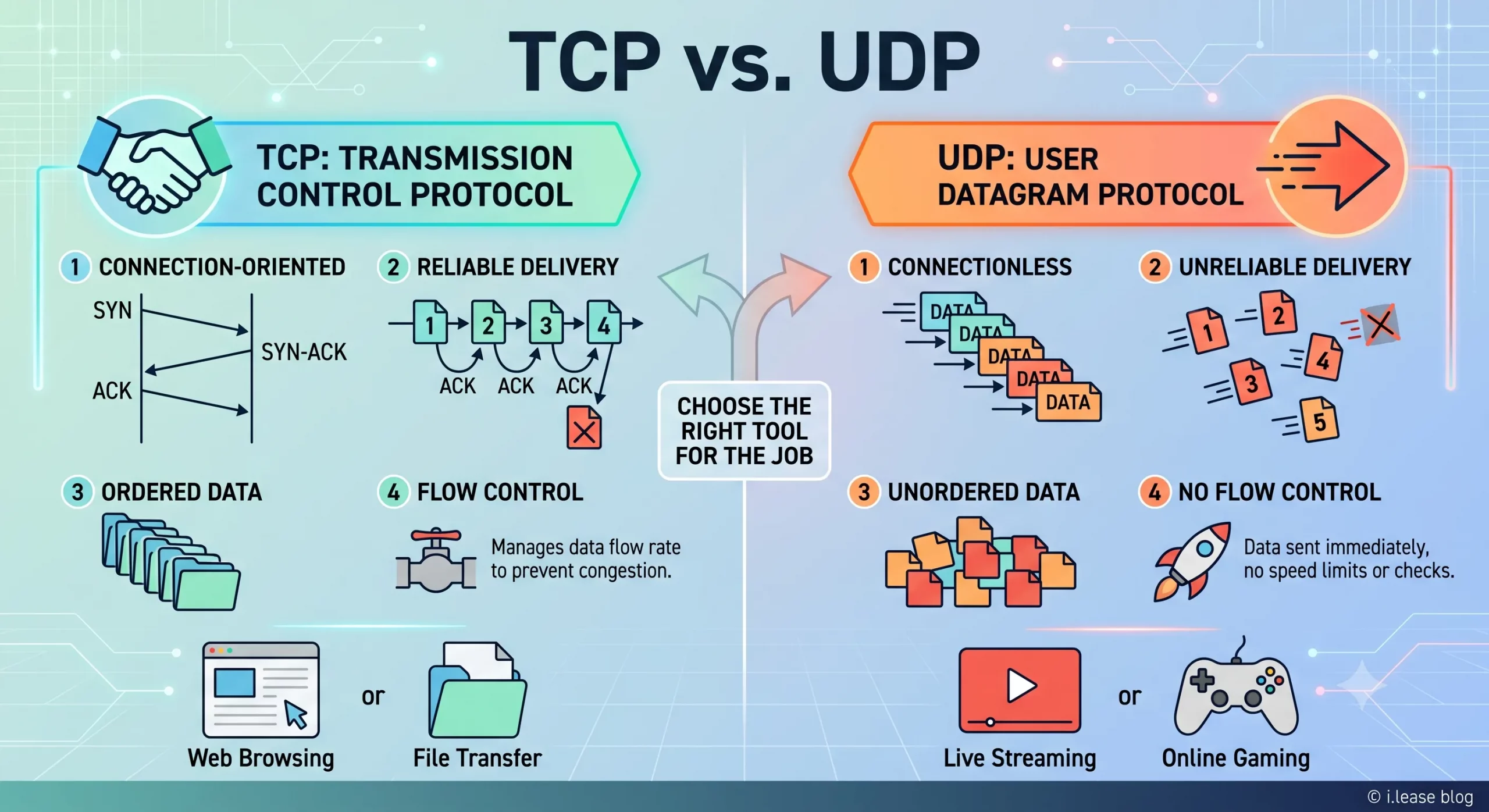
TCP 与 UDP:IPv4 租赁和企业网络指南
TCP 和 UDP 是互联网中最重要的两种传输层协议。它们决定数据如何在设备、服务器、云平台、VPN 网关、DNS 解析器、电子邮件系统、流媒体平台以及企业应用程序之间传输。 对于企业而言,TCP 和 UDP 不仅仅是技术术语,它们会直接影响实际的基础设施性能。公网 IPv4 地址提供可从互联网访问的网络端点,而 TCP 和 UDP 则决定流量如何通过该端点进行传输。 这对于租用或购买 IPv4 地址的企业尤为重要。企业租用 IPv4 地址并不是单纯为了持有这些地址,而是为了运行网站、API、VPN 隧道、DNS 服务、电子邮件平台、SaaS 应用程序、游戏服务器、流媒体系统、安全工具以及云端工作负载。不同类型的服务决定了需要使用 TCP、UDP,还是同时使用两者。 通过 i.lease,企业可以使用 IPv4 租赁服务获取用于实际网络部署的公网 IPv4 资源。需要长期控制 IP 地址资源的企业也可以购买 IP 地址,而拥有闲置 IPv4 资源的组织则可以出售 IP 地址。 TCP和UDP是什么? TCP 和 UDP 都是传输层协议。它们位于 IP 协议之上,帮助应用程序通过网络发送和接收数据。 IP 地址用于确定流量应该发送到哪里,而 TCP 和 UDP 则决定这些流量如何进行传输。 简单来说: TCP 适用于重视可靠性和按顺序传输数据的场景。 UDP 适用于重视速度、低延迟和轻量化数据传输的场景。 企业可能会使用同一个公网 IPv4 地址来运行不同的服务,但每项服务可能依赖不同的传输协议。例如,网站可能使用 TCP,VPN 网关可能使用 UDP,DNS 解析器可能同时使用 UDP 和 TCP,而游戏服务器则可能更倾向于使用 UDP,因为对于实时游戏而言,延迟造成的影响通常比少量数据包丢失更加明显。 因此,TCPRead more Related Posts 什么是电信公司?电信运营商如何为英国、美国和加拿大提供网络连接支持? 电信公司(Telco Companies),也称为电信运营商(Telecommunications Companies),提供通信与网络连接服务。这些服务包括移动通信网络、宽带互联网、光纤连接、固定电话服务、企业网络连接、云连接、托管网络服务以及数据中心连接等。 对于普通消费者而言,电信公司通常被视为移动通信或宽带互联网服务提供商。对于企业来说,电信公司远不只是一个服务品牌,更是关键的基础设施合作伙伴,帮助企业连接办公室、数据中心、云平台、远程员工、客户应用程序以及各类数字化服务。 随着企业越来越依赖云平台、SaaS 应用、AI 工具、VPN、网络安全系统以及在线服务,电信公司已成为数字基础设施规划中不可或缺的重要组成部分。 电信公司是什么? 电信公司(Telco Companies)是提供电信服务的企业。这些服务让个人、设备、企业和各种系统能够跨越距离进行通信与连接。 一家电信公司可能提供以下服务: 移动通信服务 宽带互联网 光纤连接 固定电话服务 企业互联网接入 企业广域网(WAN)服务 云连接服务 数据中心连接 VPN TCP 与 UDP:IPv4 租赁和企业网络指南 TCP 和 UDP 是互联网中最重要的两种传输层协议。它们决定数据如何在设备、服务器、云平台、VPN 网关、DNS 解析器、电子邮件系统、流媒体平台以及企业应用程序之间传输。 对于企业而言,TCP 和 UDP 不仅仅是技术术语,它们会直接影响实际的基础设施性能。公网 IPv4 地址提供可从互联网访问的网络端点,而 TCP 和 UDP 则决定流量如何通过该端点进行传输。 这对于租用或购买 IPv4 地址的企业尤为重要。企业租用 IPv4 什么是区域互联网注册管理机构(RIR) 区域互联网注册管理机构(Regional Internet Registry, RIR)是负责在特定地理区域内分配和管理互联网编号资源的组织。这些资源主要包括 IP 地址(IPv4 和 IPv6)以及自治系统号(ASN),它们是支撑设备和网络在互联网上相互通信的关键要素。 如果没有一套组织完善的系统来分配唯一的 IP 地址和路由标识符,互联网便无法正常运转。RIR 确保这一过程在各自管辖的区域内保持公平、高效与一致,从而避免冲突,并提升互联网治理的透明度。 全球五大 RIR 目前全球共有五家获官方认可的 RIR,各自负责世界上特定的区域:AFRINIC – 非洲网络信息中心(非洲)APNIC – 亚太网络信息中心(亚太地区)ARIN .related-post {} .related-post .post-list { text-align: left; } .related-post .post-list .item { margin: 5px; padding: 10px; } .related-post .headline { font-size: 18px !important; color: #999999 !important; } .related-post .post-list .item .post_thumb { max-height: 220px; margin: 10px 0px; padding: 0px; display: block; } .related-post .post-list .item .post_title { font-size: 16px; color: #3f3f3f; margin: 10px 0px; padding: 0px; display: block; text-decoration: none; } .related-post .post-list .item .post_excerpt { font-size: 13px; color: #3f3f3f; margin: 10px 0px; padding: 0px; display: block; text-decoration: none; } @media only screen and (min-width: 1024px) { .related-post .post-list .item { width: 30%; } } @media only screen and (min-width: 768px) and (max-width: 1023px) { .related-post .post-list .item { width: 90%; } } @media only screen and (min-width: 0px) and (max-width: 767px) { .related-post .post-list .item { width: 90%; } }
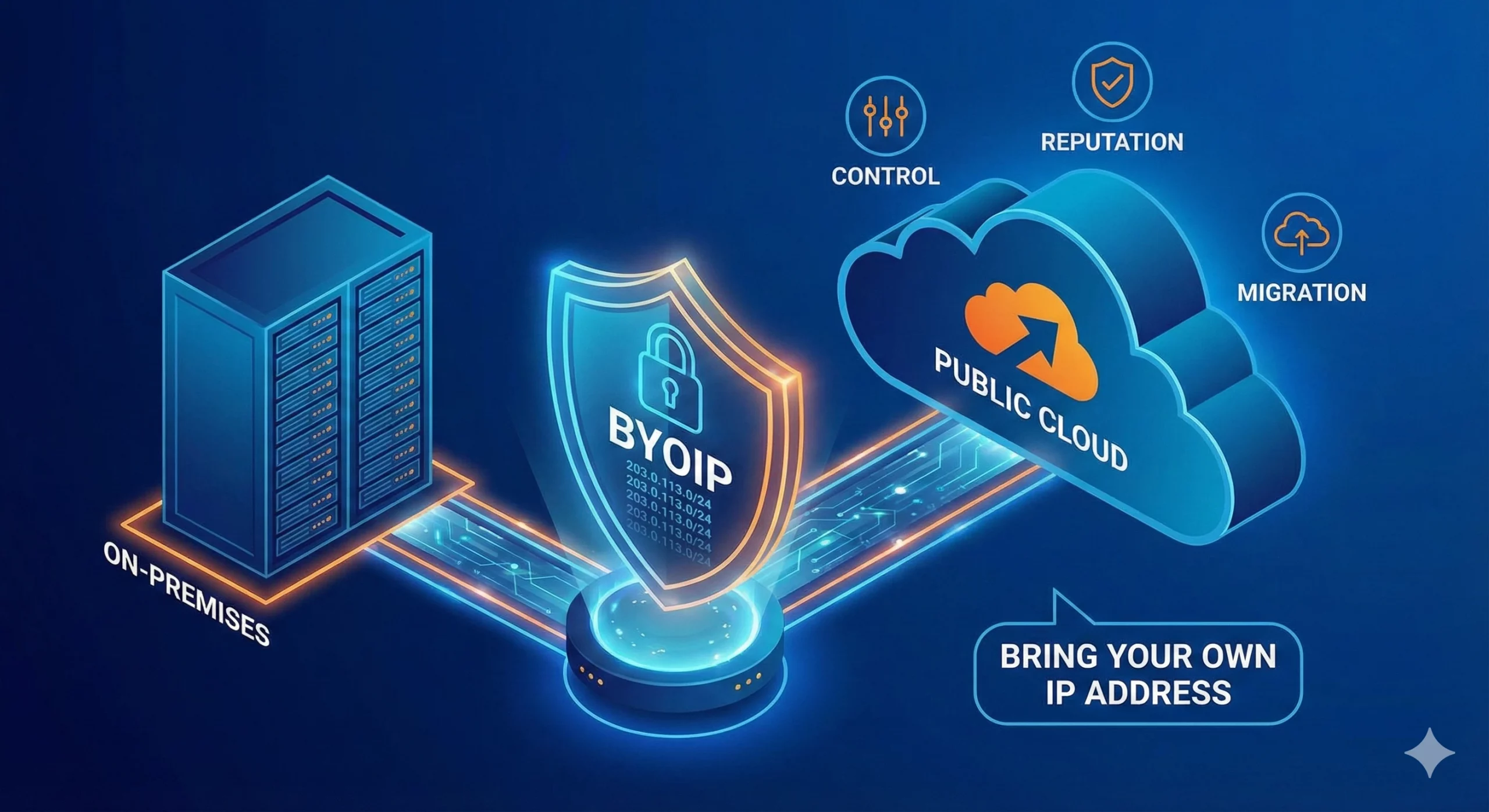
什么是BYOIP(自备IP地址)?
自带 IP(Bring Your Own IP,简称 BYOIP)是一种网络部署方式,允许企业将自己现有的公网 IP 地址段应用于云服务提供商、数据中心、内容分发网络(CDN)或其他基础设施平台。 企业无需使用服务提供商分配的新公网 IP 地址,而是可以使用自己已拥有或已获授权使用的 IPv4 或 IPv6 地址前缀。服务提供商会验证该组织对该地址段的使用权限,并在支持的情况下,通过其自身网络对该地址段进行路由公告(Advertise)。 BYOIP 有助于企业在迁移至云平台时保留现有的防火墙规则、白名单(Allowlists)、客户系统集成、IP 信誉(IP Reputation)、DNS 配置以及既有的网络身份。这不仅能够减少因更换 IP 地址而带来的业务中断,还能降低对服务提供商分配 IP 的依赖,使未来的基础设施迁移与扩展更加灵活且易于管理。 对于需要 BYOIP 地址资源的企业,可选择 购买 IPv4 地址(Buy IP),以获得长期控制权;如果更重视灵活性,也可采用 IPv4 租赁(IPv4 Leasing),按业务需求获取公网 IP 资源。 什么是BYOIP? BYOIP 是 Bring Your Own IP(自带 IP)的缩写。这是一种网络部署模式,允许组织将现有的公网 IP 地址段带入云服务提供商或其他基础设施平台使用。 在 BYOIP 模式下,组织仍然拥有或保留该 IP 地址段的使用权,而平台则获得授权,可在其基础设施中对该地址段进行路由公告(Advertise)和使用。随后,这些 IP 地址可分配给虚拟机(Virtual Machines)、负载均衡器(Load Balancers)、VPN 网关、内容分发服务(CDN)、安全平台以及公网应用程序端点等受支持的服务。 例如,一家企业将应用程序从本地数据中心迁移到云环境时,可能并不希望更换现有的公网 IP 地址。这些 IP 地址可能已经存在于客户白名单(Allowlists)、防火墙策略、DNS 记录、合作伙伴配置以及电子邮件信誉(Email Reputation)数据库中。 BYOIP 使企业能够在迁移工作负载的同时,继续使用原有的公网 IP 地址,从而保持更一致的网络身份,并减少因更换 IP 地址而带来的配置调整和业务影响。 Related Posts 什么是电信公司?电信运营商如何为英国、美国和加拿大提供网络连接支持? 电信公司(Telco Companies),也称为电信运营商(Telecommunications Companies),提供通信与网络连接服务。这些服务包括移动通信网络、宽带互联网、光纤连接、固定电话服务、企业网络连接、云连接、托管网络服务以及数据中心连接等。 对于普通消费者而言,电信公司通常被视为移动通信或宽带互联网服务提供商。对于企业来说,电信公司远不只是一个服务品牌,更是关键的基础设施合作伙伴,帮助企业连接办公室、数据中心、云平台、远程员工、客户应用程序以及各类数字化服务。 随着企业越来越依赖云平台、SaaS 应用、AI 工具、VPN、网络安全系统以及在线服务,电信公司已成为数字基础设施规划中不可或缺的重要组成部分。 电信公司是什么? 电信公司(Telco Companies)是提供电信服务的企业。这些服务让个人、设备、企业和各种系统能够跨越距离进行通信与连接。 一家电信公司可能提供以下服务: 移动通信服务 宽带互联网 光纤连接 固定电话服务 企业互联网接入 企业广域网(WAN)服务 云连接服务 数据中心连接 VPN TCP 与 UDP:IPv4 租赁和企业网络指南 TCP 和 UDP 是互联网中最重要的两种传输层协议。它们决定数据如何在设备、服务器、云平台、VPN 网关、DNS 解析器、电子邮件系统、流媒体平台以及企业应用程序之间传输。 对于企业而言,TCP 和 UDP 不仅仅是技术术语,它们会直接影响实际的基础设施性能。公网 IPv4 地址提供可从互联网访问的网络端点,而 TCP 和 UDP 则决定流量如何通过该端点进行传输。 这对于租用或购买 IPv4 地址的企业尤为重要。企业租用 IPv4 什么是区域互联网注册管理机构(RIR) 区域互联网注册管理机构(Regional Internet Registry, RIR)是负责在特定地理区域内分配和管理互联网编号资源的组织。这些资源主要包括 IP 地址(IPv4 和 IPv6)以及自治系统号(ASN),它们是支撑设备和网络在互联网上相互通信的关键要素。 如果没有一套组织完善的系统来分配唯一的 IP 地址和路由标识符,互联网便无法正常运转。RIR 确保这一过程在各自管辖的区域内保持公平、高效与一致,从而避免冲突,并提升互联网治理的透明度。 全球五大 RIR 目前全球共有五家获官方认可的 RIR,各自负责世界上特定的区域:AFRINIC – 非洲网络信息中心(非洲)APNIC – 亚太网络信息中心(亚太地区)ARIN .related-post {} .related-post .post-list { text-align: left; } .related-post .post-list .item { margin: 5px; padding: 10px; } .related-post .headline { font-size: 18px !important; color: #999999 !important; } .related-post .post-list .item .post_thumb { max-height: 220px; margin: 10px 0px; padding: 0px; display: block; } .related-post .post-list .item .post_title { font-size: 16px; color: #3f3f3f; margin: 10px 0px; padding: 0px; display: block; text-decoration: none; } .related-post .post-list .item .post_excerpt { font-size: 13px; color: #3f3f3f; margin: 10px 0px; padding: 0px; display: block; text-decoration: none; } @media only screen and (min-width: 1024px) { .related-post .post-list .item { width: 30%; } } @media only screen and (min-width: 768px) and (max-width: 1023px) { .related-post .post-list .item { width: 90%; } } @media only screen and (min-width: 0px) and (max-width: 767px) { .related-post .post-list .item { width: 90%; } }
