The Difference Between RIRs and IP Brokers in IPv4 Transfers
 Stephanie
Table of Contents
• RIRs regulate IPv4 transfers under strict regional policies; brokers mediate and streamline transactions.
• IP leasing services like i.lease offer flexible, rapid access without full ownership transfers.
Introduction
The looming exhaustion of IPv4 addresses has turned these resources into highly traded assets. Two main pathways for organisations to acquire IPv4 space are via Regional Internet Registries (RIRs) or third-party IP brokers. An emerging alternative, i.lease, offers leasing rather than full ownership transfer, reshaping how businesses obtain IP space. This article examines how RIRs and IP brokers differ, highlights the advantages of leasing, and explores how i.lease fits into this evolving landscape.
Regional internet registries govern ownership transfers
Regional Internet Registries (RIRs) are the official authorities managing IPv4 address space within defined global regions. Organisations must comply with each RIR’s policies to initiate transfers. These policies include validating ownership, demonstrating justification for additional addresses, and meeting specific regional restrictions and fees.
Each RIR has its own nuances. Such as whilst AFRINIC prevents transfers to intra-RIR only, APNIC, ARIN, RIPE, and LACNIC all facilitate inter-RIR transfers under reciprocal, needs-based policies. The registry affirms the fact the seller is the legitimate owner of the IP addresses and makes sure that all applicable regulations are met before RIR-led transfers can take position. Each transfer involves documentation, justification of need, and processing fees, making the process thorough but sometimes slow.
Direct transactions: pros and cons
Some organisations choose to bypass brokers altogether and negotiate IP transfers directly. This avoids brokerage fees and provides full control over negotiation—but requires in-house expertise, time, and familiarity with complex RIR requirements.
An increasingly precious resource
IPv4 addresses applied to have been widely available, but as the Internet’s global infrastructure while growing promptly in the early 2000s, that number dropped. In 2011, when IPv4 addresses begun to feel more like things than freely available resources, the Internet Assigned Numbers Authority (IANA) presented over the final of its IPv4 blocks to Regional Internet Registries (RIRs). The shift started an IPv4 transfer market during which brokers and leasing platforms evolved into vital players in regulating supply and gratifying demand.
Regional Internet Registries: the guardians of allocation
The official body parts in the position of transferring and maintaining IPv4 address space within established geographic areas are regional internet registries. When it comes to transferring IPv4 address blocks, the five her primary source RIRs—APNIC (Asia Pacific), LACNIC (Latin America and the Caribbean), RIPE NCC (Europe, Middle East, Central Asia), AFRINIC (Africa), and ARIN (North America)—each enforce their own policies and procedures. When both parties are under the same RIR, as arises when two European companies transfer an address block within RIPE NCC, this is designated as an intra-RIR transfer.
On the flip side, inter-RIR transfers encompasses cross-registry transfers, such as those from ARIN to RIPE NCC, and demand that both RIRs support individuals and adhere to compatible policies. With solely the receiving RIR’s acceptance, intra-RIR transfers typically happen simpler and quicker. Inter-RIR transfers have more complicated and time-consuming since both source and destination registries have to perform verification, enforce documentation requirements, and guarantee that they adhere to local rules and regulations.Within ARIN, for instance, transfers require an Online account, proper organisational identifiers, signed agreements, processing fees and completion within specific windows of time.
Though thorough and secure, RIR transfers demand administrative effort, policy compliance, and in some cases justification of need. That level of complexity, fuelled by regional nuance and documentation, stimulates demand for intermediaries who can navigate the system more efficiently.
IP brokers: intermediaries simplifying complexity
IP brokers become go-betweens for buyers and sellers in the secondary IPv4 market. They raise the process collectively by directing transaction flow, connecting with RIRs, managing documentation, validating ownership, and negotiating terms. These mid-men offer expertise in navigating diverse regional policies, reducing the burden on organisations unfamiliar with RIR intricacies or those seeking to expedite the process.
“An IPv4 broker acts as an intermediary between buyers and sellers, ensuring a compliant, successful transaction every time.”
— Vincentas Grinius, IPXO Co-Founder
This kind of service accelerates transactions, mitigates regulatory risk and delivers peace of mind. nevertheless through the brokered route may on occasion limitation direct negotiation with the other party and comes at a cost, which typically ranges coming from 5 to 15% of the transaction. When deciding on this course, entities need to consider the trade-off between speed and autonomy.
Leasing IPv4: a flexible alternative
Leasing IPv4 address space has emerged as a nimble and cost-effective substitute to both outright transfer and lengthy RIR approval. In leasing, organisations gain temporary usage rights to an IPv4 block, without permanent ownership or registration. This model suits those needing flexibility, rapid deployment, or temporary burst capacity.
ARIN’s Chief Experience Officer John Sweeting notes that leasing can sidestep market delays or lengthy waiting lists. However, he cautions that leasing does not grant permanent registration or autonomy, and addresses must be returned once lease terms expire; misuse of leasing to justify new allocations under ARIN policy could trigger policy enforcement.
LARUS, a provider of IPv4 leasing services, advertises delivery within 48 hours of contract, payment and authorisation letter. Their approach ensures agility for networks needing fast allocation without RIR membership or fees.
A shortage that created a market
The estimated value during the Internet wasn’t expected by the people who developed it when it was first conceived. With its 32-bit address space, the IPv4 protocol delivered in 4.3 billion distinguished addresses. This seemed sufficient at the time.Yet the boom of mobile devices, broadband, and cloud computing quickly consumed this supply. By 2011, the Internet Assigned Numbers Authority (IANA) had allocated its final blocks to the five Regional Internet Registries. Scarcity set in, and what had once been free infrastructure became a tradable asset.
In response, organisations began looking for ways to secure IPv4 space for their networks. This gave rise to two distinct routes: going directly through RIRs under strict regional policies, or using brokers to simplify and speed up the process. More recently, leasing models such as i.lease have introduced a third option, where companies can access addresses on demand without buying them outright.
The authority of Regional Internet Registries
North America is protected by ARIN, Europe and parts of Central Asia due to RIPE NCC, Asia Pacific with APNIC, Latin America and the Caribbean with LACNIC, and Africa due to AFRINIC. The main aim of all registry services, spite of their variances in strategy, is to verify that IPv4 allocations are true to themselves effectively registered, and in accordance with the local laws (arin.net). An organization must go through an intra-RIR method if it seeks to transfer IPv4 addresses within just one region.This typically involves verifying the current holder’s rights, approving the transfer request, and sometimes justifying the need for additional space.
If the transfer crosses borders—for example from ARIN to RIPE—then both RIRs must approve the transaction. These inter-RIR transfers are slower and involve more documentation (prefixbroker.com).
The advantage of working directly with an RIR is that the process is secure and results in definitive ownership recorded in the registry’s database. The drawback is time. Processing can take weeks or months, and for organisations needing addresses quickly, the bureaucracy may feel like an obstacle.
Brokers as market facilitators
This is where brokers have carved out a role. By acting as go-betweens, IPv4 brokers help buyers and sellers navigate the complex global landscape of registry policies. On behalf of their clients, brokers manage negotiations, prepare paperwork, and coordinate with RIRs — reducing the risk of errors or rejected applications.
“The job of a broker is to ensure a successful transaction every time, by validating ownership and navigating complex policy requirements.”
— ipxo.com
Beyond facilitating transfers, brokers typically:
- Validate IP ownership and ensure legitimate registry records before submission.
- Prepare and manage documentation required by RIRs across multiple jurisdictions.
- Negotiate deal terms between buyer and seller, maintaining neutrality and compliance.
- Liaise directly with RIRs, ensuring each step aligns with regional transfer policies.
- Pre-screen IP blocks to check for blacklisting or previous abuse associations.
- Coordinate escrow and payment processes to safeguard both parties.
- Charge brokerage fees, usually between 5–15% of the deal value, depending on block size and complexity.
Leasing reshapes the landscape
While RIRs and brokers focus on ownership transfers, IPv4 leasing takes a different route — offering access without the need to buy. Businesses can rent address space for a defined term, gaining flexibility and speed while avoiding long approval cycles.
i.lease stands out as a full-service platform that simplifies the entire leasing process:
- Contracts signed and approved within days
- Pre-vetted, clean IPs to avoid blacklist or abuse issues
- Built-in abuse management and multilingual support
- No RIR membership required
This model suits companies needing fast or temporary expansion — such as start-ups, hosting providers, or seasonal content networks. As IPv4 prices continue rising, leasing offers a cost-effective bridge until IPv6 adoption becomes widespread.
Expert perspectives
Ioana Livadariu of APNIC has noted that the IPv4 transfer market is “carefully monitored” but still heavily influenced by intermediaries who manage the practicalities of deal-making (blog.apnic.net). Researchers such as Vasileios Giotsas have highlighted the problem of address reputation, finding that a significant portion of transferred blocks were already blocklisted, underlining the importance of using trusted brokers or platforms to vet addresses (ipxo.com).
These insights reinforce the idea that while RIRs provide legitimacy, the marketplace requires additional layers of assurance and flexibility. Leasing services, including i.lease, are effectively responding to this gap by combining speed with quality control.
The choice businesses face
Every organisation must decide which approach suits its strategy. If permanence is essential, RIR-led transfers remain the gold standard. They ensure ownership is fully recognised and cannot be disputed. If speed and convenience matter more, brokers provide professional support that shortens the timeline and reduces administrative headaches. For those prioritising flexibility and cost control, leasing via platforms like i.lease offers an attractive third way.
None of these paths is universally superior. They coexist because business needs vary. A multinational telecom operator planning for decades of service continuity will likely prefer secure ownership. A digital media firm launching a short-term platform may instead lease what it needs for six months. The key lies in aligning the method with operational goals.
Looking ahead
The long-term solution to IPv4 exhaustion is of course IPv6. Nevertheless, adoption has been uneven, and IPv4 remains extensively utilized in many networks. The necessity for IPv4 leases and transfers will not end until IPv6 is implemented roughly by everyone. knowing the presence of services like i.lease, leasing could possibly continue to be valuable in a dual-stack the natural world where IPv4 capacity will continue to be needed in combination with IPv6.
Trusted IPv4 Leasing for Business Growth
Get enterprise-grade IPv4 space quickly, with seamless deployment and end-to-end management.
Get Started with i.leaseFAQs
What distinguishes intra-RIR transfers from inter-RIR transfers?
An intra-RIR transfer occurs within a single registry’s region, requiring approval only from that registry. An inter-RIR transfer moves addresses between two registries, requiring both to approve.
Why use a broker rather than apply directly through an RIR?
Brokers simplify complex processes, reduce administrative burden, and help avoid mistakes. They also provide market knowledge and reputational screening of IP blocks.
How does i.lease differ from brokers?
i.lease does not arrange ownership transfers. Instead, it offers temporary leasing of IPv4 addresses with fast provisioning and clean reputational checks.
Is leasing cheaper than buying?
For short-term needs, leasing is almost always more economical. Buying provides permanent ownership, but costs have risen significantly in recent years.
Will IPv6 make all of this irrelevant?
Eventually IPv6 should reduce demand for IPv4, but the transition is slow. Until adoption becomes universal, IPv4 transfers and leasing will remain essential.
Related Blogs
相关文章

什么是电信公司?电信运营商如何为英国、美国和加拿大提供网络连接支持?
电信公司(Telco Companies),也称为电信运营商(Telecommunications Companies),提供通信与网络连接服务。这些服务包括移动通信网络、宽带互联网、光纤连接、固定电话服务、企业网络连接、云连接、托管网络服务以及数据中心连接等。 对于普通消费者而言,电信公司通常被视为移动通信或宽带互联网服务提供商。对于企业来说,电信公司远不只是一个服务品牌,更是关键的基础设施合作伙伴,帮助企业连接办公室、数据中心、云平台、远程员工、客户应用程序以及各类数字化服务。 随着企业越来越依赖云平台、SaaS 应用、AI 工具、VPN、网络安全系统以及在线服务,电信公司已成为数字基础设施规划中不可或缺的重要组成部分。 电信公司是什么? 电信公司(Telco Companies)是提供电信服务的企业。这些服务让个人、设备、企业和各种系统能够跨越距离进行通信与连接。 一家电信公司可能提供以下服务: 移动通信服务 宽带互联网 光纤连接 固定电话服务 企业互联网接入 企业广域网(WAN)服务 云连接服务 数据中心连接 VPN 服务 托管网络解决方案 互联网传输(Internet Transit) 电信批发服务 部分电信公司拥有并运营大规模的实体网络基础设施;另一些则通过批发接入、租用基础设施或与网络运营商合作来提供电信服务。 电信公司提供哪些服务? 电信公司同时为个人消费者和企业客户提供服务。 面向消费者的服务通常包括移动通信套餐、家庭宽带、光纤互联网、固定电话以及通信组合套餐。 面向企业的服务则可能包括专线互联网接入、企业光纤、专用网络、云连接、托管安全服务、数据中心连接、物联网(IoT)连接以及企业移动通信方案。 对于大型企业客户,电信公司还可提供: 多地点办公室网络连接 远程员工接入 私有云连接 SD-WAN(软件定义广域网) 灾难恢复连接 低延迟网络路由 互联网传输(Internet Transit) 网络监控 托管防火墙服务 正因如此,电信公司不仅对日常通信至关重要,也是现代企业建设先进数字基础设施的重要支柱。 电信公司 vs 互联网服务提供商 vs 网络运营商 电信公司(Telco)、互联网服务提供商(ISP)和网络运营商(Network Operator)之间可能存在重叠,但它们并不完全相同。 电信公司提供电信服务。 互联网服务提供商(ISP)提供互联网接入服务。 网络运营商负责建设、运营和管理网络基础设施。 一些大型电信公司同时承担这三种角色。它们拥有基础设施、运营网络,并向市场提供互联网、移动通信以及企业网络服务。 规模较小的服务提供商则可能专注于其中某一层。例如,互联网服务提供商(ISP)可以销售宽带服务,而无需拥有所有实体网络基础设施;网络运营商可能负责建设和运营光纤网络,并向电信公司或 ISP 提供批发网络接入;电信公司则可能结合自有网络与合作伙伴网络,为客户提供移动通信和企业服务。 对于企业而言,理解这些区别非常重要,因为服务质量不仅取决于销售该方案的品牌,还受到其底层网络、路由设计、网络覆盖范围以及技术支持体系等因素的影响。 为什么电信公司对企业至关重要 电信公司之所以重要,是因为几乎所有现代企业都依赖稳定的网络连接。 企业可能需要电信服务来支持: 办公室互联网接入 移动网络连接 远程办公 客户支持系统 云应用程序 SaaS 平台 支付系统 VPNRead more Related Posts 什么是电信公司?电信运营商如何为英国、美国和加拿大提供网络连接支持? 电信公司(Telco Companies),也称为电信运营商(Telecommunications Companies),提供通信与网络连接服务。这些服务包括移动通信网络、宽带互联网、光纤连接、固定电话服务、企业网络连接、云连接、托管网络服务以及数据中心连接等。 对于普通消费者而言,电信公司通常被视为移动通信或宽带互联网服务提供商。对于企业来说,电信公司远不只是一个服务品牌,更是关键的基础设施合作伙伴,帮助企业连接办公室、数据中心、云平台、远程员工、客户应用程序以及各类数字化服务。 随着企业越来越依赖云平台、SaaS 应用、AI 工具、VPN、网络安全系统以及在线服务,电信公司已成为数字基础设施规划中不可或缺的重要组成部分。 电信公司是什么? 电信公司(Telco Companies)是提供电信服务的企业。这些服务让个人、设备、企业和各种系统能够跨越距离进行通信与连接。 一家电信公司可能提供以下服务: 移动通信服务 宽带互联网 光纤连接 固定电话服务 企业互联网接入 企业广域网(WAN)服务 云连接服务 数据中心连接 VPN TCP 与 UDP:IPv4 租赁和企业网络指南 TCP 和 UDP 是互联网中最重要的两种传输层协议。它们决定数据如何在设备、服务器、云平台、VPN 网关、DNS 解析器、电子邮件系统、流媒体平台以及企业应用程序之间传输。 对于企业而言,TCP 和 UDP 不仅仅是技术术语,它们会直接影响实际的基础设施性能。公网 IPv4 地址提供可从互联网访问的网络端点,而 TCP 和 UDP 则决定流量如何通过该端点进行传输。 这对于租用或购买 IPv4 地址的企业尤为重要。企业租用 IPv4 什么是区域互联网注册管理机构(RIR) 区域互联网注册管理机构(Regional Internet Registry, RIR)是负责在特定地理区域内分配和管理互联网编号资源的组织。这些资源主要包括 IP 地址(IPv4 和 IPv6)以及自治系统号(ASN),它们是支撑设备和网络在互联网上相互通信的关键要素。 如果没有一套组织完善的系统来分配唯一的 IP 地址和路由标识符,互联网便无法正常运转。RIR 确保这一过程在各自管辖的区域内保持公平、高效与一致,从而避免冲突,并提升互联网治理的透明度。 全球五大 RIR 目前全球共有五家获官方认可的 RIR,各自负责世界上特定的区域:AFRINIC – 非洲网络信息中心(非洲)APNIC – 亚太网络信息中心(亚太地区)ARIN .related-post {} .related-post .post-list { text-align: left; } .related-post .post-list .item { margin: 5px; padding: 10px; } .related-post .headline { font-size: 18px !important; color: #999999 !important; } .related-post .post-list .item .post_thumb { max-height: 220px; margin: 10px 0px; padding: 0px; display: block; } .related-post .post-list .item .post_title { font-size: 16px; color: #3f3f3f; margin: 10px 0px; padding: 0px; display: block; text-decoration: none; } .related-post .post-list .item .post_excerpt { font-size: 13px; color: #3f3f3f; margin: 10px 0px; padding: 0px; display: block; text-decoration: none; } @media only screen and (min-width: 1024px) { .related-post .post-list .item { width: 30%; } } @media only screen and (min-width: 768px) and (max-width: 1023px) { .related-post .post-list .item { width: 90%; } } @media only screen and (min-width: 0px) and (max-width: 767px) { .related-post .post-list .item { width: 90%; } }
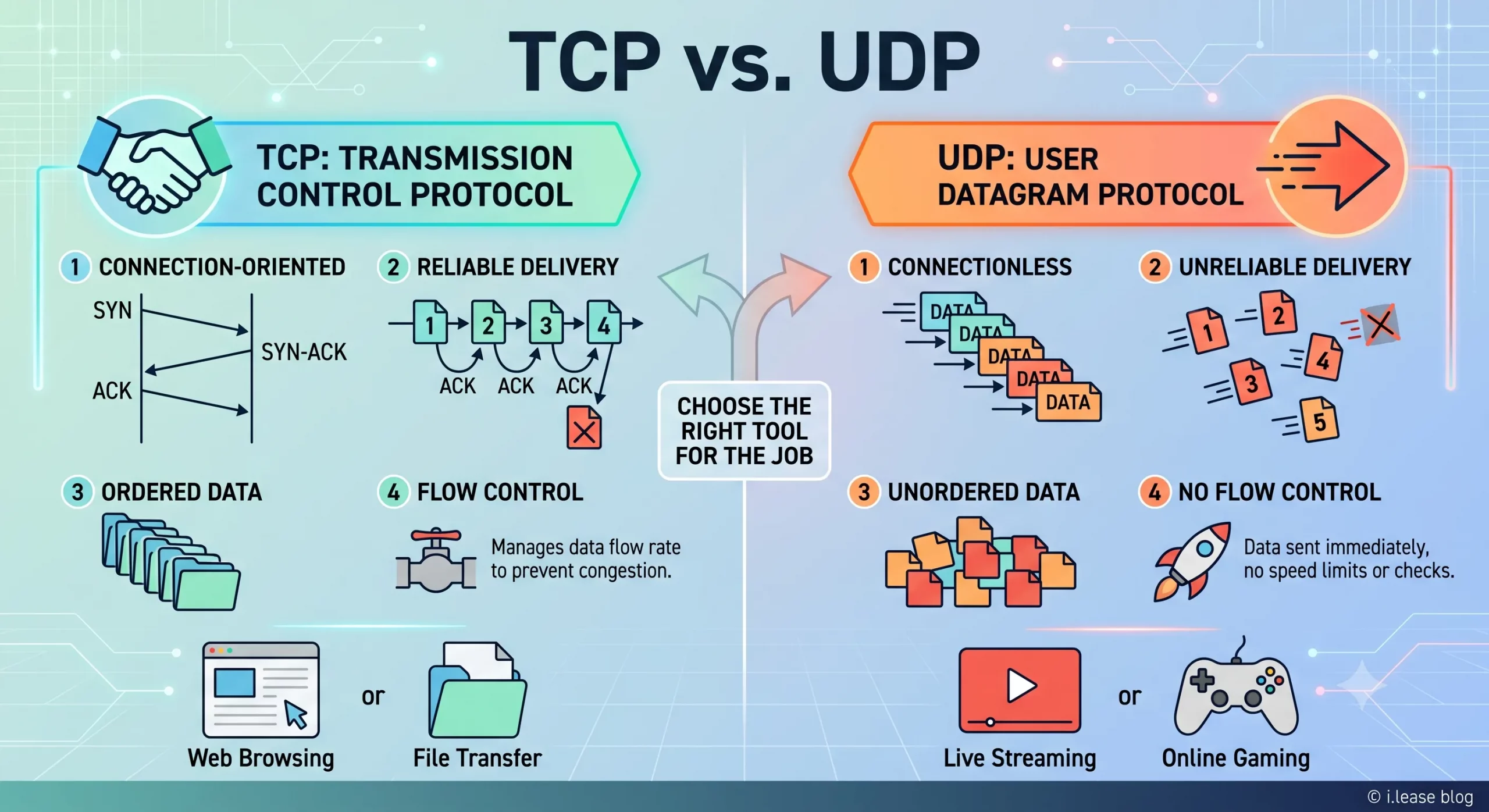
TCP 与 UDP:IPv4 租赁和企业网络指南
TCP 和 UDP 是互联网中最重要的两种传输层协议。它们决定数据如何在设备、服务器、云平台、VPN 网关、DNS 解析器、电子邮件系统、流媒体平台以及企业应用程序之间传输。 对于企业而言,TCP 和 UDP 不仅仅是技术术语,它们会直接影响实际的基础设施性能。公网 IPv4 地址提供可从互联网访问的网络端点,而 TCP 和 UDP 则决定流量如何通过该端点进行传输。 这对于租用或购买 IPv4 地址的企业尤为重要。企业租用 IPv4 地址并不是单纯为了持有这些地址,而是为了运行网站、API、VPN 隧道、DNS 服务、电子邮件平台、SaaS 应用程序、游戏服务器、流媒体系统、安全工具以及云端工作负载。不同类型的服务决定了需要使用 TCP、UDP,还是同时使用两者。 通过 i.lease,企业可以使用 IPv4 租赁服务获取用于实际网络部署的公网 IPv4 资源。需要长期控制 IP 地址资源的企业也可以购买 IP 地址,而拥有闲置 IPv4 资源的组织则可以出售 IP 地址。 TCP和UDP是什么? TCP 和 UDP 都是传输层协议。它们位于 IP 协议之上,帮助应用程序通过网络发送和接收数据。 IP 地址用于确定流量应该发送到哪里,而 TCP 和 UDP 则决定这些流量如何进行传输。 简单来说: TCP 适用于重视可靠性和按顺序传输数据的场景。 UDP 适用于重视速度、低延迟和轻量化数据传输的场景。 企业可能会使用同一个公网 IPv4 地址来运行不同的服务,但每项服务可能依赖不同的传输协议。例如,网站可能使用 TCP,VPN 网关可能使用 UDP,DNS 解析器可能同时使用 UDP 和 TCP,而游戏服务器则可能更倾向于使用 UDP,因为对于实时游戏而言,延迟造成的影响通常比少量数据包丢失更加明显。 因此,TCPRead more Related Posts 什么是电信公司?电信运营商如何为英国、美国和加拿大提供网络连接支持? 电信公司(Telco Companies),也称为电信运营商(Telecommunications Companies),提供通信与网络连接服务。这些服务包括移动通信网络、宽带互联网、光纤连接、固定电话服务、企业网络连接、云连接、托管网络服务以及数据中心连接等。 对于普通消费者而言,电信公司通常被视为移动通信或宽带互联网服务提供商。对于企业来说,电信公司远不只是一个服务品牌,更是关键的基础设施合作伙伴,帮助企业连接办公室、数据中心、云平台、远程员工、客户应用程序以及各类数字化服务。 随着企业越来越依赖云平台、SaaS 应用、AI 工具、VPN、网络安全系统以及在线服务,电信公司已成为数字基础设施规划中不可或缺的重要组成部分。 电信公司是什么? 电信公司(Telco Companies)是提供电信服务的企业。这些服务让个人、设备、企业和各种系统能够跨越距离进行通信与连接。 一家电信公司可能提供以下服务: 移动通信服务 宽带互联网 光纤连接 固定电话服务 企业互联网接入 企业广域网(WAN)服务 云连接服务 数据中心连接 VPN TCP 与 UDP:IPv4 租赁和企业网络指南 TCP 和 UDP 是互联网中最重要的两种传输层协议。它们决定数据如何在设备、服务器、云平台、VPN 网关、DNS 解析器、电子邮件系统、流媒体平台以及企业应用程序之间传输。 对于企业而言,TCP 和 UDP 不仅仅是技术术语,它们会直接影响实际的基础设施性能。公网 IPv4 地址提供可从互联网访问的网络端点,而 TCP 和 UDP 则决定流量如何通过该端点进行传输。 这对于租用或购买 IPv4 地址的企业尤为重要。企业租用 IPv4 什么是区域互联网注册管理机构(RIR) 区域互联网注册管理机构(Regional Internet Registry, RIR)是负责在特定地理区域内分配和管理互联网编号资源的组织。这些资源主要包括 IP 地址(IPv4 和 IPv6)以及自治系统号(ASN),它们是支撑设备和网络在互联网上相互通信的关键要素。 如果没有一套组织完善的系统来分配唯一的 IP 地址和路由标识符,互联网便无法正常运转。RIR 确保这一过程在各自管辖的区域内保持公平、高效与一致,从而避免冲突,并提升互联网治理的透明度。 全球五大 RIR 目前全球共有五家获官方认可的 RIR,各自负责世界上特定的区域:AFRINIC – 非洲网络信息中心(非洲)APNIC – 亚太网络信息中心(亚太地区)ARIN .related-post {} .related-post .post-list { text-align: left; } .related-post .post-list .item { margin: 5px; padding: 10px; } .related-post .headline { font-size: 18px !important; color: #999999 !important; } .related-post .post-list .item .post_thumb { max-height: 220px; margin: 10px 0px; padding: 0px; display: block; } .related-post .post-list .item .post_title { font-size: 16px; color: #3f3f3f; margin: 10px 0px; padding: 0px; display: block; text-decoration: none; } .related-post .post-list .item .post_excerpt { font-size: 13px; color: #3f3f3f; margin: 10px 0px; padding: 0px; display: block; text-decoration: none; } @media only screen and (min-width: 1024px) { .related-post .post-list .item { width: 30%; } } @media only screen and (min-width: 768px) and (max-width: 1023px) { .related-post .post-list .item { width: 90%; } } @media only screen and (min-width: 0px) and (max-width: 767px) { .related-post .post-list .item { width: 90%; } }
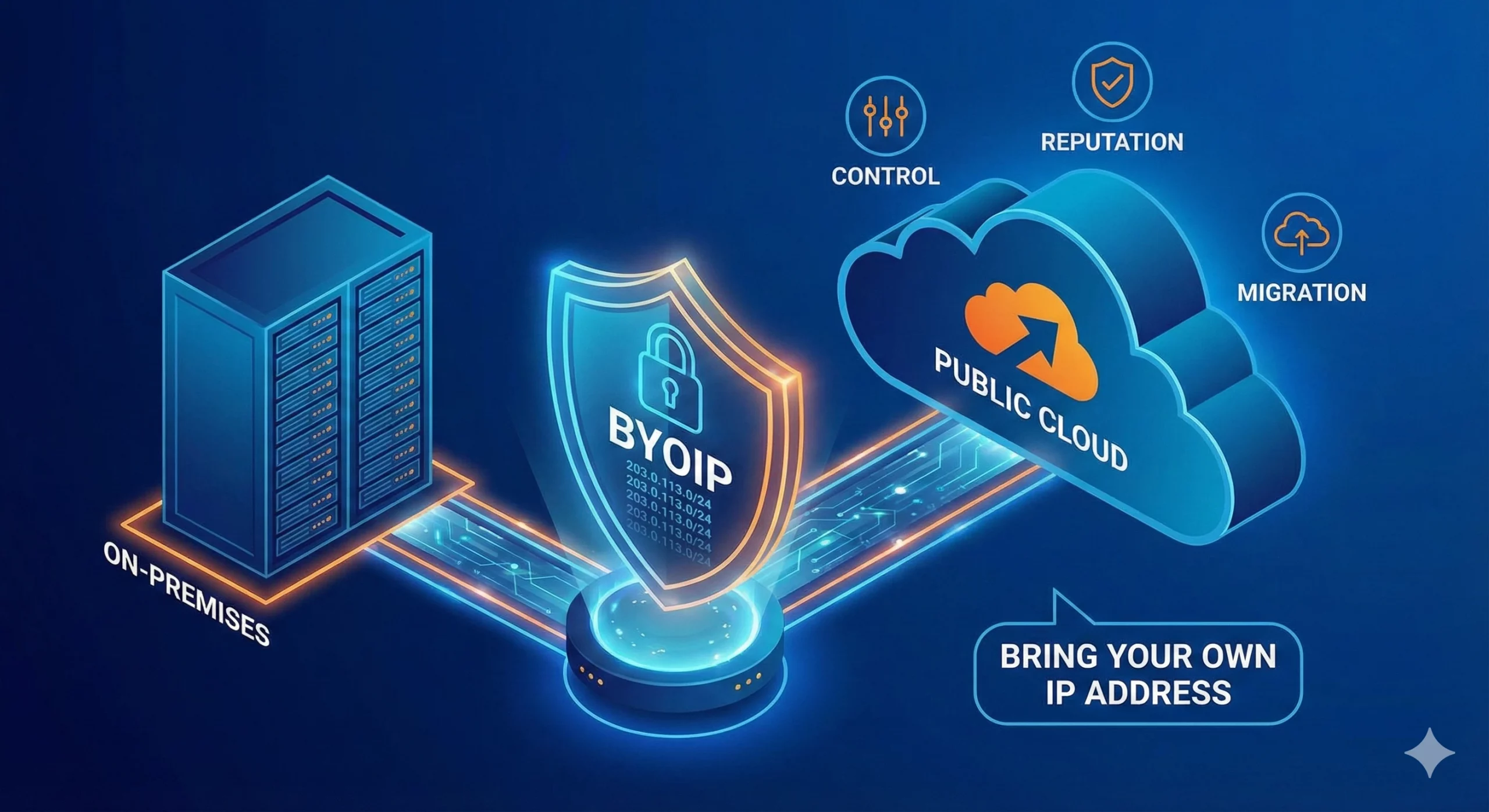
什么是BYOIP(自备IP地址)?
自带 IP(Bring Your Own IP,简称 BYOIP)是一种网络部署方式,允许企业将自己现有的公网 IP 地址段应用于云服务提供商、数据中心、内容分发网络(CDN)或其他基础设施平台。 企业无需使用服务提供商分配的新公网 IP 地址,而是可以使用自己已拥有或已获授权使用的 IPv4 或 IPv6 地址前缀。服务提供商会验证该组织对该地址段的使用权限,并在支持的情况下,通过其自身网络对该地址段进行路由公告(Advertise)。 BYOIP 有助于企业在迁移至云平台时保留现有的防火墙规则、白名单(Allowlists)、客户系统集成、IP 信誉(IP Reputation)、DNS 配置以及既有的网络身份。这不仅能够减少因更换 IP 地址而带来的业务中断,还能降低对服务提供商分配 IP 的依赖,使未来的基础设施迁移与扩展更加灵活且易于管理。 对于需要 BYOIP 地址资源的企业,可选择 购买 IPv4 地址(Buy IP),以获得长期控制权;如果更重视灵活性,也可采用 IPv4 租赁(IPv4 Leasing),按业务需求获取公网 IP 资源。 什么是BYOIP? BYOIP 是 Bring Your Own IP(自带 IP)的缩写。这是一种网络部署模式,允许组织将现有的公网 IP 地址段带入云服务提供商或其他基础设施平台使用。 在 BYOIP 模式下,组织仍然拥有或保留该 IP 地址段的使用权,而平台则获得授权,可在其基础设施中对该地址段进行路由公告(Advertise)和使用。随后,这些 IP 地址可分配给虚拟机(Virtual Machines)、负载均衡器(Load Balancers)、VPN 网关、内容分发服务(CDN)、安全平台以及公网应用程序端点等受支持的服务。 例如,一家企业将应用程序从本地数据中心迁移到云环境时,可能并不希望更换现有的公网 IP 地址。这些 IP 地址可能已经存在于客户白名单(Allowlists)、防火墙策略、DNS 记录、合作伙伴配置以及电子邮件信誉(Email Reputation)数据库中。 BYOIP 使企业能够在迁移工作负载的同时,继续使用原有的公网 IP 地址,从而保持更一致的网络身份,并减少因更换 IP 地址而带来的配置调整和业务影响。 Related Posts 什么是电信公司?电信运营商如何为英国、美国和加拿大提供网络连接支持? 电信公司(Telco Companies),也称为电信运营商(Telecommunications Companies),提供通信与网络连接服务。这些服务包括移动通信网络、宽带互联网、光纤连接、固定电话服务、企业网络连接、云连接、托管网络服务以及数据中心连接等。 对于普通消费者而言,电信公司通常被视为移动通信或宽带互联网服务提供商。对于企业来说,电信公司远不只是一个服务品牌,更是关键的基础设施合作伙伴,帮助企业连接办公室、数据中心、云平台、远程员工、客户应用程序以及各类数字化服务。 随着企业越来越依赖云平台、SaaS 应用、AI 工具、VPN、网络安全系统以及在线服务,电信公司已成为数字基础设施规划中不可或缺的重要组成部分。 电信公司是什么? 电信公司(Telco Companies)是提供电信服务的企业。这些服务让个人、设备、企业和各种系统能够跨越距离进行通信与连接。 一家电信公司可能提供以下服务: 移动通信服务 宽带互联网 光纤连接 固定电话服务 企业互联网接入 企业广域网(WAN)服务 云连接服务 数据中心连接 VPN TCP 与 UDP:IPv4 租赁和企业网络指南 TCP 和 UDP 是互联网中最重要的两种传输层协议。它们决定数据如何在设备、服务器、云平台、VPN 网关、DNS 解析器、电子邮件系统、流媒体平台以及企业应用程序之间传输。 对于企业而言,TCP 和 UDP 不仅仅是技术术语,它们会直接影响实际的基础设施性能。公网 IPv4 地址提供可从互联网访问的网络端点,而 TCP 和 UDP 则决定流量如何通过该端点进行传输。 这对于租用或购买 IPv4 地址的企业尤为重要。企业租用 IPv4 什么是区域互联网注册管理机构(RIR) 区域互联网注册管理机构(Regional Internet Registry, RIR)是负责在特定地理区域内分配和管理互联网编号资源的组织。这些资源主要包括 IP 地址(IPv4 和 IPv6)以及自治系统号(ASN),它们是支撑设备和网络在互联网上相互通信的关键要素。 如果没有一套组织完善的系统来分配唯一的 IP 地址和路由标识符,互联网便无法正常运转。RIR 确保这一过程在各自管辖的区域内保持公平、高效与一致,从而避免冲突,并提升互联网治理的透明度。 全球五大 RIR 目前全球共有五家获官方认可的 RIR,各自负责世界上特定的区域:AFRINIC – 非洲网络信息中心(非洲)APNIC – 亚太网络信息中心(亚太地区)ARIN .related-post {} .related-post .post-list { text-align: left; } .related-post .post-list .item { margin: 5px; padding: 10px; } .related-post .headline { font-size: 18px !important; color: #999999 !important; } .related-post .post-list .item .post_thumb { max-height: 220px; margin: 10px 0px; padding: 0px; display: block; } .related-post .post-list .item .post_title { font-size: 16px; color: #3f3f3f; margin: 10px 0px; padding: 0px; display: block; text-decoration: none; } .related-post .post-list .item .post_excerpt { font-size: 13px; color: #3f3f3f; margin: 10px 0px; padding: 0px; display: block; text-decoration: none; } @media only screen and (min-width: 1024px) { .related-post .post-list .item { width: 30%; } } @media only screen and (min-width: 768px) and (max-width: 1023px) { .related-post .post-list .item { width: 90%; } } @media only screen and (min-width: 0px) and (max-width: 767px) { .related-post .post-list .item { width: 90%; } }
