Understanding IT Infrastructure: The Backbone of Modern Businesses
 Chan
Chan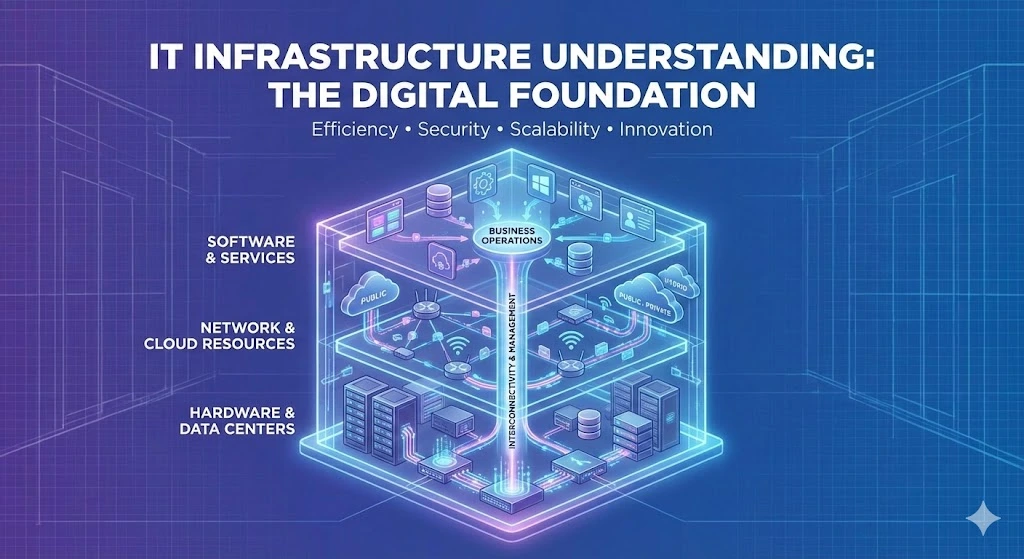
A robust IT infrastructure is critical for the success of any business in today’s digital age. It forms the foundation on which companies build their day-to-day operations, ensuring everything runs smoothly—from managing internal processes to interacting with customers. But what exactly is IT infrastructure, and why is it so essential?
Table of Contents
This article will walk you through the key elements of IT infrastructure and its importance in the modern business landscape.
What is IT Infrastructure?
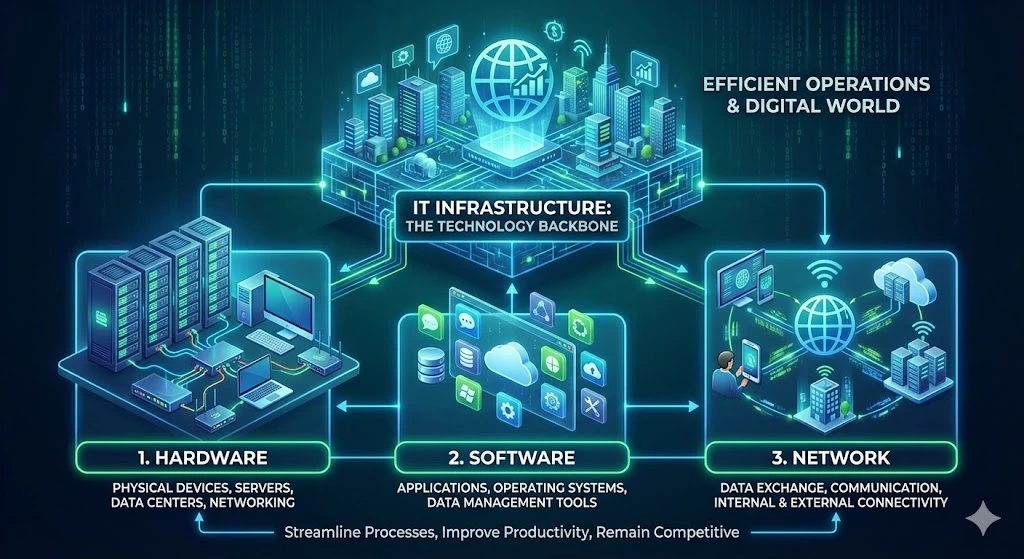
IT infrastructure refers to the collection of hardware, software, networks, and services required for an organization to operate efficiently in the digital world. Essentially, a company’s technology backbone supports all operations, allowing businesses to streamline processes, improve productivity, and remain competitive in a fast-evolving market.
IT infrastructure can be broadly categorized into three components:
1. Hardware: This includes physical devices such as servers, data centers, computers, and networking equipment (routers, switches, etc.) that form the core of IT operations.
2. Software: The applications and operating systems that run on hardware, providing businesses with the tools they need for communication, data management, and other functions.
3. Network: This enables data exchange and communication between devices, systems, and users, both internally and externally.
Key Components of IT Infrastructure
1. Servers:
Servers are the heart of IT infrastructure. They store, process, and manage data, ensuring that employees, systems, and customers can access information quickly and reliably. Businesses may rely on on-premises servers or cloud-based servers, depending on their size and needs.
2. Networking Equipment:
Routers, switches, and firewalls are essential for connecting different devices, systems, and users within an organization. They manage the flow of information and secure networks against cyber threats.
3. Data Storage:
Storing data securely and efficiently is a critical aspect of IT infrastructure. Businesses use storage solutions such as Network Attached Storage (NAS) or cloud storage to ensure that data is always available and protected from potential threats or disasters.
4. Software and Applications:
Operating systems, databases, and specialized applications all contribute to business efficiency. Whether it’s enterprise resource planning (ERP) systems, customer relationship management (CRM) software, or cloud-based collaboration tools, software plays an integral role in business operations.
5. Cloud Infrastructure:
Increasingly, businesses are turning to cloud infrastructure to reduce the cost and complexity of managing physical servers. Cloud computing enables businesses to scale their IT resources on demand and provides flexibility for remote access.
6. Security Systems:
Cybersecurity is a crucial aspect of IT infrastructure. Firewalls, encryption, intrusion detection systems, and antivirus software protect sensitive information from cyberattacks and ensure compliance with data protection regulations.
Why IT Infrastructure Matters for Businesses
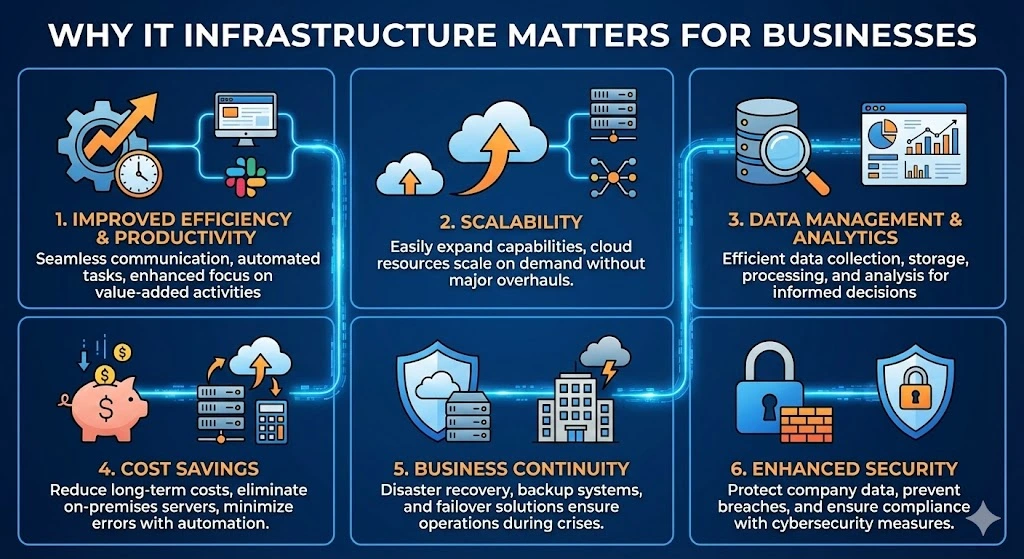
1. Improved Efficiency and Productivity:
A well-designed IT infrastructure ensures seamless communication between systems, automates manual tasks and allows employees to focus on more value-added activities. The integration of advanced software and collaboration tools enhances overall productivity.
2. Scalability:
As businesses grow, their IT needs evolve. A scalable IT infrastructure allows companies to expand their technology capabilities without major overhauls or disruptions. This is particularly important in cloud computing environments, where resources can be quickly scaled up or down based on demand.
3. Data Management and Analytics:
Modern businesses rely heavily on data to make informed decisions. A strong IT infrastructure enables efficient data collection, storage, and processing, providing valuable insights that can drive business strategy. Proper infrastructure also ensures that data remains secure and accessible for analysis.
4. Cost Savings:
By investing in the right infrastructure, businesses can reduce long-term costs. Cloud solutions, for example, eliminate the need for expensive on-premises servers, while automation tools can reduce labor costs and minimize errors.
5. Business Continuity:
A reliable IT infrastructure helps businesses remain operational during crises or unforeseen events. Disaster recovery plans, backup systems, and failover solutions are essential for ensuring business continuity in the face of cyberattacks, hardware failures, or natural disasters.
6. Enhanced Security:
With cyber threats on the rise, protecting company data and customer information is more important than ever. A strong IT infrastructure that incorporates cybersecurity measures helps prevent data breaches and ensures compliance with legal regulations.
Trusted IPv4 Leasing for Business Growth
Get enterprise-grade IPv4 space quickly, with seamless deployment and end-to-end management.
Get Started with i.lease相关文章
关于 弹性IP地址 Elastic IP address: AWS 用户指南
在云计算中,保持 稳定的 IP 地址 对于 网站托管、应用程序和网络管理 至关重要。这就是 Elastic IP 地址(弹性 IP) 发挥作用的地方。如果你使用 亚马逊云 AWS,了解 Elastic IP 的工作原理,可以帮助你 提高可靠性、防止宕机,并优化云端成本。本文将详细介绍 Elastic IP 的定义、工作方式、优势及最佳实践。 什么是弹性 IP 地址? Elastic IP 地址 是 AWS 提供的静态公网 IPv4 地址,可分配给 Amazon EC2(Elastic Compute Cloud)实例。与普通公网 IP 不同,Elastic IP 在实例重启后不会更改,确保服务稳定运行。 弹性 IP 的工作原理 Elastic IP 地址来自 AWS 的 IP 地址池,并可随时分配给 EC2 实例。如果实例发生故障,你可以 快速将 Elastic IP 重新绑定到另一台实例,从而减少宕机时间,保持业务连续性。 ? Elastic IP 主要特点: ✔ 静态 IP 地址 – 不会随实例重启而改变。✔ 可自由分配 – 可在同一区域内的不同实例间切换。✔Read more Related Posts Why IPv4 scarcity drives economic value for operators Finite IPv4 supply, persistent demand, and slow IPv6 transition are turning IP addresses into tradable assets shaping telecom economics globally. IPv4 Read more What Determines IPv4 Pricing in Today’s Market? Scarcity, shifting demand, and leasing platforms such as i.lease are reshaping how IPv4 addresses are valued and traded globally.IPv4 pricing is driven Read more How much does a /24 IPv4 block cost in 2026? IPv4 scarcity continues to shape internet infrastructure, with /24 blocks still trading actively on global markets despite growing IPv6 adoption. Key Read more .related-post {} .related-post .post-list { text-align: left; } .related-post .post-list .item { margin: 5px; padding: 10px; } .related-post .headline { font-size: 18px !important; color: #999999 !important; } .related-post .post-list .item .post_thumb { max-height: 220px; margin: 10px 0px; padding: 0px; display: block; } .related-post .post-list .item .post_title { font-size: 16px; color: #3f3f3f; margin: 10px 0px; padding: 0px; display: block; text-decoration: none; } .related-post .post-list .item .post_excerpt { font-size: 13px; color: #3f3f3f; margin: 10px 0px; padding: 0px; display: block; text-decoration: none; } @media only screen and (min-width: 1024px) { .related-post .post-list .item { width: 30%; } } @media only screen and (min-width: 768px) and (max-width: 1023px) { .related-post .post-list .item { width: 90%; } } @media only screen and (min-width: 0px) and (max-width: 767px) { .related-post .post-list .item { width: 90%; } }
为什么没有 IPv5?互联网协议背后的故事
在讨论互联网协议时,大多数人都熟悉 IPv4 和 IPv6。但你可能会问 IPv5 发生了什么?为什么互联网似乎从 IPv4 跳到了 IPv6?让我们深入了解一下这个 “失踪 ”协议背后的精彩历史。 IPv5 是什么? IPv5 正式名称为互联网流协议(ST),是 20 世纪 70 年代末和 80 年代开发的一种实验性协议。它旨在支持通过 IP 网络传输语音和视频等实时多媒体数据流。与在无连接基础上运行的 IPv4 不同,IPv5 旨在创建一个面向连接的通信系统,以提高多媒体性能。 为什么 IPv5 没有成为下一个主要互联网协议? 尽管 IPv5 具有创新性,但从未被广泛采用。原因就在这里: 1) IP 地址空间限制 IPv5 使用与 IPv4 相同的 32 位地址空间。随着互联网的快速发展,IPv4 地址耗尽成为一个关键问题,这使得 IPv5 的寻址系统同样无法满足未来的需求。 2) 技术转型 随着对可扩展性更强的解决方案的需求不断增长,开发人员将重点放在创建 IPv6 上,IPv6 引入了 128 位寻址,解决了地址短缺的问题,并增加了内置安全性和简化网络管理等增强功能。 3) 试验状况 IPv5 从未打算长期取代 IPv4。它被分配的协议编号为 5,用于试验性使用,协议栈中的这一保留意味着它以后不能被重新命名为未来版本的 IP。 为什么 IPv6 取代了 IPv4(而非 IPv5) IPv6 被设计为 IPv4 的全面升级版,解决了地址短缺等局限性问题,提高了互联网通信的效率。它已成为满足现代网络需求的标准协议,而 IPv5Read more Related Posts Why IPv4 scarcity drives economic value for operators Finite IPv4 supply, persistent demand, and slow IPv6 transition are turning IP addresses into tradable assets shaping telecom economics globally. IPv4 Read more What Determines IPv4 Pricing in Today’s Market? Scarcity, shifting demand, and leasing platforms such as i.lease are reshaping how IPv4 addresses are valued and traded globally.IPv4 pricing is driven Read more The future of IPv4 markets Despite IPv6 expansion, scarcity keeps IPv4 valuable, sustaining a global secondary market where addresses increasingly function as tradable digital assets.Finite Read more .related-post {} .related-post .post-list { text-align: left; } .related-post .post-list .item { margin: 5px; padding: 10px; } .related-post .headline { font-size: 18px !important; color: #999999 !important; } .related-post .post-list .item .post_thumb { max-height: 220px; margin: 10px 0px; padding: 0px; display: block; } .related-post .post-list .item .post_title { font-size: 16px; color: #3f3f3f; margin: 10px 0px; padding: 0px; display: block; text-decoration: none; } .related-post .post-list .item .post_excerpt { font-size: 13px; color: #3f3f3f; margin: 10px 0px; padding: 0px; display: block; text-decoration: none; } @media only screen and (min-width: 1024px) { .related-post .post-list .item { width: 30%; } } @media only screen and (min-width: 768px) and (max-width: 1023px) { .related-post .post-list .item { width: 90%; } } @media only screen and (min-width: 0px) and (max-width: 767px) { .related-post .post-list .item { width: 90%; } }
IP 子网设置和 CIDR:互联网专员指南
在互联网通信中,IP 寻址是使设备能够无缝连接和交换信息的基础技术。对于互联网服务提供商(ISP)和 IT 专业人员来说,了解 IP 子网划分和 CIDR(无类域间路由)对于高效网络管理和可扩展性至关重要。 本文章将深入探讨 IP 子网划分和 CIDR 概念,重点介绍它们的意义和实际应用。 IP 子网设置? IP 子网划分是将大型 IP 网络划分为更小、更易于管理的网段(称为子网)的过程。这就像把一大块土地分割成较小的地块,供特定用途使用,以便更好地组织和利用。 为什么要建立子网? 高效使用 IP 地址: IPv4 地址空间有限,子网划分可确保根据不同网段的具体需求分配地址。 提高安全性: 通过划分网络,可以隔离敏感数据,降低未经授权访问的风险。 减少网络流量: 子网划分可将流量定位在每个子网内,从而减少拥塞并提高性能。 CIDR:无类域间路由 CIDR 引入于 20 世纪 90 年代,它取代了僵化的基于类的 IP 寻址系统。CIDR 允许使用长度可变的子网掩码,从而提供了一种更灵活、更高效的 IP 地址分配方式。 CIDR 的主要特征 可变长度子网掩码 (VLSM): CIDR 允许网络管理员定义不同长度的子网掩码,从而优化地址利用率。 聚合(Supernetting): CIDR 支持路由聚合,将多个 IP 网络合并为一个单一的汇总路由。这可以减少路由表的大小,提高路由器的效率。 消除类别: 传统的 IP 类别(A、B、C)不再具有限制性;有了 CIDR,地址的网络部分由前缀长度定义(如/8、/16、/24)。 子网设置和 CIDR 的实际应用 1. 高效分配 IP 地址 互联网服务提供商经常面临为客户高效分配 IP 地址的挑战。利用 CIDR,ISP 可以为需要 4Read more Related Posts Why IPv4 scarcity drives economic value for operators Finite IPv4 supply, persistent demand, and slow IPv6 transition are turning IP addresses into tradable assets shaping telecom economics globally. IPv4 Read more What Determines IPv4 Pricing in Today’s Market? Scarcity, shifting demand, and leasing platforms such as i.lease are reshaping how IPv4 addresses are valued and traded globally.IPv4 pricing is driven Read more How much does a /24 IPv4 block cost in 2026? IPv4 scarcity continues to shape internet infrastructure, with /24 blocks still trading actively on global markets despite growing IPv6 adoption. Key Read more .related-post {} .related-post .post-list { text-align: left; } .related-post .post-list .item { margin: 5px; padding: 10px; } .related-post .headline { font-size: 18px !important; color: #999999 !important; } .related-post .post-list .item .post_thumb { max-height: 220px; margin: 10px 0px; padding: 0px; display: block; } .related-post .post-list .item .post_title { font-size: 16px; color: #3f3f3f; margin: 10px 0px; padding: 0px; display: block; text-decoration: none; } .related-post .post-list .item .post_excerpt { font-size: 13px; color: #3f3f3f; margin: 10px 0px; padding: 0px; display: block; text-decoration: none; } @media only screen and (min-width: 1024px) { .related-post .post-list .item { width: 30%; } } @media only screen and (min-width: 768px) and (max-width: 1023px) { .related-post .post-list .item { width: 90%; } } @media only screen and (min-width: 0px) and (max-width: 767px) { .related-post .post-list .item { width: 90%; } }