Understanding the Difference Between Ipv4 and IPv6
 admin
admin
When a device connects to a network, it needs to follow a certain standard. This standard, called Internet Protocol, allows a device to communicate with other devices.
Table of Contents
Whether it’s over the Internet or on a local network (like a home or office network), a device needs a network address. A device receives a network address once it connects to a network, typically through a router.
To communicate over the Internet, a device uses an IP address.The Internet Protocol (IP) standardizes how data are structured and how addresses on the Internet must be formatted to deliver data to their destination.
1.0 IP Address Types
Each device that uses “Internet Protocol” can communicate with other devices that can use the same protocol. These devices can be computers, phones, or even toasters. The Internet Protocol addresses can be “public” and “private.”
a. Public IP Addresses
Public IP addresses have direct access to the Internet. An Internet Service Provider (ISP) assigns these addresses to devices like your home router. They allow devices to be reachable from the outside world.
b. Private IP Addresses
Private IP addresses have no direct access to the internet and connect through your home or office router. These addresses are accessible only within private networks such as local networks (LAN) or virtual private networks (VPN).
Your home or office router has a public address. But it also assigns private addresses to devices within your private network. It is related to NAT (Network Address Translation), We will talk a bit later.
Network Address Translation (NAT)
When a private network connects to the Internet and sends out data through a router, the router uses Network Address Translation (NAT).NAT allows multiple devices in a private network to share a single public IP address.
However, it makes it challenging for devices with private addresses to provide services on the Internet as they are not easily reachable from the outside.
2.0 What is IPv4?
You can use NAT only in the fourth version of the Internet Protocol, known as IP version 4 (IPv4). An IPv4 address is made up of four blocks of numbers ranging from 0 to 255 separated by dots.
These four numbers are four groups of eight binary digits (bits). IPv4 addresses are expressed as decimal numbers for readability.For clarity, let’s look at a common IP address: 192.168.0.1.
The table below shows how IPv4 is a binary system represented by decimal digits, for easier readability.
| Decimal | Binary |
| 192 | 11000000 |
| 168 | 10101000 |
| 0 | 00000000 |
| 1 | 00000001 |
3.0 What is IPv6?
The problem with IPv4 is that it provides only approximately 4.3 billion addresses.
4.3 billion is such a small number when we factor in the increasing number of devices connecting to the internet.
To address this limitation, IPv6 was introduced. An IPv6 address is made up of eight blocks of 16-bit numbers. Each block is separated by colons and represented in hexadecimal format. IPv6 uses 128 bits for each address.
In plain speak, an IPv6 address is much longer compared to an IPv4 address. Letters and numbers make up an IPv6 address.
This is an example of an IPv6 address:2001:0db8:85a3:0000:0000:8a2e:0370:7334
4.0 Ipv4 vs IPv6 : A Comparison
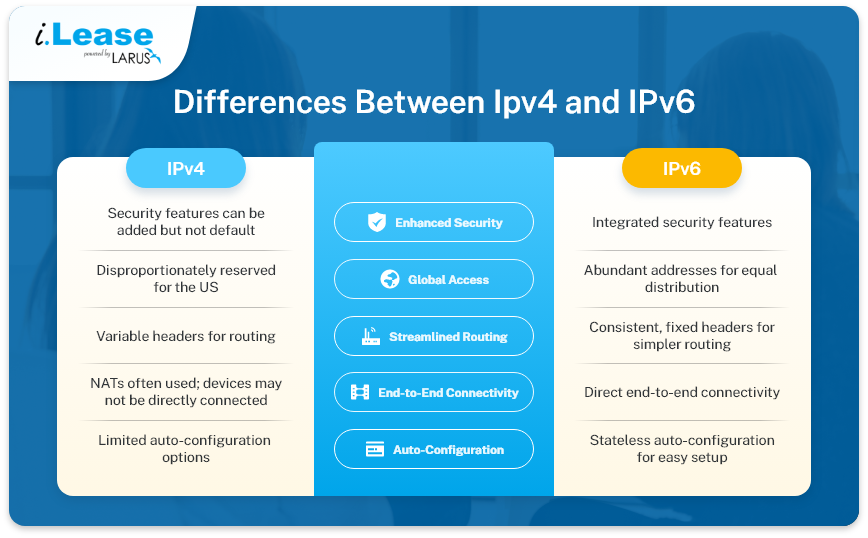
IPv4 is still the most commonly used version of the Internet Protocol. That’s why there’s a huge demand for it. However, IPv6 offers more in terms of performance and security. In this section, we’ll look into IPv4 vs. IPv6.
1. Enhanced Security
IPv6 was designed with integrated security features. While these features can be added to IPv4, they don’t come pre-configured as in the case with IPv6.
2. Global Access
Around 50% of IPv4 addresses were initially reserved for the US, leading to uneven distribution worldwide. In contrast, IPv6 addresses are in higher abundance. Therefore, they can be equally distributed worldwide.
3. Potential for Streamlined Routing
Each IP version has a certain number of headers (or information fields). Some of these fields tell the computers about the type of data, the size of the packet (the data being sent), the source address (where it’s coming from), and the destination address (where it’s going).
IPv6 employs consistent and fixed headers, unlike IPv4’s variable headers. This could simplify the routing code and reduce hardware processing requirements.
4. Direct End-to-End Connectivity
There is enough IPv6 to go around, leaving NATs unnecessary.
With IPv6, each device can directly connect to the internet and communicate with websites without intermediary network address translations.
However, this creates a potential downside: devices that use IPv6 might be more vulnerable if they use the same address over the Internet all the time. The fix is to use a temporary IPv6 address that changes regularly.
5. Effortless Auto-Configuration
IPv6 offers a feature called stateless auto-configuration. Devices can autonomously assign themselves IP addresses based on their unique MAC addresses. Self-configuration makes it easy for devices to find and connect within the same network.
5.0 How Much IPv4 and IPv6 are Used in the World?
As of July 2023, 41% of Google users are using IPv6.
According to APNIC, around 36% of devices are IPv6 capable while 35% are IPv6 preferred. IPv6 is seeing high adoption among various countries. 100% of devices in Bahrain are now using IPv6. The following countries make up the rest of the top 10:
| Country | % of IPv6 Adoption |
| US Minor Outlying Islands | 100% |
| India | 60.9% |
| Malaysia | 57.5% |
| Saudia Arabia | 55.7% |
| France | 55.3% |
| Germany | 55.2% |
| Montserrat | 55.1% |
| Uruguay | 54.5% |
| Belgium | 51.6% |
However, the statistics for IPv6 adoption is lopsided. While some countries are close to a full transition, there are countries in Asia and Africa that barely have any form of IPv6 adoption.
6.0 Why We Haven’t Switched to IPv6 Yet
IPv6 may offer clear advantages. But there are challenges that make its adoption difficult:
6.1 IPv6 devices might not be compatible with devices that run on IPv4.
6.2 There are no clear or immediate benefits for the average user.- Any organization, government, office, or school that wants to upgrade will need upgrades across devices and systems.
7.0 Frequently Asked Questions (FAQ) about Ipv4 vs IPv6
a. What happens when the IPv4 address pool is finally depleted?
Existing devices and networks connected to the Internet using IPv4 addresses will continue to work as they do now. IPv4-based networks are expected to co-exist with IPv6-based networks simultaneously.
b. When will IPv4 addresses actually run out?
The last IPv4 address blocks have already been allocated to the Regional Internet Registries (RIRs). These are either depleted or very close to depletion.
Obtaining new address blocks for future Internet growth will no longer be possible.
c. Is IPv6 more secure than IPv4, or is it less secure?
Debates concerning IPv6 versus IPv4 security often focus on different aspects of network deployment.
IPv6 supports improved security because IP Security (IPsec) was originally developed for IPv6. However, IPsec can also be used with IPv4 — just not built-in.
Reported IPv6 security issues are often related to vulnerabilities in specific products, not the IPv6 protocol itself. Both IPv4 and IPv6 require careful compliance with security practices.
d. Is IPv6 ready for deployment now?
IPv6 is a tried and tested technology deployed since 2002. The core IPv6 specifications have been developed for over 20 years. Major operating systems and software applications are IPv6-ready.
e. Why has it taken so long for IPv6 to be implemented?
The transition to IPv6 didn’t offer immediate advantages in the short term (since people can still get IPv4 by buying or leasing). The switch can also be expensive.
Additionally, the introduction of NAT extended the IPv4 address space, delaying the urgency for IPv6 adoption. Now that IPv4 address space has run out, deploying IPv6 is necessary.
f. How much will the transition to IPv6 cost?
The costs depend on the organization and business. Operational costs, training, and upgrading in-house custom software are potential expenses.
g. I have enough IPv4 addresses today. Why should I bother implementing IPv6?
IPv6 is already widely supported, and more sites will only support IPv6 in the future. Translation mechanisms (like NAT) can negatively impact performance and make troubleshooting complex.
h. Is there a specific date when everything needs to be upgraded to IPv6?
There is no specific date, but organizations should incorporate IPv6 into their upgrade and procurement plans.
i. Will IPv6 addresses run out eventually?
In practical terms, no. IPv6 has sufficient support for trillions of Internet devices in the future.An IPv6 future is near but we’re not quite there yet. If you need reliable connectivity, it might be a good option for you to lease an IPv4 address
相关文章
关于 弹性IP地址 Elastic IP address: AWS 用户指南
在云计算中,保持 稳定的 IP 地址 对于 网站托管、应用程序和网络管理 至关重要。这就是 Elastic IP 地址(弹性 IP) 发挥作用的地方。如果你使用 亚马逊云 AWS,了解 Elastic IP 的工作原理,可以帮助你 提高可靠性、防止宕机,并优化云端成本。本文将详细介绍 Elastic IP 的定义、工作方式、优势及最佳实践。 什么是弹性 IP 地址? Elastic IP 地址 是 AWS 提供的静态公网 IPv4 地址,可分配给 Amazon EC2(Elastic Compute Cloud)实例。与普通公网 IP 不同,Elastic IP 在实例重启后不会更改,确保服务稳定运行。 弹性 IP 的工作原理 Elastic IP 地址来自 AWS 的 IP 地址池,并可随时分配给 EC2 实例。如果实例发生故障,你可以 快速将 Elastic IP 重新绑定到另一台实例,从而减少宕机时间,保持业务连续性。 ? Elastic IP 主要特点: ✔ 静态 IP 地址 – 不会随实例重启而改变。✔ 可自由分配 – 可在同一区域内的不同实例间切换。✔Read more Related Posts Why IPv4 scarcity drives economic value for operators Finite IPv4 supply, persistent demand, and slow IPv6 transition are turning IP addresses into tradable assets shaping telecom economics globally. IPv4 Read more What Determines IPv4 Pricing in Today’s Market? Scarcity, shifting demand, and leasing platforms such as i.lease are reshaping how IPv4 addresses are valued and traded globally.IPv4 pricing is driven Read more How much does a /24 IPv4 block cost in 2026? IPv4 scarcity continues to shape internet infrastructure, with /24 blocks still trading actively on global markets despite growing IPv6 adoption. Key Read more .related-post {} .related-post .post-list { text-align: left; } .related-post .post-list .item { margin: 5px; padding: 10px; } .related-post .headline { font-size: 18px !important; color: #999999 !important; } .related-post .post-list .item .post_thumb { max-height: 220px; margin: 10px 0px; padding: 0px; display: block; } .related-post .post-list .item .post_title { font-size: 16px; color: #3f3f3f; margin: 10px 0px; padding: 0px; display: block; text-decoration: none; } .related-post .post-list .item .post_excerpt { font-size: 13px; color: #3f3f3f; margin: 10px 0px; padding: 0px; display: block; text-decoration: none; } @media only screen and (min-width: 1024px) { .related-post .post-list .item { width: 30%; } } @media only screen and (min-width: 768px) and (max-width: 1023px) { .related-post .post-list .item { width: 90%; } } @media only screen and (min-width: 0px) and (max-width: 767px) { .related-post .post-list .item { width: 90%; } }
为什么没有 IPv5?互联网协议背后的故事
在讨论互联网协议时,大多数人都熟悉 IPv4 和 IPv6。但你可能会问 IPv5 发生了什么?为什么互联网似乎从 IPv4 跳到了 IPv6?让我们深入了解一下这个 “失踪 ”协议背后的精彩历史。 IPv5 是什么? IPv5 正式名称为互联网流协议(ST),是 20 世纪 70 年代末和 80 年代开发的一种实验性协议。它旨在支持通过 IP 网络传输语音和视频等实时多媒体数据流。与在无连接基础上运行的 IPv4 不同,IPv5 旨在创建一个面向连接的通信系统,以提高多媒体性能。 为什么 IPv5 没有成为下一个主要互联网协议? 尽管 IPv5 具有创新性,但从未被广泛采用。原因就在这里: 1) IP 地址空间限制 IPv5 使用与 IPv4 相同的 32 位地址空间。随着互联网的快速发展,IPv4 地址耗尽成为一个关键问题,这使得 IPv5 的寻址系统同样无法满足未来的需求。 2) 技术转型 随着对可扩展性更强的解决方案的需求不断增长,开发人员将重点放在创建 IPv6 上,IPv6 引入了 128 位寻址,解决了地址短缺的问题,并增加了内置安全性和简化网络管理等增强功能。 3) 试验状况 IPv5 从未打算长期取代 IPv4。它被分配的协议编号为 5,用于试验性使用,协议栈中的这一保留意味着它以后不能被重新命名为未来版本的 IP。 为什么 IPv6 取代了 IPv4(而非 IPv5) IPv6 被设计为 IPv4 的全面升级版,解决了地址短缺等局限性问题,提高了互联网通信的效率。它已成为满足现代网络需求的标准协议,而 IPv5Read more Related Posts Why IPv4 scarcity drives economic value for operators Finite IPv4 supply, persistent demand, and slow IPv6 transition are turning IP addresses into tradable assets shaping telecom economics globally. IPv4 Read more What Determines IPv4 Pricing in Today’s Market? Scarcity, shifting demand, and leasing platforms such as i.lease are reshaping how IPv4 addresses are valued and traded globally.IPv4 pricing is driven Read more The future of IPv4 markets Despite IPv6 expansion, scarcity keeps IPv4 valuable, sustaining a global secondary market where addresses increasingly function as tradable digital assets.Finite Read more .related-post {} .related-post .post-list { text-align: left; } .related-post .post-list .item { margin: 5px; padding: 10px; } .related-post .headline { font-size: 18px !important; color: #999999 !important; } .related-post .post-list .item .post_thumb { max-height: 220px; margin: 10px 0px; padding: 0px; display: block; } .related-post .post-list .item .post_title { font-size: 16px; color: #3f3f3f; margin: 10px 0px; padding: 0px; display: block; text-decoration: none; } .related-post .post-list .item .post_excerpt { font-size: 13px; color: #3f3f3f; margin: 10px 0px; padding: 0px; display: block; text-decoration: none; } @media only screen and (min-width: 1024px) { .related-post .post-list .item { width: 30%; } } @media only screen and (min-width: 768px) and (max-width: 1023px) { .related-post .post-list .item { width: 90%; } } @media only screen and (min-width: 0px) and (max-width: 767px) { .related-post .post-list .item { width: 90%; } }
IP 子网设置和 CIDR:互联网专员指南
在互联网通信中,IP 寻址是使设备能够无缝连接和交换信息的基础技术。对于互联网服务提供商(ISP)和 IT 专业人员来说,了解 IP 子网划分和 CIDR(无类域间路由)对于高效网络管理和可扩展性至关重要。 本文章将深入探讨 IP 子网划分和 CIDR 概念,重点介绍它们的意义和实际应用。 IP 子网设置? IP 子网划分是将大型 IP 网络划分为更小、更易于管理的网段(称为子网)的过程。这就像把一大块土地分割成较小的地块,供特定用途使用,以便更好地组织和利用。 为什么要建立子网? 高效使用 IP 地址: IPv4 地址空间有限,子网划分可确保根据不同网段的具体需求分配地址。 提高安全性: 通过划分网络,可以隔离敏感数据,降低未经授权访问的风险。 减少网络流量: 子网划分可将流量定位在每个子网内,从而减少拥塞并提高性能。 CIDR:无类域间路由 CIDR 引入于 20 世纪 90 年代,它取代了僵化的基于类的 IP 寻址系统。CIDR 允许使用长度可变的子网掩码,从而提供了一种更灵活、更高效的 IP 地址分配方式。 CIDR 的主要特征 可变长度子网掩码 (VLSM): CIDR 允许网络管理员定义不同长度的子网掩码,从而优化地址利用率。 聚合(Supernetting): CIDR 支持路由聚合,将多个 IP 网络合并为一个单一的汇总路由。这可以减少路由表的大小,提高路由器的效率。 消除类别: 传统的 IP 类别(A、B、C)不再具有限制性;有了 CIDR,地址的网络部分由前缀长度定义(如/8、/16、/24)。 子网设置和 CIDR 的实际应用 1. 高效分配 IP 地址 互联网服务提供商经常面临为客户高效分配 IP 地址的挑战。利用 CIDR,ISP 可以为需要 4Read more Related Posts Why IPv4 scarcity drives economic value for operators Finite IPv4 supply, persistent demand, and slow IPv6 transition are turning IP addresses into tradable assets shaping telecom economics globally. IPv4 Read more What Determines IPv4 Pricing in Today’s Market? Scarcity, shifting demand, and leasing platforms such as i.lease are reshaping how IPv4 addresses are valued and traded globally.IPv4 pricing is driven Read more How much does a /24 IPv4 block cost in 2026? IPv4 scarcity continues to shape internet infrastructure, with /24 blocks still trading actively on global markets despite growing IPv6 adoption. Key Read more .related-post {} .related-post .post-list { text-align: left; } .related-post .post-list .item { margin: 5px; padding: 10px; } .related-post .headline { font-size: 18px !important; color: #999999 !important; } .related-post .post-list .item .post_thumb { max-height: 220px; margin: 10px 0px; padding: 0px; display: block; } .related-post .post-list .item .post_title { font-size: 16px; color: #3f3f3f; margin: 10px 0px; padding: 0px; display: block; text-decoration: none; } .related-post .post-list .item .post_excerpt { font-size: 13px; color: #3f3f3f; margin: 10px 0px; padding: 0px; display: block; text-decoration: none; } @media only screen and (min-width: 1024px) { .related-post .post-list .item { width: 30%; } } @media only screen and (min-width: 768px) and (max-width: 1023px) { .related-post .post-list .item { width: 90%; } } @media only screen and (min-width: 0px) and (max-width: 767px) { .related-post .post-list .item { width: 90%; } }