What Is a /24 IPv4 Subnet and Why Is It Popular for Leasing?
 Stephanie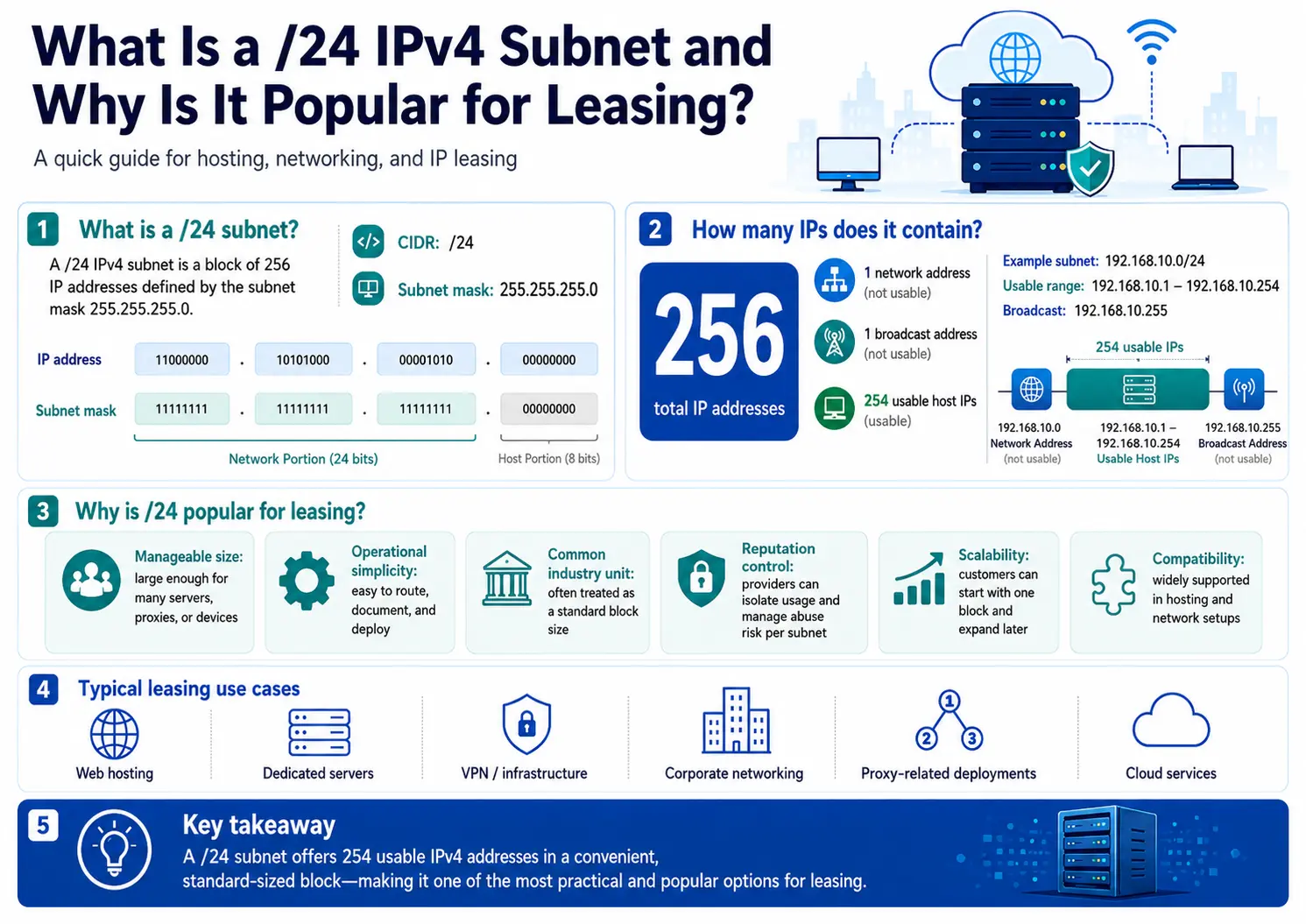
A /24 IPv4 subnet is one of the most common block sizes in the IPv4 leasing market. For hosting providers, SaaS platforms, VPN operators, ISPs, cloud infrastructure teams, and enterprises, it offers a practical balance between address capacity, routing usability, and cost control.
Table of Contents
As IPv4 scarcity continues, businesses are no longer treating IP addresses as simple technical resources. IPv4 space has become operational infrastructure. The question is no longer only “Can we get IP addresses?” but also “Can we use them reliably, route them properly, protect their reputation, and renew them when needed?”
That is why /24 IPv4 blocks remain popular for leasing.
What Is a /24 IPv4 Subnet?
A /24 IPv4 subnet is a block of 256 IPv4 addresses.
IPv4 addresses are 32-bit addresses. In CIDR notation, “/24” means the first 24 bits are used for the network portion, leaving 8 bits for host addresses. Since 8 bits provide 256 possible address combinations, a /24 block contains 256 total IPv4 addresses.
For example:
192.0.2.0/24
This block includes:
192.0.2.0 to 192.0.2.255
In traditional LAN design, the first and last addresses may be reserved as the network and broadcast addresses. However, in public IPv4 leasing and internet routing discussions, a /24 is generally treated as a 256-address allocation.
Why Is a /24 IPv4 Block So Common?
A /24 block is popular because it is the smallest IPv4 prefix that is widely accepted for global BGP routing.
Many networks filter IPv4 routes longer than /24, such as /25 or /26, to reduce routing table growth. This makes /24 the practical minimum size for organizations that want independently routable IPv4 space.
That routing acceptance gives /24 blocks strong market demand. They are large enough for many production use cases but small enough to lease without committing to thousands of addresses.
Why Is a /24 Popular for IPv4 Leasing?
1. It Is Practical for Production Networks
A /24 gives businesses 256 IPv4 addresses, which is enough for many real-world deployments.
Common use cases include:
- Web hosting
- Dedicated servers
- SaaS infrastructure
- VPN services
- Proxy networks
- Email infrastructure
- Cloud platforms
- Cybersecurity testing
- ISP and telecom services
- Enterprise network expansion
For many organizations, a smaller block may not be routable or operationally useful, while a larger block may create unnecessary cost. A /24 sits in the middle, which makes it one of the most flexible IPv4 leasing options.
2. It Helps Businesses Avoid Large Upfront Purchase Costs
Buying IPv4 addresses can require a significant upfront investment. According to i.lease’s guide on how much a /24 IPv4 block costs in 2026, /24 blocks can cost thousands of dollars to purchase, depending on market conditions, block quality, registry region, and reputation.
Leasing gives organizations access to IPv4 space without tying up capital in permanent ownership. This is especially useful for companies that need IPv4 capacity for growth, temporary workloads, customer demand, testing, or regional expansion.
Instead of buying a block outright, businesses can lease a /24 and treat IPv4 as an operating expense.
3. It Is Easier to Deploy Than Larger Allocations
A /24 is easier to document, route, monitor, and manage than larger IPv4 allocations such as /22, /20, or /16 blocks.
Network teams can assign addresses across services, customers, servers, or regions without managing an overly large pool. This makes /24 leasing attractive for organizations that need public IPv4 space but want a manageable operational footprint.
For companies comparing leasing and ownership, the benefits of purchasing a /24 IP block may be worth reviewing. However, for many businesses, leasing remains the more flexible option because it reduces upfront cost and allows capacity to scale as demand changes.
4. It Supports Faster Infrastructure Scaling
A /24 block allows a business to start with a manageable IPv4 allocation and expand later.
This is useful for organizations that do not want to overcommit at the beginning. A startup, hosting provider, SaaS company, or VPN operator may begin with one /24 and lease additional blocks as traffic, customers, or infrastructure needs grow.
This modular approach is one of the main reasons /24 blocks are so active in the leasing market.
5. It Works Well With Managed IPv4 Leasing
Leasing a /24 is not only about receiving a list of IP addresses. Production networks also need routing readiness, clean reputation, proper registry coordination, RPKI, rDNS, abuse handling, and geolocation accuracy.
That is where managed IPv4 leasing becomes important.
With a managed leasing model, businesses can access clean, pre-vetted IPv4 subnets with operational support. This may include Letter of Authorization generation, RPKI and ROA management, rDNS delegation, geofeed synchronization, reputation checks, and abuse mitigation.
For production workloads, these controls matter. A cheap block with poor reputation, bad geolocation, missing route authorization, or weak support can create more cost than it saves.
Why IPv4 Leasing Remains Important
IPv4 addresses remain valuable because the global IPv4 supply is limited and many networks still depend on IPv4 compatibility. IPv6 adoption continues to grow, but the internet still operates in a dual-stack reality where businesses often need IPv4 to reach customers, services, partners, and legacy systems.
This creates ongoing demand from:
- Hosting providers
- Cloud platforms
- Data centers
- ISPs
- SaaS companies
- VPN and proxy operators
- Enterprises
- Cybersecurity firms
- AI and web data infrastructure providers
Because IPv4 supply is scarce, leasing has become a practical way to access address space without going through the full purchase and transfer process.
For a broader look at market drivers, this article on IPv4 lease pricing factors explains how scarcity, block size, region, reputation, and demand can affect leasing cost.
What Makes a Good /24 IPv4 Block for Leasing?
Not every /24 block has the same value. Before leasing, businesses should evaluate the quality and usability of the block.
Important factors include:
IP Reputation
A clean IPv4 block is easier to use for hosting, SaaS, VPN, email, and cloud services. If a block has spam history, blacklist issues, or abuse records, it may require remediation before it can support production workloads.
Routing Readiness
A leased /24 should be ready for BGP announcement. Businesses should confirm that the provider can support LOA issuance, route authorization, and proper registry documentation.
RPKI and ROA Support
RPKI helps protect routing integrity by allowing networks to validate whether an ASN is authorized to announce a prefix. For production IPv4 leasing, RPKI and ROA management are important safeguards against routing mistakes and hijack risk.
rDNS Delegation
Reverse DNS is important for many hosting, email, and enterprise network use cases. A managed leasing provider should be able to support rDNS delegation where required.
Geolocation Accuracy
Incorrect IP geolocation can affect user experience, compliance, content delivery, fraud controls, and service access. Geofeed support and geolocation correction workflows can help keep leased IPv4 blocks properly attributed.
Abuse Handling
Abuse reports can disrupt operations if they are not handled properly. A good leasing provider should have a clear abuse mitigation process to protect the long-term reputation of the block.
Renewal and Continuity
For production systems, losing access to a /24 can create downtime, renumbering work, customer disruption, and reputation risk. This is why businesses should consider not only price but also leasing continuity.
The concept of IPv4 leasing continuity assurance is especially relevant for organizations that cannot afford sudden IP loss, broken routes, renewal uncertainty, or operational interruptions.
Buying vs Leasing a /24 IPv4 Block
Both buying and leasing can make sense depending on the business goal.
Buying may be suitable for organizations that want long-term ownership, have available capital, and are prepared to manage registry transfer, compliance, routing, reputation, and ongoing administration.
Leasing is often better for organizations that want flexibility, faster access, lower upfront cost, and managed operational support.
For many businesses, leasing a /24 is the practical choice because it provides usable IPv4 capacity without the complexity of permanent acquisition.
Is a /24 IPv4 Subnet Right for Your Business?
A /24 IPv4 subnet is a strong option for businesses that need a routable, manageable, and widely accepted block of public IPv4 addresses.
It provides enough capacity for many production use cases, fits common routing policies, and offers a practical entry point into IPv4 leasing. When combined with managed support, a /24 can help businesses scale infrastructure while reducing operational risk.
For organizations that need clean IPv4 space with registry coordination, routing support, reputation checks, RPKI, rDNS, geolocation workflows, and abuse handling, managed leasing is often the smarter path.
A /24 IPv4 subnet remains popular because it solves a real infrastructure problem: businesses still need IPv4, but they need it in a way that is flexible, reliable, and operationally safe.
Looking for reliable IPv4 space? Contact i.lease today to lease a /24 IPv4 subnet with expert support, routing guidance, and end-to-end IP management.
Frequent Asked Questions
1. How many IP addresses are in a /24 IPv4 subnet?
A /24 IPv4 subnet contains 256 total IPv4 addresses. In CIDR notation, “/24” means 24 bits are used for the network portion of the address, leaving 8 bits for individual addresses. Since 8 bits allow 256 combinations, a /24 provides 256 IPv4 addresses.
2. Why is /24 the most common subnet size for leasing?
A /24 is popular because it is widely accepted for global BGP routing and offers a practical number of IP addresses for business use. Smaller blocks such as /25 or /26 may not be accepted by many networks, while larger blocks may cost more than a business needs. This makes /24 a flexible and efficient option for IPv4 leasing.
3. Is it better to lease or buy a /24 IPv4 block?
It depends on your business needs. Buying a /24 may be suitable for organizations that want long-term ownership and have the budget for a large upfront purchase. Leasing is often better for businesses that want lower upfront costs, faster access, flexibility, and managed support. You can compare pricing considerations in i.lease’s guide on how much a /24 IPv4 block costs in 2026.
4. What should I check before leasing a /24 IPv4 subnet?
Before leasing a /24, check the block’s IP reputation, blacklist history, routing readiness, RPKI/ROA support, rDNS delegation, geolocation accuracy, abuse history, lease terms, and renewal conditions. Working with a managed IPv4 leasing provider can help reduce operational risks and make deployment easier.
5. What businesses commonly lease /24 IPv4 blocks?
A wide range of businesses lease /24 IPv4 blocks, including hosting providers, cloud platforms, SaaS companies, ISPs, VPN providers, proxy networks, cybersecurity firms, email infrastructure providers, and enterprises. These organizations often need routable IPv4 space that is large enough for production use but still manageable from a cost and operations perspective.
相关文章

IP地址租赁中的授权书 (LOA) 是什么?LOA 与 ROA 的区别以及需要核实的内容
授权书(Letter of Authorization,LOA)是一份正式文件,由 IP 地址块的注册持有者授权另一方通过指定的自治系统编号(ASN)公告该地址空间。 它是一份书面授权,将使用地址空间的合同权利与实际进行路由公告的技术行为连接起来——如果没有 LOA,上游服务提供商通常会拒绝接受你的路由公告。 正是这种拒绝,使 LOA 在运营上具有决定性意义,而不仅仅是一项行政文件。Transit 服务提供商、数据中心和电信运营商都需要证明,公告某个前缀的一方确实获得了授权,因为接受未经授权的公告就意味着参与了一次路由劫持。Cloudflare 的 BYOIP 文档对此说明得非常明确:其 Transit 服务提供商要求在接受 Cloudflare 代表客户公告的路由之前提供 LOA,而且文件必须明确列出获得授权的前缀以及将用于公告这些前缀的 ASN。整个行业普遍都有类似要求。一家企业即使已经签署租赁协议、完成路由器配置,仍然可能因为 LOA 尚未提供而无法让服务上线。 这份文件还具体体现了一个重要概念,尤其对于租赁地址空间的企业来说十分关键:LOA 授权的是路由公告——它不会转移所有权,也不会更改注册信息。 地址空间仍然注册在原持有者名下;LOA 所授予的只是对该地址空间进行路由的权限。本文将介绍 LOA 包含哪些内容、为什么服务提供商需要它、它与 ROA 和 IRR route object 有什么区别、谁有资格合法签发 LOA,以及在你为准备公告的地址空间付款之前,究竟应该核实哪些事项。 什么是授权书(LOA)? LOA 是由 IP 地址空间的注册持有者签署的一份声明,授权指定的一方通过指定的 ASN 公告特定前缀。 它有时也被称为 Letter of Agency,是一份由人撰写、签署并由上游服务提供商工作人员阅读的合同性质文件,而不是由路由器自动读取的技术记录。 它的作用,是回答路由系统本身无法独立回答的一个问题。公共注册数据能够显示某个地址块由哪个组织持有,但不会显示该持有者允许谁公告这个地址块。当注册持有者以外的网络希望成为某个前缀的起源网络时——例如租户公告租赁的地址空间、服务提供商公告客户的地址块,或平台公告客户的 BYOIP 前缀——上游服务提供商就需要证据证明这一安排已经获得授权。LOA 就是这种证据。 它有两个核心特征: Related Posts IP地址租赁中的授权书 (LOA) 是什么?LOA 与 ROA 的区别以及需要核实的内容 授权书(Letter of Authorization,LOA)是一份正式文件,由 IP 地址块的注册持有者授权另一方通过指定的自治系统编号(ASN)公告该地址空间。 它是一份书面授权,将使用地址空间的合同权利与实际进行路由公告的技术行为连接起来——如果没有 LOA,上游服务提供商通常会拒绝接受你的路由公告。 正是这种拒绝,使 LOA 在运营上具有决定性意义,而不仅仅是一项行政文件。TransitRead more Related Posts IP地址租赁中的授权书 (LOA) 是什么?LOA 与 ROA 的区别以及需要核实的内容 授权书(Letter of Authorization,LOA)是一份正式文件,由 IP 地址块的注册持有者授权另一方通过指定的自治系统编号(ASN)公告该地址空间。 它是一份书面授权,将使用地址空间的合同权利与实际进行路由公告的技术行为连接起来——如果没有 LOA,上游服务提供商通常会拒绝接受你的路由公告。 正是这种拒绝,使 LOA 在运营上具有决定性意义,而不仅仅是一项行政文件。Transit 服务提供商、数据中心和电信运营商都需要证明,公告某个前缀的一方确实获得了授权,因为接受未经授权的公告就意味着参与了一次路由劫持。Cloudflare 的 BYOIP 文档对此说明得非常明确:其 Transit 服务提供商要求在接受 Cloudflare 代表客户公告的路由之前提供 LOA,而且文件必须明确列出获得授权的前缀以及将用于公告这些前缀的 ASN。整个行业普遍都有类似要求。一家企业即使已经签署租赁协议、完成路由器配置,仍然可能因为 Qu’est-ce qu’une lettre d’autorisation (LOA) dans le cadre d’un bail de propriété intellectuelle ? LOA vs ROA et points à vérifier Une Lettre d’Autorisation (LOA) est un document officiel dans lequel le titulaire enregistré d’un bloc d’adresses IP autorise une autre What Is a Letter of Authorization (LOA) in IP Leasing? LOA vs ROA and What to Verify A Letter of Authorization (LOA) is a formal document in which the registered holder of an IP address block authorizes .related-post {} .related-post .post-list { text-align: left; } .related-post .post-list .item { margin: 5px; padding: 10px; } .related-post .headline { font-size: 18px !important; color: #999999 !important; } .related-post .post-list .item .post_thumb { max-height: 220px; margin: 10px 0px; padding: 0px; display: block; } .related-post .post-list .item .post_title { font-size: 16px; color: #3f3f3f; margin: 10px 0px; padding: 0px; display: block; text-decoration: none; } .related-post .post-list .item .post_excerpt { font-size: 13px; color: #3f3f3f; margin: 10px 0px; padding: 0px; display: block; text-decoration: none; } @media only screen and (min-width: 1024px) { .related-post .post-list .item { width: 30%; } } @media only screen and (min-width: 768px) and (max-width: 1023px) { .related-post .post-list .item { width: 90%; } } @media only screen and (min-width: 0px) and (max-width: 767px) { .related-post .post-list .item { width: 90%; } }
IPv4 地址总共有多少个?43 亿个地址详解
在 32 位 IPv4 地址空间中,理论上总共有 4,294,967,296 个可能的 IPv4 地址。 这个数字来自 232,因为一个 IPv4 地址包含 32 个二进制位。然而,42.9 亿并不意味着有 42.9 亿个地址可用于普通的公共互联网。IPv4 地址空间中的很大一部分被保留用于私有网络、回环通信、多播、共享地址空间、文档、基准测试、协议功能以及其他特殊用途。剩余的全球可用地址空间,在互联网发展历史中也已经被大量分配。IPv4 地址总量与可公开使用的 IPv4 地址之间的这种差别非常重要。它有助于解释 IPv4 地址耗尽、NAT 和 CGNAT 的持续使用、IPv4 转让与租赁市场的增长,以及为什么即使 IPv6 的采用不断增加,企业仍然需要谨慎规划 IPv4 资源。 一共有多少个 IPv4 地址? IPv4 理论上总共有 4,294,967,296 个唯一地址。 这个数量由 IPv4 的设计所决定:每个地址长度为 32 位,因此该协议可以表示 232 种不同的二进制组合。 IPv4 地址容量一览32 位地址空间 → 232 种组合 → 4,294,967,296 个 IPv4 地址总量 这个数字通常会四舍五入为 43 亿个 IPv4 地址。需要注意的是,这只是整个数学地址空间的大小,并不等于可供企业用于网站、服务器、VPN、云服务或其他公共互联网服务的地址数量。 为什么 IPv4 只有大约 43 亿个地址? IPv4 是围绕一个 Related Posts Qu’est-ce qu’une lettre d’autorisation (LOA) dans le cadre d’un bail de propriété intellectuelle ? LOA vs ROA et points à vérifier Une Lettre d’Autorisation (LOA) est un document officiel dans lequel le titulaire enregistré d’un bloc d’adresses IP autorise une autre 数据中心IP地址与住宅IP地址:区别是什么?为什么这很重要? 常见问题解答 数据中心 IP 地址来源于商业数据中心、云服务提供商或托管公司,而住宅 IP 地址则由互联网服务提供商分配给家庭或企业用户。 两者的区别在于来源:一种来自为运行服务器而建设的基础设施,另一种来自为终端用户提供连接而建设的网络。正是这一根本区别,决定了互联网其他系统如何看待来自这两类地址的流量。 这个话题通常只会在代理和反检测的狭窄语境下被讨论,因此很容易形成片面的认知。实际上,数据中心 IP 与住宅 IP 的区别,对任何运营互联网基础设施的人都很重要,因为它会影响一个地址天然具有多少信任度、网站和安全系统如何响应它,以及这个地址适合什么用途。几乎所有合法的商业互联网基础设施——包括你使用的每个网站、API、邮件服务器和云服务——都运行在数据中心 IP 地址空间上,而这本来就是正确的使用方式。重点并不是哪一种更好、哪一种更差;而是它们服务于不同目的,也会受到不同方式的对待。了解自己正在使用或真正需要哪一种,可以避免许多本来可以避免的问题。 本文将解释这两种 IP 地址分别是什么、系统如何区分它们、为什么它们会受到不同对待,以及这种差异对于在公共 IPv4 地址空间上部署真实服务的企业意味着什么——包括它与地址信誉、地理定位以及不同使用场景究竟需要哪种地址空间之间的关系。 数据中心 Direcciones IP de centros de datos frente a direcciones IP residenciales: ¿Cuál es la diferencia y por qué es importante? A data center IP address originates from a commercial data center, cloud provider, or hosting company, while a residential IP .related-post {} .related-post .post-list { text-align: left; } .related-post .post-list .item { margin: 5px; padding: 10px; } .related-post .headline { font-size: 18px !important; color: #999999 !important; } .related-post .post-list .item .post_thumb { max-height: 220px; margin: 10px 0px; padding: 0px; display: block; } .related-post .post-list .item .post_title { font-size: 16px; color: #3f3f3f; margin: 10px 0px; padding: 0px; display: block; text-decoration: none; } .related-post .post-list .item .post_excerpt { font-size: 13px; color: #3f3f3f; margin: 10px 0px; padding: 0px; display: block; text-decoration: none; } @media only screen and (min-width: 1024px) { .related-post .post-list .item { width: 30%; } } @media only screen and (min-width: 768px) and (max-width: 1023px) { .related-post .post-list .item { width: 90%; } } @media only screen and (min-width: 0px) and (max-width: 767px) { .related-post .post-list .item { width: 90%; } }
数据中心IP地址与住宅IP地址:区别是什么?为什么这很重要?
常见问题解答 数据中心 IP 地址来源于商业数据中心、云服务提供商或托管公司,而住宅 IP 地址则由互联网服务提供商分配给家庭或企业用户。 两者的区别在于来源:一种来自为运行服务器而建设的基础设施,另一种来自为终端用户提供连接而建设的网络。正是这一根本区别,决定了互联网其他系统如何看待来自这两类地址的流量。 这个话题通常只会在代理和反检测的狭窄语境下被讨论,因此很容易形成片面的认知。实际上,数据中心 IP 与住宅 IP 的区别,对任何运营互联网基础设施的人都很重要,因为它会影响一个地址天然具有多少信任度、网站和安全系统如何响应它,以及这个地址适合什么用途。几乎所有合法的商业互联网基础设施——包括你使用的每个网站、API、邮件服务器和云服务——都运行在数据中心 IP 地址空间上,而这本来就是正确的使用方式。重点并不是哪一种更好、哪一种更差;而是它们服务于不同目的,也会受到不同方式的对待。了解自己正在使用或真正需要哪一种,可以避免许多本来可以避免的问题。 本文将解释这两种 IP 地址分别是什么、系统如何区分它们、为什么它们会受到不同对待,以及这种差异对于在公共 IPv4 地址空间上部署真实服务的企业意味着什么——包括它与地址信誉、地理定位以及不同使用场景究竟需要哪种地址空间之间的关系。 数据中心 IP 与住宅 IP:简要答案 数据中心 IP 来自托管和云基础设施,并且会被系统识别为这类基础设施;住宅 IP 来自消费者 ISP 连接,因此通常会被视为普通终端用户。 这种识别会带来一系列实际差异: 两者都不是天生更优。Web 服务器应该运行在数据中心 IP 上;这正是这种地址类型存在的用途。只有在某些特定情况下,这种差异才会成为真正的决策点——主要是当目标是让流量看起来像普通消费者,而不是基础设施时。相比大多数相关文章所暗示的情况,这其实是一种更狭窄、更专业的需求。 什么是数据中心 IP 地址? 数据中心 IP 地址是指来源于商业数据中心、云服务提供商或托管公司的 IP 地址,而不是来源于消费者 ISP 网络连接。 这些地址通常以大型地址块的形式分配给托管公司和云服务提供商,因此运行在这些基础设施上的服务器都会使用数据中心 IP。 它们的特性源自其本身的用途——大规模运行服务器: 数据中心 IP 是几乎所有面向互联网服务的基础。当你访问网站、调用 API 或连接云应用时,你几乎肯定是在访问一个数据中心 IP。能够明确识别其基础设施身份并不是缺点——对于服务器来说,被识别为基础设施完全符合其本来的用途。 什么是住宅 IP 地址? 住宅 IP 地址是由互联网服务提供商分配给家庭或企业用户的地址,与真实物理位置上的消费者网络连接相关。 当普通用户在家中浏览互联网时,互联网所看到的地址通常就是其 ISP 提供的住宅 IP。 它们的特性同样来自其来源——真实的消费者网络连接: 还有一种特殊类别,即住宅代理,它会通过住宅 IP 转发流量,使流量看起来来自普通家庭用户。该领域中合乎伦理的服务会从真正同意参与的用户处获取地址——来源是否合法是一个真实且重要的区别因素,因为其他方式会引发明显的用户同意问题。 数据中心 Related Posts Qu’est-ce qu’une lettre d’autorisation (LOA) dans le cadre d’un bail de propriété intellectuelle ? LOA vs ROA et points à vérifier Une Lettre d’Autorisation (LOA) est un document officiel dans lequel le titulaire enregistré d’un bloc d’adresses IP autorise une autre 数据中心IP地址与住宅IP地址:区别是什么?为什么这很重要? 常见问题解答 数据中心 IP 地址来源于商业数据中心、云服务提供商或托管公司,而住宅 IP 地址则由互联网服务提供商分配给家庭或企业用户。 两者的区别在于来源:一种来自为运行服务器而建设的基础设施,另一种来自为终端用户提供连接而建设的网络。正是这一根本区别,决定了互联网其他系统如何看待来自这两类地址的流量。 这个话题通常只会在代理和反检测的狭窄语境下被讨论,因此很容易形成片面的认知。实际上,数据中心 IP 与住宅 IP 的区别,对任何运营互联网基础设施的人都很重要,因为它会影响一个地址天然具有多少信任度、网站和安全系统如何响应它,以及这个地址适合什么用途。几乎所有合法的商业互联网基础设施——包括你使用的每个网站、API、邮件服务器和云服务——都运行在数据中心 IP 地址空间上,而这本来就是正确的使用方式。重点并不是哪一种更好、哪一种更差;而是它们服务于不同目的,也会受到不同方式的对待。了解自己正在使用或真正需要哪一种,可以避免许多本来可以避免的问题。 本文将解释这两种 IP 地址分别是什么、系统如何区分它们、为什么它们会受到不同对待,以及这种差异对于在公共 IPv4 地址空间上部署真实服务的企业意味着什么——包括它与地址信誉、地理定位以及不同使用场景究竟需要哪种地址空间之间的关系。 数据中心 Direcciones IP de centros de datos frente a direcciones IP residenciales: ¿Cuál es la diferencia y por qué es importante? A data center IP address originates from a commercial data center, cloud provider, or hosting company, while a residential IP .related-post {} .related-post .post-list { text-align: left; } .related-post .post-list .item { margin: 5px; padding: 10px; } .related-post .headline { font-size: 18px !important; color: #999999 !important; } .related-post .post-list .item .post_thumb { max-height: 220px; margin: 10px 0px; padding: 0px; display: block; } .related-post .post-list .item .post_title { font-size: 16px; color: #3f3f3f; margin: 10px 0px; padding: 0px; display: block; text-decoration: none; } .related-post .post-list .item .post_excerpt { font-size: 13px; color: #3f3f3f; margin: 10px 0px; padding: 0px; display: block; text-decoration: none; } @media only screen and (min-width: 1024px) { .related-post .post-list .item { width: 30%; } } @media only screen and (min-width: 768px) and (max-width: 1023px) { .related-post .post-list .item { width: 90%; } } @media only screen and (min-width: 0px) and (max-width: 767px) { .related-post .post-list .item { width: 90%; } }
