Comment les forces de l’ordre traquent les pirates informatiques et les escrocs des télécommunications : outils et techniques
 Stephanie
Cybercrime is on the rise, with hackers and telco scammers using sophisticated methods to hide their identities. Law enforcement agencies rely on advanced IP tracking tools, forensic analysis, and cyber intelligence to trace and catch these criminals. In this article, we’ll explore the top tools and techniques used by authorities worldwide to track down cybercriminals.
Table of Contents
IP Tracking & Geolocation Tools
To pinpoint the location of a hacker, authorities use IP tracking and geolocation tools such as MaxMind GeoIP, IPinfo.io, and Whois Lookup. These tools provide insights into an IP address’s physical location, associated ISP, and network details. Shodan and Censys further help by scanning connected devices to reveal potential vulnerabilities that hackers might exploit.
Network Traffic Analysis & Packet Capture
Monitoring real-time network traffic is essential in cybercrime investigations. Tools like Wireshark, Tcpdump, and Zeek (Bro IDS) allow law enforcement to capture and analyze network packets, helping to identify malicious activity. These tools can detect unauthorized connections, suspicious data transfers, and unusual traffic spikes that may indicate cybercrime activities.
Digital Forensics & Log Analysis
Cybercriminals often leave digital footprints that can be uncovered through forensic analysis. Tools like Autopsy, X-Ways Forensics, and Splunk help authorities analyze logs, recover deleted files, and trace an attacker’s movements. ELK Stack (Elasticsearch, Logstash, Kibana) and Graylog provide powerful log monitoring capabilities, assisting in tracking hacker activities over time.
OSINT (Open-Source Intelligence) Tools
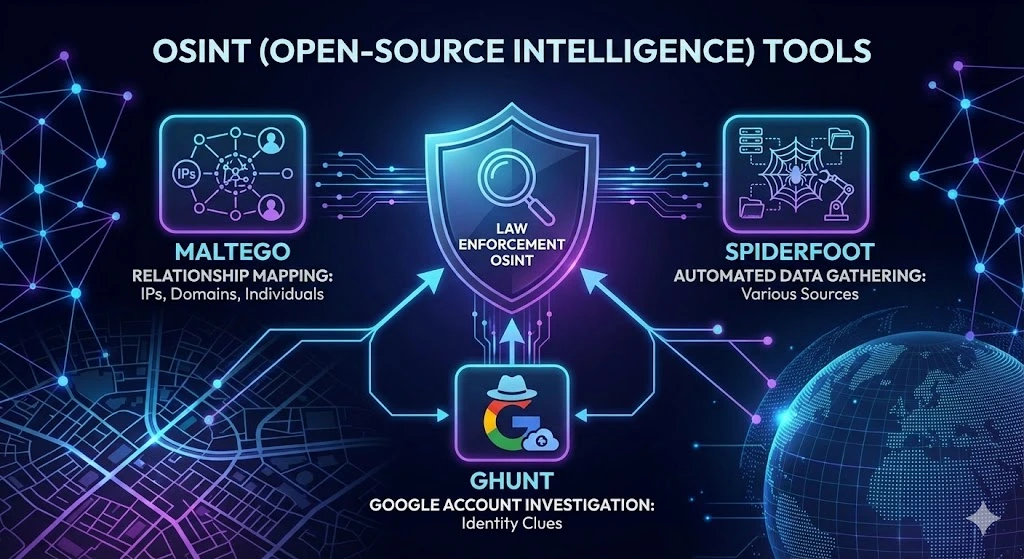
Law enforcement leverages OSINT tools to collect intelligence from publicly available sources. Maltego helps map relationships between IPs, domains, and individuals, while SpiderFoot automates data gathering from various sources. Additionally, GHunt can investigate Google account activity, providing valuable clues about a suspect’s identity.
Tor & Dark Web Monitoring
Hackers and scammers frequently use Tor and dark web platforms to operate anonymously. Tools like Ahmia and OnionScan assist in uncovering hidden services, while CipherTrace and Chainalysis track cryptocurrency transactions linked to cybercrime. Law enforcement also employs ShadowDragon to monitor darknet activities and uncover criminal networks.
ISP Collaboration & Legal Requests
One of the most effective ways to trace hackers is through ISP collaboration. Law enforcement agencies issue subpoenas and MLAT (Mutual Legal Assistance Treaty) requests to obtain user logs from ISPs. Programs like LEAP (Law Enforcement Access Program) and organizations such as Interpol, FBI, and Europol work together to track cybercriminals across borders.
Anti-VPN & Proxy Detection
Many hackers use VPNs, proxies, or the Tor network to mask their real IP addresses. Tools like IPQualityScore, FraudLabs Pro, and Scamalytics help detect these disguises by identifying suspicious IP patterns, VPN usage, and proxy servers. These solutions help law enforcement unmask hidden attackers.
Honeypots & Cyber Threat Intelligence

To catch cybercriminals, law enforcement deploys honeypots—decoy systems designed to lure hackers. Tools like Dionaea, Cowrie, and T-Pot simulate vulnerable systems, allowing authorities to study attacker behavior. Additionally, AlienVault OTX and VirusTotal provide real-time threat intelligence, helping to identify and block malicious IP addresses.
Advanced & Government-Level Tracking
Top intelligence agencies employ advanced surveillance programs to track cybercriminals worldwide. XKeyscore (NSA tool) and PRISM (U.S. surveillance program) collect vast amounts of internet data. Echelon, a global surveillance system, monitors communications for national security threats. Meanwhile, Palantir Gotham integrates AI-powered analytics for large-scale investigations.
How Law Enforcement Tracks Hackers & Scammers
To successfully track and apprehend cybercriminals, law enforcement follows a multi-layered approach. This includes IP geolocation tracking, ISP subpoenas, network traffic analysis, OSINT research, and social engineering tactics. Some agencies conduct undercover dark web operations to infiltrate hacking forums and identify criminal masterminds. By combining cutting-edge technology with intelligence collaboration, authorities can track and prosecute hackers effectively.
Final Thoughts
As cyber threats continue to evolve, so do the tools and techniques used by law enforcement to track and locate hackers and scammers. By leveraging IP tracking, digital forensics, OSINT, honeypots, and dark web monitoring, authorities can uncover cybercriminal networks and bring them to justice. If you’re in cybersecurity, law enforcement, or digital forensics, staying ahead of these trends is critical to combating online threats.
Trusted IPv4 Leasing for Business Growth
Get enterprise-grade IPv4 space quickly, with seamless deployment and end-to-end management.
Get Started with i.lease相关文章

IP地址租赁中的授权书 (LOA) 是什么?LOA 与 ROA 的区别以及需要核实的内容
授权书(Letter of Authorization,LOA)是一份正式文件,由 IP 地址块的注册持有者授权另一方通过指定的自治系统编号(ASN)公告该地址空间。 它是一份书面授权,将使用地址空间的合同权利与实际进行路由公告的技术行为连接起来——如果没有 LOA,上游服务提供商通常会拒绝接受你的路由公告。 正是这种拒绝,使 LOA 在运营上具有决定性意义,而不仅仅是一项行政文件。Transit 服务提供商、数据中心和电信运营商都需要证明,公告某个前缀的一方确实获得了授权,因为接受未经授权的公告就意味着参与了一次路由劫持。Cloudflare 的 BYOIP 文档对此说明得非常明确:其 Transit 服务提供商要求在接受 Cloudflare 代表客户公告的路由之前提供 LOA,而且文件必须明确列出获得授权的前缀以及将用于公告这些前缀的 ASN。整个行业普遍都有类似要求。一家企业即使已经签署租赁协议、完成路由器配置,仍然可能因为 LOA 尚未提供而无法让服务上线。 这份文件还具体体现了一个重要概念,尤其对于租赁地址空间的企业来说十分关键:LOA 授权的是路由公告——它不会转移所有权,也不会更改注册信息。 地址空间仍然注册在原持有者名下;LOA 所授予的只是对该地址空间进行路由的权限。本文将介绍 LOA 包含哪些内容、为什么服务提供商需要它、它与 ROA 和 IRR route object 有什么区别、谁有资格合法签发 LOA,以及在你为准备公告的地址空间付款之前,究竟应该核实哪些事项。 什么是授权书(LOA)? LOA 是由 IP 地址空间的注册持有者签署的一份声明,授权指定的一方通过指定的 ASN 公告特定前缀。 它有时也被称为 Letter of Agency,是一份由人撰写、签署并由上游服务提供商工作人员阅读的合同性质文件,而不是由路由器自动读取的技术记录。 它的作用,是回答路由系统本身无法独立回答的一个问题。公共注册数据能够显示某个地址块由哪个组织持有,但不会显示该持有者允许谁公告这个地址块。当注册持有者以外的网络希望成为某个前缀的起源网络时——例如租户公告租赁的地址空间、服务提供商公告客户的地址块,或平台公告客户的 BYOIP 前缀——上游服务提供商就需要证据证明这一安排已经获得授权。LOA 就是这种证据。 它有两个核心特征: Related Posts IP地址租赁中的授权书 (LOA) 是什么?LOA 与 ROA 的区别以及需要核实的内容 授权书(Letter of Authorization,LOA)是一份正式文件,由 IP 地址块的注册持有者授权另一方通过指定的自治系统编号(ASN)公告该地址空间。 它是一份书面授权,将使用地址空间的合同权利与实际进行路由公告的技术行为连接起来——如果没有 LOA,上游服务提供商通常会拒绝接受你的路由公告。 正是这种拒绝,使 LOA 在运营上具有决定性意义,而不仅仅是一项行政文件。TransitRead more Related Posts IP地址租赁中的授权书 (LOA) 是什么?LOA 与 ROA 的区别以及需要核实的内容 授权书(Letter of Authorization,LOA)是一份正式文件,由 IP 地址块的注册持有者授权另一方通过指定的自治系统编号(ASN)公告该地址空间。 它是一份书面授权,将使用地址空间的合同权利与实际进行路由公告的技术行为连接起来——如果没有 LOA,上游服务提供商通常会拒绝接受你的路由公告。 正是这种拒绝,使 LOA 在运营上具有决定性意义,而不仅仅是一项行政文件。Transit 服务提供商、数据中心和电信运营商都需要证明,公告某个前缀的一方确实获得了授权,因为接受未经授权的公告就意味着参与了一次路由劫持。Cloudflare 的 BYOIP 文档对此说明得非常明确:其 Transit 服务提供商要求在接受 Cloudflare 代表客户公告的路由之前提供 LOA,而且文件必须明确列出获得授权的前缀以及将用于公告这些前缀的 ASN。整个行业普遍都有类似要求。一家企业即使已经签署租赁协议、完成路由器配置,仍然可能因为 Qu’est-ce qu’une lettre d’autorisation (LOA) dans le cadre d’un bail de propriété intellectuelle ? LOA vs ROA et points à vérifier Une Lettre d’Autorisation (LOA) est un document officiel dans lequel le titulaire enregistré d’un bloc d’adresses IP autorise une autre What Is a Letter of Authorization (LOA) in IP Leasing? LOA vs ROA and What to Verify A Letter of Authorization (LOA) is a formal document in which the registered holder of an IP address block authorizes .related-post {} .related-post .post-list { text-align: left; } .related-post .post-list .item { margin: 5px; padding: 10px; } .related-post .headline { font-size: 18px !important; color: #999999 !important; } .related-post .post-list .item .post_thumb { max-height: 220px; margin: 10px 0px; padding: 0px; display: block; } .related-post .post-list .item .post_title { font-size: 16px; color: #3f3f3f; margin: 10px 0px; padding: 0px; display: block; text-decoration: none; } .related-post .post-list .item .post_excerpt { font-size: 13px; color: #3f3f3f; margin: 10px 0px; padding: 0px; display: block; text-decoration: none; } @media only screen and (min-width: 1024px) { .related-post .post-list .item { width: 30%; } } @media only screen and (min-width: 768px) and (max-width: 1023px) { .related-post .post-list .item { width: 90%; } } @media only screen and (min-width: 0px) and (max-width: 767px) { .related-post .post-list .item { width: 90%; } }
IPv4 地址总共有多少个?43 亿个地址详解
在 32 位 IPv4 地址空间中,理论上总共有 4,294,967,296 个可能的 IPv4 地址。 这个数字来自 232,因为一个 IPv4 地址包含 32 个二进制位。然而,42.9 亿并不意味着有 42.9 亿个地址可用于普通的公共互联网。IPv4 地址空间中的很大一部分被保留用于私有网络、回环通信、多播、共享地址空间、文档、基准测试、协议功能以及其他特殊用途。剩余的全球可用地址空间,在互联网发展历史中也已经被大量分配。IPv4 地址总量与可公开使用的 IPv4 地址之间的这种差别非常重要。它有助于解释 IPv4 地址耗尽、NAT 和 CGNAT 的持续使用、IPv4 转让与租赁市场的增长,以及为什么即使 IPv6 的采用不断增加,企业仍然需要谨慎规划 IPv4 资源。 一共有多少个 IPv4 地址? IPv4 理论上总共有 4,294,967,296 个唯一地址。 这个数量由 IPv4 的设计所决定:每个地址长度为 32 位,因此该协议可以表示 232 种不同的二进制组合。 IPv4 地址容量一览32 位地址空间 → 232 种组合 → 4,294,967,296 个 IPv4 地址总量 这个数字通常会四舍五入为 43 亿个 IPv4 地址。需要注意的是,这只是整个数学地址空间的大小,并不等于可供企业用于网站、服务器、VPN、云服务或其他公共互联网服务的地址数量。 为什么 IPv4 只有大约 43 亿个地址? IPv4 是围绕一个 Related Posts Qu’est-ce qu’une lettre d’autorisation (LOA) dans le cadre d’un bail de propriété intellectuelle ? LOA vs ROA et points à vérifier Une Lettre d’Autorisation (LOA) est un document officiel dans lequel le titulaire enregistré d’un bloc d’adresses IP autorise une autre 数据中心IP地址与住宅IP地址:区别是什么?为什么这很重要? 常见问题解答 数据中心 IP 地址来源于商业数据中心、云服务提供商或托管公司,而住宅 IP 地址则由互联网服务提供商分配给家庭或企业用户。 两者的区别在于来源:一种来自为运行服务器而建设的基础设施,另一种来自为终端用户提供连接而建设的网络。正是这一根本区别,决定了互联网其他系统如何看待来自这两类地址的流量。 这个话题通常只会在代理和反检测的狭窄语境下被讨论,因此很容易形成片面的认知。实际上,数据中心 IP 与住宅 IP 的区别,对任何运营互联网基础设施的人都很重要,因为它会影响一个地址天然具有多少信任度、网站和安全系统如何响应它,以及这个地址适合什么用途。几乎所有合法的商业互联网基础设施——包括你使用的每个网站、API、邮件服务器和云服务——都运行在数据中心 IP 地址空间上,而这本来就是正确的使用方式。重点并不是哪一种更好、哪一种更差;而是它们服务于不同目的,也会受到不同方式的对待。了解自己正在使用或真正需要哪一种,可以避免许多本来可以避免的问题。 本文将解释这两种 IP 地址分别是什么、系统如何区分它们、为什么它们会受到不同对待,以及这种差异对于在公共 IPv4 地址空间上部署真实服务的企业意味着什么——包括它与地址信誉、地理定位以及不同使用场景究竟需要哪种地址空间之间的关系。 数据中心 Direcciones IP de centros de datos frente a direcciones IP residenciales: ¿Cuál es la diferencia y por qué es importante? A data center IP address originates from a commercial data center, cloud provider, or hosting company, while a residential IP .related-post {} .related-post .post-list { text-align: left; } .related-post .post-list .item { margin: 5px; padding: 10px; } .related-post .headline { font-size: 18px !important; color: #999999 !important; } .related-post .post-list .item .post_thumb { max-height: 220px; margin: 10px 0px; padding: 0px; display: block; } .related-post .post-list .item .post_title { font-size: 16px; color: #3f3f3f; margin: 10px 0px; padding: 0px; display: block; text-decoration: none; } .related-post .post-list .item .post_excerpt { font-size: 13px; color: #3f3f3f; margin: 10px 0px; padding: 0px; display: block; text-decoration: none; } @media only screen and (min-width: 1024px) { .related-post .post-list .item { width: 30%; } } @media only screen and (min-width: 768px) and (max-width: 1023px) { .related-post .post-list .item { width: 90%; } } @media only screen and (min-width: 0px) and (max-width: 767px) { .related-post .post-list .item { width: 90%; } }
数据中心IP地址与住宅IP地址:区别是什么?为什么这很重要?
常见问题解答 数据中心 IP 地址来源于商业数据中心、云服务提供商或托管公司,而住宅 IP 地址则由互联网服务提供商分配给家庭或企业用户。 两者的区别在于来源:一种来自为运行服务器而建设的基础设施,另一种来自为终端用户提供连接而建设的网络。正是这一根本区别,决定了互联网其他系统如何看待来自这两类地址的流量。 这个话题通常只会在代理和反检测的狭窄语境下被讨论,因此很容易形成片面的认知。实际上,数据中心 IP 与住宅 IP 的区别,对任何运营互联网基础设施的人都很重要,因为它会影响一个地址天然具有多少信任度、网站和安全系统如何响应它,以及这个地址适合什么用途。几乎所有合法的商业互联网基础设施——包括你使用的每个网站、API、邮件服务器和云服务——都运行在数据中心 IP 地址空间上,而这本来就是正确的使用方式。重点并不是哪一种更好、哪一种更差;而是它们服务于不同目的,也会受到不同方式的对待。了解自己正在使用或真正需要哪一种,可以避免许多本来可以避免的问题。 本文将解释这两种 IP 地址分别是什么、系统如何区分它们、为什么它们会受到不同对待,以及这种差异对于在公共 IPv4 地址空间上部署真实服务的企业意味着什么——包括它与地址信誉、地理定位以及不同使用场景究竟需要哪种地址空间之间的关系。 数据中心 IP 与住宅 IP:简要答案 数据中心 IP 来自托管和云基础设施,并且会被系统识别为这类基础设施;住宅 IP 来自消费者 ISP 连接,因此通常会被视为普通终端用户。 这种识别会带来一系列实际差异: 两者都不是天生更优。Web 服务器应该运行在数据中心 IP 上;这正是这种地址类型存在的用途。只有在某些特定情况下,这种差异才会成为真正的决策点——主要是当目标是让流量看起来像普通消费者,而不是基础设施时。相比大多数相关文章所暗示的情况,这其实是一种更狭窄、更专业的需求。 什么是数据中心 IP 地址? 数据中心 IP 地址是指来源于商业数据中心、云服务提供商或托管公司的 IP 地址,而不是来源于消费者 ISP 网络连接。 这些地址通常以大型地址块的形式分配给托管公司和云服务提供商,因此运行在这些基础设施上的服务器都会使用数据中心 IP。 它们的特性源自其本身的用途——大规模运行服务器: 数据中心 IP 是几乎所有面向互联网服务的基础。当你访问网站、调用 API 或连接云应用时,你几乎肯定是在访问一个数据中心 IP。能够明确识别其基础设施身份并不是缺点——对于服务器来说,被识别为基础设施完全符合其本来的用途。 什么是住宅 IP 地址? 住宅 IP 地址是由互联网服务提供商分配给家庭或企业用户的地址,与真实物理位置上的消费者网络连接相关。 当普通用户在家中浏览互联网时,互联网所看到的地址通常就是其 ISP 提供的住宅 IP。 它们的特性同样来自其来源——真实的消费者网络连接: 还有一种特殊类别,即住宅代理,它会通过住宅 IP 转发流量,使流量看起来来自普通家庭用户。该领域中合乎伦理的服务会从真正同意参与的用户处获取地址——来源是否合法是一个真实且重要的区别因素,因为其他方式会引发明显的用户同意问题。 数据中心 Related Posts Qu’est-ce qu’une lettre d’autorisation (LOA) dans le cadre d’un bail de propriété intellectuelle ? LOA vs ROA et points à vérifier Une Lettre d’Autorisation (LOA) est un document officiel dans lequel le titulaire enregistré d’un bloc d’adresses IP autorise une autre 数据中心IP地址与住宅IP地址:区别是什么?为什么这很重要? 常见问题解答 数据中心 IP 地址来源于商业数据中心、云服务提供商或托管公司,而住宅 IP 地址则由互联网服务提供商分配给家庭或企业用户。 两者的区别在于来源:一种来自为运行服务器而建设的基础设施,另一种来自为终端用户提供连接而建设的网络。正是这一根本区别,决定了互联网其他系统如何看待来自这两类地址的流量。 这个话题通常只会在代理和反检测的狭窄语境下被讨论,因此很容易形成片面的认知。实际上,数据中心 IP 与住宅 IP 的区别,对任何运营互联网基础设施的人都很重要,因为它会影响一个地址天然具有多少信任度、网站和安全系统如何响应它,以及这个地址适合什么用途。几乎所有合法的商业互联网基础设施——包括你使用的每个网站、API、邮件服务器和云服务——都运行在数据中心 IP 地址空间上,而这本来就是正确的使用方式。重点并不是哪一种更好、哪一种更差;而是它们服务于不同目的,也会受到不同方式的对待。了解自己正在使用或真正需要哪一种,可以避免许多本来可以避免的问题。 本文将解释这两种 IP 地址分别是什么、系统如何区分它们、为什么它们会受到不同对待,以及这种差异对于在公共 IPv4 地址空间上部署真实服务的企业意味着什么——包括它与地址信誉、地理定位以及不同使用场景究竟需要哪种地址空间之间的关系。 数据中心 Direcciones IP de centros de datos frente a direcciones IP residenciales: ¿Cuál es la diferencia y por qué es importante? A data center IP address originates from a commercial data center, cloud provider, or hosting company, while a residential IP .related-post {} .related-post .post-list { text-align: left; } .related-post .post-list .item { margin: 5px; padding: 10px; } .related-post .headline { font-size: 18px !important; color: #999999 !important; } .related-post .post-list .item .post_thumb { max-height: 220px; margin: 10px 0px; padding: 0px; display: block; } .related-post .post-list .item .post_title { font-size: 16px; color: #3f3f3f; margin: 10px 0px; padding: 0px; display: block; text-decoration: none; } .related-post .post-list .item .post_excerpt { font-size: 13px; color: #3f3f3f; margin: 10px 0px; padding: 0px; display: block; text-decoration: none; } @media only screen and (min-width: 1024px) { .related-post .post-list .item { width: 30%; } } @media only screen and (min-width: 768px) and (max-width: 1023px) { .related-post .post-list .item { width: 90%; } } @media only screen and (min-width: 0px) and (max-width: 767px) { .related-post .post-list .item { width: 90%; } }
